For the following questions answer them individually
In the density measurement of a cube, the mass and edge length are measured as $$(10.00 \pm 0.10)$$ kg and $$(0.10 \pm 0.01)$$ m, respectively. The error in the measurement of density is:
A ball is thrown vertically up (taken as +z-axis) from the ground. The correct momentum-height (p-h) diagram is:
The stream of a river is flowing with a speed of 2 km h$$^{-1}$$. A swimmer can swim at a speed of 4 km h$$^{-1}$$. The direction of the swimmer with respect to the flow of the river, to cross the river straight, is:
A uniform cable of mass $$M$$ and length $$L$$ is placed on a horizontal surface such that its $$\left(\frac{1}{n}\right)^{th}$$ part is hanging below the edge of the surface. To lift the hanging part of the cable upto the surface, the work done should be:
A body of mass 2 kg makes an elastic collision with a second body at rest and continues to move in the original direction but with one fourth of its original speed. What is the mass of the second body?
A stationary horizontal disc is free to rotate about its axis. When a torque is applied on it, its kinetic energy as a function of $$\theta$$, where $$\theta$$ is the angle by which it has rotated, is given as $$k\theta^2$$. If its moment of inertia is I then the angular acceleration of the disc is:
The following bodies are made to roll up (without slipping) the same inclined plane from a horizontal plane: (i) a ring of radius R, (ii) a solid cylinder of radius $$\frac{R}{2}$$ and (iii) a solid sphere of radius $$\frac{R}{4}$$. If, in each case, the speed of the center of mass at the bottom of the incline is same, the ratio of the maximum heights they climb is:
A solid sphere of mass M and radius a is surrounded by a uniform concentric spherical shell of thickness 2a and mass 2M. The gravitational field at distance 3a from the centre will be:
If 'M' is the mass of water that rises in a capillary tube of radius 'r', then mass of water which will rise in a capillary tube of radius '2r' is:
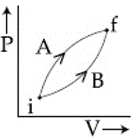
Following figure shows two processes A and B for a gas. If $$\Delta Q_A$$ and $$\Delta Q_B$$ are the amount of heat absorbed by the system in two cases, and $$\Delta U_A$$ and $$\Delta U_B$$ are changes in internal energies, respectively, then: