
Join Our JEE Preparation Group
Prep with like-minded aspirants; Get access to free daily tests and study material.
Sign in
Please select an account to continue using cracku.in
↓ →
Join Our JEE Preparation Group
Prep with like-minded aspirants; Get access to free daily tests and study material.
If a tangent to the circle $$x^2 + y^2 = 1$$ intersects the coordinate axes at distinct points P and Q, then the locus of the mid-point of PQ is:
We begin by noting that the given circle is $$x^2 + y^2 = 1$$ whose centre is the origin $$O(0,0)$$ and whose radius is $$1.$$
If a straight line cuts the $$x$$-axis at the point $$P(a,0)$$ and the $$y$$-axis at the point $$Q(0,b)$$, then its equation in the intercept form is
$$\frac{x}{a} + \frac{y}{b} = 1.$$
This line is stated to be a tangent to the circle. A standard result for tangency is used here:
Formula: The distance of the centre $$(x_0,y_0)$$ of a circle from a line $$\alpha x + \beta y + \gamma = 0$$ must equal the radius $$r$$ of the circle for the line to be tangent. The distance is
$$\text{Distance} = \frac{|\alpha x_0 + \beta y_0 + \gamma|}{\sqrt{\alpha^2 + \beta^2}}.$$
For our line $$\dfrac{x}{a} + \dfrac{y}{b} - 1 = 0$$ we have $$\alpha = \dfrac{1}{a},\; \beta = \dfrac{1}{b},\; \gamma = -1.$$ The centre is $$O(0,0),$$ so substituting into the distance formula we obtain
$$\frac{\left|\dfrac{1}{a}\cdot 0 + \dfrac{1}{b}\cdot 0 - 1\right|}{\sqrt{\left(\dfrac{1}{a}\right)^2 + \left(\dfrac{1}{b}\right)^2}} \;=\; 1.$$
Simplifying the numerator gives $$| -1 | = 1,$$ so the condition reduces to
$$\frac{1}{\sqrt{\dfrac{1}{a^{2}} + \dfrac{1}{b^{2}}}} = 1.$$
Taking reciprocals on both sides yields
$$\sqrt{\frac{1}{a^{2}} + \frac{1}{b^{2}}} = 1.$$
Squaring both sides we get
$$\frac{1}{a^{2}} + \frac{1}{b^{2}} = 1. \quad -(1)$$
Now we focus on the mid-point $$M(h,k)$$ of the chord $$PQ$$ connecting the intercepts. Since $$P(a,0)$$ and $$Q(0,b),$$ the mid-point coordinates are obtained via the two-point midpoint formula:
Formula: For points $$(x_1,y_1)$$ and $$(x_2,y_2),$$ their midpoint is $$\left(\dfrac{x_1+x_2}{2},\dfrac{y_1+y_2}{2}\right).$$
Applying this, we have
$$h = \frac{a + 0}{2} = \frac{a}{2}, \qquad k = \frac{0 + b}{2} = \frac{b}{2}.$$
From these relations we can express the intercepts in terms of the midpoint coordinates:
$$a = 2h, \qquad b = 2k.$$ \quad -(2)
Substituting (2) into the tangency condition (1), we obtain
$$\frac{1}{(2h)^2} + \frac{1}{(2k)^2} = 1.$$
Recognising $$(2h)^2 = 4h^2$$ and $$(2k)^2 = 4k^2,$$ the equation becomes
$$\frac{1}{4h^{2}} + \frac{1}{4k^{2}} = 1.$$
Multiplying every term by $$4$$ to clear denominators, we get
$$\frac{1}{h^{2}} + \frac{1}{k^{2}} = 4.$$
To eliminate the remaining denominators, we multiply throughout by $$h^{2}k^{2}:$$
$$k^{2} + h^{2} = 4h^{2}k^{2}.$$
Re-ordering terms brings us to
$$h^{2} + k^{2} - 4h^{2}k^{2} = 0.$$
Finally, replacing the placeholder symbols $$(h,k)$$ of the midpoint by the general coordinates $$(x,y)$$ of the locus, we write
$$x^{2} + y^{2} - 4x^{2}y^{2} = 0.$$
This exactly matches Option B.
Hence, the correct answer is Option B.
Was this solution helpful?
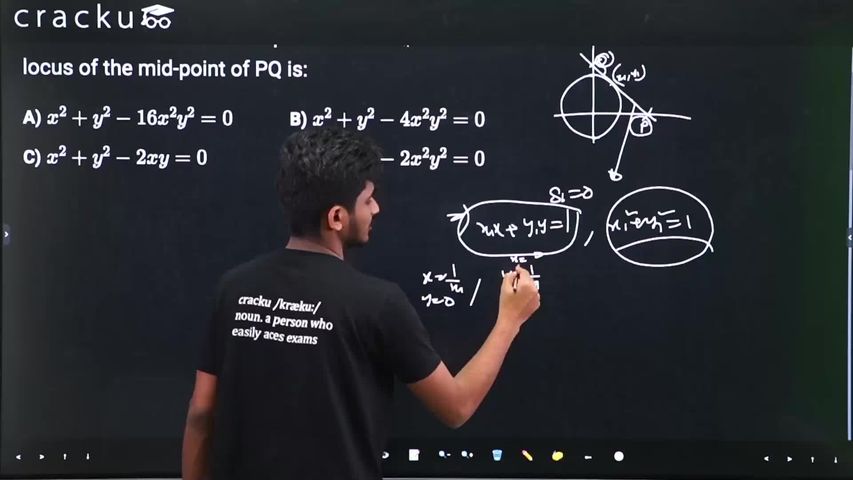
Click on the Email ☝️ to Watch the Video Solution
Create a FREE account and get:
_1.webp)

Educational materials for JEE preparation

Ask our AI anything

AI can make mistakes. Please verify important information.
AI can make mistakes. Please verify important information.
