
Join Our JEE Preparation Group
Prep with like-minded aspirants; Get access to free daily tests and study material.
Sign in
Please select an account to continue using cracku.in
↓ →
Join Our JEE Preparation Group
Prep with like-minded aspirants; Get access to free daily tests and study material.
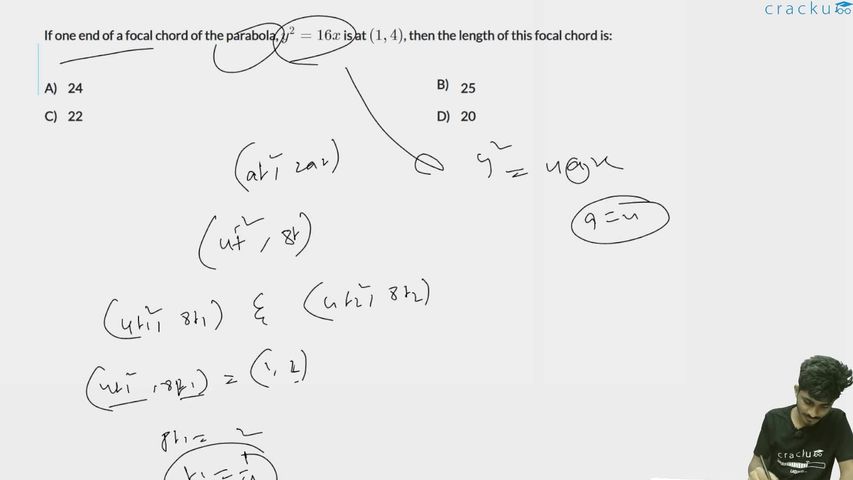
If one end of a focal chord of the parabola, $$y^2 = 16x$$ is at $$(1, 4)$$, then the length of this focal chord is:
We are given the parabola $$y^{2}=16x$$.
First we rewrite it in the standard form $$y^{2}=4ax$$ to identify the value of $$a$$.
Comparing $$y^{2}=16x$$ with $$y^{2}=4ax$$, we obtain $$4a = 16 \;\Rightarrow\; a = 4$$.
For the parabola $$y^{2}=4ax$$, the focus is known to be $$\bigl(a,0\bigr)$$. Hence here the focus is $$\bigl(4,0\bigr)$$.
Any point on the parabola can be written in the standard parametric form. The formula is:
“For $$y^{2}=4ax$$, a point corresponding to parameter $$t$$ is $$\bigl(at^{2},\,2at\bigr)$$.”
With $$a = 4$$, the coordinates become $$\bigl(4t^{2},\,8t\bigr)$$.
One end of the focal chord is given as $$(1,4)$$. Because this point lies on the parabola, there exists a parameter, say $$t_{1}$$, such that
$$\bigl(4t_{1}^{2},\,8t_{1}\bigr) = (1,4).$$
We equate the coordinates one by one:
From the $$x$$-coordinate: $$4t_{1}^{2}=1 \;\Longrightarrow\; t_{1}^{2}=\dfrac14 \;\Longrightarrow\; t_{1}=\pm\dfrac12.$$
From the $$y$$-coordinate: $$8t_{1}=4 \;\Longrightarrow\; t_{1}=\dfrac48=\dfrac12.$$
Combining these, we fix $$t_{1}=\dfrac12$$ (the positive sign satisfies both equations).
For a chord that passes through the focus—called a focal chord—there is a well-known relation between the parameters of its two endpoints.
The property is:
“If the endpoints of a chord of $$y^{2}=4ax$$ correspond to parameters $$t_{1}$$ and $$t_{2}$$, the chord passes through the focus if and only if $$t_{1}t_{2}=-1$$.”
We already have $$t_{1}=\dfrac12$$, so we obtain $$t_{2}$$ directly:
$$t_{1}t_{2}=-1 \;\Longrightarrow\; \dfrac12\,t_{2}=-1 \;\Longrightarrow\; t_{2}=-2.$$
Now we compute the coordinates of the second endpoint using $$t_{2}=-2$$:
$$x_{2}=4t_{2}^{2}=4(-2)^{2}=4\cdot4=16,$$
$$y_{2}=8t_{2}=8(-2)=-16.$$
So the second endpoint is $$Q(16,-16)$$.
The focal chord therefore has endpoints $$P(1,4)$$ and $$Q(16,-16)$$.
To find its length, we use the distance formula between two points $$\bigl(x_{1},y_{1}\bigr)$$ and $$\bigl(x_{2},y_{2}\bigr)$$:
$$\text{Distance}=\sqrt{(x_{2}-x_{1})^{2}+(y_{2}-y_{1})^{2}}.$$
Substituting $$P(1,4)$$ and $$Q(16,-16)$$, we have
$$$ \begin{aligned} PQ &= \sqrt{(16-1)^{2}+(-16-4)^{2}} \\ &= \sqrt{15^{2}+(-20)^{2}} \\ &= \sqrt{225+400} \\ &= \sqrt{625} \\ &= 25. \end{aligned} $$$
Thus the length of the required focal chord is $$25$$.
Hence, the correct answer is Option B.
Was this solution helpful?
Click on the Email ☝️ to Watch the Video Solution
Create a FREE account and get:
_1.webp)

Educational materials for JEE preparation

Ask our AI anything

AI can make mistakes. Please verify important information.
AI can make mistakes. Please verify important information.
