Group
Group
 Group
Group


 Preferred Source

 Google Discover

JEE Mains Chemistry Formulas 2027
Chemistry is a very high-scoring subject in the JEE Main. As compared to Mathematics, where complex calculations are needed, a number of questions from Chemistry can be easily solved if the formulas and reactions are known by the students. Being thorough with the formulas can help save time during examinations and enhance their accuracy as well.
Those who are preparing for JEE Main 2027 must maintain a formula sheet for themselves to prepare better. For Physical Chemistry topics including the mole concept, Thermodynamics, Electrochemistry, Chemical Kinetics, and Solutions among others, knowing the formulas becomes crucial. Hence, students need to keep on revising the JEE Main 2027 Formula sheet. In this article, we provide chapter-wise Chemistry Formulas , important equations, revision tips, common mistakes to avoid, and details about the JEE Mains Chemistry Formulas PDF.
Chapter-Wise JEE Mains Chemistry Formulas
Chemistry preparation becomes easier when formulas are organised chapter-wise. The table below lists Important topics and commonly used Formulas.
| Topic-wise Formulas | PDF Links |
|---|---|
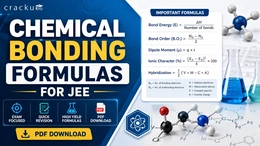
JEE Chemical Bonding Formula PDF |
📄 Download PDF |
JEE General Organic Chemistry Formula PDF |
📄 Download PDF |
JEE P-Block Elements Formula PDF |
📄 Download PDF |
JEE Mole Concept Formula PDF |
📄 Download PDF |
JEE Atomic Structure Formula PDF |
📄 Download PDF |
JEE Coordination Compounds Formula PDF |
📄 Download PDF |
JEE Chemical Thermodynamics Formula PDF |
📄 Download PDF |
JEE Equilibrium Formula PDF |
📄 Download PDF |
JEE Electrochemistry Formula PDF |
📄 Download PDF |
JEE Aldehydes, Ketones & Carboxylic Acids Formula PDF |
📄 Download PDF |
Physical Chemistry
Physical Chemistry involves numerical-based questions, making formulas extremely important. Here are the key formulas:
Topic | Key Formulas |
Mole Concept | Molarity (M) = Moles of Solute / Volume (L) , χ = Moles of component / Total Moles , n = Given mass (m) / Molar mass (M) |
Gas Laws | PV = nRT, Dalton’s Law: Ptotal = P1 + P2 + … (Sum of partial pressures) |
Thermodynamics | ΔU = q + w, ΔH = ΔU + ΔnRT, ΔG = ΔH − TΔS |
Chemical Equilibrium | Kc = [products]ˣ / [reactants]ʸ, Q = [products]ˣ / [reactants]ʸ |
Electrochemistry | E = E° − (0.0591/n) log Q, m = (Q × M) / nF |
Kinetics | Rate = k[A]ⁿ, t₁/₂ = 0.693 / k |
Solutions | π = CRT, P = X × P°, ΔTb = Kb × m |
Inorganic Chemistry
Inorganic Chemistry focuses on conceptual clarity and memorisation of formulas. Key formulas include:
Topic | Key Formulas / Concepts |
d- block & p-block | Oxidation states, Acidic/Basic nature |
Chemical Bonding | Formal Charge (FC) = V − N − B/2, BO = (Nb − Na)/2 |
Coordination Compounds | EAN = Z − O + 2L, CFSE, μ = √[n(n+2)] |
Periodic Table | Ionization Energy (IE), Electron Affinity (EA), Atomic / Molecular Radius trends |
Organic Chemistry
Organic Chemistry formulas are mostly application-based for reaction calculations and structural analysis. Some of the important formulas involved include:
Topic | Key Formulas / Concepts |
Hydrocarbons | Alkanes: CnH₂n+₂, Alkenes: CnH₂n, Alkynes: CnH₂n−₂ |
Degree of Unsaturation | DU = (2C + 2 − H + N − X)/2 |
Functional Groups | Alcohols, Aldehydes, Ketones, Carboxylic Acids, Amines |
Reaction Rules | Markovnikov rule, Anti-Markovnikov |
Stereochemistry | Optical Activity, R/S notation, cis/trans isomerism |
Importance of Chemistry Formulas for JEE Mains
Formulas are not just for memorization—they are tools for problem-solving.
Understanding the right formulas helps students:
- Solve numerical questions quickly
- Reduce calculation errors in Physical and Organic Chemistry
- Memorize concepts more efficiently
- Gain confidence in solving previous year questions
A strong grasp of formulas can give students a competitive edge in the exam.
High-Weightage Chemistry Chapters for JEE Main 2027
Based on previous years' trends, students should focus on the following chapters:
Chapter | Expected Weightage |
Chemical Bonding | High |
Coordination Compounds | High |
Mole Concept | High |
Thermodynamics | High |
Electrochemistry | High |
Chemical Kinetics | High |
Solutions | Medium to High |
Equilibrium | High |
Organic Chemistry | Very High |
Biomolecules | Medium |
Mastering formulas from these chapters can significantly improve Chemistry scores.
Common Mistakes Students Make While Revising Chemistry Formulas
Most students put in their best efforts but end up scoring lower because of preventable errors.
Learning by Memorization: Learning the logic behind a formula works better than memorizing it.
Disregarding Units: Wrong units result in wrong answers while solving numerical questions.
Not Studying Consistently: Forgetting formulas becomes easy when one stops revising.
Not Focusing on Organic Chemistry Formulas: Most students pay attention to formulas related to physical chemistry only.
Avoiding Mock Tests: A mock test highlights your weaknesses and helps apply formulas.
Over-relying on the PDF: JEE Mains Chemistry Formulas PDF is helpful, but personal notes make you remember it better.
Preparation Tips to Master JEE Mains Chemistry Formulas 2027
- Revisit formulas everyday.
- Solve numerical problems often.
- Solve previous year question papers of JEE main for at least 10 years.
- Keep a separate book of formulas.
- Solve chapter wise mock test papers.
- Cover weightage topics first.
- Revise formulas before going to sleep.
These methods will help you increase your speed and accuracy in the Chemistry section.
JEE Mains Chemistry Formulas 2027: Conclusion
Chemistry plays a crucial role in JEE preparation, and having a strong command of formulas across Physical, Organic, and Inorganic sections can significantly improve performance. Understanding how and when to apply formulas helps students solve both numerical and theory-based questions efficiently. Regular practice and consistent revision are key to mastering this subject.
To achieve better results, students should focus on important chapters, revise formulas daily, and apply them in problem-solving. Building clarity in concepts along with formula-based practice boosts confidence and accuracy. With the right strategy and disciplined revision, Chemistry can become one of the most scoring sections in the exam.
.webp)