JEE WhatsApp Group



JEE Physics Chapter-Wise PYQs
JEE Physics Chapter-Wise PYQs are one of the best resources for students preparing for JEE 2027. Once your concepts are clear, solving previous year questions chapter by chapter helps you understand the actual exam pattern, repeated question types, important formulas, and difficulty level of each topic.
Instead of solving random questions, students should complete the theory first, revise formulas, and then practice JEE Chapter-wise PYQ. This approach improves accuracy, speed, and confidence. In this blog, you can download JEE Physics chapter-wise PYQ PDFs, check expected chapter weightage, understand the most important chapters, and learn how to use PYQs effectively for JEE 2027 preparation.
JEE Physics Chapter Wise PYQs PDF
Practice makes you perfect. So, solving JEE questions frequently can build your confidence along with trends. Here you can download the JEE physics chapter-wise PYQs. Do check them one by one and analyse your answers carefully.
Chapter Name | PYQ PDF Link |
Note: After downloading the JEE Physics PYQ PDF of a chapter, first revise the formulas and notes. Then solve all PYQs without checking solutions. Finally, review mistakes and create a short revision notebook.This method helps retain concepts for a longer period.
JEE Physics Chapter-Wise PYQ Weightage Analysis
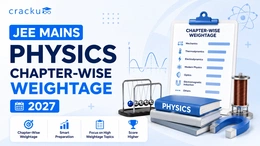
Knowing the JEE Physics chapter-wise weightage helps students prioritize preparation. Some chapters contribute more questions every year and therefore deserve extra attention. Based on recent JEE Questions trends, Modern Physics, Current Electricity, Thermodynamics, Electrostatics, and Optics contribute a significant share of the Physics section.
The following weightage is based on recent JEE Main Physics PYQ trends from previous-year papers. The exact number of questions may vary by shift, but these chapters have appeared regularly in recent exams.
| Chapter | Expected Questions | Approx Weightage | Priority |
|---|---|---|---|
| Modern Physics Topics | 4–5 | 16% | Very High |
| Current Electricity | 2–3 | 8–10% | High |
| Electrostatics | 2–3 | 8–10% | High |
| Optics | 2–3 | 8–10% | High |
| Thermodynamics & Heat | 2–3 | 8–10% | High |
| Magnetism & EMI | 3 | 10–12% | High |
| Kinematics | 1–2 | 5–8% | Medium |
| Oscillations & Waves | 1–2 | 5–8% | Medium |
| Laws of Motion | 1 | 3–4% | Medium |
| Work, Power & Energy | 1 | 3–4% | Medium |
| Units & Measurements | 1 | 3% | Easy Scoring |
While weightage is useful, preparation should never ignore lower-weightage chapters. Even one question can make a big difference in rank. This is not only about Physics, but the whole exam. So ensure you have the right JEE question bank ready.
Also Read: JEE Mains Physics Formula PDF
Most Important Physics Chapters Based on PYQ Analysis
Some physics chapters repeatedly appear in JEE examinations. These chapters usually have strong conceptual applications and connections with other topics.
| Chapter | Why It Is Important | Difficulty Level |
|---|---|---|
| Current Electricity | Regular numerical questions from circuits | Medium |
| Electrostatics | Base for electricity and capacitance | Medium |
| Optics | High-frequency chapter in JEE papers | Medium |
| Thermodynamics | Formula-based and concept-based questions | Medium |
| Modern Physics | Scoring and frequently asked | Easy to Medium |
| Rotational Motion | Concept-heavy and important for Advanced | Difficult |
If you have limited time, start with these chapters and solve their JEE Chapter-wise PYQ PDFs first
Also Read: JEE Advanced Previous year papers
How to Use JEE Physics Chapter-Wise PYQs for Best Results
Many students solve PYQs randomly. This method rarely gives the best results. A structured JEE online coaching with experts helps work much better.
Step 1: Complete Theory First
Before opening the PYQ PDF, finish the chapter from the NCERT Solutions, coaching notes, or reference books. Understanding concepts is important.
Step 2: Solve Questions Without Looking at Solutions
Try every question honestly. Even if the answer seems difficult, attempt it independently first.
Step 3: Mark Weak Areas
Create a notebook for mistakes. Write down formulas, concepts, and shortcuts that caused errors.
Step 4: Revise Again After One Week
Revisit the same set of questions after a few days. This process strengthens memory retention.
Step 5: Create a Chapter Progress Tracker
Use a simple table like this:
Activity | Status |
Theory Completed | ✓ |
PYQs Attempted | ✓ |
Mistakes Reviewed | ✓ |
Formulas Revised | ✓ |
Reattempt Done | ✓ |
Step 6: Mix Chapters Later
After completing individual chapters, start solving mixed-topic tests. This approach prepares you for the actual examination environment.
Using JEE Chapter-wise PYQ PDFs in this way improves both speed and accuracy.
Also Read: JEE Mains Previous year papers
Common Mistakes Students Make While Solving JEE Physics PYQs
Many students work hard but still fail to get the maximum benefit from JEE PYQ practice. Usually, a few common mistakes are responsible. Let’s check and avoid them for the best results.
| Mistake | Why It Hurts Preparation | What to Do Instead |
|---|---|---|
| Solving PYQs before theory | Creates confusion | Complete theory first |
| Memorising solutions | Does not build problem-solving skill | Understand the logic |
| Not analysing mistakes | Same errors repeat in mocks | Maintain an error notebook |
| Skipping easy chapters | Easy marks are lost | Revise scoring chapters regularly |
| Not reattempting PYQs | Retention becomes weak | Reattempt after 7 days |
| Using too many resources | Creates overload | Use limited but quality resources |
JEE Physics Chapter-Wise PYQs: Conclusion
JEE Physics Chapter-wise PYQs are a crucial resource for aspirants preparing for JEE 2027. They allow students to practise previous-year questions in an organized way, understand the exam pattern, prioritise chapters based on weightage, and revise important formulas. Using chapter-wise PDFs, aspirants can systematically attempt each topic, check mistakes, and improve accuracy while building conceptual clarity. This method ensures a strong foundation for both easy and advanced-level questions.
Regular practice with JEE Physics PYQs also strengthens problem-solving speed, confidence, and retention of formulas and concepts. By tracking progress, revisiting weak topics, and creating short revision notes, students can optimise their preparation for JEE Main and Advanced. Chapter-wise PYQs, combined with theory revision and error analysis, help aspirants achieve higher scores and secure a better rank in competitive exams.