Group
 Group


 Preferred Source

 Google Discover
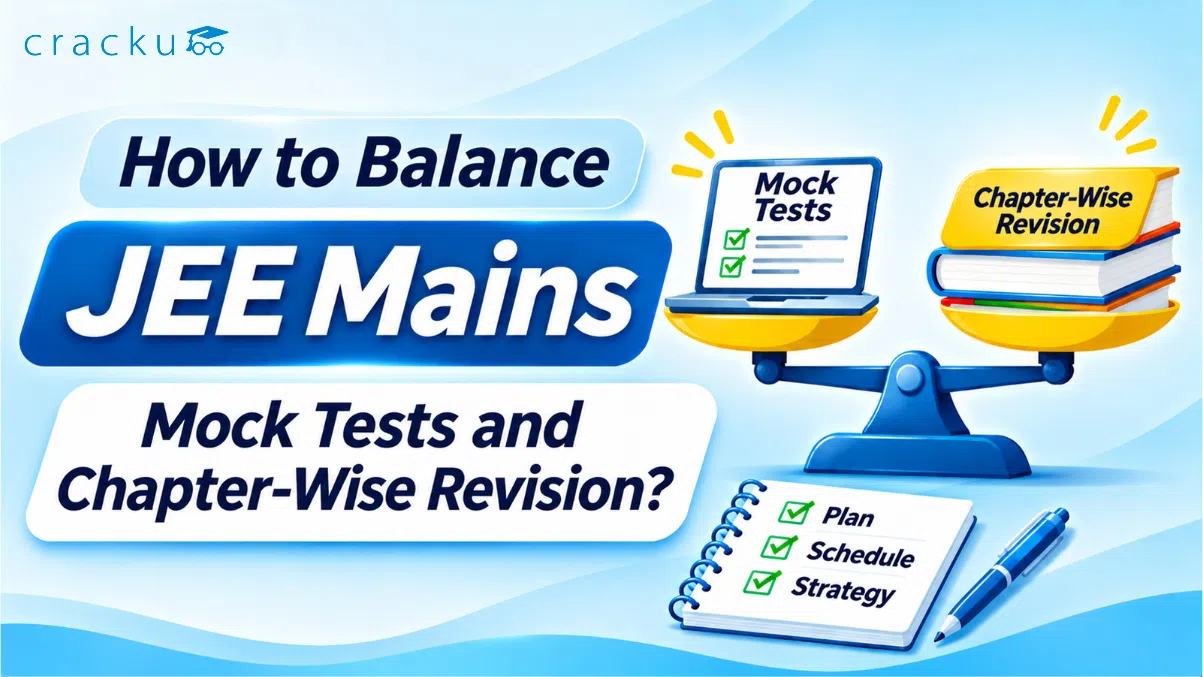
JEE Main preparation needs two things: regular mock tests and consistent chapter-wise revision. But how much time should you give to each JEE practice session? A full-length JEE Mains mock test takes three hours, while its analysis needs another one or two hours. You also need enough time to revise Physics, Chemistry, and Mathematics. The right balance can help you improve without leaving weak chapters untouched. Whether you are in Class 12 or preparing as a dropper, a simple weekly routine can make your preparation more effective.
How Many Mock Tests Should You Attempt Alongside Chapter-Wise Revision?
Your mock test frequency should depend on your preparation level and available time. Class 11 students need more chapter practice, while Class 12 students need regular full-length tests. Droppers can attempt more mocks because they have completed the syllabus once.
The JEE Main question paper carries 300 marks across 75 questions. Each subject has 25 questions, so your revision should cover all three subjects.
Preparation stage | Mock tests per week | Chapter revision per day | Main focus |
Class 11 | 1 | 3–4 hours | Concept building |
Class 12 | 2 | 3 hours | Syllabus coverage |
Droppers | 2–3 | 3–4 hours | Accuracy and speed |
Last 30 days | 3–4 | 2–3 hours | Exam practice and revision |
These numbers are suggested targets, not compulsory rules. Your syllabus completion and mock performance should guide your test frequency.
Try the alternate-day mock model:
This model gives you enough time for tests and chapter revision. You can attempt a mock on Monday and analyse it on Tuesday. You can go through JEE Main previous years question papers to boost your confidence.
Day | Main activity | Suggested time |
Monday | Full-length mock test | 3 hours |
Tuesday | Mock analysis and weak chapter revision | 4 hours |
Wednesday | Chapter-wise practice | 4 hours |
Thursday | Full-length mock test | 3 hours |
Friday | Mock analysis and formula revision | 4 hours |
Saturday | Chapter revision and PYQs | 4 hours |
Sunday | Short test and weekly revision | 3 hours |
You can adjust this routine according to your school or coaching schedule. However, never sacrifice mock analysis just to attempt another paper.
Best Time to Take a JEE Main Mock Test (Morning, Noon, and Evening)
Your mock test should match the actual examination environment. JEE Main usually has examination shifts during morning and afternoon sessions. Therefore, morning or afternoon practice can help you build exam-day familiarity.
Time slot | Suggested schedule | Best suited for |
Morning (9 AM–12 PM) | Full-length mock test | Building exam-day routine |
Afternoon (2 PM–5 PM) | Full-length mock test | Practising afternoon shifts |
Evening (5 PM–8 PM) | Chapter revision and practice | Formula revision and problem-solving |
Night (8 PM–9 PM) | Error log and short revision | Reviewing mistakes |
Morning: Attempt a full-length test between 9 AM and 12 PM. Keep your phone away and follow the actual examination rules.
Afternoon: Use this slot to practise the afternoon examination schedule. It can help you maintain concentration during a different time window.
Evening: Reserve this period for chapter revision and question practice. Avoid another full-length test after an exhausting morning attempt.
Night: Revise formulas and review your error log for about 30–45 minutes. Keep this session light instead of starting difficult chapters.
How to Revise Weak Chapters Based on Mock Test Performance?
Your JEE mock test results can show which chapters need immediate attention. Instead of revising every chapter equally, give more time to topics where you lose marks.
For example, suppose your mock test score is 90 out of 300. Your subject-wise performance looks like this:
Subject | Marks scored | Maximum marks | Required action |
Physics | 40 | 100 | Revise Electricity and Rotational Motion |
Chemistry | 35 | 100 | Practise Inorganic Chemistry |
Mathematics | 15 | 100 | Revise Integration and Coordinate Geometry |
Total | 90 | 300 | Improve weak chapters |
This breakdown gives you a clear direction for the next few days.
Follow this chapter revision method:
- Identify weak topics: Check incorrect and unattempted questions after every mock. Note the chapters where you lose marks repeatedly.
- Revise important formulas: Spend 20–30 minutes recalling formulas from weak chapters. For example, revise torque and moment of inertia in Rotational Motion.
- Solve basic questions: Attempt 10–15 easy questions before moving towards moderate problems. This helps you rebuild confidence and understand the concept.
- Practise previous year questions: Solve 15–20 questions from the revised chapter. JEE Mains previous year question papers can help you understand actual examination patterns.
- Take a short chapter test: Attempt 10–15 questions after revision. Check whether your accuracy improves compared with earlier attempts.
You can also refer to JEE Advanced papers for additional conceptual practice. However, keep JEE Main question patterns and difficulty levels as your first priority.
Weekly Study Timetable for JEE Main Mock Tests and Revision
A weekly JEE Main practice timetable should give enough space for all three subjects. You also need time for mock analysis, formula revision, and previous year questions.
The following timetable suits Class 12 students and droppers with approximately six study hours daily.
Day | Physics | Chemistry | Mathematics | Additional activity |
Monday | Full-length mock | Full-length mock | Full-length mock | 3-hour test |
Tuesday | Electricity revision | Inorganic Chemistry | Integration | Mock analysis |
Wednesday | Rotational Motion | Chemical Bonding | Coordinate Geometry | 45 PYQs |
Thursday | Full-length mock | Full-length mock | Full-length mock | 3-hour test |
Friday | Weak chapter revision | Formula revision | Calculus practice | Mock analysis |
Saturday | Mechanics PYQs | Organic Chemistry | Algebra | 30–45 questions |
Sunday | Physics revision | Chemistry revision | Maths revision | Weekly short test |
You can make this timetable more effective with a few simple rules:
- Reserve 30 minutes daily for formula revision across all subjects.
- Solve 15–20 chapter-wise questions after revising each topic.
- Spend at least 60–90 minutes analysing every full-length mock.
- Keep Sunday evening for error log revision and unfinished topics.
- Use JEE Mains sample papers when you need additional examination-style practice.
Also Read: How to Analyse Your JEE Main Mock Test Performance?
Common Mistakes to Avoid While Balancing Mock Tests and Revision
A packed timetable does not always produce better results. Avoid these mistakes to keep your preparation steady:
- Too many mock tests: Five tests weekly can leave little revision time. Maintain a realistic frequency based on your preparation.
- Skipping mock analysis: A test without review offers limited learning. Reserve at least 60–90 minutes for checking mistakes.
- Ignoring weak chapters: Do not revise only your favourite topics. Give extra attention to chapters where your accuracy remains low.
- Leaving PYQs until the end: Previous year questions help you understand actual exam patterns. Include chapter-wise PYQs throughout your preparation.
- Studying without breaks: Long sessions can reduce concentration and accuracy. Take a 10–15-minute break after every 60–90 minutes.
Your JEE preparation needs a steady mix of practice, revision, and self-assessment. Keep your mock scores, accuracy, and weak chapters under regular review. A well-balanced routine can help you improve without unnecessary study pressure.
Conclusion
Let each JEE Main mock test guide your next revision session. If you lost marks in Rotational Motion, check the question that caused trouble. Forgetting the formula for torque calls for a quick review. Using the wrong distance from the axis calls for drawing the diagram again and trying a similar problem.
Build your weekly JEE Main study timetable around that review. Two mocks a week can be a useful starting point for Class 12 students, with time between papers for chapter-wise revision and previous year questions. At the end of the week, retry a few missed questions with your notes closed. Use the ones you still find difficult to plan the following week.