

Your first mock test is the start of your JEE Main 2027 preparation. But when should you take one, and how should you use it? JEE Main exam contains 75 questions for 300 marks across three subjects. Regular mock tests can expose weak concepts, slow calculations, careless errors, and poor question selection. However, simply collecting test scores will not improve your performance. You need to attempt, review, verify, and correct your approach after every test. Cracku currently offers 4 free JEE Mains mock tests, along with performance analysis and detailed solutions. You have 100 days left for the JEE Mains January 2027 session. Therefore, you need to focus on practice. Use the JEE 2027 countdown to plan your revision accordingly.
How to Take Cracku's Free JEE Mains Mock Tests
The main purpose of Online JEE Mains Mock tests is to give a practice version of the actual JEE 2027 exam. These tests are not daily worksheets; for each mock, you should dedicate 3 hours in a quiet place and concentrate completely on the problems. This is how you can recreate the same exam pressure. That’s why Cracku’s teachers designed the Free JEE mock tests.
You can visit the Cracku JEE Main Mock Test page and select a free mock. You can take Four free full-length tests, each following the latest JEE Main structure.
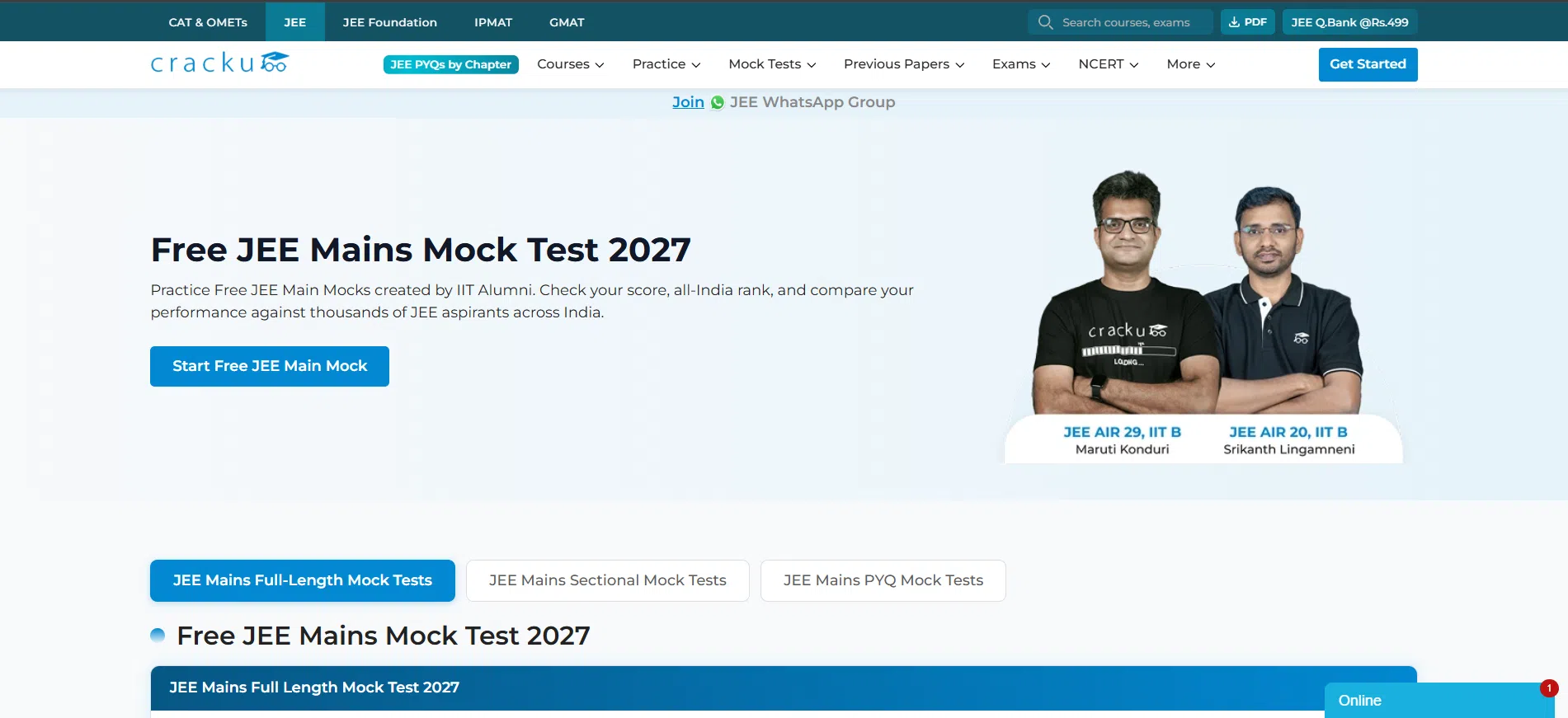
Open the Free JEE Main Mock Test Page: Visit the JEE Main Mock Test free online 2027 page and access the available free tests.
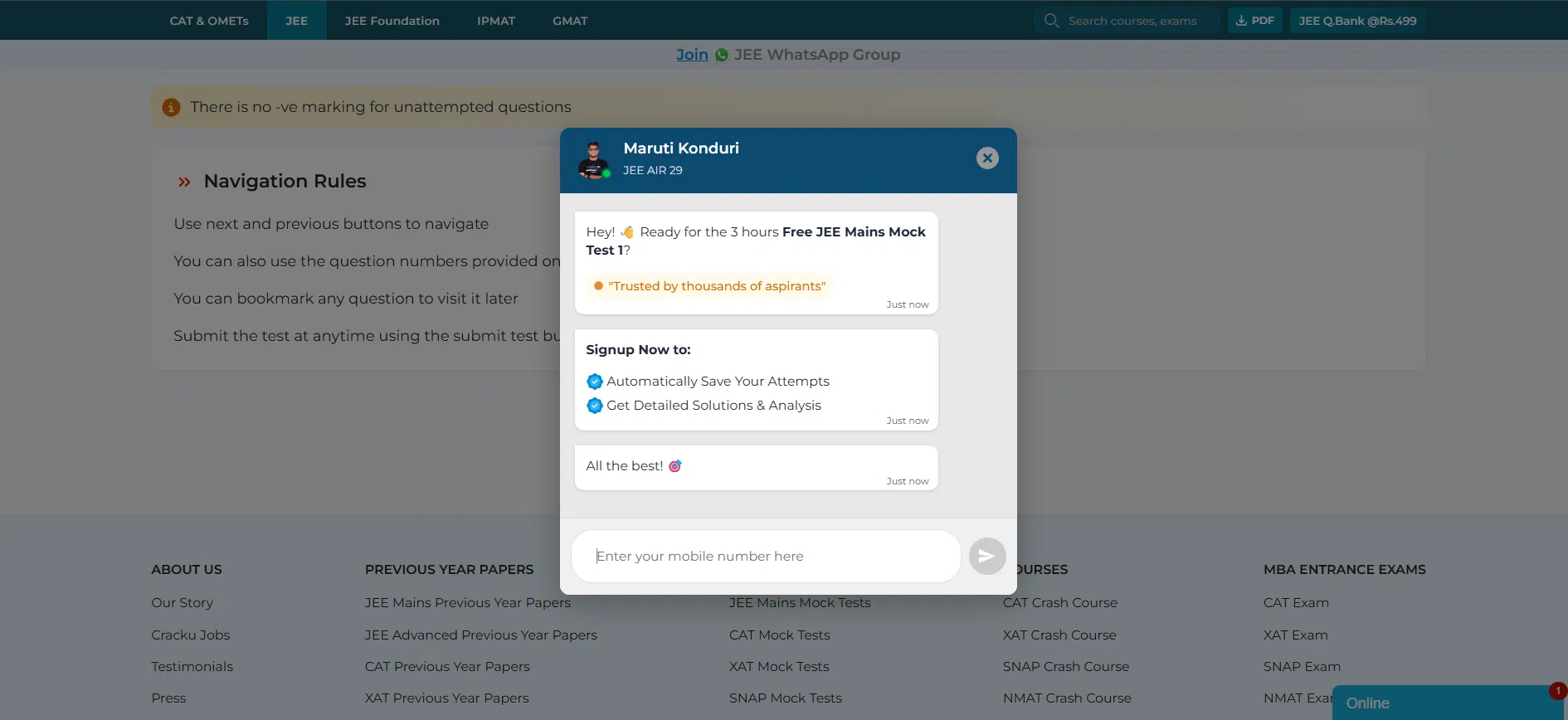
Register with Mobile and OTP: Enter your mobile number and verify it using the OTP received.
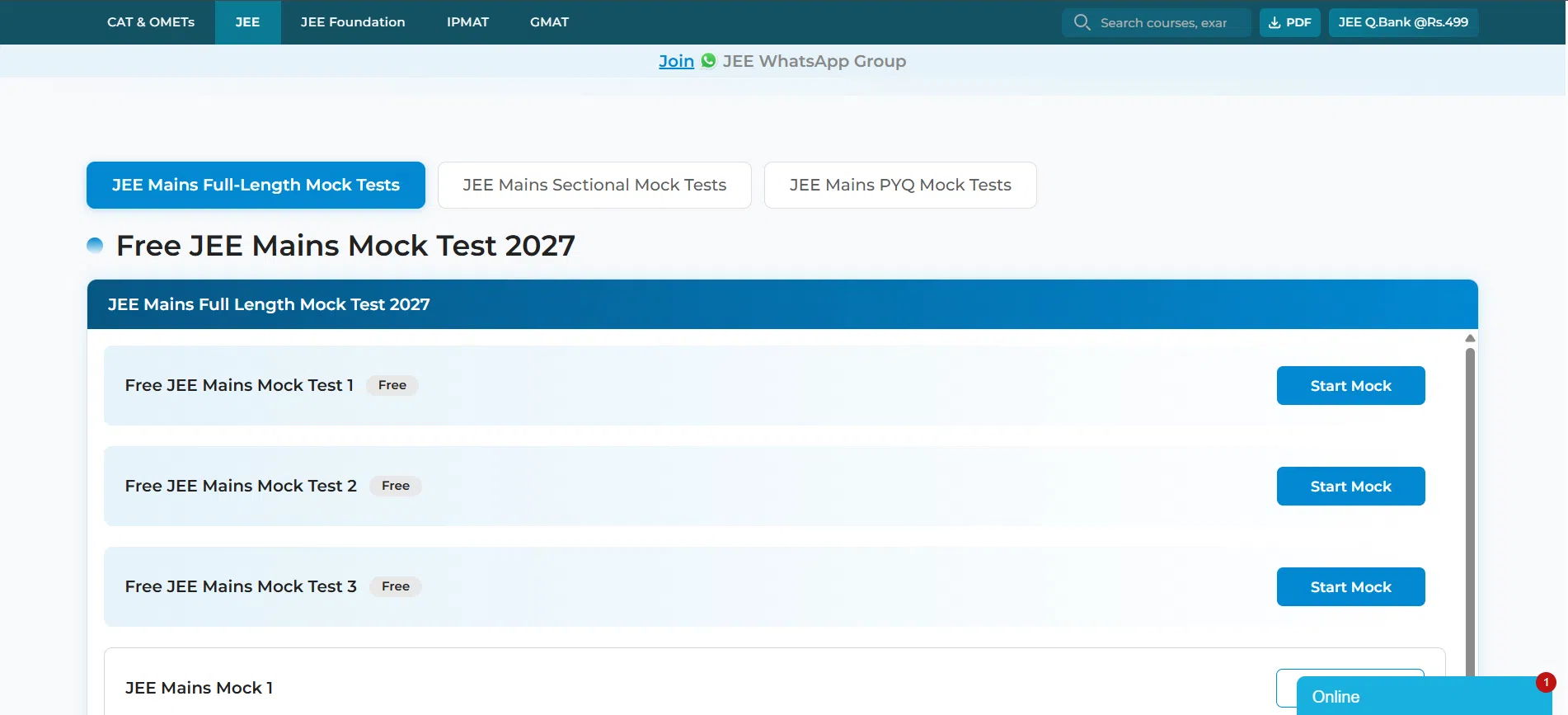
Select a Free Mock: Open an available free mock and begin with a complete JEE Mains mock test.
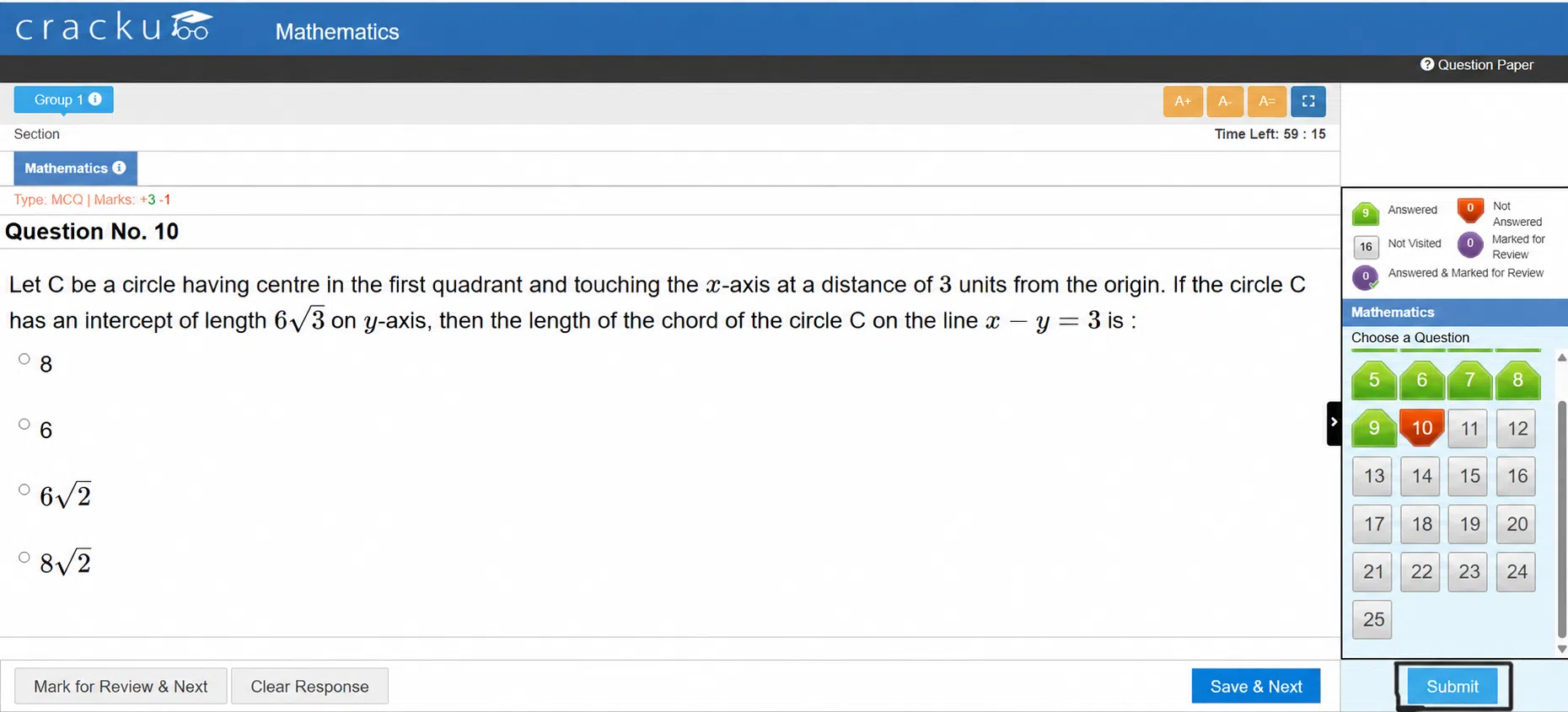
Keep Three Hours Free: Set aside three uninterrupted hours to recreate the actual Paper 1 environment.
Attempt All Three Subjects: Solve questions from Physics, Chemistry, and Mathematics under the same time limit.
Submit the Test: Once the mock test is completed, hit the submit button and finish your exam.
Check Incorrect Answers: Review every wrong response and identify the exact reason behind each mistake.
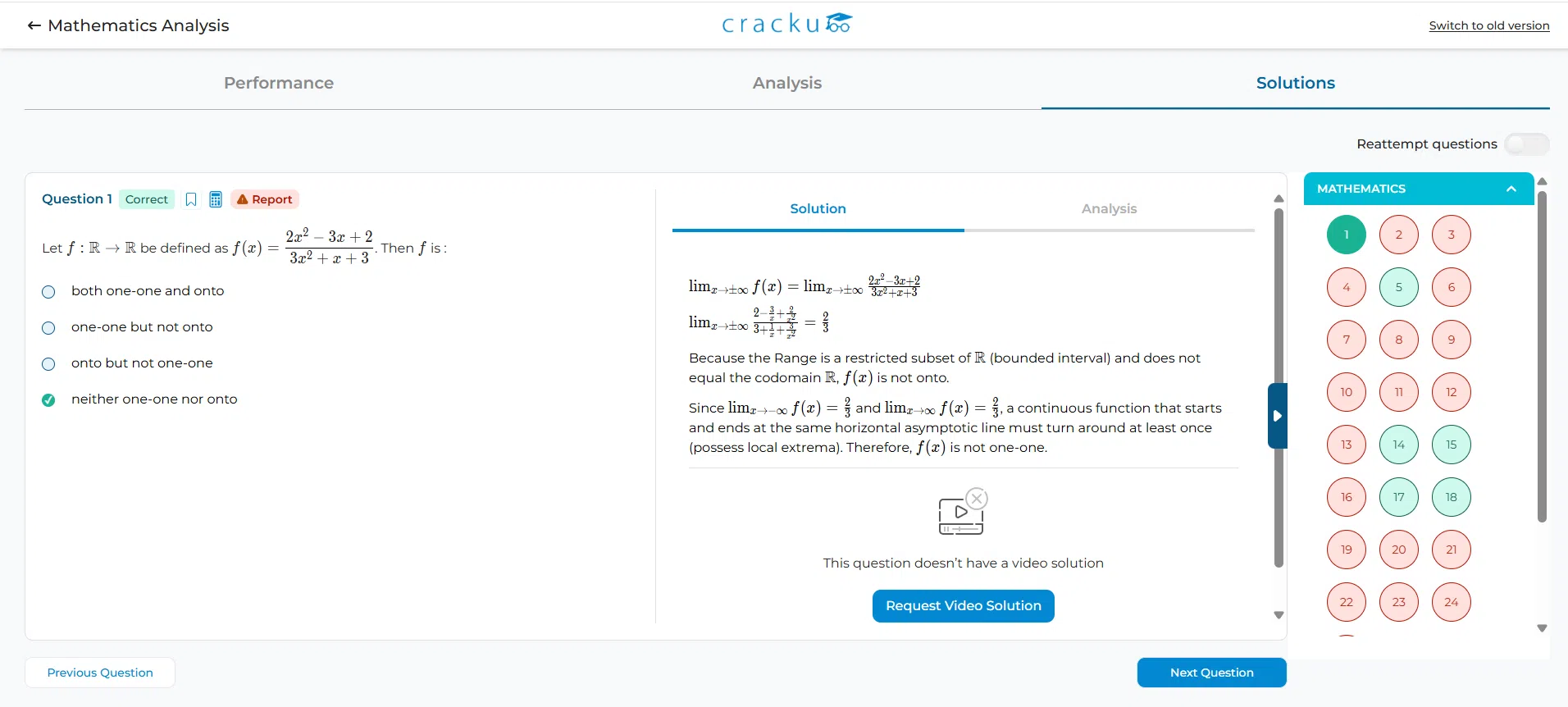
Read Detailed Solutions: Compare your approach with the explained solution and verify the correct method.
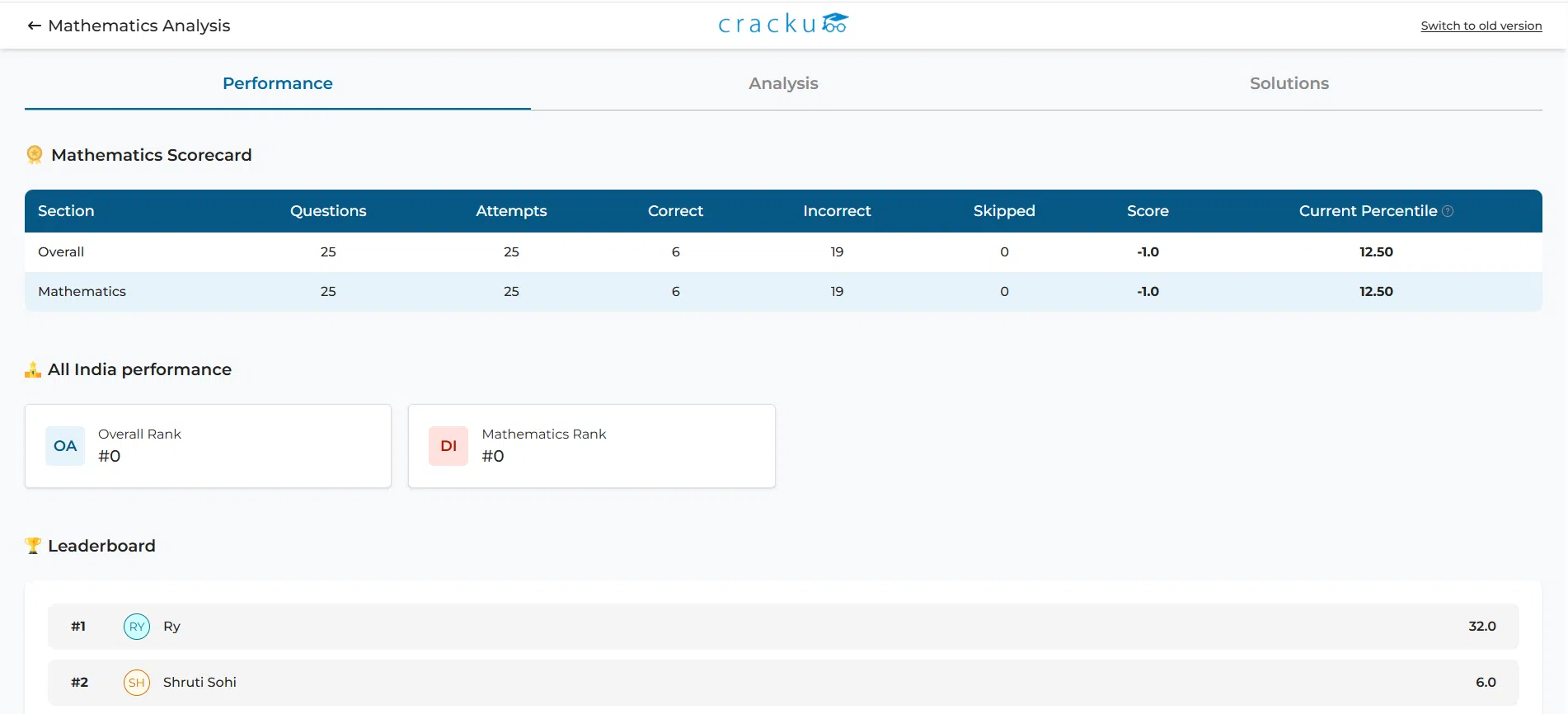
Get Your Mock Analysis: After the JEE Main free mock test 2027 is completed, you can generate your performance analysis that contains the leaderboard, all-India performance and other metrics. s.
Revisit Weak Chapters: Return to weak topics and practise targeted questions before attempting another mock.
The free tests follow a similar pattern to the official CBT-based JEE Main structure: 75 questions, 300 marks, with 25 questions from each subject. Each subject contains 20 MCQs and five numerical-value questions. Correct responses carry four marks, while incorrect MCQs attract one negative mark.
Do not stop when the score appears.
The score is only the first layer of your JEE Mains mock-test report. Cracku provides performance details covering accuracy, time spent per question, percentile, and AIR-related analysis. Detailed solutions are also available for the questions attempted incorrectly or left unanswered.
After finishing a test, divide your mistakes into clear categories.
- Concept gap: If your JEE fundamental topics are unclear. Revisit the topic and solve 10 to 15 basic questions.
- Formula slip: You forgot or misused a formula. Revise it and practise 5-10 related questions.
- Calculation slip: A small +or- mistake costs -1 mark. So, you have to solve 10 similar problems with careful steps.
- Reading lapse: You missed a condition or detail while reading a question; this should be rectified with careful checking twice for each question.
- Time issue: If one question took too long, then you have to set a limit of 2 to 3 minutes during practice. This is how you learn to move forward.
- Guesswork: An uncertain attempt caused negative marks. Use elimination before marking an unsure answer.
- Careless marking: You knew the answer but selected the wrong option. Keep 5 minutes for checking.
- Repeated weakness: The same problem appeared again. Add that topic to your next 2 practice sessions.
This process matters because a 120-mark score does not explain why those marks disappeared. Error analysis provides that missing information.
You can also use the wider JEE Mains test series available on Cracku after your mock. Along with JEE daily target to keep your daily practice consistent between two full-length tests. It provides a fresh set of questions regularly, giving you shorter practice sessions between larger assessments.
For a more engaging break from conventional practice, JEE Rush adds a gamified layer to Mathematics, Physics, and Chemistry practice.
The idea is simple: mock → analyse → practise → revise → mock again.
That cycle makes each mock test for JEE 2027 useful instead of turning your preparation into a score-collecting exercise.
Who Should Take the JEE Main Mock Test
If you think only a mock test should be taken after the JEE syllabus is completed, then that's your first and costly mistake. No matter what your preparation level is, you must take sectional or full mock tests to habituate and understand the JEE questions types. If you are in Class 11, you can start with sectionals based on the topics you are practising. Take a look at how you can use the JEE Free Mock Tests.
| Your Current Stage | Main Purpose of Mock Tests | What You Should Track |
|---|---|---|
| Class 11 | Early exposure and concept application | Accuracy and question familiarity |
| Class 12 | Full-syllabus execution | Time, accuracy, and subject balance |
| Dropper | Speed, retention, and consistency | Repeated mistakes and question selection |
| Lower scorer | Diagnosis and confidence building | Concept gaps and careless errors |
| Higher scorer | Precision and rank improvement | Negative marks and difficult questions |
You do not need to wait for perfect preparation. Your first test can simply establish your current baseline.
Class 11 Students
Class 11 is an excellent stage to become comfortable with JEE model questions. You may not have completed the full chapter-wise JEE Mains mock tests, so a complete mock can initially feel unfamiliar. That is useful because it shows how school-level concepts appear inside competitive questions.
Your early attempts must not be concerned about low scores, but rather on being aware of topic-wise strengths and weaknesses. You should be familiar with how questions combine concepts, how quickly you read conditions, and where calculations begin taking longer.
| Focus Area | What You Can Learn Early |
|---|---|
| Question style | How familiar concepts become application-based problems |
| Accuracy | Whether you solve carefully or rush through familiar ideas |
| Time awareness | Which chapters consume excessive solving time |
| Concept gaps | Which topics need another round of revision |
| Exam comfort | How you respond to a timed computer-based environment |
You can also use subject-wise practice before attempting full mocks. Cracku provides separate Mathematics, Physics, and Chemistry question resources for targeted practice.
For Class 11, one diagnostic mock followed by JEE topic-wise mocks can be more useful than repeated full tests. Your aim should be building familiarity without allowing test preparation to replace concept learning.
Class 12 Students
Class 12 is when mock tests become a serious performance tool. Your preparation now needs to combine Class 11 and Class 12 concepts under strict time limits.
A complete Free test series for JEE Mains 2027 helps you manage the three subjects instead of confusing yourself about what to do next.
| What to Check | Questions You Should Ask Yourself |
|---|---|
| Physics | Did calculations consume too much time? |
| Chemistry | Did you attempt direct questions quickly? |
| Mathematics | Which problems took too much of your time? |
| Accuracy | How frequently did avoidable errors reduce your marks? |
| Selection | Did you identify easier questions quickly enough? |
| Endurance | Could you maintain concentration for three hours? |
You should not judge your preparation through marks alone. A 150-mark JEE attempt with poor accuracy may need a different response than a 150-mark attempt with strong accuracy.
Use the JEE mock tests or PYQ performance report to identify that difference.
For example: Let’s assume that your Physics accuracy over the past mocks remains quite good but Mathematics is taking more time. Next time, your practice should reflect the change and improve your accuracy in Mathematics. Similarly, repeated Chemistry mistakes can signal a need for sharper revision rather than another full mock.
Droppers
If you are taking a year to dedicate completely to JEE with the dream of entering IIT, you may already be familiar with the JEE exam pattern and syllabus. Therefore, these Free JEE Mains Mock tests can serve a sharper purpose.
Your focus should move toward retention, speed, accuracy, and decision-making.
| Challenge | How JEE Mock Tests Can Help |
|---|---|
| Repeated mistakes | Identify patterns across several attempts |
| Forgotten concepts | Expose chapters that require quick revision |
| Slow solving | Reveal questions that consume disproportionate time |
| Negative marks | Show whether guessing is hurting your score |
| Weak stamina | Test your concentration across three hours |
| Old strategies | Compare previous habits with newer approaches |
One previous attempt can also create false confidence. You may have solved a lot of JEE chapter-wise problems but still struggle with new ones and models.
That is why a fresh mock should challenge your current habits rather than confirm what you already know.
After each attempt, record repeated mistakes separately. If the same chapter appears in your error log three times, it deserves immediate attention.
Your goal is not merely to score higher next time. Your goal is to remove the reason behind the lost marks.
High or Low Scorers
A mock test for JEE Mains is equally useful at both ends of the score range, although the purpose changes.
If your scores are low, treat that mock test as a diagnostic mirror, not a verdict. A low score can expose missing concepts, weak recall, poor question selection, or rushed calculations.
| If Your JEE Score Is Lower | What You Should Do Next |
|---|---|
| Concept errors dominate | Return to basic theory and solved examples |
| Calculation errors dominate | Practice controlled calculations |
| Questions remain unanswered | Improve chapter coverage gradually |
| Time runs out | Work on question selection |
| Negative marks are high | Reduce uncertain attempts |
| Accuracy is poor | Practice fewer questions with greater care |
While giving consistent JEE Main practice tests, you might see different scenarios where the score goes high and sometimes low; however, when you are correcting them, the accuracy will remain steady.
You should inspect negative marks, difficult questions, time allocation, and missed easy questions. A single avoidable error can separate close percentile ranges at the top.
| High-Score Focus | What to Examine |
|---|---|
| Accuracy | Are correct answers being converted into marks? |
| Selection | Did you skip lengthy traps quickly enough? |
| Speed | Did you attempt easy questions immediately? |
| Negative marking | Did uncertain attempts reduce your score? |
| Difficult questions | Can you solve them without disrupting your timing? |
| Consistency | Does your performance remain stable across tests? |
Whether your first score is 80 or 220, the response should remain analytical. Your mock score is not your final JEE Main result.
The strongest habit is simple: attempt honestly, inspect carefully, and correct specifically.
When to Start Taking JEE Main Mock Tests
You do not need to finish the multiple JEE Main test series and syllabus before attempting your first mock. Waiting for perfect preparation can hide weaknesses until the final months.
A better approach is to introduce testing in stages. Your first JEE Main online mock tests can establish a baseline, while later attempts measure whether your corrections are working.
Cracku recommends starting full-length mocks early rather than postponing them until the examination approaches. Its current JEE resources also combine mocks with daily practice, previous-year questions, and topic-wise work.
A practical timeline for JEE Main 2027
| Preparation Stage | JEE Mock Test Frequency | Primary Focus | What You Should Do Afterwards |
|---|---|---|---|
| Initial syllabus building | 1 test every 2 weeks | Baseline accuracy | Identify major concept gaps |
| About 6–9 months before the exam | 1 test weekly | Question selection | Check time spent and weak chapters |
| About 3–6 months before the exam | 2 tests weekly | Speed and accuracy | Compare performance across tests |
| Final 8 weeks | 2–4 tests weekly | Exam simulation | Replicate your preferred exam strategy |
| Final 3 weeks | 3 tests weekly | Stability and precision | Reduce repeated mistakes |
| Final week | 1–2 light simulations | Confidence and rhythm | Avoid exhausting yourself with excessive testing |
These numbers are a practical preparation framework, not an NTA-prescribed requirement.
The most important factor is what happens between two tests. If you take five JEE Mains online mocks without analysing them, the fifth test can repeat the same mistakes.
A well-reviewed mock can therefore be worth more than several rushed attempts.
Start earlier with shorter tests.
Full-length tests are not the only way to begin. You can first use JEE Mains chapter-wise mock tests while preparing.
Cracku's JEE Daily Target provides a useful bridge between regular study and full-paper testing. The current format offers five questions each from Mathematics, Physics, and Chemistry.
| Practice Format | Questions | Best Use |
|---|---|---|
| Daily Target | 15 | Maintain daily contact with each subject |
| Topic test | Chapter-dependent | Improve a specific weak area |
| Sectional mock | One subject | Build subject-level speed |
| Full mock | 75 | Test complete exam execution |
| Previous-year paper | Actual JEE questions | Understand NTA’s question style |
This progression prevents full mocks from becoming intimidating. You gradually build the stamina required for a three-hour paper.
Your first few tests should answer one question: what breaks when you solve under time pressure? That answer should guide your next JEE practice session.
How to Choose the Best JEE Main Mock Test Platform
A good platform should do more than place 75 questions behind a timer. It should help you understand what happened during those three hours.
When comparing a Free JEE Mains mock test with a paid test series, inspect the quality of feedback rather than the price alone.
Check these features before committing
| Feature | What You Should Look For | Why It Helps |
|---|---|---|
| Latest pattern | 75 questions and 300 marks for Paper 1 | Keeps your practice aligned with the exam |
| CBT interface | Realistic navigation and question palette | Reduces interface-related hesitation |
| Detailed solutions | Complete reasoning rather than just answer keys | Helps correct your solving method |
| Time analysis | Time spent on different questions or subjects | Reveals pacing problems |
| Accuracy report | Subject-wise and test-wise accuracy | Separates knowledge gaps from execution issues |
| Percentile analysis | Estimated competitive standing | Provides context for your raw score |
| Question bank | Large topic-wise question collection | Supports targeted improvement |
| PYQs | Actual previous-year questions | Builds familiarity with NTA’s question style |
| Daily practice | Short, timed question sets | Keeps your preparation active between mocks |
| Free access | Genuine tests without compulsory payment | Lets you evaluate the platform first |
Cracku currently lists 4+ free full-length mocks following the latest JEE Main pattern. Each test includes performance analysis, subject-wise accuracy, time-per-question information, percentile, and step-by-step solutions.
The platform also lists 10,700+ JEE questions, including 4,000+ Mathematics, 3,300+ Physics, and 3,400+ Chemistry questions.
That combination matters because a mock should lead directly into targeted practice.
Suppose your mock reveals repeated errors in Electrostatics. You should not need to search through several unrelated resources before practising that topic.
The same principle applies to Calculus, Organic Chemistry, Mechanics, or Coordinate Geometry.
Look beyond the number of tests
A test series advertising 50 tests may sound attractive. However, quantity becomes meaningless if explanations are weak or the questions lack relevance.
A useful Free JEE Mock test should answer three things after submission:
- What did you get wrong?
- Why did you get it wrong?
- What should you practise next?
That third answer is often the missing link in test-based preparation.
Full-Length vs. Sectional Mock Tests: Which Should You Take First
You should not treat full-length and sectional mocks as competing resources. They solve different problems.
JEE subject-wise mock tests zoom in on one subject or topic. A full-length test shows whether you can manage the complete examination without losing control of time or accuracy.
Think of sectional testing as sharpening individual tools. Full-length testing checks whether you can use those tools together.
Full-Length Mock Tests
A full-length mock is designed to recreate the pressure of the complete JEE Main Paper 1.
- Coverage: Physics, Chemistry, and Mathematics appear together in one test.
- Duration: You have three hours to complete the entire paper.
- Purpose: It tests your stamina, timing, accuracy, and question selection together.
- Best stage: Use these regularly after covering a substantial portion of your syllabus.
- Performance check: Look at marks, percentile, accuracy, time usage, and unanswered questions.
- Mistake review: A full paper can reveal errors caused by fatigue or rushed decisions.
- Strategy practice: You can experiment with subject order, question selection, and time allocation.
Sectional Mock Tests
A sectional test focuses your attention on one subject or a specific portion.
- Coverage: You can practise Mathematics, Physics, or Chemistry separately.
- Duration: These tests usually require less time than a complete paper.
- Purpose: They help sharpen subject-specific speed, accuracy, and conceptual application.
- Best stage: Use them while completing chapters or correcting a particular weakness.
- Performance check: Focus on accuracy, solving speed, skipped questions, and chapter-wise performance.
- Mistake review: Subject-focused testing makes recurring conceptual gaps easier to spot.
- Strategy practice: You can test different solving methods without managing three subjects simultaneously.
Which one should you take first?
If your syllabus is still developing, begin with sectional or topic-level tests.
For example, you may have completed Kinematics, Laws of Motion, and Work Energy Power. A Physics sectional test can reveal whether those concepts actually work under pressure.
Once you have covered a substantial portion of all three subjects, introduce full-length tests. You can then alternate between both formats instead of abandoning sectionals completely.
| Stage | Suggested Mix |
|---|---|
| Early preparation | 70% sectional tests + 30% full-length tests |
| Middle preparation | 50% sectional tests + 50% full-length tests |
| Final preparation | 30% sectional tests + 70% full-length tests |
| Final month | Weak-area sectional tests + regular full-length mocks |
The exact ratio can change according to your scores.
If Mathematics remains weak, additional sectional practice makes sense. If your subjects are strong individually but your three-hour score remains inconsistent, full-length simulations.
That distinction can save hours of unfocused practice.
Free JEE Mock Tests Are Built by JEE AIR 20 & AIR 29 Toppers
A mock's quality depends partly on who understands the exam well enough to design it.
Cracku states that its Online JEE mock tests are built by IIT Bombay alumni who achieved AIR 20 and AIR 29 in IIT-JEE. The platform also highlights detailed solutions and performance analysis after each test.
The experience behind those ranks matters because high-level preparation involves more than knowing formulas. It involves recognizing which questions deserve immediate attention, which ones can unnecessarily consume five minutes, and when to skip an apparently difficult problem. That mindset can influence how practice questions are framed and explained.
What this expertise can add to your preparation
| Top-Ranker Perspective | How It Can Help You |
|---|---|
| Question selection | Learn when a question deserves your time |
| Logical solving | Understand methods beyond formula recall |
| Time awareness | Recognise calculation-heavy traps |
| Accuracy | Reduce avoidable mark losses |
| Difficulty judgement | Distinguish difficult questions from lengthy ones |
| Solution strategy | Compare your approach with a more efficient method |
Cracku's wider JEE ecosystem also includes a JEE Maths course designed by Maruti Sir (JEE AIR 29) and RK Sir, along with 8,000+ PYQs with video solutions, daily practice problems, and mock tests.
That makes these Free JEE mock tests more useful when you add them to focused learning.
For example, a poor JEE Mathematics score should not simply lead to another Mathematics mock. You could revisit the relevant concept, solve targeted questions, and then test the same skill again.
How to Take the Official NTA JEE Main Mock Test
NTA provides National Test Abhyas, its official mock-test practice platform. NTA describes it as offering real exam-level mock tests along with personalised performance reports and analytics.
NTA originally launched National Test Abhyas specifically to help candidates practise JEE Main and other entrance examinations through mock tests.
You can access the service through NTA's official page.
A Simple Way to Use National Test Abhyas
- Open the official NTA National Test Abhyas platform and sign in.
- Select the NTA JEE Mains mock test from the available examination categories.
- Open an available mock and attempt it within the set time limit.
- Stay distraction-free and solve the paper like the actual exam.
- Complete the test and submit it after checking your responses.
- Review the performance feedback provided after submission.
- Note chapters, question types, and mistakes that affected your score.
- Work on those gaps before attempting another full-length mock.
An official mock gives you one reference point. A dedicated preparation platform can provide additional question practice, analysis, revision, and repeated testing.
Cracku's JEE Main Mock Test vs. Official NTA Mock Test: What's the Difference
Both resources can support your preparation, but they serve different purposes. The NTA platform is useful for understanding the official testing ecosystem. While Cracku’s Free JEE Mains online mock test adds a broader preparation layer around the mock, including question practice, analysis, solutions, Daily Targets, PYQs, and JEE Rush.
| Feature | Cracku Free JEE Mains Mock Tests | NTA National Test Abhyas |
|---|---|---|
| Purpose | Preparation, testing, and performance improvement | Official mock-test practice |
| Free mocks | 4+ currently listed | Available through National Test Abhyas |
| Exam simulation | Yes | Yes |
| Performance analysis | Accuracy, time, percentile, and AIR-related insights | Personalised performance reports and analytics |
| Detailed solutions | Step-by-step solutions | Feedback and explanations through the platform |
| Question bank | 10,700+ JEE questions listed | Primarily focused on mock tests |
| Daily practice | JEE Daily Target | Not a primary focus |
| Gamified practice | JEE Rush | Not a primary focus |
| PYQ resources | Available within Cracku’s JEE ecosystem | Official testing resources |
| Best role | Continuous preparation and mock analysis | Official-style testing exposure |
The smartest approach is not to ask which platform should replace the other.
Use NTA's platform to become familiar with official-style testing. Use Cracku's free JEE Main mock tests to build a repeatable practice-and-analysis cycle.
Between two full mocks, you can use the 10,700+ JEE Question Bank, Daily Targets, JEE Mains previous papers, and JEE Rush to work on the weaknesses exposed by your previous attempt.
That creates a much stronger loop than taking mock after mock without correction.
Build your JEE Mains mock routine around three numbers
15 → 75 → 3
- 15 questions can keep your daily practice active across three subjects.
- 75 questions represent the complete JEE Main Paper 1 workload.
- 3 hours train you to manage the full exam duration.
Start with simple and doable practice. Increase the testing load as your syllabus grows. Then use full mocks to make your execution reliable.
That is how Online JEE Mock tests become more than timed question papers. They become checkpoints showing whether your preparation is actually moving forward.


