91- 6303239042


 Group
 Group


 Preferred Source

 Google Discover
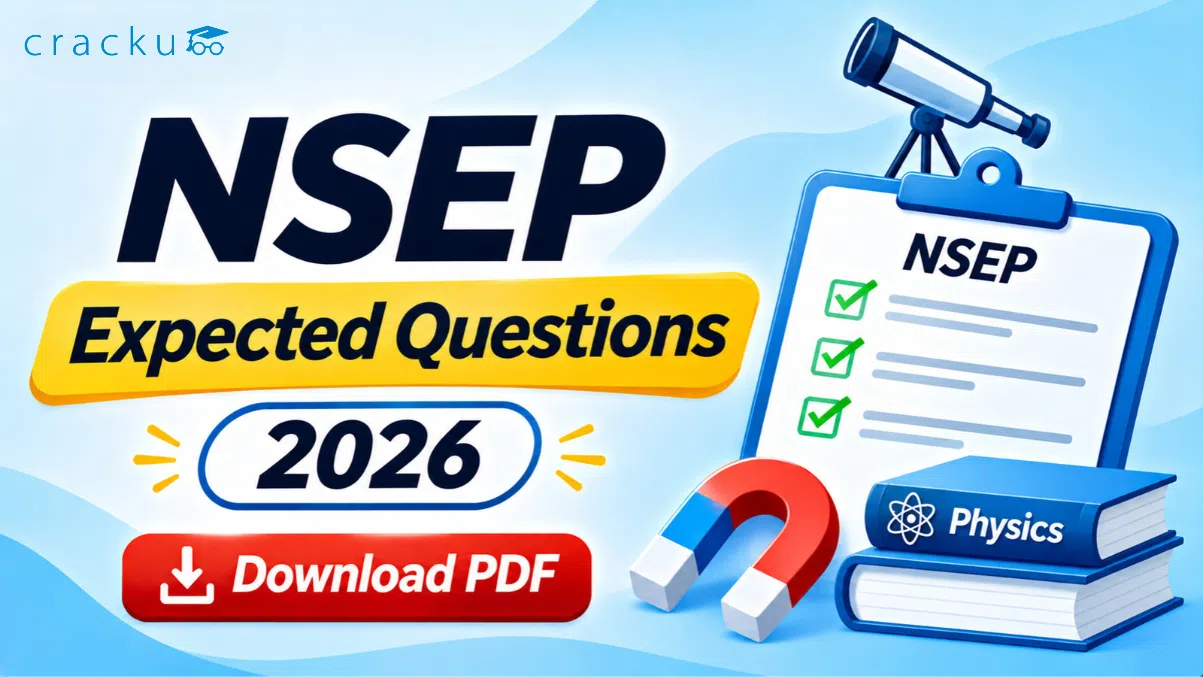
NSEP Expected Questions 2026
If a ring and a solid disc roll down the same slope, which one reaches the bottom first? Assume both start from rest and roll without slipping. The disc wins. For the same vertical drop, the ring puts a larger share of its energy into rotation, so it moves down the slope more slowly. Try explaining that in your own words before reaching for a formula.
The NSEP 2026 exam is on Sunday, 22 November, from 8:30 AM to 10:30 AM. With two days left, use the NSEP Expected Questions 2026 to find out which chapters need one more look. Start with a topic you know well. If a familiar question still takes too long, check where you lose time. It could be the diagram, the choice of equation or the calculation itself.
NSEP Expected Questions 2026 PDF
Download the NSEP Expected Questions 2026 PDF below. Pick a few questions from different chapters and attempt them without opening your notes. Keep your rough work, especially for questions where you change your answer. During revision, it helps to see what made you reconsider an option.
When you finish, put a question mark beside any answer you guessed, even if you got it right. Say you narrowed a circuit question down to two options. Can you explain what happens to the current in each branch? If one branch still confuses you, redraw that part of the circuit and try again.
NSEP 2026 High-Weightage Topics
Which chapters should you revise first? The official NSEP syllabus broadly follows CBSE Physics up to Class 12 and expects Mathematics at the same level. HBCSE lists the topics without giving a fixed chapter-wise marks distribution. Use the table below to choose NSEP important topics for your final revision. The last column gives you a question to try from each area.
| Topic | What to revise | Ask yourself |
|---|---|---|
| Mechanics | Forces, friction, energy and rotation | What makes a ring start rotating as it rolls down an incline? |
| Electricity and magnetism | Circuits, capacitors and induction | If you disconnect a charged capacitor from a battery and pull its plates apart, what stays constant? |
| Heat and thermodynamics | Gas laws, heat and work | On a pressure–volume graph, how would you find the work done by an expanding gas? |
| Oscillations and waves | Wave speed, frequency and standing waves | Can you sketch the two lowest-frequency standing waves on a string fixed at both ends? |
| Optics | Lenses, refraction and image formation | What happens to the image as an object moves towards a convex lens from twice its focal length? |
| Modern physics | Photoelectric effect and nuclear decay | Above the threshold frequency, how does increasing the frequency of light affect the stopping potential? |
Also Read: NSEP Sample Paper 2026 PDF with Answers, Download Now
How to Prepare Using NSEP Expected Questions 2026?
Keep your NSEP preparation strategy simple for the final two days. Set aside an hour today for a mixed set. Leave enough time to go back through your answers while you still remember why you chose them.
| Time | What to do |
|---|---|
| First 25 minutes | Attempt a few questions across chapters. Circle any question you leave halfway through. |
| Next 20 minutes | Check your answers and find the first step where your working went wrong. |
| Last 15 minutes | Pick two missed questions and solve them again on a fresh page. |
Write your corrections in language that will make sense tomorrow morning. “Revise capacitors” is easy to forget. “I treated the voltage as constant after disconnecting the battery” tells you exactly what went wrong. Tomorrow, try the same problem with the battery connected and explain how that changes your answer.
Also Read: NSEP 2025 Question Paper PDF, Solutions and Exam Analysis
NSEP Expected Questions vs Previous Year Questions
Use expected questions when you want more practice with a particular idea. Turn to NSEP previous year papers when you want to see how that idea appears in an exam. In the official 2025 paper, for example, Question 2 showed two blocks connected by a string over a pulley. The important detail was that their total mass stayed constant. Students had to use that condition to identify a relationship between acceleration and tension.
Try that question after revising Newton’s laws. Draw a separate force diagram for each block. Before looking at the options, write down what changes as you transfer mass from one side to the other. This gives you a reason for choosing an answer, even if several expressions look familiar.
Common Mistakes While Practising NSEP Expected Questions
Missing a condition in the question. The 2025 paper included a body falling from a height equal to one-fifth of Earth’s radius. If you use \(mgh\) with the surface value of \(g\), you miss the change in gravity over that distance. Read the height carefully before choosing your energy equation.
Stopping after one correct option. The official 2025 paper included questions with more than one correct answer. When practising these, check every statement. Finding one true statement still leaves the others to test.
Doing the same calculation twice without checking the diagram. If your answer is off by a factor of two, look at the given dimensions first. Did you copy the diameter into a formula that needs the radius? Label the diagram before starting the arithmetic again.
Conclusion
Use the NSEP Expected Questions 2026 PDF to decide what deserves your remaining revision time. After today’s practice, choose two or three questions you want to revisit tomorrow and note why you chose them. Before the exam, solve those questions once more with your notes closed. If you can draw the diagram, explain your first step and reach the answer on your own, move on to the next topic.