91- 6303239042


 Group
 Group


 Preferred Source

 Google Discover
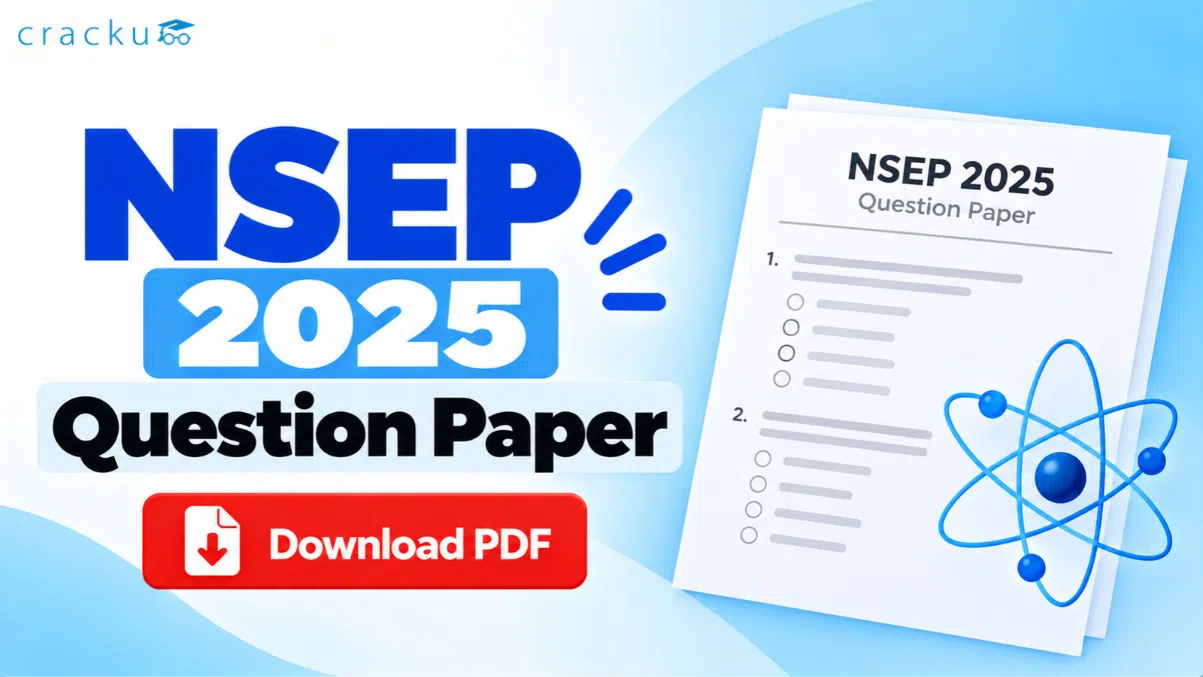
NSEP 2025 Question Paper
The NSEP 2025 Question Paper contained 60 Physics questions to be answered in 120 minutes, with a maximum score of 216 marks. The Indian Association of Physics Teachers (IAPT) examined on November 23, 2025, from 8:30 AM to 10:30 AM.
For students preparing for upcoming attempts, this paper provides useful practice in applying Physics concepts under time pressure. Questions cover areas such as mechanics, electricity, magnetism, waves, optics, thermal physics and modern physics.
The paper goes beyond recalling formulas. For example, students must interpret physical arrangements, connect different concepts and check whether individual statements are correct. Solving it in one sitting can help you identify both subject weaknesses and problems with question selection.
NSEP 2025 Question Paper PDF
Download the NSEP 2025 Question Paper PDF below to practise all 60 questions, review diagrams and understand the worked solutions. Save it for offline practice and use it to identify topics that need more revision.
Attempt the paper within 120 minutes before checking the solutions. Mark questions you find difficult, answer through guesswork or spend too much time solving. After your attempt, review the explanations and check every option carefully in multiple-correct-answer questions.
Reattempt the questions you missed after revising the relevant concepts. This will help you check your understanding and improve your speed and accuracy.
NSEP 2025 Question Paper – Exam Pattern
The NSEP Exam Pattern for 2025 had two parts: A-1 and A-2. Both contained objective questions, but their answer requirements and marking rules differed.
| Particulars | Part A-1 | Part A-2 |
|---|---|---|
| Question numbers | 1–48 | 49–60 |
| Number of questions | 48 | 12 |
| Correct options per question | Exactly one | One or more |
| Marks for a correct response | 3 | 6 |
| Negative marking | −1 per incorrect response | None |
| Maximum marks | 144 | 72 |
In Part A-2, six marks are awarded for selecting the complete correct combination; selecting only some correct options does not earn partial credit. The examination used an OMR answer sheet, and a non-programmable scientific calculator was permitted.
With 60 questions in 120 minutes, the average available time is two minutes per question. Treat this as a planning reference, since some problems need considerably more work than others.
Also Read: NSEP Important Topics 2026, Weightage & Preparation Plan
NSEP 2025 Question Paper: Difficulty Level
The NSEP 2025 Question Paper was moderate to difficult based on an analysis of its questions. This is an independent assessment, not an official difficulty rating.
The paper included direct concept-based questions alongside problems requiring multiple steps. The more challenging questions tested mathematical reasoning, interpretation of diagrams and the ability to apply different Physics concepts together.
| Area | Examples from the paper | Main challenge |
|---|---|---|
| Mechanics | Rolling motion, collisions, variable retardation | Choosing suitable equations and conservation laws |
| Electricity and magnetism | Charge distributions, resistor networks, inductors | Applying superposition and circuit principles |
| Waves and optics | Doppler effect, interference, lens combinations | Interpreting conditions and using correct signs |
| Thermal physics | Gas processes, radiation, thermodynamic cycles | Connecting equations with physical processes |
| Modern physics | Photoelectric effect, radioactivity, atomic energy levels | Applying concepts and completing calculations accurately |
How to Analyse the NSEP 2025 Question Paper
A useful NSEP Preparation Strategy starts with understanding why you lost marks. Your total score alone cannot show whether the problem was weak concepts, slow calculations or avoidable mistakes.
Follow these steps after attempting the paper:
- Calculate your score: Apply the marking rules separately to A-1 and A-2. Check answers against the official IAPT key for the matching paper code.
- Classify every error: Separate conceptual gaps, calculation mistakes, incorrect diagram interpretation and incomplete option selection.
- Review correct guesses: A correct answer obtained through uncertain reasoning still needs revision.
- Reattempt unfinished questions: Solve them without a timer to distinguish knowledge gaps from time pressure.
- Create a revision list: Record the concept, the mistake and the correction needed.
Use a simple tracker:
| Question outcome | Recommended action |
|---|---|
| Correct but slow | Look for a shorter, reliable method |
| Incorrect despite confidence | Recheck assumptions and conceptual understanding |
| Unattempted due to time | Practise selection and timed sets |
| Unable to start | Revise the concept before solving similar questions |
Reattempt difficult questions after a few days. Being able to reproduce the reasoning independently is a better sign of progress than recognising a solution.
Benefits of Solving NSEP Previous Year Question Papers
Solving NSEP previous year papers helps you become familiar with the reasoning expected in the examination. It also provides a practical way to test whether your revision translates into accurate answers.
The NSEP Syllabus is broadly equivalent to senior secondary Physics, up to and including CBSE Class 12, with Mathematics at the same level expected. However, HBCSE notes that Olympiad questions can be unconventional and highly challenging.
Previous papers help you:
- Apply familiar concepts: Use standard principles in unfamiliar physical situations.
- Improve question selection: Recognise manageable problems before committing time to lengthy calculations.
- Build accuracy: Practise units, signs, approximations and option checking.
- Measure progress: Compare accuracy and completion time across fresh papers.
Use several years of papers. One paper’s topic distribution should not become a reason to skip other syllabus areas.
Common Mistakes to Avoid While Solving NSEP Question Papers
The most costly mistakes often come from incomplete reading and rushed decisions. Avoid these habits during practice:
- Using formulas without checking conditions: Confirm assumptions such as rolling without slipping, negligible resistance or ideal behaviour.
- Treating A-2 as single-answer: Examine every option before finalising the response.
- Guessing blindly in A-1: Account for the one-mark penalty when deciding whether to attempt.
- Ignoring diagrams and units: Mark directions, distances and circuit connections before calculating.
- Spending too long on one problem: Move ahead when progress stops and return later.
- Reading solutions too early: Make a serious independent attempt first.
Finish each practice session with a short error review. Consistent correction of recurring mistakes makes previous-paper practice more useful than simply increasing the number of questions attempted.
NSEP 2025 Question Paper: Conclusion
The NSEP 2025 Question Paper is a useful resource for understanding the NSEP Exam Pattern and practising concept-based Physics questions. Attempting the paper within 120 minutes can help you assess your accuracy, question selection and time management. Use the NSEP 2025 Question Paper PDF with worked explanations to review difficult problems after completing an independent attempt.
Make this review part of your NSEP Preparation Strategy by recording mistakes and revising the related topics in the NSEP Syllabus. Solve NSEP previous year papers from several years to practise a wider range of questions. Regular revision and independent reattempts can help you strengthen weak areas and approach unfamiliar problems with greater confidence.