91- 6303239042


 Group
Group
 Group
Group


 Preferred Source

 Google Discover
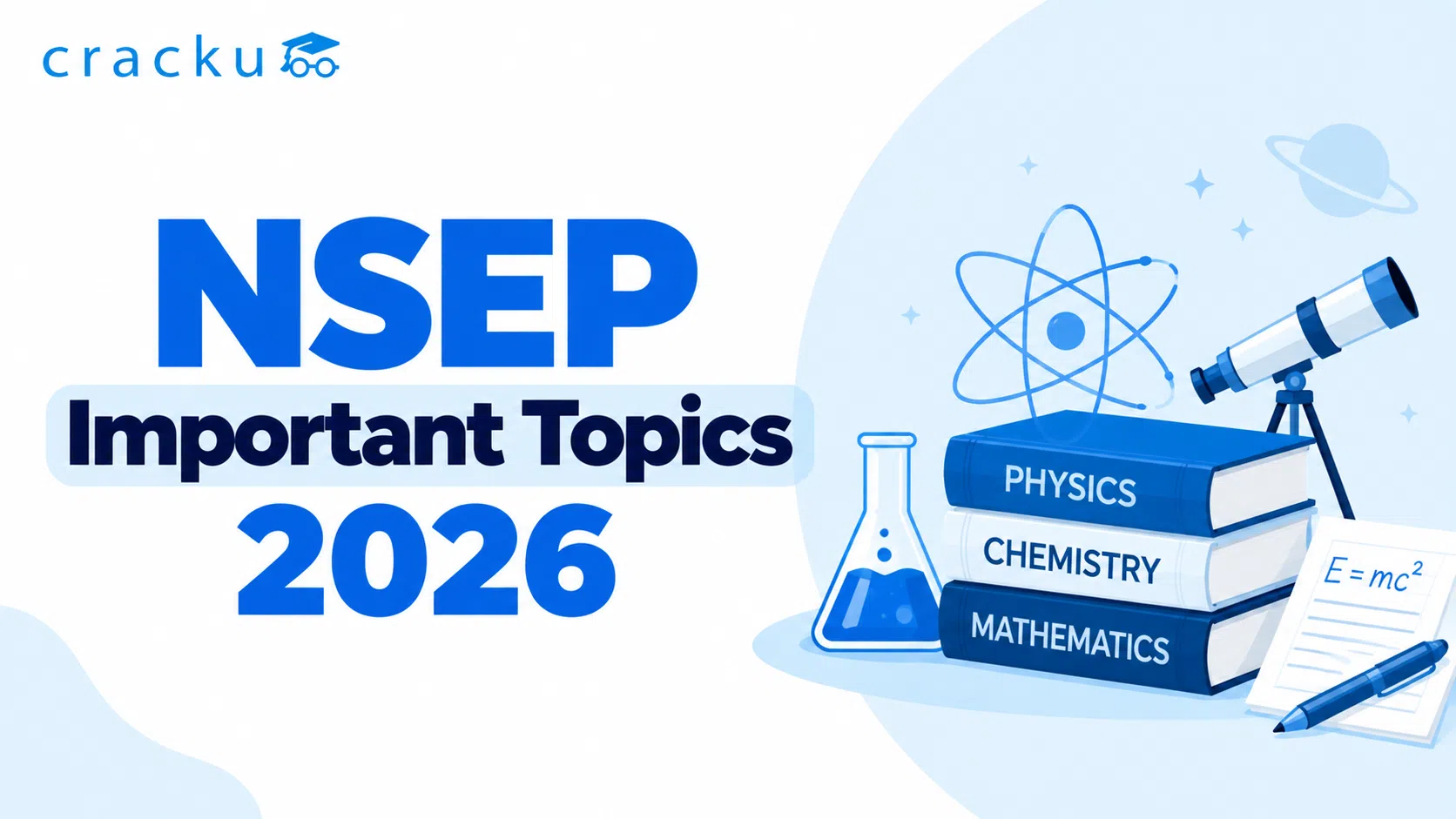
NSEP Important Topics 2026
National Standard Examination in Physics (NSEP) is organised by the Indian Association of Physics Teachers (IAPT) as the first-level exam for students who aspire to appear in India’s Physics Olympiad. The NSEP 2026 syllabus encompasses topics related to Physics of Class 12 CBSE Board, including Mechanics, Thermodynamics, Waves, Electromagnetism, Optics, and Modern Physics. For effective preparation, students need to be aware of the NSEP Important Syllabus and work on those topics that have the highest priority, along with question-based practice that involves the use of concepts instead of simply mugging up formulae. The NSEP exam date for 2026 is November 22, 2026, according to the IAPT calendar.
NSEP Important Topics
NSEP syllabus includes various topics from Class 11 and Class 12 Physics. Although students need to learn the entire syllabus, certain topics merit more importance as they include many concepts and are regularly asked in past years' question papers.
Physics Unit | Important Topics | Priority |
Mechanics | Kinematics, Laws of Motion, Work, Energy and Power, Circular Motion, Centre of Mass, Momentum and Collisions | Very High |
Torque, Angular Momentum, Moment of Inertia, Rolling Motion | High | |
Gravitational Field, Potential, Satellites, Escape Velocity, Kepler's Laws | High | |
Properties of Matter | Fluid Mechanics, Viscosity, Surface Tension, Bernoulli's Principle | Medium |
Laws of Thermodynamics, Heat Engines, Refrigerators, Kinetic Theory | Very High | |
Oscillations and Waves | SHM, Wave Motion, Standing Waves, Sound Waves, Doppler Effect | Very High |
Electric Field, Gauss's Law, Potential, Capacitance | Very High | |
Kirchhoff's Laws, Resistance, Cells, Wheatstone Bridge, Electrical Instruments | Very High | |
Magnetic Field, Lorentz Force, Biot-Savart Law, Ampere's Law | Very High | |
EMI and AC | Faraday's Law, Lenz's Law, Induction, LCR Circuits, Resonance | Very High |
Optics | Ray Optics, Mirrors, Lenses, Optical Instruments, Interference, Diffraction | Very High |
Photoelectric Effect, de Broglie Waves, Atoms, Nuclei, Radioactivity | High | |
p-n Junction, Diodes, Rectifiers, Zener Diode, LED, Photodiode | High | |
Dimensions, Errors, Significant Figures, Accuracy and Precision | Medium |
NSEP Chapter-Wise Weightage 2026
There is no officially fixed chapter-wise weightage for NSEP 2026. The following distribution should therefore be treated as an indicative guide based on analysis of previous papers, rather than a guaranteed question pattern.
Chapter/Topic | Approx. Weightage | Priority |
Ray Optics and Optical Instruments | 11.25% | Very High |
Work, Energy and Power | 5.75% | Very High |
Oscillations | 5.50% | Very High |
Mechanical Properties of Fluids | 5.25% | Very High |
Moving Charges and Magnetism | 5.25% | Very High |
Waves | 5.00% | High |
Alternating Current | 4.50% | High |
Electric Charges and Fields | 4.50% | High |
Thermal Properties of Matter | 4.50% | High |
Current Electricity | 4.25% | High |
Dual Nature of Radiation and Matter | 4.25% | High |
Semiconductor Electronics | 4.25% | High |
System of Particles and Rotational Motion | 4.00% | High |
Electrostatic Potential and Capacitance | 3.50% | Moderate |
Thermodynamics | 3.00% | Moderate |
3.00% | Moderate | |
Atoms | 2.75% | Moderate |
2.25% | Moderate | |
Motion in a Plane | 3.75% | Moderate |
Laws of Motion | 2.50% | Moderate |
Gravitation | 2.00% | Moderate |
Units and Measurements | 2.00% | Moderate |
1.50% | Moderate | |
Kinetic Theory | 1.25% | Moderate |
Magnetism and Matter | 1.25% | Low |
1.00% | Low | |
Mechanical Properties of Solids | 0.75% | Low |
How to Use Previous Year Papers to Prepare for NSEP 2026
Solving a previous year paper of NSEP is the most effective way to get an insight into the actual level and nature of the exam. Papers must not be solved only towards the end of the preparation schedule but should be an integral part of it.
1. Begin by Preparing Chapter-wise Questions
Once you finish reading a chapter, practice solving questions from NSEP Previous year papers. This will assist you in realising how theoretical knowledge is put to practical use.
2. Prepare a Mistakes Notebook
Note down all those questions which you are unable to solve. Note down formulas which you have forgotten along with confusing concepts.
3. Evaluate the Level of Difficulty
It would be a mistake to concentrate only on your grade. Determine if you made mistakes due to:
- Conceptual flaws
- Calculation mistakes
- Mistaken choice of formulas
- Question misinterpretation
- Time shortage
- Guessing
4. Do Complete Tests under Time Constraints
After having completed the majority of the syllabus, attempt entire NSEP tests under time pressure. The real NSEP 2026 exam will last two hours, starting at 8:30 AM and ending at 10:30 AM.
5. Recognize Repeat Concepts
Sometimes there are certain concepts that come up in different forms of questions. It is not good to remember just the question itself, but try to know the physics concept involved.
6. Solve Incorrect Question Again
After analysis of paper, wait for a few days and solve those questions that were answered wrongly without referring to answers to check your understanding of that concept.
Also Read: NSEP Syllabus 2026, Important Topics and Weightage
Common Mistakes to Avoid While Preparing for NSEP 2026
The correct preparation approach does not mean doing just some more study. It also implies not making mistakes that cost you time and leave knowledge gaps.
Ignoring Class 11 Physics: The preparation for the NSEP competition involves a good understanding of the basics of both Class 11 and Class 12 Physics. One shouldn't ignore mechanics, thermodynamics, waves, and other subjects of Class 11.
Memorising only formulas: The NSEP competition highly appreciates conceptual understanding and application of knowledge. Instead of memorising formulas, one should learn the physics behind them.
Avoiding difficult chapters: It may result in big knowledge gaps in your preparation. Difficult chapters should be divided into concepts.
Not solving old papers: Studying the theory without solving the NSEP Previous Year Paper will not provide adequate familiarity with the problem-solving skills required for the exam.
Using too many books: Preparing from too many books is not a good idea. Finish one book well before moving to the other.
Ignoring mistakes: It is not enough just to check the solution after doing it wrong. Know why it went wrong.
Poor time management: Wasting time trying to solve one tough question may affect the entire paper.
Also Read: NSEP 2026, Important Dates, Pattern & Eligibility Criteria
Last-Month Preparation Plan for NSEP 2026
The last month before NSEP 2026 must be spent on revision, solving problems, and working on previous year question papers and mock tests. Rather than learning new topics, students must concentrate on mastering crucial topics, understanding their weak areas, and increasing speed and accuracy.
Week | Preparation Focus | What to Do |
Week 1 | Revise Important Topics | Revise Mechanics, Electrostatics, Current Electricity, Magnetism, Optics, Thermodynamics, and Waves. |
Week 2 | Complete Syllabus Revision | Cover remaining topics such as Modern Physics, Semiconductors, Gravitation, EMI, AC, and Units & Measurements. |
Week 3 | Previous Year Papers | Solve NSEP Previous Year Papers under a time limit. Analyse every mistake after each paper. |
Week 4 | Mock Tests & Final Revision | Attempt full-length mock tests, revise formulas, review weak topics, and practise important concepts. |
Also Read: NSEP Eligibility Criteria 2026, Age Limit, Qualification
NSEP Important Topics 2026: Conclusion
The NSEP Important Topics 2026 can help you organise your preparation across Mechanics, Thermodynamics, Waves, Electromagnetism, Optics and Modern Physics. Build a strong foundation in both Class 11 and Class 12 concepts, and practise applying them to unfamiliar problems. Use the indicative chapter-wise weightage to prioritise revision while maintaining coverage of the complete syllabus.
Make NSEP previous-year papers, mock tests and mistake analysis regular parts of your study routine. Reattempt difficult questions, revise formulas with their conditions of use and give extra attention to weak areas. A structured NSEP 2026 preparation plan can help you improve accuracy, manage time and approach the examination with greater confidence.