Join WhatsApp Icon JEE WhatsApp Group
JEE Electromagnetic Induction Questions

Electromagnetic Induction is a high-weightage, conceptually rich chapter in the Electrodynamics unit of JEE Physics. It explains how changing magnetic fields generate electric currents, a principle that powers generators, transformers, and countless devices. Because it combines field concepts with circuit reasoning, JEE Electromagnetic Induction questions are reliably tested in both JEE Main and JEE Advanced and reward students who understand flux and its rate of change. This chapter covers magnetic flux, Faraday's law of induction, Lenz's law, motional EMF, eddy currents, self-inductance and mutual inductance, the energy stored in an inductor, and growth and decay of current in inductive circuits. JEE Main typically tests Faraday's and Lenz's laws and motional EMF, while JEE Advanced often presents combined induction-and-circuit problems or moving-conductor setups. Practising topic-wise JEE Questions helps you track flux changes and apply Lenz's law for direction with confidence.

Question 1

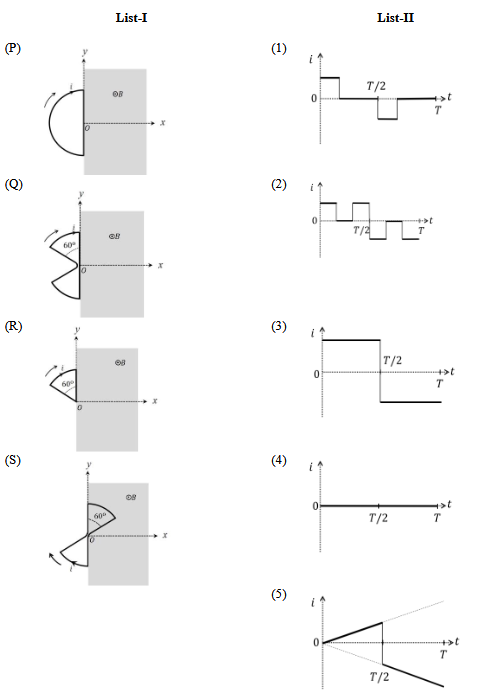
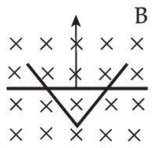
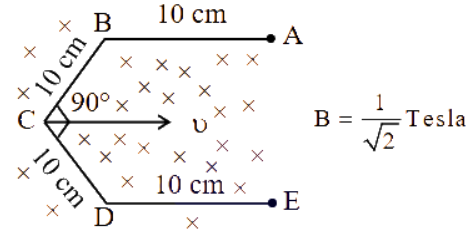
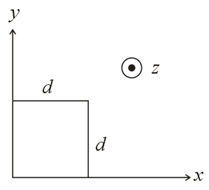
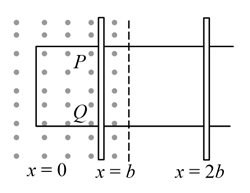
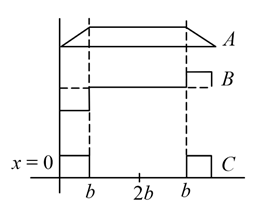
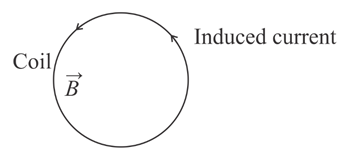
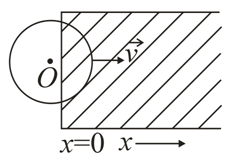
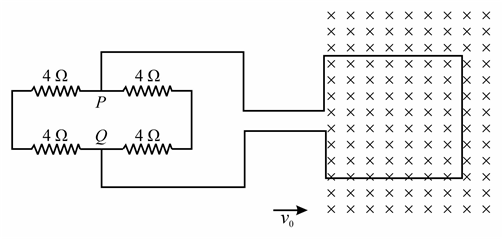
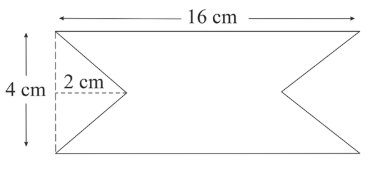
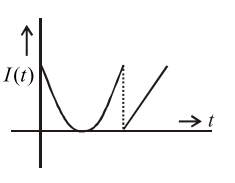
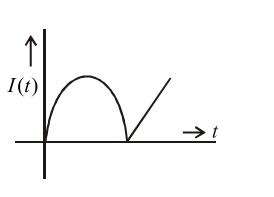
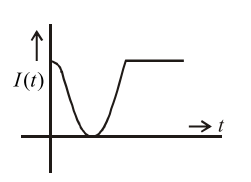
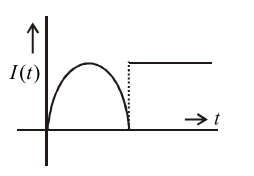
List-I contains four conducting loops lying in the $$XY$$ plane, as shown in the figures. The loops are rotating about $$Z$$ axis passing through the point $$O$$ with time period $$T$$ in clockwise direction. The region $$x>0$$ contains a uniform magnetic field $$B$$ in the $$+z$$ direction. List-II contains the qualitative variation of the induced current $$i(t)$$ for each of these loops. Choose the option which describes the correct match between the entries in List-I to those in List-II.

image
Question 2

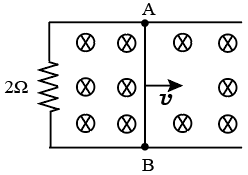
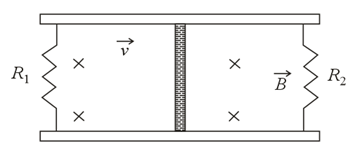
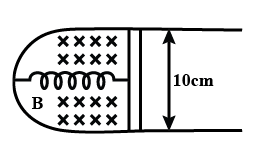
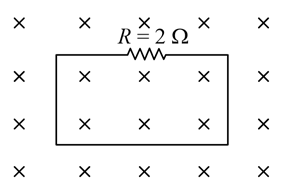
A 1 m long metal rod AB completes the circuit as shown in figure. The area of circuit is perpendicular to the magnetic field of 0.10 T. lf the resistance of the total circuit is 2Ω then the force needed to move the rod towards right with constant speed (v) of 1.5 m/s is ___ N

Screenshot_1
Question 3

Suppose a long solenoid of 100 cm length, radius 2 cm having 500 turns per unit length, carries a current $$I= 10 \sin (\omega t)$$ A, where $$\omega$$ = 1000 rad/s. A circular conducting loop (B) of radius 1 cm coaxially slided through the solenoid at a speed $$v = 1 cm/s$$. The r.m.s. current through the loop when the coil B is inserted 10 cm inside the solenoid is $$\alpha/\sqrt{2}\mu A$$. The value of $$\alpha$$ is ______.
[Resistance of the loop= 10$$\Omega$$]

Question 4

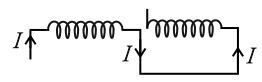
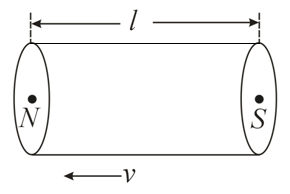
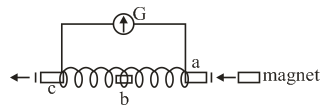
Three identical coils $$C_{1}, C_{2}$$ and $$C_{3}$$ are closely placed such that they share a common axis. $$C_{2}$$ is exactly midway. $$C_{1}$$ carries current $$I$$ in anti-clockwise direction while $$C_{3}$$ carries current $$I$$ in clockwise direction. An induced Current flows through $$C_{2}$$ will be in clockwise direction when

Question 5

A metal rod of length $$L$$ rotates about one end at origin with a uniform angular velocity $$\omega$$. The magnetic field radially falls off as $$B(r) = B_0 e^{-\lambda r}$$. $$\lambda$$ being a positive constant. The EMF induced (neglecting the centripetal force on electrons in the rod) is :

Question 6

When a coil is placed in a time dependent magnetic field the power dissipated in it is P. The number of turns, area of the coil and radius of the coil wire are N, A and r respectively. For a second coil number of turns, area of the coil and radius of the coil wire are 2N, 2A and 3r respectively. When the first coil is replaced with second coil the power dissipated in it is $$\sqrt{2} \alpha P$$. The value of $$\alpha$$ is __________.

Question 7

A square loop of side 2 cm is placed in a time varying magnetic field with magnitude as $$B = 0.4 \sin(300t)$$ Tesla. The normal to the plane of loop makes an angle of $$60°$$ with the field. The maximum induced emf produced in the loop is __________ mV.

Question 8

A 30 cm long solenoid has 10 turns per cm and area of 5 cm$$^2$$. The current through the solenoid coil varies from 2 A to 4 A in 3.14 s. The e.m.f. induced in the coil is $$\alpha \times 10^{-5}$$ V. The value of $$\alpha$$ is __________.

Question 9

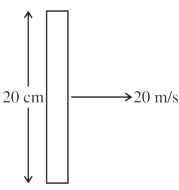
A 20 m long uniform copper wire held horizontally is allowed to fall under the gravity $$(g=10m/s^{2})$$ through a uniform horizontal magnetic fie ld of 0.5 Gauss perpendicular to the length of the wire. The induced EMF across the wire when it travells a vertical distance of200 m is ____ mV.

Question 10

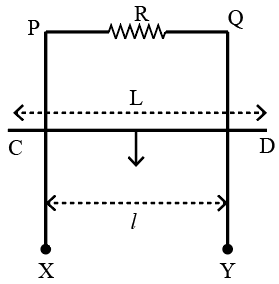
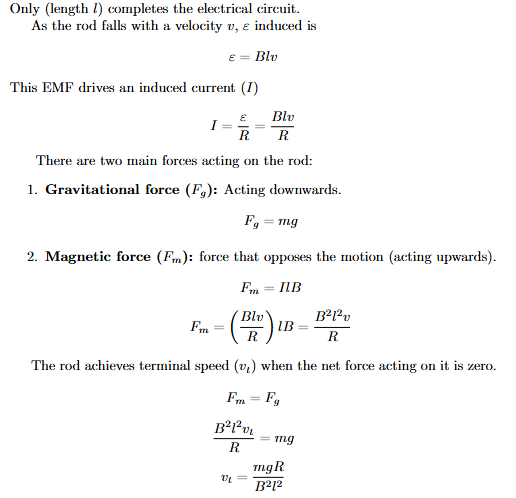
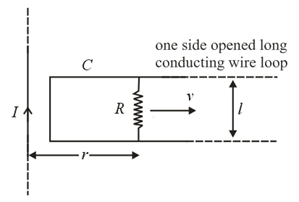
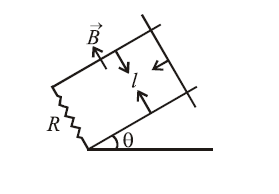
$$XPQY$$ is a vertical smooth long loop having a total resistance $$R$$ where $$PX$$ is parallel to $$QY$$ and separation between them is $$l$$. A constant magnetic field $$B$$ perpendicular to the plane of the loop exists in the entire space. A rod $$CD$$ of length $$L (L > l)$$ and mass $$m$$ is made to slide down from rest under the gravity as shown in figure. The terminal speed acquired by the rod is _______ $$m/s. (g$$ = acceleration due to gravity)

Screenshot_43
Question 11

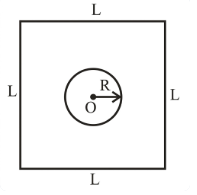
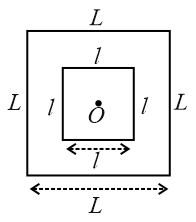
A circular current loop of radius $$R$$ is placed inside square loop of side length $$L$$ ($$L \gg R$$) such that they are co-planar and their centers coincide. The permeability of free space is $$\mu_0$$. The mutual inductance between circular loop and square loop is :

Question 12

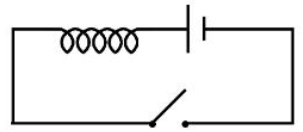
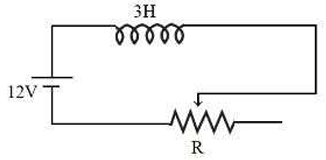
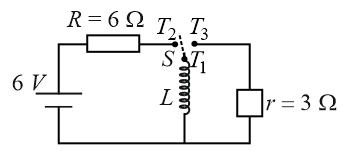
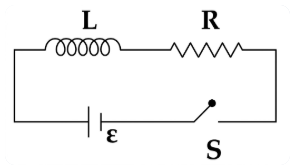
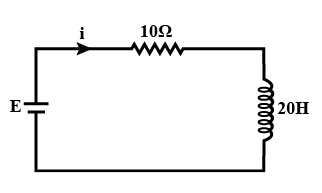
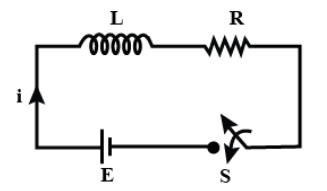
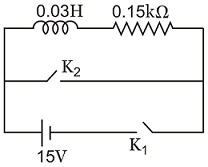
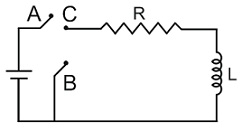
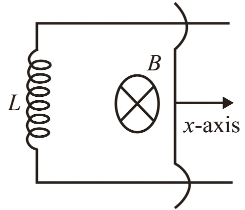
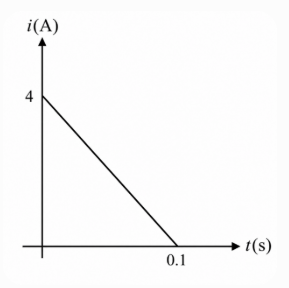
An inductor of inductance 10 mH having resistance of 100 $$\Omega$$ is connected to battery of E.M.F. 1.0 V through a switch as shown in the figure below. After switch is closed, the ratio of instantaneous voltages across the inductor when the current passing through it is 2 mA and 4 mA is _______.

image
Question 13

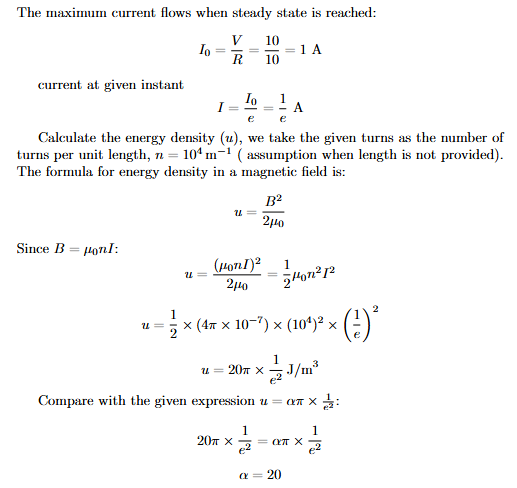
Inductance of a coil with $$ 10^{4} $$ turns is $$10 mH$$ and it is connected to a dc source of $$10 V$$ with internal resistance of $$10\Omega $$ The energy density in the inductor when the current reaches $$ \left( \frac{1}{e} \right) $$ of its maximum value is $$ \alpha\pi \times \frac{1}{e^{2}}J/m^{3} $$. The value of $$ \alpha$$ is_______.
$$ (\mu_{o}=4\pi\times 10^{-7}Tm/A). $$

Question 14

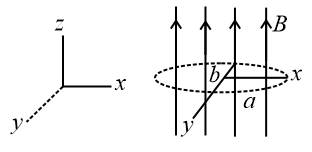
A conducting circular loop is rotated about its diameter at a constant angular speed of 100 rad/s in a magnetic field of 0.5 T perpendicular to the axis of rotation. When the loop is rotated by $$30 ^{\circ}$$ from the horizontal position, the induced EMF is 15.4 mV. The radius of the loop is ____ mm. (Take $$\pi = \frac{22}{7}$$)

Question 15

A circular loop of radius $$r = 20$$ cm and resistance $$R = 2\,\Omega$$ is placed in a time varying  magnetic field $$B = (2t^2 + 2t + 3)$$ T. At $$t = 0$$, for the plane of the loop being perpendicular to the magnetic field and, The induced current in the loop  at $$t = 3$$ s is $$\frac{\alpha}{50}$$ A. The value of $$\alpha$$ is__________.
(Take $$\pi = 22/7$$)

Question 16

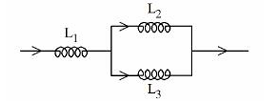
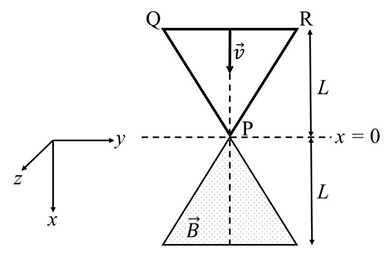
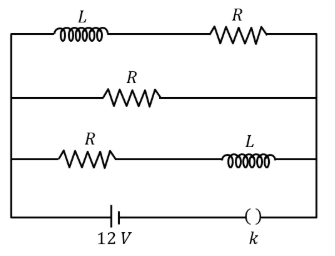
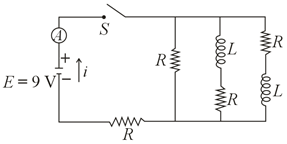
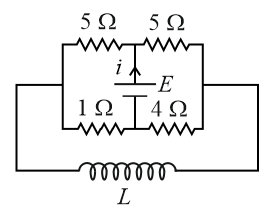
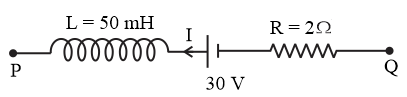
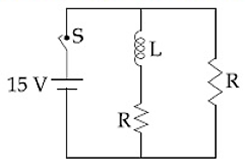
In the given circuit below inductance values of $$L_1$$, $$L_2$$ and $$L_3$$ are same. The magnetic energy stored in the entire circuit is $$(U_t)$$ and that stored in the $$L_2$$ inductor is $$(U_l)$$. $$U_t / U_l$$ is _______. (Ignore the mutual inductance if any)

image

Electromagnetic Induction Topic Overview

Parameter

Details

Topic Name

Electromagnetic Induction

Subject

Physics

JEE Main Weightage

~3–5% (1–2 questions on average)

JEE Advanced Weightage

~5–7% (often combined)

Difficulty Level

Moderate to High

Important Concepts

Magnetic Flux, Faraday's Law, Lenz's Law, Motional EMF, Inductance

Recommended Practice Level

High – attempt 70+ mixed problems

Why Practice JEE Electromagnetic Induction Questions?

  • High weightage: Induction contributes 1–2 questions in JEE Main most years.
  • Leads into AC: It is the foundation for the alternating-currents chapter.
  • Direction reasoning: Lenz's law problems sharpen conceptual understanding.
  • Strong in Advanced: Moving-conductor and combined-circuit problems are common.
  • Links field and circuit: It connects magnetism with circuit analysis.
  • Reliable EMF questions: Motional and flux-change EMF yield consistent problems.
  • Concept-rich: Self- and mutual inductance build deep electromagnetic intuition.

Important Concepts and Subtopics

Concept

Importance

Difficulty Level

Frequently Asked In

Magnetic Flux

Very High

Easy–Moderate

JEE Main

Faraday's Law of Induction

Very High

Moderate

JEE Main & Advanced

Lenz's Law & Induced-Current Direction

Very High

Moderate

JEE Main & Advanced

Motional EMF

Very High

Moderate–High

JEE Main & Advanced

Eddy Currents

Moderate

Easy

JEE Main

Self & Mutual Inductance

High

Moderate–High

JEE Main & Advanced

Energy Stored in an Inductor

High

Moderate

JEE Main

Growth & Decay in LR Circuits

High

Moderate–High

JEE Advanced

Preparation Strategy for JEE Electromagnetic Induction

Concept learning: Begin with magnetic flux and Faraday's law, then master Lenz's law for determining the direction of induced current. Study motional EMF as a special case, then move to self- and mutual inductance and the behaviour of current in LR circuits.

Formula revision: Keep flux, Faraday's law, motional-EMF, inductance, and LR growth-decay relations together for quick review. Well-organised JEE Study Material helps you keep these formulas and their conditions in one place for fast revision before the exam.

Problem-solving techniques: Always compute flux carefully, accounting for area, field, and angle. Use Lenz's law to fix direction before assigning signs. For motional EMF, identify the effective length and velocity components. For LR circuits, use the time-constant behaviour for growth and decay.

Common mistakes: Sign and direction errors from misapplying Lenz's law, forgetting the angle in flux calculations, confusing self- and mutual inductance, and mishandling the LR time constant.

Exam strategy: Solve direct Faraday and motional-EMF questions first, then attempt inductance and LR-circuit problems that require more steps. When induction combines with a moving conductor and a circuit, find the EMF first, then analyse the circuit it drives.

JEE Main & Advanced Weightage Analysis

Exam

Average Questions

Expected Marks

JEE Main

1–2

4–8

JEE Advanced

2–3 (often combined)

8–14

Electromagnetic Induction is a steady contributor in JEE Main and a frequent source of moving-conductor and combined-circuit problems in JEE Advanced. Mastery here leads directly into alternating currents, making it doubly valuable.

Tips to Solve Electromagnetic Induction Questions Faster

  • Compute flux carefully, including the angle between field and area.
  • Use Lenz's law to fix the induced-current direction before assigning signs.
  • For motional EMF, identify the effective length and the perpendicular velocity component.
  • Treat the inductor as opposing changes in current, using the LR time constant.
  • Use energy stored (½LI²) directly for inductor-energy questions.
  • For mutual inductance, relate the EMF in one coil to the rate of current change in the other.

Reinforcing these techniques with a timed JEE Mock Test builds the flux-tracking and direction fluency that induction problems reward.

Frequently Asked Questions