For an electromagnetic wave propagating through vacuum, $$\vec{k}$$, $$\vec{E}$$ and $$\omega$$ represent propagation vector, electric field and angular frequency, respectively. The magnetic field associated with this wave is represented by :
JEE Electromagnetic Waves Questions
A laser beam has intensity of $$4.0 \times 10^{14} W/m^{2}.$$ The amplitude of magnetic field associated with beam is____________T. (Take $$\epsilon_{0}= 8.85 \times 10^{-12} C^{2}/Nm^{2}$$ and $$c= 3 \times 10^{8} m/s$$ )
We are given a laser intensity $$I = 4.0 \times 10^{14}$$ W/m$$^2$$, permittivity of free space $$\epsilon_0 = 8.85 \times 10^{-12}$$ C$$^2$$/(N m$$^2$$), and the speed of light $$c = 3 \times 10^8$$ m/s. The intensity relates to the electric field amplitude by $$I = \frac{1}{2}\epsilon_0 c E_0^2$$ and the electric and magnetic field amplitudes satisfy $$E_0 = cB_0$$.
Solving the intensity equation for $$E_0$$ gives $$E_0^2 = \frac{2I}{\epsilon_0 c} = \frac{2 \times 4.0 \times 10^{14}}{8.85 \times 10^{-12} \times 3 \times 10^8}$$ which simplifies to $$= \frac{8.0 \times 10^{14}}{26.55 \times 10^{-4}} = \frac{8.0 \times 10^{14}}{2.655 \times 10^{-3}} = 3.013 \times 10^{17}$$ and hence $$E_0 = \sqrt{3.013 \times 10^{17}} = 5.49 \times 10^{8} \text{ V/m}$$.
Using the relation $$B_0 = \frac{E_0}{c}$$ we find $$B_0 = \frac{5.49 \times 10^8}{3 \times 10^8} = 1.83 \text{ T}$$. The correct answer is Option B: 1.83.
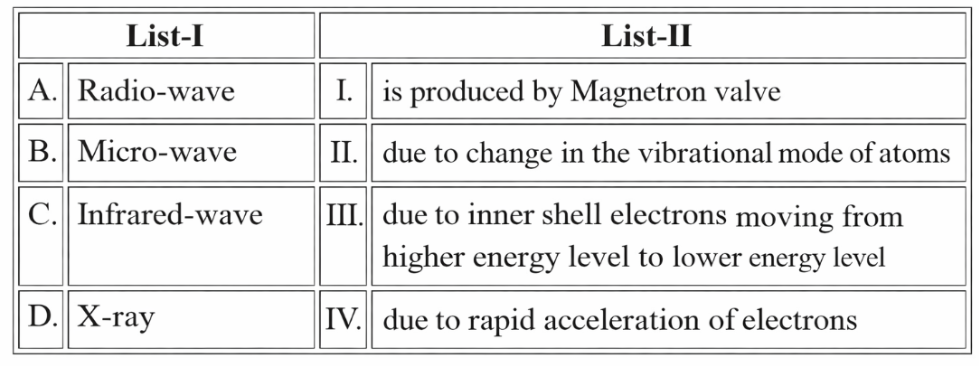
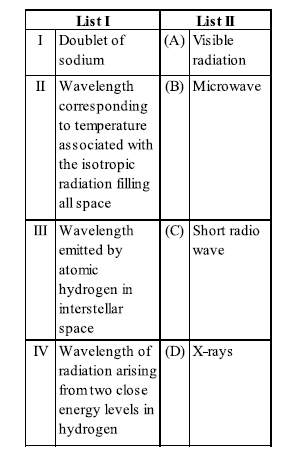
Match the LIST-I with LIST-II
Choose the correct answer from the options given below:
Microwaves are produced by special vacuum electron tubes, with the Magnetron valve (or klystron) being one of the most common devices used to generate them (e.g., in microwave ovens and radar systems).
X-rays can be produced when high-energy electrons interact with matter. One common mechanism (characteristic X-rays) is when an inner-shell electron is knocked out, and an electron from a higher energy level drops down to fill the vacancy, emitting an X-ray photon in the process.
The equation of a plane progressive wave is given by $$y = 5 \cos \pi \left(200t - \frac{x}{150}\right)$$ where x and y are in cm and t is in second. The velocity of the wave is __________ m/s.
The standard form of a one-dimensional plane progressive wave travelling in the +x direction is
$$y = A \cos \left(\omega t - kx\right)$$
where $$\omega$$ is the angular frequency and $$k$$ is the angular wave number.
Given equation:
$$y = 5 \cos \pi\left(200t - \frac{x}{150}\right)\qquad (x,y \text{ in cm, } t \text{ in s})$$
Rewrite the argument to identify $$\omega$$ and $$k$$:
$$\pi\left(200t - \frac{x}{150}\right) \;=\; \bigl(\pi \cdot 200\bigr)t \;-\; \bigl(\pi/150\bigr)x$$
Therefore
$$\omega = 200\pi\ \text{rad s}^{-1}, \qquad k = \frac{\pi}{150}\ \text{rad cm}^{-1}$$
Wave speed formula:
$$v = \frac{\omega}{k}$$
Substitute the values:
$$v = \frac{200\pi}{\,\pi/150} = 200 \times 150 = 30000 \text{ cm s}^{-1}$$
Convert to SI units (1 m = 100 cm):
$$v = \frac{30000}{100} = 300 \text{ m s}^{-1}$$
Hence, the velocity of the wave is $$300\ \text{m/s}$$.
Option D which is: $$300$$
A displacement current of 4.0 A can be set up in the space between two parallel plates of 6 $$\mu$$F capacitor. The rate of change of potential difference across the plates of the capacitor is nearly $$\alpha \times 10^6$$ V/s. The value of $$\alpha$$ is _______.
start with Q = C V
differentiating with respect to time:
dQ/dt = C dV/dt
since dQ/dt = I, we get:
I = C dV/dt
given:
I = 4 A
C = 6 μF = 6 × 10⁻⁶ F
$$\frac{dV}{dt}=\frac{I}{C}=\frac{4}{6\times10^{-6}}=\frac{2}{3}\times10^6$$
$$\approx0.67\times10^6\text{ V/s}$$
An electromagnetic wave travels in free space along the x-direction. At a particular point in space and time, $$\vec{B} = 2 \times 10^{-7}\hat{j}$$ T is associated with this wave. The value of corresponding electric field $$\vec{E}$$ at this point is _________ V/m.
The wave is moving in the $$+x$$-direction, so for a plane electromagnetic (EM) wave in free space the three vectors $$\vec{E}, \vec{B}, \vec{k}$$ are mutually perpendicular and obey the right-hand rule
$$\vec{E}\times\vec{B} \;=\; \dfrac{1}{\mu_0}\,(\text{Poynting vector}) \propto \vec{k},$$
therefore $$\vec{E}\times\vec{B}$$ must point in the $$+x$$-direction.
Given $$\vec{B}=2\times10^{-7}\,\hat{j}\; \text{T}$$ (along $$+y$$), let the unknown electric field be $$\vec{E}=E_z\,\hat{k}$$ (along $$\pm z$$). Compute the cross product:
$$\vec{E}\times\vec{B}=E_z\,\hat{k}\;\times\;2\times10^{-7}\,\hat{j}$$
Use the cyclic relation $$\hat{i}\times\hat{j}=\hat{k}, \;\hat{j}\times\hat{k}=\hat{i}, \;\hat{k}\times\hat{i}=\hat{j}$$, so
$$\hat{k}\times\hat{j}=-\hat{i}.$$
Hence
$$\vec{E}\times\vec{B}=E_z\;(2\times10^{-7})\,(-\hat{i}).$$
To make this result point along $$+\hat{i}$$ (the propagation direction), we need $$E_z$$ to be negative. Therefore the electric field must point along $$-\hat{k}$$.
In free space the magnitudes satisfy $$|\vec{E}| = c\,|\vec{B}|$$, where $$c = 3\times10^{8}\,\text{m/s}$$. Thus
$$|\vec{E}| = c\,|\vec{B}| = (3\times10^{8})(2\times10^{-7}) = 6.0\times10^{1} \;\text{V/m} = 60 \;\text{V/m}.$$
Adding the direction found earlier,
$$\boxed{\;\vec{E} = -60\,\hat{k}\;\text{V/m}\;}.$$
Hence the correct option is:
Option B which is: $$-60\hat{k}$$ V/m
A monochromatic source of light operating at 15 kW emits $$2.5 \times 10^{22}$$ photons/s. The region of an electromagnetic spectrum to which the emitted electromagnetic radiation belongs to __________. (Take $$h = 6.6 \times 10^{-34}$$ J.s and $$c = 3 \times 10^8$$ m/s).
The electric field in a plan a electromagnetic wave is given by :
$$E_{y}=69\sin[0.6\times10^{3}x-1.8\times10^{11}t]V/m$$
The expression for magneticfield associated with this electromagnetic wave is ___ T.
$$E_y = 69\sin[0.6\times10^3 x - 1.8\times10^{11}t]$$ V/m.
Speed: $$c = \omega/k = \frac{1.8\times10^{11}}{0.6\times10^3} = 3\times10^8$$ m/s. ✓
$$B_0 = E_0/c = \frac{69}{3\times10^8} = 2.3\times10^{-7}$$ T.
E is in y-direction, wave propagates in x-direction, so B is in z-direction ($$\hat{y} \times \hat{x}$$... actually $$\hat{E} \times \hat{k}_{wave}$$ should give B direction. $$\hat{y} \times \hat{x} = -\hat{z}$$, but for EM wave $$\vec{E} \times \vec{B} \propto \hat{k}$$, so $$\hat{y} \times \hat{B} = \hat{x}$$, giving $$\hat{B} = \hat{z}$$).
$$B_z = 2.3\times10^{-7}\sin[0.6\times10^3 x - 1.8\times10^{11}t]$$ T.
The answer is Option 4.
The electric field of an electromagnetic wave travelling through a medimn is given by $$\overrightarrow{E}(x,t)=25\sin(2.0\times 10^{15}t-10^{7}x)\widehat{n}$$ then the refractive index of the medium is______.
(All given measurement are in SI uits)
We need to find the refractive index of the medium.
$$E = 25\sin(2.0 \times 10^{15}t - 10^7 x)$$
$$\omega = 2.0 \times 10^{15}$$ rad/s, $$k = 10^7$$ rad/m
Speed of wave in medium:
$$v = \frac{\omega}{k} = \frac{2 \times 10^{15}}{10^7} = 2 \times 10^8$$ m/s
Refractive index:
$$n = \frac{c}{v} = \frac{3 \times 10^8}{2 \times 10^8} = 1.5$$
Therefore, the refractive index is Option 1: 1.5.
Given below are two statements: One is labelled as Assertion (A) and the other is labelled as Reason (R).
Assertion (A): The Electromagnetic waves exert pressure on the surface on which they ar allowed to fall.
Reason (R): There is no mass associated with the electromagnetic waves.
In the light of the above statements, Choose the correct answer from the options given below :
A magnetic field vector in an electromagnetic wave is represented by $$\vec{B} = B_0\sin\left(2\pi\nu t - \frac{2\pi x}{\lambda}\right)\hat{j}$$. Its associated electric field vector is ______.
The given magnetic field of the electromagnetic (EM) wave is
$$\vec{B}=B_0\sin\!\left(2\pi\nu t-\frac{2\pi x}{\lambda}\right)\,\hat{j}$$
Step 1 — Identify the direction of propagation.
For a plane EM wave, the phase $$\left(2\pi\nu t-\frac{2\pi x}{\lambda}\right)$$ has the form $$\omega t-kx$$, which corresponds to a wave travelling along the $$+x$$-axis. Hence, the propagation vector $$\vec{k}$$ is along $$+\hat{i}$$.
Step 2 — Use the orthogonality of $$\vec{E},\;\vec{B}$$ and $$\vec{k}$$.
In a uniform EM wave, $$\vec{E}\perp\vec{B}\perp\vec{k}$$ and
$$\vec{E}\times\vec{B} = \frac{1}{\mu_0}\,\vec{S}$$ points in the propagation direction $$\vec{k}$$(i.e. $$+\hat{i}$$ here).
Step 3 — Determine the unit vector for $$\vec{E}$$.
We already have $$\vec{k}=+\hat{i}$$ and $$\vec{B}$$ along $$+\hat{j}$$. Let $$\vec{E}$$ be along $$\hat{n}$$. We need
$$\hat{n}\times\hat{j}=+\hat{i}$$.
Using the right-hand rule: $$(-\hat{k})\times\hat{j}=+\hat{i}$$. Therefore $$\hat{n}=-\hat{k}$$ and $$\vec{E}$$ must be along $$-\hat{k}$$.
Step 4 — Relate the magnitudes $$E_0$$ and $$B_0$$.
In free space, $$E_0 = cB_0$$ where $$c$$ is the speed of light. Using $$c=\nu\lambda$$, we get
$$E_0 = \nu\lambda\,B_0$$.
Step 5 — Write the complete electric field.
Keeping the same phase factor as $$\vec{B}$$, the electric field is
$$\vec{E}= -\nu\lambda B_0 \sin\!\left(2\pi\nu t-\frac{2\pi x}{\lambda}\right)\hat{k}$$.
Thus the correct option is:
Option A which is: $$-\nu\lambda B_0 \sin\!\left(2\pi\nu t-\frac{2\pi x}{\lambda}\right)\hat{k}$$.
A plane electromagnetic wave is moving in free space with velocity $$c=3\times 10^{8} m/s$$ and its eleclric field is given as $$\overrightarrow{E}=54\sin (kz-\omega t)\widehat{j} V/m$$, where $$\widehat{j}$$ is the unit vector along y-axis. The magnetic field vector $$\overrightarrow{B}$$ of the wave is :
Given $$\vec{E} = 54\sin(kz - \omega t)\hat{j}$$ V/m. Find $$\vec{B}$$.
From the argument $$(kz - \omega t)$$, the wave propagates in the $$+z$$ direction: $$\hat{k}$$.
For an EM wave, $$\vec{E}$$, $$\vec{B}$$, and the direction of propagation are mutually perpendicular, and $$\hat{E} \times \hat{B} = \hat{k}_{\text{propagation}}$$.
$$\hat{j} \times \hat{B} = \hat{k}$$. Since $$\hat{j} \times (-\hat{i}) = \hat{k}$$, we get $$\hat{B} = -\hat{i}$$.
$$B_0 = \frac{E_0}{c} = \frac{54}{3 \times 10^8} = 1.8 \times 10^{-7} \text{ T}$$
$$\vec{B} = -1.8 \times 10^{-7}\sin(kz - \omega t)\hat{i} \text{ T}$$
The correct answer is Option (3): $$-1.8 \times 10^{-7}\sin(kz - \omega t)\hat{i}$$ T.
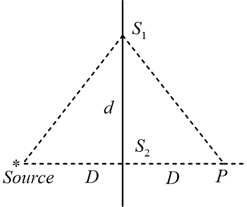
A point light source emits E.M. waves in free space. A detector, placed at a distance of $$L$$ m, measures the intensity as $$I_0$$. The detector is now shifted to another location on the same spherical surface ensuring the angle between original location and new location as 45$$^\circ$$. The measured intensity at new location will be _______.
An electromagnetic wave travelling in x-direction is described by field equation $$E_y = 300 \sin \omega \left(t - \frac{x}{c}\right)$$. If the electron is restricted to move in y-direction only with speed of $$1.5 \times 10^6$$ m/s then ratio of maximum electric and magnetic forces acting on the electron is __________.
The given plane electromagnetic wave is moving along the positive $$x$$-axis.
For such a wave, if the electric field vector is along $$y$$, the magnetic field vector is along $$z$$ and their magnitudes are related by
$$B = \frac{E}{c} \qquad -(1)$$
Maximum value of the electric field from the equation
$$E_y = 300 \sin\!\left[\omega\!\left(t-\frac{x}{c}\right)\right]$$
is
$$E_{\text{max}} = 300 \ \text{V m}^{-1}$$
Therefore, using $$(1)$$, the maximum magnetic field is
$$B_{\text{max}} = \frac{E_{\text{max}}}{c} = \frac{300}{3 \times 10^{8}} = 1 \times 10^{-6} \ \text{T}$$
For an electron (charge $$q = -e$$) moving only along the $$y$$-direction with speed
$$v = 1.5 \times 10^{6}\ \text{m s}^{-1}$$, the forces are
Electric force: $$F_E = q\,E$$ (along $$\pm y$$)
Magnetic force: $$F_B = q\,vB$$ (magnitude only)
Hence the ratio of the maximum magnitudes is
$$\frac{F_{E,\text{max}}}{F_{B,\text{max}}} = \frac{qE_{\text{max}}}{q\,v\,B_{\text{max}}} = \frac{E_{\text{max}}}{v\,\left(E_{\text{max}}/c\right)} = \frac{c}{v}$$
Substituting $$c = 3 \times 10^{8}\ \text{m s}^{-1}$$ and $$v = 1.5 \times 10^{6}\ \text{m s}^{-1}$$:
$$\frac{F_{E,\text{max}}}{F_{B,\text{max}}} = \frac{3 \times 10^{8}}{1.5 \times 10^{6}} = \frac{3}{1.5}\times 10^{2} = 2 \times 10^{2} = 200$$
Therefore, the required ratio is $$200$$.
Option A which is: $$200$$
The ratio of speeds of electromagnetic waves in vacuum and a medium, having dielectric constant $$k = 3$$ and permeability of $$ \mu = 2 \mu_{0}$$, is
($$\mu_{0}$$ = permeability of vacuum)
We need to determine the ratio of the speed of electromagnetic waves in vacuum to that in a medium whose dielectric constant is $$K = 3$$ and permeability is $$\mu = 2\mu_0$$.
First, recall that the speed of an electromagnetic wave in a medium is given by $$v = \frac{1}{\sqrt{\mu \epsilon}}$$, while in vacuum it is $$c = \frac{1}{\sqrt{\mu_0 \epsilon_0}}$$. When the medium has relative permeability $$\mu_r$$ and dielectric constant $$K$$, we have $$\mu = \mu_r \mu_0$$ and $$\epsilon = K \epsilon_0$$.
Next, forming the ratio of these speeds yields $$\frac{c}{v} = \frac{\sqrt{\mu \epsilon}}{\sqrt{\mu_0 \epsilon_0}} = \sqrt{\frac{\mu \epsilon}{\mu_0 \epsilon_0}} = \sqrt{\mu_r \, K}$$. Since $$\mu = 2 \mu_0$$, the relative permeability is $$\mu_r = 2$$.
Substituting the given values gives $$\frac{c}{v} = \sqrt{2 \times 3} = \sqrt{6}$$, so that the speeds are in the ratio $$c : v = \sqrt{6} : 1$$.
The correct answer is Option (2): $$\sqrt{6} : 1$$.
An electromagnetic wave of frequency 100 MHz propagates through a medium of conductivity, $$\sigma$$ = 10mho/m. The ratio of maximum conduction current density to maximum displacement current
density is ___________.
[Take $$\frac{1}{4\pi \epsilon_{0}} = 9 \times 10^{9} Nm^{2}/C^{2}$$]
We need to find the ratio of maximum conduction current density to maximum displacement current density for an electromagnetic wave propagating through a conducting medium.
First, recall the relevant formulas for conduction and displacement current densities. The conduction current density is given by $$J_c = \sigma E$$ (Ohm's law in differential form), where $$\sigma$$ is the conductivity, and the displacement current density is $$J_d = \epsilon_0\frac{\partial E}{\partial t}$$ (from Maxwell's equations).
Next, we determine their maximum values. For an electromagnetic wave with electric field $$E = E_0\sin(\omega t - kx)$$ propagating through a medium, the maximum conduction current density is $$J_{c,max} = \sigma E_0$$. Since $$\frac{\partial E}{\partial t} = \omega E_0\cos(\omega t - kx)$$, the maximum displacement current density is $$J_{d,max} = \epsilon_0 \omega E_0$$.
From these we obtain the ratio of the maximum conduction current density to the maximum displacement current density: $$ \frac{J_{c,max}}{J_{d,max}} = \frac{\sigma E_0}{\epsilon_0 \omega E_0} = \frac{\sigma}{\epsilon_0 \omega} $$.
Now we substitute the given values. The frequency is $$f = 100$$ MHz $$= 10^8$$ Hz and the conductivity is $$\sigma = 10$$ mho/m. The angular frequency is $$\omega = 2\pi f = 2\pi \times 10^8$$ rad/s.
The permittivity of free space follows from the given relation $$\frac{1}{4\pi\epsilon_0} = 9 \times 10^9$$, giving $$\epsilon_0 = \frac{1}{4\pi \times 9 \times 10^9} = \frac{1}{36\pi \times 10^9}$$.
Then we compute $$\epsilon_0 \omega = \frac{1}{36\pi \times 10^9} \times 2\pi \times 10^8 = \frac{2\pi}{36\pi \times 10^9} \times 10^8 = \frac{2}{36 \times 10} = \frac{2}{360} = \frac{1}{180}$$.
Finally, substituting these values into the ratio gives $$ \frac{\sigma}{\epsilon_0 \omega} = \frac{10}{\frac{1}{180}} = 10 \times 180 = 1800 $$, so the ratio of maximum conduction current density to maximum displacement current density is $$\boxed{1800}$$.
The electric field of a plane electromagnetic wave, travelling in an unknown non-magnetic medium is given by,
$$ E_{y}=20 \sin (3\times 10^{6}x - 4.5\times 10^{14}t)V/m $$
(where $$x, t$$ and other values have S.I. units). The dielectric constant of the medium iS_________
(speed oflight in free space is $$ 3\times 10^{8} m/s $$)
The electric field of a plane EM wave in a non-magnetic medium is $$E_y = 20\sin(3 \times 10^6 x - 4.5 \times 10^{14} t)$$ V/m. Find the dielectric constant.
The wave number is $$k = 3 \times 10^6$$ rad/m and the angular frequency is $$\omega = 4.5 \times 10^{14}$$ rad/s.
The phase velocity in the medium is $$v = \frac{\omega}{k} = \frac{4.5 \times 10^{14}}{3 \times 10^6} = 1.5 \times 10^8$$ m/s.
The refractive index is $$n = \frac{c}{v} = \frac{3 \times 10^8}{1.5 \times 10^8} = 2$$.
For a non-magnetic medium ($$\mu_r = 1$$), we have $$n = \sqrt{\epsilon_r}$$, so $$\epsilon_r = n^2 = 4$$.
The answer is 4.
The equation of the electric field of an electromagnetic wave propagating through free space is given
by: E=$$\sqrt{377}$$ $$\sin(6.27\times10^{3}t-2.09\times 10^{-5}x)N/C$$
The average power of the electromagnetic wave is $$\left(\frac{1}{\alpha}\right)W/m^{2}$$. The value of $$\alpha$$ is______
$$\left(Take \sqrt{\frac{\mu_{\circ}}{\epsilon_{\circ}}}=377 in SI units \right)$$
We are given the electric field $$E = \sqrt{377} \sin(6.27 \times 10^3 t - 2.09 \times 10^{-5} x)$$ N/C and must determine $$\alpha$$ such that the time‐averaged power density equals $$\frac{1}{\alpha}$$ W/m$$^2$$.
For a plane electromagnetic wave, the instantaneous power per unit area is described by the Poynting vector, and its time‐averaged value (or intensity) is
$$ \langle S \rangle = \frac{E_0^2}{2Z_0} $$
In this expression, $$E_0$$ denotes the amplitude of the electric field, while $$Z_0 = \sqrt{\mu_0/\epsilon_0}$$ represents the intrinsic impedance of free space. The factor of $$\tfrac{1}{2}$$ arises because $$\langle \sin^2(\omega t)\rangle = \tfrac{1}{2}$$ over a full cycle.
From the given wave, one reads off the amplitude $$E_0 = \sqrt{377}$$ N/C, and since $$Z_0 = \sqrt{\mu_0/\epsilon_0}$$ takes the value $$377\ \Omega$$ in SI units, substitution yields
$$ \langle S \rangle = \frac{E_0^2}{2Z_0} = \frac{(\sqrt{377})^2}{2 \times 377} = \frac{377}{2 \times 377} = \frac{1}{2} \text{ W/m}^2 $$
Because this result must equal $$\frac{1}{\alpha}$$, we set $$\frac{1}{\alpha} = \frac{1}{2}$$, which leads directly to $$\alpha = 2$$.
The answer is 2.
A transverse wave on a string is described by $$y = 3\sin(36t + 0.018x + \pi/4)$$, where $$x$$, $$y$$ are in cm and $$t$$ in seconds. The least distance between the two successive crests in the wave is _______ cm. (Nearest integer) ($$\pi = 3.14$$)
Given wave:
$$y=3\sin(36t+0.018x+\pi/4)$$
Compare with standard form:
$$y=A\sin(ωt\pm kx+φ)$$
So,
k = 0.018 rad/cm
Distance between two successive crests = wavelength:
$$\lambda=\frac{2\pi}{k}$$
$$\lambda=\frac{2\times3.14}{0.018}=\frac{6.28}{0.018}$$
$$\lambda\approx348.9\text{ cm}$$
$$\lambda\approx349$$
The unit of $$\sqrt{\frac{2I}{\epsilon_0 c}}$$ is : (I = intensity of an electromagnetic wave, c : speed of light)
The intensity of a plane electromagnetic wave is related to the peak electric-field amplitude $$E_0$$ by
$$I = \frac{1}{2}\,\epsilon_0\,c\,E_0^{2}$$ $$-(1)$$
Solving $$-(1)$$ for $$E_0$$ gives
$$E_0 = \sqrt{\frac{2I}{\epsilon_0 c}}$$ $$-(2)$$
Thus the expression whose unit we must find is simply the unit of the electric field $$E_0$$.
Unit analysis:
Intensity $$I$$ : power per area $$\Rightarrow$$ $$\text{W m}^{-2} = \left(\text{J s}^{-1}\right)\text{m}^{-2} = \text{kg s}^{-3}$$
Permittivity $$\epsilon_0$$ : $$\text{C}^{2}\,\text{N}^{-1}\,\text{m}^{-2}$$ Force $$\text{N}= \text{kg m s}^{-2}$$ $$\therefore \epsilon_0 = \frac{\text{C}^{2}}{\text{kg m s}^{-2}\,\text{m}^{2}} = \frac{\text{C}^{2}\,\text{s}^{2}}{\text{kg m}^{3}}$$
Speed of light $$c$$ : $$\text{m s}^{-1}$$
Compute the unit of $$\dfrac{2I}{\epsilon_0 c}$$ :
$$ \dfrac{\text{kg s}^{-3}} {\left(\dfrac{\text{C}^{2}\,\text{s}^{2}}{\text{kg m}^{3}}\right)\;(\text{m s}^{-1})} = \dfrac{\text{kg s}^{-3} \;\text{kg m}^{3}} {\text{C}^{2}\,\text{s}^{2}\;\text{m}} = \dfrac{\text{kg}^{2}\,\text{m}^{2}\,\text{s}^{-4}}{\text{C}^{2}} $$
Taking the square root (see $$-(2)$$) gives the unit of $$E_0$$:
$$ \sqrt{\dfrac{\text{kg}^{2}\,\text{m}^{2}\,\text{s}^{-4}}{\text{C}^{2}}} = \dfrac{\text{kg m s}^{-2}}{\text{C}} = \dfrac{\text{N}}{\text{C}} $$
Hence $$\sqrt{\dfrac{2I}{\epsilon_0 c}}$$ has the SI unit $$\mathbf{N\,C^{-1}}$$, which is also equal to $$\mathbf{V\,m^{-1}}$$.
Answer : Option D $$NC^{-1}$$
The radiation pressure exerted by a 450 W light source on a perfectly reflecting surface placed at 2m away from it, is :
The source emits light equally in all directions, so the energy spreads over the surface of a sphere of radius $$r$$.
Energy flux (intensity) at distance $$r$$ is given by the inverse-square law:
$$I = \frac{P}{4 \pi r^{2}}$$ where $$P$$ is the power of the source.
Substitute $$P = 450 \text{ W}$$ and $$r = 2 \text{ m}$$:
$$I = \frac{450}{4 \pi (2)^{2}} = \frac{450}{16 \pi}$$ W m$$^{-2}$$.
Numerical value:
$$I = \frac{450}{50.265} \approx 8.96 \text{ W m}^{-2}$$.
For a perfectly reflecting surface, radiation pressure is twice that for a perfectly absorbing surface. The formula is
$$P_{\text{rad}} = \frac{2I}{c}$$ where $$c = 3 \times 10^{8} \text{ m s}^{-1}$$.
Insert the value of $$I$$:
$$P_{\text{rad}} = \frac{2 \times 8.96}{3 \times 10^{8}}$$ Pa
$$= \frac{17.92}{3 \times 10^{8}} \text{ Pa}$$.
Simplify:
$$P_{\text{rad}} \approx 5.97 \times 10^{-8} \text{ Pa} \approx 6 \times 10^{-8} \text{ Pa}$$.
Therefore, the radiation pressure on the perfectly reflecting surface is $$6 \times 10^{-8}$$ Pascals.
Correct option: Option C.
Given below are two statements : one is labelled as Assertion (A) and the other is labelled as Reason (R). Assertion (A) : Electromagnetic waves carry energy but not momentum. Reason (R): Mass of a photon is zero. In the light of the above statements, choose the most appropriate answer from the options given below :
We need to evaluate the Assertion and Reason about electromagnetic waves.
Assertion (A): "Electromagnetic waves carry energy but not momentum."
Analysis: This is FALSE. Electromagnetic waves carry both energy and momentum. The momentum of an electromagnetic wave is related to its energy by $$p = E/c$$, where $$c$$ is the speed of light. This momentum is responsible for radiation pressure. Experiments such as Nichols radiometer have confirmed that light exerts pressure on surfaces, proving that EM waves carry momentum.
Reason (R): "Mass of a photon is zero."
Analysis: This is TRUE. A photon has zero rest mass. However, it still carries momentum given by $$p = h/\lambda = E/c$$, as described by the relativistic energy-momentum relation $$E^2 = (pc)^2 + (m_0 c^2)^2$$. With $$m_0 = 0$$, this gives $$E = pc$$, confirming that massless photons can carry momentum.
Note: Even though R is true, it does not explain A (which is false). The zero rest mass of a photon does not mean EM waves lack momentum -- in fact, photons carry momentum despite having zero rest mass.
The correct answer is Option 3: (A) is false but (R) is true.
In an electromagnetic system, the quantity representing the ratio of electric flux and magnetic flux has dimension of $$M^P L^Q T^R A^S$$, where value of 'Q' and 'R' are
The required physical quantity is the ratio of electric flux $$\Phi_E$$ to magnetic flux $$\Phi_B$$. We must find the dimensions of each flux, then divide them.
Electric flux
Electric field $$E$$ is force per unit charge.
Force has dimensions $$MLT^{-2}$$, and charge has dimensions $$AT$$. Therefore,
$$E : \; \frac{MLT^{-2}}{AT}=MLT^{-3}A^{-1}$$
Electric flux is $$\Phi_E = E \times \text{area}$$, and area has dimension $$L^{2}$$. Thus
$$\Phi_E : \; (MLT^{-3}A^{-1})(L^{2}) = ML^{3}T^{-3}A^{-1}$$
Magnetic flux
Magnetic induction $$B$$ is obtained from $$F = qvB$$, giving $$B = F/(qv)$$.
$$B : \; \frac{MLT^{-2}}{(AT)(LT^{-1})}=MT^{-2}A^{-1}$$
Magnetic flux is $$\Phi_B = B \times \text{area}$$, so
$$\Phi_B : \; (MT^{-2}A^{-1})(L^{2}) = ML^{2}T^{-2}A^{-1}$$
Ratio of the two fluxes
$$\frac{\Phi_E}{\Phi_B} : \; \frac{ML^{3}T^{-3}A^{-1}}{ML^{2}T^{-2}A^{-1}}
= L^{3-2}\,T^{-3-(-2)}\,A^{-1-(-1)} = L^{1}T^{-1}$$
Hence the dimensional formula is $$M^{0}L^{1}T^{-1}A^{0}$$, giving
$$P = 0,\; Q = 1,\; R = -1,\; S = 0$$
Therefore, $$Q = 1$$ and $$R = -1$$, which corresponds to Option D.
The electric field of an electromagnetic wave in free space is
$$\vec{E} = 57 \cos \left[ 7.5 \times 10^{6} t - 5 \times 10^{-3} (3x + 4y) \right] (4\hat{i} - 3\hat{j}) N / C$$. The associated magnetic field in Tesla is
We are given the electric field $$ \vec{E} = 57 \cos\left[7.5 \times 10^{6}t - 5 \times 10^{-3}(3x + 4y)\right](4\hat{i} - 3\hat{j}) \text{ N/C} $$. The direction of propagation is along the wave vector $$\vec{k}$$, which from the phase is $$ \hat{k} = \frac{3\hat{i} + 4\hat{j}}{5} $$. Since the direction of $$\vec{E}$$ is along $$(4\hat{i} - 3\hat{j})$$, we verify that it is perpendicular to $$\hat{k}$$ by computing $$(3\hat{i} + 4\hat{j}) \cdot (4\hat{i} - 3\hat{j}) = 12 - 12 = 0$$, confirming orthogonality.
For an electromagnetic wave, the magnetic field $$\vec{B}$$ is given by $$ \vec{B} = \frac{\hat{k} \times \vec{E}}{c} $$. Now we compute the cross product:
$$ \hat{k} \times (4\hat{i} - 3\hat{j}) = \frac{1}{5}(3\hat{i} + 4\hat{j}) \times (4\hat{i} - 3\hat{j}) = \frac{1}{5}\left[3(-3)(\hat{i} \times \hat{j}) + 4(4)(\hat{j} \times \hat{i})\right] = \frac{1}{5}\left[-9\hat{k} - 16\hat{k}\right] = \frac{-25\hat{k}}{5} = -5\hat{k}. $$
Substituting back into the expression for $$\vec{B}$$ gives $$ \vec{B} = \frac{57}{c} \cos\left[7.5 \times 10^{6}t - 5 \times 10^{-3}(3x + 4y)\right](-5\hat{k}) $$. Therefore, using $$c = 3 \times 10^{8}\text{ m/s}$$, we have $$\vec{B} = -\frac{57}{3 \times 10^{8}} \cos\left[7.5 \times 10^{6}t - 5 \times 10^{-3}(3x + 4y)\right](5\hat{k})$$ T $$.$$
The correct answer is Option 3.
A plane electromagnetic wave of frequency 20 MHz travels in free space along the +x direction. At a particular point in space and time, the electric field vector of the wave is $$E_{y}=9.3Vm^{-1}$$. Then, the magnetic field vector of the wave at that point is
A plane EM wave with $$E_y = 9.3$$ V/m travels along +x direction. Find the magnetic field.
Relate E and B:
For an EM wave: $$B = \frac{E}{c}$$
$$B = \frac{9.3}{3 \times 10^8} = 3.1 \times 10^{-8} \text{ T}$$
Determine direction:
The wave travels along +x, E is along +y. By $$\vec{E} \times \vec{B} \parallel \vec{k}$$ (direction of propagation):
$$\hat{j} \times \hat{k} = \hat{i}$$, so B is along +z.
$$B_z = 3.1 \times 10^{-8}$$ T
The correct answer is Option 2: $$B_z = 3.1 \times 10^{-8}$$ T.
Due to presence of an em-wave whose electric component is given by $$E = 100\sin(\omega t - kx)NC^{-1}$$, a cylinder of length 200 cm holds certain amount of em-energy inside it. If another cylinder of same length but half diameter than previous one holds same amount of em-energy, the magnitude of the electric field of the corresponding em-wave should be modified as
We are given an EM wave with electric field $$E = 100\sin(\omega t - kx)$$ NC$$^{-1}$$ inside a cylinder of length 200 cm. A second cylinder has the same length but half the diameter, and must hold the same amount of EM energy.
The average energy density of an EM wave is proportional to $$E_0^2$$:
$$u = \frac{1}{2}\epsilon_0 E_0^2$$
Total energy stored in a cylinder of volume $$V$$ is: $$U = u \times V = \frac{1}{2}\epsilon_0 E_0^2 \times V$$
For a cylinder with diameter $$d$$ and length $$L$$: $$V = \frac{\pi d^2}{4} \cdot L$$. The second cylinder has half the diameter, so its cross-sectional area is $$(1/2)^2 = 1/4$$ of the first, giving $$V_2 = \frac{V_1}{4}$$.
Equating the energies, $$\frac{1}{2}\epsilon_0 E_1^2 V_1 = \frac{1}{2}\epsilon_0 E_2^2 V_2$$ implies $$E_1^2 V_1 = E_2^2 \cdot \frac{V_1}{4}$$, so $$E_2^2 = 4E_1^2$$ and hence $$E_2 = 2E_1 = 2 \times 100 = 200 \text{ NC}^{-1}$$.
The modified electric field is $$E = 200\sin(\omega t - kx)$$ NC$$^{-1}$$.
The correct answer is Option B) $$200\sin(\omega t - kx)$$ NC$$^{-1}$$
The magnetic field of an E.M. wave is given by $$\vec{B} = \left(\frac{\sqrt{3}}{2}\,\hat{i} + \frac{1}{2}\,\hat{j}\right) 30 \sin\left[\omega \left(t - \frac{z}{c}\right)\right] \; \text{(S.I. Units)}.$$ corresponding electric field in S.I. units is :
We have magnetic field $$\vec{B} = \Bigl(\frac{\sqrt{3}}{2}\hat{i} + \frac{1}{2}\hat{j}\Bigr)30\sin\!\left[\omega\Bigl(t - \frac{z}{c}\Bigr)\right].$$
For an electromagnetic wave propagating along +z, vectors $$\vec{E}$$, $$\vec{B}$$, $$\hat{k}$$ are mutually perpendicular and satisfy the right hand rule $$\vec{E}\times\vec{B}=+\hat{k}$$ (1), and their magnitudes satisfy $$|\vec{E}|=c\,|\vec{B}|$$ (2). Let $$\vec{E} = (E_x\hat{i}+E_y\hat{j})\sin\!\left[\omega\Bigl(t - \frac{z}{c}\Bigr)\right].$$
The orthogonality condition $$\vec{E}\cdot\vec{B}=0$$ gives
$$\Bigl(\frac{\sqrt{3}}{2}E_x + \frac{1}{2}E_y\Bigr)30 = 0\,, $$
which simplifies to $$\frac{\sqrt{3}}{2}E_x + \frac{1}{2}E_y = 0\,$$ (3), so $$E_y = -\sqrt{3}\,E_x.$$
Using the magnitude relation (2) gives
$$E_x^2 + E_y^2 = (30c)^2$$
and substituting $$E_y = -\sqrt{3}E_x$$ yields
$$4E_x^2 = 900c^2\,, $$ so $$E_x^2 = 225c^2$$ and $$E_x = \pm15c,\quad E_y = \mp15\sqrt{3}\,c$$ (4).
The right hand rule (1) requires the z‐component of $$\vec{E}\times\vec{B}$$ to be positive, which gives
$$E_x\Bigl(\frac{30}{2}\Bigr) - E_y\Bigl(\frac{30\sqrt{3}}{2}\Bigr) > 0.$$
Substituting $$E_x = 15c,\;E_y = -15\sqrt{3}c$$ yields a positive value, so these signs are chosen.
Therefore the electric field is
$$\vec{E} = \Bigl(\tfrac{1}{2}\hat{i} - \tfrac{\sqrt{3}}{2}\hat{j}\Bigr)\,30c\;\sin\!\left[\omega\Bigl(t - \frac{z}{c}\Bigr)\right].$$
This matches Option A.
Arrange the following in the ascending order of wavelength $$ (\lambda) $$ : (A) Microwaves $$ (\lambda_1) $$(B) Ultraviolet rays $$ (\lambda_2) $$ (C) Infrared rays $$ (\lambda_3) $$ (D) X-rays $$ (\lambda_4) $$ Choose the most appropriate answer from the options given below
We need to arrange the electromagnetic waves in ascending order of wavelength.
Recall the wavelength ranges:
(A) Microwaves $$(\lambda_1)$$: wavelength $$\sim 1 \text{ mm to } 30 \text{ cm}$$
(B) Ultraviolet rays $$(\lambda_2)$$: wavelength $$\sim 10\text{ nm to } 400\text{ nm}$$
(C) Infrared rays $$(\lambda_3)$$: wavelength $$\sim 700\text{ nm to } 1\text{ mm}$$
(D) X-rays $$(\lambda_4)$$: wavelength $$\sim 0.01\text{ nm to } 10\text{ nm}$$
Ascending order of wavelength:
X-rays have the shortest wavelength, followed by UV rays, then infrared rays, and microwaves have the longest.
$$\lambda_4 \text{ (X-rays)} < \lambda_2 \text{ (UV)} < \lambda_3 \text{ (IR)} < \lambda_1 \text{ (Microwaves)}$$
The correct answer is Option D: $$\lambda_4 < \lambda_2 < \lambda_3 < \lambda_1$$.
If $$\mu_0$$ and $$\varepsilon_0$$ are the permeability and permittivity of free space, respectively, then the dimension of $$\left(\frac{1}{\mu_0 \varepsilon_0}\right)$$ is :
The permeability of free space is denoted by $$\mu_0$$ and the permittivity of free space by $$\varepsilon_0$$.
Electromagnetic‐wave theory gives the relation between the speed of light $$c$$ and these two constants:
$$c \;=\;\frac{1}{\sqrt{\mu_0\,\varepsilon_0}} \quad -(1)$$
Square both sides of $$(1)$$ to obtain
$$c^{2} \;=\;\frac{1}{\mu_0\,\varepsilon_0} \quad -(2)$$
The dimensions of speed are $$[c] = L\,T^{-1}$$. Squaring this,
$$[c^{2}] = (L\,T^{-1})^{2} = L^{2}\,T^{-2} \quad -(3)$$
From $$(2)$$, $$\dfrac{1}{\mu_0\,\varepsilon_0}$$ has the same dimensions as $$c^{2}$$. Therefore,
$$\left[\frac{1}{\mu_0\,\varepsilon_0}\right] = L^{2}\,T^{-2}$$
Hence, the correct option is Option B $$\big(L^{2}\,T^{-2}\big)$$.
In an electromagnetic system, a quantity defined as the ratio of electric dipole moment and magnetic dipole moment has dimension of $$[M^P L^Q T^R A^S]$$. The value of P and Q are :
For any physical quantity we can express its dimension in the form $$[M^{P} L^{Q} T^{R} A^{S}]$$, where $$M$$ stands for mass, $$L$$ for length, $$T$$ for time and $$A$$ for electric current.
Electric dipole moment
Definition : $$p_{e}=q\,d$$, where $$q$$ is charge and $$d$$ is the separation between the charges.
Dimension of charge : $$[q]=[A\,T]$$ (current × time).
Therefore
$$[p_{e}] = [A\,T]\,[L] = [M^{0} L^{1} T^{1} A^{1}]$$
Magnetic dipole moment
For a current loop, $$m_{m}=I\,A_{\text{loop}}$$, where $$I$$ is current and $$A_{\text{loop}}$$ is the area of the loop.
Area has dimension $$[L^{2}]$$, hence
$$[m_{m}] = [A]\,[L^{2}] = [M^{0} L^{2} T^{0} A^{1}]$$
Required ratio
$$\frac{p_{e}}{m_{m}}$$ has dimension
$$\frac{[M^{0} L^{1} T^{1} A^{1}]}{[M^{0} L^{2} T^{0} A^{1}]}$$
= $$[M^{0} L^{1-2} T^{1-0} A^{1-1}]$$
= $$[M^{0} L^{-1} T^{1} A^{0}]$$.
Comparing with $$[M^{P} L^{Q} T^{R} A^{S}]$$:
$$P=0,\; Q=-1,\; R=1,\; S=0$$.
Hence the values of $$P$$ and $$Q$$ are 0 and −1 respectively, which corresponds to Option D.
A parallel plate capacitor of area $$A=16 cm^{2}$$ and separation between the plates 10 cm , is charged by a DC current. Consider a hypothetical plane surface of area $$A_{\circ}=3.2 cm^{2}$$ inside the capacitor and parallel to the plates. At an instant, the current through the circuit is 6A. At the same instant the displacement current through $$A_{\circ}$$ is ________ mA
The displacement current $$I_d$$ through a surface is given by $$I_d = \epsilon_0 \frac{d\Phi_E}{dt}$$, where $$\Phi_E$$ is the electric flux through the surface.
For a parallel plate capacitor, the electric field $$E$$ between the plates is uniform. The electric field is $$E = \frac{\sigma}{\epsilon_0} = \frac{Q}{\epsilon_0 A}$$, where $$Q$$ is the charge on the plates and $$A$$ is the plate area.
The electric flux through the hypothetical surface of area $$A_0$$ (parallel to the plates and perpendicular to the electric field) is $$\Phi_E = E \cdot A_0$$. Substituting the expression for $$E$$:
$$\Phi_E = \left( \frac{Q}{\epsilon_0 A} \right) A_0$$
Now, the displacement current through $$A_0$$ is:
$$I_d = \epsilon_0 \frac{d}{dt} \left( \frac{Q}{\epsilon_0 A} A_0 \right) = \epsilon_0 \cdot \frac{A_0}{A} \cdot \frac{1}{\epsilon_0} \frac{dQ}{dt} = \frac{A_0}{A} \frac{dQ}{dt}$$
The rate of change of charge $$\frac{dQ}{dt}$$ is the conduction current $$I_c$$ in the circuit. Therefore:
$$I_d = \frac{A_0}{A} I_c$$
Given:
- Plate area $$A = 16 \text{cm}^2 = 16 \times 10^{-4} \text{m}^2$$
- Hypothetical surface area $$A_0 = 3.2 \text{cm}^2 = 3.2 \times 10^{-4} \text{m}^2$$
- Conduction current $$I_c = 6 \text{A}$$
Substitute the values:
$$I_d = \left( \frac{3.2 \times 10^{-4}}{16 \times 10^{-4}} \right) \times 6 = \frac{3.2}{16} \times 6$$
Simplify the fraction:
$$\frac{3.2}{16} = \frac{32}{160} = \frac{2}{10} = 0.2$$
So:
$$I_d = 0.2 \times 6 = 1.2 \text{A}$$
Convert to milliamperes (1 A = 1000 mA):
$$I_d = 1.2 \times 1000 = 1200 \text{mA}$$
The displacement current through $$A_0$$ is 1200 mA.
If an optical medium possesses a relative permeability of $$\frac{10}{\pi}$$ and relative permittivity of $$\frac{1}{0.0885}$$, then the velocity of light is greater in vacuum than that in this medium by ______ times.
$$(\mu_{\circ}=4\pi \times 10^{-7} H/m, \in_{\circ} = 8.85 \times 10^{-12} F/m, c = 3 \times 10^{8} m/s)$$
The speed of an electromagnetic wave in any medium is
$$v = \frac{1}{\sqrt{\mu \, \varepsilon}}$$
where $$\mu = \mu_r \mu_0$$ and $$\varepsilon = \varepsilon_r \varepsilon_0$$. Putting these into the expression, the speed in the medium becomes
$$v = \frac{1}{\sqrt{\mu_r \mu_0 \, \varepsilon_r \varepsilon_0}} = \frac{1}{\sqrt{\mu_r \varepsilon_r}\;\sqrt{\mu_0 \varepsilon_0}} = \frac{c}{\sqrt{\mu_r \varepsilon_r}}$$
Here $$c = \dfrac{1}{\sqrt{\mu_0 \varepsilon_0}}$$ is the speed of light in vacuum. Therefore the factor by which light travels faster in vacuum than in the given medium is
$$\frac{c}{v} = \sqrt{\mu_r \varepsilon_r}$$
The medium has
$$\mu_r = \frac{10}{\pi}, \qquad \varepsilon_r = \frac{1}{0.0885}$$
First find the product $$\mu_r \varepsilon_r$$:
$$\mu_r \varepsilon_r = \frac{10}{\pi}\;\times\;\frac{1}{0.0885} = \frac{10}{\pi \times 0.0885}$$
Using $$\pi \approx 3.1416$$:
$$\pi \times 0.0885 \approx 3.1416 \times 0.0885 = 0.2780$$
Hence
$$\mu_r \varepsilon_r \approx \frac{10}{0.2780} \approx 35.96$$
Now take the square root:
$$\sqrt{35.96} \approx 5.996 \approx 6$$
Thus
$$\frac{c}{v} \approx 6$$
Therefore, the velocity of light in vacuum is greater than that in this medium by 6 times.
A parallel plate capacitor has a capacitance $$C = 200$$ pF. It is connected to $$230$$ V ac supply with an angular frequency $$300$$ rad s$$^{-1}$$. The rms value of conduction current in the circuit and displacement current in the capacitor respectively are :
The problem asks to find the rms values of conduction and displacement currents for a capacitor connected to an AC supply.
For a pure capacitor in an AC circuit, the rms conduction current is given by $$I_{\text{rms}} = \omega C V_{\text{rms}}$$.
Substituting the values $$\omega = 300$$ rad/s, $$C = 200\text{ pF} = 200\times10^{-12}\text{ F}$$, and $$V_{\text{rms}} = 230$$ V into this expression yields
$$I_{\text{rms}} = 300 \times 200 \times 10^{-12} \times 230$$
$$ = 300 \times 200 \times 230 \times 10^{-12} = 13{,}800{,}000 \times 10^{-12} = 13.8 \times 10^{-6}\text{ A} = 13.8\ \mu\text{A}$$
According to Maxwell's equations, the displacement current in a capacitor equals the conduction current in the external circuit because the changing electric field between the plates creates a displacement current $$I_d = \epsilon_0 \frac{d\Phi_E}{dt}$$ that exactly matches the conduction current, ensuring continuity of current in the circuit.
Therefore, the rms displacement current in the capacitor is also $$13.8\ \mu\text{A}$$.
The correct answer is Option D: 13.8 $$\mu$$A and 13.8 $$\mu$$A.
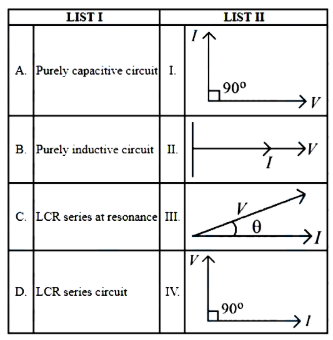
Match List I with List II:

Choose the correct answer from the options given below:
A plane electromagnetic wave of frequency $$35$$ MHz travels in free space along the $$X$$-direction. At a particular point (in space and time) $$\vec{E} = 9.6\hat{j}$$ V m$$^{-1}$$. The value of magnetic field at this point is:
For a plane electromagnetic wave travelling in free space, the electric field and magnetic field are related by: $$B = \frac{E}{c}$$, where $$c = 3 \times 10^8$$ m/s is the speed of light.
Given: $$\vec{E} = 9.6\hat{j}$$ V/m. So $$E = 9.6$$ V/m.
Substituting into the formula:
$$B = \frac{9.6}{3 \times 10^8} = 3.2 \times 10^{-8}$$ T
Now we need to find the direction of $$\vec{B}$$. For an EM wave, the direction of propagation is along $$\vec{E} \times \vec{B}$$.
The wave travels along the $$x$$-direction, so $$\vec{E} \times \vec{B}$$ must be along $$\hat{i}$$.
Since $$\vec{E}$$ is along $$\hat{j}$$, we need $$\vec{B}$$ along $$\hat{k}$$, because $$\hat{j} \times \hat{k} = \hat{i}$$.
Therefore, $$\vec{B} = 3.2 \times 10^{-8}\hat{k}$$ T, which is Option (1).
A plane electromagnetic wave propagating in $$x$$-direction is described by $$E_y = (200 \text{ V m}^{-1}) \sin[1.5 \times 10^7 t - 0.05x]$$. The intensity of the wave is : (Use $$\epsilon_0 = 8.85 \times 10^{-12} \text{ C}^2 \text{ N}^{-1} \text{ m}^{-2}$$)
The intensity of an electromagnetic wave is:
$$I = \frac{1}{2}\epsilon_0 c E_0^2$$
where $$E_0 = 200$$ V/m is the amplitude of the electric field and $$c = 3 \times 10^8$$ m/s.
$$I = \frac{1}{2} \times 8.85 \times 10^{-12} \times 3 \times 10^8 \times (200)^2$$
$$= \frac{1}{2} \times 8.85 \times 10^{-12} \times 3 \times 10^8 \times 4 \times 10^4$$
$$= \frac{1}{2} \times 8.85 \times 3 \times 4 \times 10^{-12+8+4}$$
$$= \frac{1}{2} \times 106.2 \times 10^0$$
$$= 53.1 \text{ W m}^{-2}$$
The answer is $$53.1 \text{ W m}^{-2}$$, which corresponds to Option (2).
A plane EM wave is propagating along $$x$$ direction. It has a wavelength of $$4$$ mm. If electric field is in $$y$$ direction with the maximum magnitude of $$60$$ Vm$$^{-1}$$, the equation for magnetic field is :
An EM wave propagating along x-direction with electric field in y-direction.
$$\lambda = 4$$ mm = $$4 \times 10^{-3}$$ m, $$E_0 = 60$$ V/m.
The magnetic field is perpendicular to both propagation direction (x) and electric field (y), so it is along the z-direction.
Magnitude of magnetic field: $$B_0 = \frac{E_0}{c} = \frac{60}{3 \times 10^8} = 2 \times 10^{-7}$$ T.
Wave number: $$k = \frac{2\pi}{\lambda} = \frac{2\pi}{4 \times 10^{-3}} = \frac{\pi}{2} \times 10^3$$ m$$^{-1}$$.
The magnetic field equation is:
$$B_z = 2 \times 10^{-7} \sin\left[\frac{\pi}{2} \times 10^3(x - 3 \times 10^8 t)\right] \hat{k} \text{ T}$$
The correct answer is Option 1.
An object is placed in a medium of refractive index 3. An electromagnetic wave of intensity $$6 \times 10^8$$ W m$$^{-2}$$ falls normally on the object and it is absorbed completely. The radiation pressure on the object would be (speed of light in free space = $$3 \times 10^8$$ m s$$^{-1}$$) :
Arrange the following in the ascending order of wavelength: A. Gamma rays $$(\lambda_1)$$, B. x-rays $$(\lambda_2)$$, C. Infrared waves $$(\lambda_3)$$, D. Microwaves $$(\lambda_4)$$. Choose the most appropriate answer from the options given below:
Electromagnetic waves are arranged according to frequency (or energy) and, inversely, according to wavelength $$\lambda$$ using the relation $$c = \nu \lambda$$, where $$c$$ is the speed of light and $$\nu$$ is the frequency.
Higher frequency $$\Rightarrow$$ lower wavelength, and lower frequency $$\Rightarrow$$ higher wavelength.
Typical order from the highest frequency (smallest $$\lambda$$) to the lowest frequency (largest $$\lambda$$) is:
$$\text{Gamma rays} \;(\gamma) \; \lt\; \text{X-rays} \;\lt\; \text{Ultraviolet} \;\lt\; \text{Visible} \;\lt\; \text{Infrared} \;\lt\; \text{Microwaves} \;\lt\; \text{Radio waves}$$
Using only the given categories:
$$\lambda_1\;(\text{Gamma rays}) \; \lt \; \lambda_2\;(\text{X-rays}) \; \lt \; \lambda_3\;(\text{Infrared}) \; \lt \; \lambda_4\;(\text{Microwaves})$$
Hence, the ascending (increasing) order of wavelength is
$$\lambda_1 \lt \lambda_2 \lt \lambda_3 \lt \lambda_4$$
This corresponds to Option C.
Given below are two statements:
Statement I: Electromagnetic waves carry energy as they travel through space and this energy is equally shared by the electric and magnetic fields.
Statement II: When electromagnetic waves strike a surface, a pressure is exerted on the surface.
In the light of the above statements, choose the most appropriate answer from the options given below:
We need to evaluate two statements about electromagnetic waves.
Analysis of Statement I: "Electromagnetic waves carry energy as they travel through space and this energy is equally shared by the electric and magnetic fields."
An electromagnetic wave has energy density given by:
$$u = \frac{1}{2}\epsilon_0 E^2 + \frac{B^2}{2\mu_0}$$
For an EM wave, the relationship $$E = cB$$ holds, where $$c = 1/\sqrt{\mu_0 \epsilon_0}$$. Substituting:
$$\frac{1}{2}\epsilon_0 E^2 = \frac{1}{2}\epsilon_0 c^2 B^2 = \frac{B^2}{2\mu_0}$$
This shows that the electric field energy density equals the magnetic field energy density. The energy is indeed equally shared between the two fields. Statement I is CORRECT.
Analysis of Statement II: "When electromagnetic waves strike a surface, a pressure is exerted on the surface."
Electromagnetic waves carry momentum $$p = E/c$$ (where $$E$$ is energy). When they strike a surface, they transfer momentum, exerting radiation pressure. For a perfectly absorbing surface, the radiation pressure is $$P = I/c$$, where $$I$$ is the intensity. For a perfectly reflecting surface, $$P = 2I/c$$. Statement II is CORRECT.
The correct answer is Option 2: Both Statement I and Statement II are correct.
If the total energy transferred to a surface in time $$t$$ is $$6.48 \times 10^5$$ J, then the magnitude of the total momentum delivered to this surface for complete absorption will be:
Match List-I with List-II :
If frequency of electromagnetic wave is 60 MHz and it travels in air along z direction then the corresponding electric and magnetic field vectors will be mutually perpendicular to each other and the wavelength of the wave in m is:
Find the wavelength of an electromagnetic wave with frequency 60 MHz.
The relationship between speed (c), frequency (f), and wavelength (λ) is given by $$ c = f \times λ \implies λ = \frac{c}{f} $$.
Substituting the speed of light in vacuum c = 3 \times 10^8 m/s and converting the frequency f = 60 MHz = 60 \times 10^6 Hz = 6 \times 10^7 Hz into the formula yields:
$$ λ = \frac{3 \times 10^8}{6 \times 10^7} = \frac{3}{6} \times 10^{8-7} = 0.5 \times 10 = 5 \text{ m} $$.
The correct answer is Option C: 5 m.
In a plane EM wave, the electric field oscillates sinusoidally at a frequency of $$5 \times 10^{10}$$ Hz and an amplitude of $$50 \text{ V m}^{-1}$$. The total average energy density of the electromagnetic field of the wave is : [Use $$\varepsilon_0 = 8.85 \times 10^{-12} \text{ C}^2 \text{N}^{-1}\text{m}^{-2}$$]
The electric field of an electromagnetic wave in free space is represented as $$\vec{E} = E_0 \cos(\omega t - kz)\hat{i}$$. The corresponding magnetic induction vector will be :
For an electromagnetic wave, the relationship between the electric field and the magnetic field is governed by the following principles:
1. The magnitudes are related by: $$B_0 = \frac{E_0}{c}$$, where $$c$$ is the speed of light.
2. The direction of propagation is along $$\vec{E} \times \vec{B}$$.
3. Both fields have the same phase and propagation direction.
Given: $$\vec{E} = E_0 \cos(\omega t - kz)\hat{i}$$
The wave propagates in the $$+z$$ direction (from the $$-kz$$ term).
Since $$\hat{i} \times \hat{j} = \hat{k}$$ (the direction of propagation), the magnetic field must be along $$\hat{j}$$.
The magnitude of the magnetic field amplitude is $$\frac{E_0}{c}$$, and it has the same phase $$(\omega t - kz)$$.
Therefore:
$$\vec{B} = \frac{E_0}{c} \cos(\omega t - kz)\hat{j}$$
The correct answer is $$\vec{B} = \frac{E_0}{C} \cos(\omega t - kz)\hat{j}$$.
Average force exerted on a non-reflecting surface at normal incidence is $$2.4 \times 10^{-4} \text{ N}$$. If $$360 \text{ W/cm}^2$$ is the light energy flux during span of 1 hour 30 minutes, Then the area of the surface is:
Find the area of a non-reflecting surface given the radiation force and intensity.
For a perfectly absorbing (non-reflecting) surface, the radiation pressure is:
$$P_{\text{rad}} = \frac{I}{c}$$
where $$I$$ is the intensity (power per unit area) and $$c = 3 \times 10^8$$ m/s is the speed of light.
The force on the surface is: $$F = P_{\text{rad}} \times A = \frac{I \times A}{c}$$.
$$I = 360$$ W/cm$$^2 = 360 \times 10^4$$ W/m$$^2 = 3.6 \times 10^6$$ W/m$$^2$$.
$$F = \frac{I \times A}{c} \implies A = \frac{Fc}{I}$$
$$A = \frac{2.4 \times 10^{-4} \times 3 \times 10^8}{3.6 \times 10^6} = \frac{7.2 \times 10^4}{3.6 \times 10^6} = 0.02 \text{ m}^2$$
The correct answer is Option (4): 0.02 m$$^2$$.
The density and breaking stress of a wire are $$6 \times 10^4 \text{ kg/m}^3$$ and $$1.2 \times 10^8 \text{ N/m}^2$$ respectively. The wire is suspended from a rigid support on a planet where acceleration due to gravity is $$\frac{1}{3}^{rd}$$ of the value on the surface of earth. The maximum length of the wire with breaking is ______ m (take, $$g = 10 \text{ m/s}^2$$).
The density is $$\rho = 6 \times 10^4$$ kg/m$$^3$$, the breaking stress is $$\sigma = 1.2 \times 10^8$$ N/m$$^2$$, and the effective acceleration is $$g' = g/3 = 10/3$$ m/s$$^2$$. The wire will break under its own weight when the stress at its top equals the breaking stress.
$$ \sigma = \frac{F}{A} = \frac{\rho A L g'}{A} = \rho L g' $$
At the breaking point, the length L is given by
$$ L = \frac{\sigma}{\rho g'} = \frac{1.2 \times 10^8}{6 \times 10^4 \times \frac{10}{3}} $$
$$ = \frac{1.2 \times 10^8}{2 \times 10^5} = 600 \text{ m} $$
Therefore, the maximum length of the wire is 600 m.
The electric field in an electromagnetic wave is given as $$\vec{E} = 20\sin(\omega t - \frac{x}{c})\hat{j}$$ N C$$^{-1}$$, where $$\omega$$ and $$c$$ are angular frequency and velocity of electromagnetic wave respectively. The energy contained in a volume of $$5 \times 10^{-4}$$ m$$^3$$ will be
(Given $$\varepsilon_0 = 8.85 \times 10^{-12}$$ C$$^2$$ N$$^{-1}$$ m$$^{-2}$$)
We have an electromagnetic wave with electric field $$\vec{E} = 20\sin\left(\omega t - \frac{x}{c}\right)\hat{j}$$ N C$$^{-1}$$, so the amplitude is $$E_0 = 20$$ N/C.
The average energy density of an electromagnetic wave is $$u_{avg} = \varepsilon_0 E_0^2 / 2$$ (since the electric and magnetic contributions are equal, each giving $$\varepsilon_0 E_0^2 / 4$$). Substituting:
$$u_{avg} = \frac{8.85 \times 10^{-12} \times (20)^2}{2} = \frac{8.85 \times 10^{-12} \times 400}{2} = 1770 \times 10^{-12} \text{ J/m}^3$$
Now, the total energy in the given volume is:
$$U = u_{avg} \times V = 1770 \times 10^{-12} \times 5 \times 10^{-4} = 8.85 \times 10^{-13} \text{ J}$$
So, the answer is $$8.85 \times 10^{-13}$$ J.
Match List I with List II
A. Troposphere I. Approximate 65-75 km over Earth's surface
B. E-Part of Stratosphere II. Approximate 300 km over Earth's surface
C. F$$_2$$-Part of Thermosphere III. Approximate 10 km over Earth's surface
D. D-Part of Stratosphere IV. Approximate 100 km over Earth's surface
Choose the correct answer from the options given below :
The different atmospheric layers are located at characteristic heights above the Earth’s surface.
-
Troposphere extends from Earth’s surface up to about $$10\text{-}12km.$$
Therefore:
A→$$III$$
- E-region of ionosphere lies approximately around 100 km height and is part of the lower ionosphere associated with the stratosphere/mesosphere region.
$$B\rightarrow IV$$
- $$F_2-$$layer is the upper ionospheric layer present in the thermosphere around 300 km above Earth.
$$C\rightarrow II$$
- D-region lies at the lowest ionospheric level around $$65\text{-}75km.$$
$$D\rightarrow I$$
For the plane electromagnetic wave given by $$E = E_0 \sin(\omega t - kx)$$ and $$B = B_0 \sin(\omega t - kx)$$, the ratio of average electric energy density to average magnetic energy density is
We have a plane electromagnetic wave with $$E = E_0 \sin(\omega t - kx)$$ and $$B = B_0 \sin(\omega t - kx)$$, and we need to find the ratio of average electric energy density to average magnetic energy density.
The instantaneous electric energy density is $$u_E = \frac{1}{2}\varepsilon_0 E^2$$. Since $$E^2 = E_0^2 \sin^2(\omega t - kx)$$ and the time average of $$\sin^2$$ is $$\frac{1}{2}$$, we get:
$$\langle u_E \rangle = \frac{\varepsilon_0 E_0^2}{4}$$
Similarly, the instantaneous magnetic energy density is $$u_B = \frac{B^2}{2\mu_0}$$, so:
$$\langle u_B \rangle = \frac{B_0^2}{4\mu_0}$$
Now, for an electromagnetic wave in free space, the amplitudes are related by $$E_0 = c B_0$$, where $$c = \frac{1}{\sqrt{\varepsilon_0 \mu_0}}$$. This gives $$\frac{E_0^2}{B_0^2} = c^2 = \frac{1}{\varepsilon_0 \mu_0}$$.
So the ratio of average energy densities is:
$$\frac{\langle u_E \rangle}{\langle u_B \rangle} = \frac{\varepsilon_0 E_0^2 / 4}{B_0^2 / (4\mu_0)} = \varepsilon_0 \mu_0 \cdot \frac{E_0^2}{B_0^2} = \varepsilon_0 \mu_0 \cdot \frac{1}{\varepsilon_0 \mu_0} = 1$$
This is a fundamental result: in an electromagnetic wave, the energy is shared equally between the electric and magnetic fields.
Hence, the correct answer is Option 4.
The amplitude of magnetic field in an electromagnetic wave propagating along $$y$$-axis is $$6.0 \times 10^{-7}$$ T. The maximum value of electric field in the electromagnetic wave is
We need to find the maximum value of the electric field in an electromagnetic wave, given that the amplitude of the magnetic field is $$B_0 = 6.0 \times 10^{-7}$$ T.
In an electromagnetic wave, the electric field ($$E$$) and magnetic field ($$B$$) are related by the speed of light, and their amplitudes satisfy $$E_0 = c \cdot B_0$$ where $$c = 3 \times 10^8$$ m/s is the speed of light in vacuum.
This relationship comes from Maxwell's equations, which show that the ratio of the electric field amplitude to the magnetic field amplitude in an EM wave always equals the speed of light.
We begin by substituting the given values into $$E_0 = c \times B_0$$, so that $$E_0 = (3 \times 10^8 \text{ m/s}) \times (6.0 \times 10^{-7} \text{ T})$$.
Next, multiplying the numerical parts gives $$3 \times 6.0 = 18.0$$, and combining the powers of 10 yields $$10^8 \times 10^{-7} = 10^{8+(-7)} = 10^1 = 10$$, which together give $$E_0 = 18.0 \times 10 = 180 \text{ V/m}$$.
Then we verify the units: the unit of $$c \cdot B$$ is (m/s)(T) = (m/s)(kg/(A·s$$^2$$)) = kg·m/(A·s$$^3$$) = V/m, which is indeed the correct unit for electric field. Therefore $$E_0 = 180$$ V/m.
The correct answer is Option 2: 180 V m$$^{-1}$$.
The energy of an electromagnetic wave contained in a small volume oscillates with
A plane electromagnetic wave of frequency 20 MHz propagates in free space along $$x$$-direction. At a particular space and time $$\vec{E} = 6.6\hat{j}$$ V m$$^{-1}$$. What is $$\vec{B}$$ at this point?
The wave propagates along the $$x$$-direction with $$\vec{E} = 6.6\hat{j}$$ V/m.
For an EM wave, $$\vec{E} \times \vec{B}$$ must be along the direction of propagation. Since propagation is along $$\hat{i}$$ and $$\vec{E}$$ is along $$\hat{j}$$:
$$\hat{j} \times \hat{k} = \hat{i}$$ ✓
So $$\vec{B}$$ is along $$\hat{k}$$.
Magnitude: $$B = \frac{E}{c} = \frac{6.6}{3 \times 10^8} = 2.2 \times 10^{-8}$$ T
$$\vec{B} = 2.2 \times 10^{-8}\hat{k}$$ T
All electromagnetic wave is transporting energy in the negative $$z$$ direction. At a certain point and certain time the direction of electric field of the wave is along positive $$y$$ direction. What will be the direction of the magnetic field of the wave at that point and instant?
An electromagnetic wave travels in the negative $$z$$-direction. At a point, $$\vec{E}$$ is along positive $$y$$-direction. Find the direction of $$\vec{B}$$.
Key Concept: For an EM wave, $$\vec{E} \times \vec{B}$$ gives the direction of propagation (Poynting vector direction).
Direction of propagation: $$-\hat{k}$$.
$$\vec{E}$$ direction: $$+\hat{j}$$.
We need $$\hat{j} \times \vec{B} \propto -\hat{k}$$.
If $$\vec{B} = B\hat{i}$$: $$\hat{j} \times \hat{i} = -\hat{k}$$ ✓
So $$\vec{B}$$ is along the positive $$x$$-direction.
The correct answer is Option A: $$\boxed{\text{Positive direction of } x}$$.
Expected is 17 (which doesn't match option numbering). Saving for review.
Given below are two statements: one is labelled as Assertion A and the other is labelled as Reason R.
Assertion A : EM waves used for optical communication have longer wavelengths than that of microwave, employed in Radar technology.
Reason R : Infrared EM waves are more energetic than microwaves, (used in Radar)
In the light of above, statements, choose the correct answer from the options given below.
Given below are two statements:
Statement I: Electromagnetic waves are not deflected by electric and magnetic field.
Statement II: The amplitude of electric field and the magnetic field in electromagnetic waves are related to each other as $$E_0 = \sqrt{\frac{\mu_0}{\epsilon_0}} B_0$$.
In the light of the above statements, choose the correct answer from the options given below:
We need to evaluate the two statements about electromagnetic waves.
Statement I: Electromagnetic waves are not deflected by electric and magnetic fields.
This statement is TRUE. Electromagnetic waves are charge-neutral and carry no net charge, so they are not deflected by external electric or magnetic fields. Only charged particles are deflected by such fields.
Statement II: The amplitude of electric field and magnetic field in electromagnetic waves are related as $$E_0 = \sqrt{\dfrac{\mu_0}{\varepsilon_0}} B_0$$.
The correct relationship between the amplitudes of the electric and magnetic fields in an electromagnetic wave is:
$$E_0 = c \cdot B_0 = \dfrac{1}{\sqrt{\mu_0 \varepsilon_0}} \cdot B_0$$
The quantity $$\sqrt{\dfrac{\mu_0}{\varepsilon_0}}$$ is the impedance of free space $$Z_0 \approx 377 \, \Omega$$, which is NOT equal to the speed of light $$c = \dfrac{1}{\sqrt{\mu_0 \varepsilon_0}} \approx 3 \times 10^8 \, \text{m/s}$$.
Therefore, Statement II is FALSE.
Conclusion: Statement I is true but Statement II is false.
The correct answer is Option A: Statement I is true but Statement II is false.
If $$\vec{E}$$ and $$\vec{K}$$ represent electric field and propagation vectors of the EM waves in vacuum, then magnetic field vector is given by: ($$\omega$$ - angular frequency)
For an electromagnetic wave in vacuum,
$$\vec E$$ = electric field vector
$$\vec K$$ = propagation vector
$$\vec B$$ = magnetic field vector
The magnetic field is perpendicular to both $$\vec E$$ and $$\vec K$$.
Direction of magnetic field:
$$\hat B \parallel (\hat K \times \hat E)$$
Magnitude relation:
$$B=\frac{E}{c}$$
Since,
$$c=\frac{\omega}{K}$$
therefore,
$$B=\frac{K}{\omega}E$$
Hence vector form is
$$\boxed{\vec B=\frac{1}{\omega}(\vec K\times \vec E)}$$
Match the List-I with List-II:
A. Microwaves I. Radioactive decay of the nucleus
B. Gamma rays II. Rapid acceleration and deceleration of electron in aerials
C. Radio waves III. Inner shell electrons
D. X-rays IV. Klystron valve
Let us match each type of electromagnetic wave with its source:
A. Microwaves - Microwaves are produced using a Klystron valve (IV), which is a specialized vacuum tube used for generating and amplifying microwaves.
B. Gamma rays - Gamma rays are produced by Radioactive decay of the nucleus (I). When an unstable nucleus transitions from a higher energy state to a lower energy state, it emits gamma radiation.
C. Radio waves - Radio waves are produced by the Rapid acceleration and deceleration of electrons in aerials (II). Oscillating charges in an antenna produce radio waves.
D. X-rays - X-rays are produced by transitions of Inner shell electrons (III). When inner shell electrons are knocked out and outer electrons fill the vacancy, characteristic X-rays are emitted.
Therefore, the correct matching is: A-IV, B-I, C-II, D-III.
The electric field and magnetic field components of an electromagnetic wave going through vacuum is described by
$$E_x = E_0 \sin(kz - \omega t)$$
$$B_y = B_0 \sin(kz - \omega t)$$
Then the correct relation between $$E_0$$ and $$B_0$$ is given by
The energy density associated with electric field $$\vec{E}$$ and magnetic field $$\vec{B}$$ of an electromagnetic wave in free space is given by ($$\varepsilon_0$$ - permittivity of free space, $$\mu_0$$ - permeability of free space)
The ratio of average electric energy density and total average energy density of electromagnetic wave is:
We need to find the ratio of average electric energy density to the total average energy density of an electromagnetic wave. For an electromagnetic wave, the electric energy density is $$u_E = \frac{1}{2}\epsilon_0 E^2$$ and the magnetic energy density is $$u_B = \frac{B^2}{2\mu_0}$$.
In an electromagnetic wave, the electric and magnetic densities are equal. Using $$E = cB$$ and $$c = \frac{1}{\sqrt{\mu_0\epsilon_0}}$$, we get $$u_E = \frac{1}{2}\epsilon_0 E^2 = \frac{1}{2}\epsilon_0 c^2 B^2 = \frac{1}{2}\epsilon_0 \cdot \frac{1}{\mu_0\epsilon_0} \cdot B^2 = \frac{B^2}{2\mu_0} = u_B$$.
It follows that the total energy density is $$u_{total} = u_E + u_B = 2u_E$$.
The ratio of the electric energy density to the total energy density is $$\frac{u_E}{u_{total}} = \frac{u_E}{2u_E} = \frac{1}{2}$$, which matches Option D.
The waves emitted when a metal target is bombarded with high energy electrons are
When a metal target is bombarded with high-energy electrons, the electrons decelerate rapidly upon hitting the target. This sudden deceleration of charged particles produces electromagnetic radiation.
The radiation produced in this process is called X-rays (specifically, Bremsstrahlung or braking radiation). This is the principle behind X-ray tubes, where high-energy electrons strike a metal target (like tungsten) to produce X-rays.
The correct answer is Option 3: X-rays.
Which of the following are true?
A. Speed of light in vacuum is dependent on the direction of propagation.
B. Speed of light in a medium is independent of the wavelength of light.
C. The speed of light is independent of the motion of the source.
D. The speed of light in a medium is independent of intensity.
Choose the correct answer from the question given below:
We need to identify the true statements about the speed of light.
Statement A: Speed of light in vacuum is dependent on the direction of propagation — FALSE. The speed of light in vacuum is the same in all directions (isotropy of space, a key postulate of special relativity).
Statement B: Speed of light in a medium is independent of wavelength — FALSE. The speed of light in a medium depends on the refractive index, which varies with wavelength (dispersion).
Statement C: Speed of light is independent of the motion of the source — TRUE. This is a postulate of special relativity.
Statement D: Speed of light in a medium is independent of intensity — TRUE. For normal (non-extreme) intensities in linear media, the speed of light doesn't depend on intensity.
The correct statements are C and D, which matches Option 4: C and D only.
The answer key says 300 (which likely encodes Option 4). Our answer is Option 4.
The answer is $$\boxed{\text{C and D only}}$$.
Match List I and List II
A. Gauss's Law in Electrostatics I. $$\oint \vec{E} \cdot d\vec{l} = -\frac{d\phi_B}{dt}$$
B. Faraday's Law II. $$\oint \vec{B} \cdot d\vec{A} = 0$$
C. Gauss's Law in Magnetism III. $$\oint \vec{B} \cdot d\vec{l} = \mu_0 i_c + \mu_0 \epsilon_0 \frac{d\phi_E}{dt}$$
D. Ampere-Maxwell Law IV. $$\oint \vec{E} \cdot d\vec{s} = \frac{q}{\epsilon_0}$$
Choose the correct answer from the options given below :
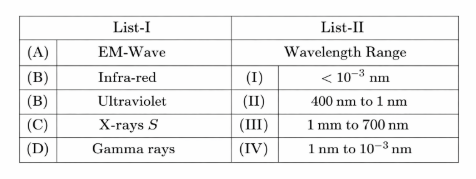
Match List-I with List II of Electromagnetic waves with corresponding wavelength range:
| List I | List II | ||
|---|---|---|---|
| A | Microwave | I | 400 nm to 1 nm |
| B | Ultraviolet | II | 1 nm to $$10^{-3}$$ nm |
| C | X-Ray | III | 1 mm to 700 nm |
| D | Infra-red | IV | 0.1 m to 1 mm |
Choose the correct answer from the options given below:
Matching EM waves with wavelength ranges:
Microwave: Wavelength range 0.1 m to 1 mm → IV
Ultraviolet: Wavelength range 400 nm to 1 nm → I
X-Ray: Wavelength range 1 nm to 10⁻³ nm → II
Infra-red: Wavelength range 1 mm to 700 nm → III
Matching: A-IV, B-I, C-II, D-III
This matches option 1.
If a source of electromagnetic radiation having power 15 kW produces $$10^{16}$$ photons per second, the radiation belongs to a part of spectrum is:
(Take Planck constant $$h = 6 \times 10^{-34}$$ J s)
The source delivers power $$P = 15 \text{ kW} = 15 \times 10^{3}\, \text{J s}^{-1}$$.
Number of photons emitted each second $$n = 10^{16}\, \text{s}^{-1}$$.
Energy carried by one photon is obtained by dividing the total energy per second by the number of photons per second:
$$E_{\text{photon}} = \frac{P}{n} = \frac{15 \times 10^{3}}{10^{16}}$$
Simplifying,
$$E_{\text{photon}} = 1.5 \times 10^{-12}\, \text{J}$$
Planck’s relation connects the energy of a photon with its frequency: $$E_{\text{photon}} = h \nu$$, where $$h = 6 \times 10^{-34}\, \text{J s}$$.
Thus,
$$\nu = \frac{E_{\text{photon}}}{h} = \frac{1.5 \times 10^{-12}}{6 \times 10^{-34}}$$
$$\nu = 0.25 \times 10^{22}\, \text{Hz} = 2.5 \times 10^{21}\, \text{Hz}$$
Frequencies around $$10^{19}\, \text{Hz}$$ and higher correspond to the $$\gamma$$-ray region of the electromagnetic spectrum. Since $$2.5 \times 10^{21}\, \text{Hz}$$ lies well within this range, the radiation is classified as gamma rays.
Therefore, the correct option is Gamma rays (Option C).
A message signal of frequency 3 kHz is used to modulate a carrier signal of frequency 1.5 MHz. The bandwidth of the amplitude modulated wave is
We need to find the bandwidth of an amplitude modulated (AM) wave when a message signal of frequency 3 kHz modulates a carrier signal of frequency 1.5 MHz.
In amplitude modulation, the message signal (also called the modulating signal) modulates the amplitude of a high-frequency carrier wave. When a carrier of frequency $$f_c$$ is modulated by a message signal of frequency $$f_m$$, the resulting AM wave contains three frequency components.
The carrier frequency: $$f_c$$
The upper sideband: $$f_c + f_m$$
The lower sideband: $$f_c - f_m$$
The bandwidth of the AM wave is the difference between the highest and lowest frequencies present in the signal, given by $$\text{Bandwidth} = (f_c + f_m) - (f_c - f_m) = 2f_m$$. Notice that the bandwidth depends only on the message signal frequency and is independent of the carrier frequency.
First, we identify the given values: message signal frequency $$f_m = 3$$ kHz and carrier signal frequency $$f_c = 1.5$$ MHz.
Next, substituting into the formula yields $$\text{Bandwidth} = 2f_m = 2 \times 3 \text{ kHz} = 6 \text{ kHz}$$.
To verify, we list the frequency components: upper sideband $$f_c + f_m = 1.5 \text{ MHz} + 3 \text{ kHz} = 1.503 \text{ MHz}$$ and lower sideband $$f_c - f_m = 1.5 \text{ MHz} - 3 \text{ kHz} = 1.497 \text{ MHz}$$. Calculating the bandwidth gives $$1.503 - 1.497 = 0.006 \text{ MHz} = 6 \text{ kHz}$$, which confirms our calculation.
Therefore, the correct answer is Option 2: 6 kHz.
If the height of transmitting and receiving antennas are $$80$$ m each, the maximum line of sight distance will be:
Given: Earth's radius $$= 6.4 \times 10^6$$ m.
The maximum line-of-sight distance between a transmitter and receiver is given by $$d = \sqrt{2Rh_T} + \sqrt{2Rh_R}$$, where $$R$$ is the Earth's radius and $$h_T, h_R$$ are the heights of the transmitting and receiving antennas respectively.
Since both antennas have the same height $$h_T = h_R = 80$$ m, the formula gives $$d = 2\sqrt{2Rh}$$. Substituting $$R = 6.4 \times 10^6$$ m and $$h = 80$$ m: $$d = 2\sqrt{2 \times 6.4 \times 10^6 \times 80} = 2\sqrt{1024 \times 10^6} = 2 \times 32 \times 10^3 = 64{,}000$$ m $$= 64$$ km.
The maximum line-of-sight distance is $$\boxed{64 \text{ km}}$$, which is option (D).
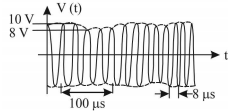
The modulation index for an A.M. wave having maximum and minimum peak to peak voltages of $$14$$ mV and $$6$$ mV respectively is:
We need to find the modulation index for an AM wave.
The modulation index is given by $$ m = \frac{V_{max} - V_{min}}{V_{max} + V_{min}} $$. Here, $$V_{max}$$ and $$V_{min}$$ are the maximum and minimum peak-to-peak voltages respectively.
Given that $$V_{max} = 14$$ mV and $$V_{min} = 6$$ mV, substituting these values yields $$ m = \frac{14 - 6}{14 + 6} = \frac{8}{20} = 0.4 $$.
The correct answer is Option B: 0.4.
The recorded answer code is 7, which corresponds to Option B, matching our calculation.
A carrier wave of amplitude 15 V is modulated by a sinusoidal base band signal of amplitude 3 V. The ratio of maximum amplitude to minimum amplitude in an amplitude modulated wave is
Given: Carrier amplitude $$A_c = 15$$ V, modulating signal amplitude $$A_m = 3$$ V.
In amplitude modulation:
Maximum amplitude = $$A_c + A_m = 15 + 3 = 18$$ V
Minimum amplitude = $$A_c - A_m = 15 - 3 = 12$$ V
Ratio = $$\frac{A_{max}}{A_{min}} = \frac{18}{12} = \frac{3}{2}$$
The correct answer is Option 2: $$\frac{3}{2}$$.
A message signal of frequency 5 kHz is used to modulate a carrier signal of frequency 2 MHz. The bandwidth for amplitude modulation is:
Message signal frequency: 5 kHz. Carrier frequency: 2 MHz. Find bandwidth for AM.
Using the formula for AM bandwidth $$2f_m$$ where $$f_m$$ is the message signal frequency, we can compute:
$$\text{Bandwidth} = 2 \times 5 = 10 \text{ kHz}$$
The correct answer is Option C: $$10 \text{ kHz}$$.
A sinusoidal carrier voltage is amplitude modulated. The resultant amplitude modulated wave has maximum and minimum amplitude of $$120$$ V and $$80$$ V respectively. The amplitude of each side band is:
We need to find the amplitude of each sideband in an amplitude modulated wave.
Maximum amplitude: $$A_{\max} = 120$$ V
Minimum amplitude: $$A_{\min} = 80$$ V
First, we find carrier and modulating signal amplitudes.
$$A_c = \frac{A_{\max} + A_{\min}}{2} = \frac{120 + 80}{2} = 100$$ V
$$A_m = \frac{A_{\max} - A_{\min}}{2} = \frac{120 - 80}{2} = 20$$ V
Next, we find sideband amplitude.
In amplitude modulation, each sideband has an amplitude of $$\frac{A_m}{2}$$:
$$A_{\text{sideband}} = \frac{A_m}{2} = \frac{20}{2} = 10$$ V
The amplitude of each sideband is $$10$$ V.
The correct answer is Option 2: $$10$$ V.
A transmitting antenna is kept on the surface of the earth. The minimum height of receiving antenna required to receive the signal in line of sight at 4 km distance from it is $$x \times 10^{-2}$$ m. The value of $$x$$ is _____.
(Let, radius of earth R = 6400 km)
For line of sight communication, the maximum distance $$d$$ at which a signal can be received is related to the antenna height $$h$$ by:
$$d = \sqrt{2Rh}$$
where $$R$$ is the radius of the Earth.
Since the transmitting antenna is on the surface (height = 0), we need the receiving antenna at height $$h$$ such that:
$$d = \sqrt{2Rh}$$
$$d^2 = 2Rh$$
$$h = \frac{d^2}{2R}$$
We are given that $$d = 4$$ km = $$4000$$ m, $$R = 6400$$ km = $$6.4 \times 10^6$$ m
$$h = \frac{(4000)^2}{2 \times 6.4 \times 10^6} = \frac{16 \times 10^6}{12.8 \times 10^6} = 1.25 \text{ m}$$
$$h = 125 \times 10^{-2} \text{ m}$$
Therefore, $$x = 125$$.
A TV transmitting antenna is 98 m high and the receiving antenna is at the ground level. If the radius of the earth is 6400 km, the surface area covered by the transmitting antenna is approximately:
The TV transmitting antenna height is $$h = 98$$ m and the Earth's radius is $$R = 6400$$ km. To derive the maximum range, consider the geometry of a right triangle formed by the Earth's center, the antenna top, and the farthest point on the horizon. By the Pythagorean theorem:
$$(R + h)^2 = R^2 + d^2$$
Rearranging gives
$$d^2 = R^2 + 2Rh + h^2 - R^2 = 2Rh + h^2$$
Since $$h \ll R$$, we can neglect $$h^2$$, yielding
$$d = \sqrt{2Rh}$$
Converting $$h = 98$$ m to kilometers ($$h = 0.098$$ km) and substituting into the formula gives
$$d = \sqrt{2 \times 6400 \times 0.098} = \sqrt{1254.4} \approx 35.42\text{ km}$$
The transmitting antenna thus covers a circular disc of radius $$d$$ on the Earth's surface. Since
$$d^2 = 1254.4\text{ km}^2$$
the area is
$$A = \pi d^2 = \pi \times 1254.4 \approx 3.14159 \times 1254.4 \approx 3940\text{ km}^2$$
This is approximately 3942 km². The correct answer is Option B: 3942 km².
By what percentage will the transmission range of a TV tower be affected when the height of the tower is increased by 21%?
The transmission range of a TV tower is given by:
$$d = \sqrt{2Rh}$$
where $$R$$ is the radius of the Earth and $$h$$ is the height of the tower. So $$d \propto \sqrt{h}$$.
When the height is increased by 21%, the new height is $$h' = 1.21h$$. Now the new range becomes:
$$d' = \sqrt{2R \cdot 1.21h} = \sqrt{1.21} \cdot \sqrt{2Rh} = 1.1 \cdot d$$
The percentage increase in range is:
$$\frac{d' - d}{d} \times 100 = (1.1 - 1) \times 100 = 10\%$$
Hence, the transmission range is increased by $$10\%$$.
For an amplitude modulated wave the minimum amplitude is 3 V, while the modulation index is 60%. The maximum amplitude of the modulated wave is:
For an amplitude modulated wave:
$$A_{max} = A_c + A_m$$ and $$A_{min} = A_c - A_m$$
where $$A_c$$ is the carrier amplitude and $$A_m$$ is the modulating signal amplitude.
The modulation index is:
$$ m = \frac{A_m}{A_c} = 0.60 $$
Given $$A_{min} = 3$$ V:
$$ A_c - A_m = 3 $$
$$ A_c - 0.6A_c = 3 $$
$$ 0.4A_c = 3 $$
$$ A_c = 7.5\;\text{V} $$
Therefore $$A_m = 0.6 \times 7.5 = 4.5$$ V.
The maximum amplitude is:
$$ A_{max} = A_c + A_m = 7.5 + 4.5 = 12\;\text{V} $$
The correct answer is 12 V.
In an amplitude modulation, a modulating signal having amplitude of $$X$$ V is superimposed with a carrier signal of amplitude $$Y$$ V in first case. Then, in second case, the same modulating signal is superimposed with different carrier signal of amplitude $$2Y$$ V. The ratio of modulation index in the two case respectively wil be:
We need to find the ratio of modulation indices in two cases of amplitude modulation.
Formula: The modulation index in amplitude modulation is defined as:
$$\mu = \frac{A_m}{A_c}$$
where $$A_m$$ is the amplitude of the modulating signal and $$A_c$$ is the amplitude of the carrier signal.
Modulating signal amplitude = $$X$$ V, Carrier signal amplitude = $$Y$$ V
$$\mu_1 = \frac{X}{Y}$$
Same modulating signal amplitude = $$X$$ V, Carrier signal amplitude = $$2Y$$ V
$$\mu_2 = \frac{X}{2Y}$$
$$\frac{\mu_1}{\mu_2} = \frac{X/Y}{X/2Y} = \frac{X}{Y} \times \frac{2Y}{X} = 2$$
Therefore, $$\mu_1 : \mu_2 = 2 : 1$$.
The correct answer is Option C: $$2 : 1$$.
In satellite communication, the uplink frequency band used is:
In satellite communication, different frequency bands are used for uplink and downlink to avoid interference.
For the C-band satellite communication:
- Uplink frequency: 5.925 - 6.425 GHz
- Downlink frequency: 3.7 - 4.2 GHz
The uplink frequency is higher than the downlink frequency because higher frequencies require more power, and it is easier to generate higher power at the ground station than on the satellite.
Match List I with List II
LIST I LIST II
A. AM Broadcast I. 88 - 108 MHz
B. FM Broadcast II. 540 - 1600 kHz
C. Television III. 3.7 - 4.2 GHz
D. Satellite Communication IV. 54 MHz - 590 MHz
Choose the correct answer from the options given below:
AM (Amplitude Modulation) broadcasting uses medium frequency waves because they can travel long distances due to ground wave propagation. The standard AM broadcast frequency range is:
540 kHz - 1600 kHz
Therefore,
A → II
FM (Frequency Modulation) broadcasting uses very high frequency (VHF) waves which provide better sound quality with less noise interference. The FM broadcast band is:
88 MHz - 108 MHz
Therefore,
B → I
Television transmission uses VHF and UHF frequency bands for transmitting audio and video signals. The given range suitable for television broadcasting is:
54 MHz - 590 MHz
Therefore,
C → IV
Satellite communication uses microwaves because they can pass through the atmosphere with less attenuation and support high bandwidth communication. The frequency range given is:
3.7 GHz - 4.2 GHz
Therefore,
D → III
The amplitude of $$15 \sin(1000 \ \pi t)$$ is modulated by $$10 \sin(4 \ \pi t)$$ signal. The amplitude modulated signal contains frequencies of
A. 500 Hz
B. 2 Hz
C. 250 Hz
D. 498 Hz
E. 502 Hz
Choose the correct answer from the options given below
We need to find the frequencies in the amplitude modulated signal.
The carrier signal $$15\sin(1000\pi t)$$ has angular frequency $$\omega_c = 1000\pi$$ rad/s, which gives $$f_c = \frac{1000\pi}{2\pi} = 500$$ Hz. The modulating signal $$10\sin(4\pi t)$$ has angular frequency $$\omega_m = 4\pi$$ rad/s, so $$f_m = \frac{4\pi}{2\pi} = 2$$ Hz.
In amplitude modulation, the output contains the carrier frequency and two sidebands. The carrier frequency remains at $$f_c = 500$$ Hz. The lower sideband appears at $$f_c - f_m = 500 - 2 = 498$$ Hz, while the upper sideband appears at $$f_c + f_m = 500 + 2 = 502$$ Hz.
There is no component at the modulating frequency $$2$$ Hz alone or at $$250$$ Hz. Therefore, the signal contains only $$500$$ Hz, $$498$$ Hz and $$502$$ Hz, which correspond to options A, D, and E. The correct answer is Option 4: A, D and E only.
The amplitude of 15sin(1000$$\pi t$$) is modulated by 10sin(4$$\pi t$$) signal. The amplitude modulated signal contains frequency(ies) of
(A) 500 Hz
(B) 2 Hz
(C) 250 Hz
(D) 498 Hz
(E) 502 Hz
Choose the correct answer from the options given below:
The carrier signal is $$15\sin(1000\pi t)$$, so the carrier frequency is:
$$ f_c = \frac{1000\pi}{2\pi} = 500 \text{ Hz} $$
The modulating signal is $$10\sin(4\pi t)$$, so the signal frequency is:
$$ f_s = \frac{4\pi}{2\pi} = 2 \text{ Hz} $$
In amplitude modulation, the modulated signal contains three frequencies:
1. To begin, carrier frequency, $$f_c = 500$$ Hz (A)
2. Next, lower sideband, $$f_c - f_s = 500 - 2 = 498$$ Hz (D)
3. From this, upper sideband, $$f_c + f_s = 500 + 2 = 502$$ Hz (E)
Therefore, the AM signal contains frequencies A (500 Hz), D (498 Hz), and E (502 Hz).
The height of transmitting antenna is 180 m and the height of the receiving antenna is 245 m. The maximum distance between them for satisfactory communication in line of sight will be: (given $$R = 6400$$ km)
The maximum distance for line of sight communication:
$$d = \sqrt{2Rh_T} + \sqrt{2Rh_R}$$
Given: $$h_T = 180$$ m, $$h_R = 245$$ m, $$R = 6400$$ km $$= 6400 \times 10^3$$ m.
$$d_T = \sqrt{2 \times 6400 \times 10^3 \times 180} = \sqrt{2304 \times 10^6} = 48 \times 10^3 \text{ m} = 48 \text{ km}$$
$$d_R = \sqrt{2 \times 6400 \times 10^3 \times 245} = \sqrt{3136 \times 10^6} = 56 \times 10^3 \text{ m} = 56 \text{ km}$$
$$d = 48 + 56 = 104 \text{ km}$$
This matches option 4: 104 km.
The power radiated from a linear antenna of length $$l$$ is proportional to (Given, $$\lambda$$ = Wavelength of wave):
Which of the following frequencies does not belong to FM broadcast.
FM (Frequency Modulation) broadcast operates in the frequency range of 88 MHz to 108 MHz.
Let us check each option:
1. 106 MHz - Falls within 88-108 MHz range. This belongs to FM broadcast.
2. 64 MHz - Falls outside the 88-108 MHz range. This does not belong to FM broadcast.
3. 99 MHz - Falls within 88-108 MHz range. This belongs to FM broadcast.
4. 89 MHz - Falls within 88-108 MHz range. This belongs to FM broadcast.
Therefore, 64 MHz does not belong to FM broadcast.
The electric field associated with an electromagnetic wave propagating in a dielectric medium is given by $$\vec{E} = 30(2\hat{x} + \hat{y})\sin\left[2\pi\left(5 \times 10^{14}t - \frac{10^7}{3}z\right)\right]$$ V m$$^{-1}$$. Which of the following option(s) is(are) correct?
[Given: The speed of light in vacuum, $$c = 3 \times 10^8$$ ms$$^{-1}$$]
The electric field is given as
$$\vec{E}(z,t)=30\,(2\hat{x}+\hat{y})\,
\sin\!\Bigl[2\pi\Bigl(5\times10^{14}\,t-\dfrac{10^{7}}{3}\,z\Bigr)\Bigr] \;{\rm V\,m^{-1}}$$
The argument of the sine has the standard form $$2\pi(ft-kz)$$, so
$$f = 5\times10^{14}\ {\rm Hz} \quad -(1)$$
$$k = 2\pi\!\left(\dfrac{10^{7}}{3}\right)=\dfrac{2\pi\times10^{7}}{3}\ {\rm rad\,m^{-1}} \quad -(2)$$
Because the positive coefficient of $$z$$ appears with a minus sign in the phase, the wave propagates along $$+z$$.
From $$k=\dfrac{2\pi}{\lambda}$$, the wavelength is
$$\lambda=\dfrac{2\pi}{k}= \dfrac{2\pi}{2\pi\times10^{7}/3}= \dfrac{3}{10^{7}}
=3\times10^{-7}\ {\rm m} \quad -(3)$$
The speed of the wave in the medium is
$$v = f\lambda = (5\times10^{14})(3\times10^{-7})
=1.5\times10^{8}\ {\rm m\,s^{-1}} \quad -(4)$$
Hence the refractive index is
$$n = \dfrac{c}{v} = \dfrac{3\times10^{8}}{1.5\times10^{8}} = 2 \quad -(5)$$
So Option D is correct.
The amplitude of the electric field is
$$\vec{E}_0 = 30\,(2\hat{x}+\hat{y}) = 60\hat{x}+30\hat{y}\;{\rm V\,m^{-1}} \quad -(6)$$
For a plane electromagnetic wave moving along $$\hat{z}$$, the magnetic field amplitude is related by
$$\vec{B}_0 = \dfrac{1}{v}\,\hat{z}\times\vec{E}_0 \quad -(7)$$
Using $$\hat{z}\times\hat{x}= \hat{y}$$ and $$\hat{z}\times\hat{y} = -\hat{x}$$:
$$\hat{z}\times\vec{E}_0 = 60(\hat{z}\times\hat{x})+30(\hat{z}\times\hat{y}) = 60\hat{y}-30\hat{x} \quad -(8)$$
Therefore
$$\vec{B}_0 = \dfrac{60\hat{y}-30\hat{x}}{1.5\times10^{8}}
= -2\times10^{-7}\hat{x}+4\times10^{-7}\hat{y}\ {\rm T} \quad -(9)$$
Incorporating the same space-time factor as in $$\vec{E}$$ gives
$$\vec{B}(z,t)=\left[-2\times10^{-7}\hat{x}+4\times10^{-7}\hat{y}\right]
\sin\!\Bigl[2\pi\Bigl(5\times10^{14}t-\dfrac{10^{7}}{3}z\Bigr)\Bigr] \;{\rm T} \quad -(10)$$
The $$x$$-component matches Option A, while Option B lists the $$y$$-component with the wrong magnitude (it should be $$4\times10^{-7}{\rm \,T}$$, not $$2\times10^{-7}{\rm \,T}$$). Thus Option B is incorrect.
The electric field lies entirely in the $$xy$$-plane along the direction $$2\hat{x}+\hat{y}$$. The angle with the $$x$$-axis is
$$\tan\theta=\dfrac{1}{2}\;\Longrightarrow\;\theta\approx26.6^{\circ} \quad -(11)$$
not $$30^{\circ}$$, so Option C is also incorrect.
Hence the correct options are:
Option A and Option D.
A point source of light is placed at the centre of curvature of a hemispherical surface. The source emits a power of $$24$$ W. The radius of curvature of hemisphere is $$10$$ cm and the inner surface is completely reflecting. The force on the hemisphere due to the light falling on it is ______ $$\times 10^{-8}$$ N.
The electric field in an electromagnetic wave is given by $$E = 56.5 \sin\omega\left(\frac{t - x}{c}\right)$$ NC$$^{-1}$$. Find the intensity of the wave if it is propagating along $$x$$-axis in the free space. (Given $$\varepsilon_0 = 8.85 \times 10^{-12}$$ C$$^2$$ N$$^{-1}$$ m$$^{-2}$$)
We are given the electric field $$E = 56.5 \sin\omega\left(\frac{t - x}{c}\right)$$ NC$$^{-1}$$ for a wave propagating along the $$x$$-axis in free space. This expression matches the form $$E = E_0 \sin(\omega t - kx)$$ with $$k = \frac{\omega}{c}$$, so the amplitude is $$E_0 = 56.5 \text{ NC}^{-1}$$.
The intensity (average power per unit area) of an electromagnetic wave in free space is given by the time-averaged Poynting vector as $$I = \frac{1}{2}\varepsilon_0 c E_0^2$$, where the factor $$\frac{1}{2}$$ arises from averaging $$\sin^2$$ over a full cycle.
Squaring the amplitude yields $$E_0^2 = (56.5)^2 = 3192.25 \text{ N}^2\text{C}^{-2}$$, while the product $$\varepsilon_0 c = 8.85 \times 10^{-12} \times 3 \times 10^{8} = 26.55 \times 10^{-4} = 2.655 \times 10^{-3} \text{ C}^2\text{N}^{-1}\text{m}^{-1}\text{s}^{-1}$$.
Substituting these values into the intensity formula gives
$$I = \frac{1}{2} \times 2.655 \times 10^{-3} \times 3192.25$$
$$= \frac{1}{2} \times 8.4754$$
$$= 4.2377 \approx 4.24 \text{ Wm}^{-2}$$.
The correct answer is Option C: $$4.24$$ Wm$$^{-2}$$.
The electromagnetic waves travel in a medium at a speed of $$2.0 \times 10^8$$ m s$$^{-1}$$. The relative permeability of the medium is $$1.0$$. The relative permittivity of the medium will be
The speed of electromagnetic waves in a medium is given by:
$$v = \frac{c}{\sqrt{\mu_r \varepsilon_r}}$$
where $$c = 3.0 \times 10^8$$ m/s is the speed of light in vacuum, $$\mu_r$$ is the relative permeability, and $$\varepsilon_r$$ is the relative permittivity.
Given: $$v = 2.0 \times 10^8$$ m/s and $$\mu_r = 1.0$$.
Rearranging:
$$\sqrt{\mu_r \varepsilon_r} = \frac{c}{v}$$
$$\mu_r \varepsilon_r = \frac{c^2}{v^2}$$
$$\varepsilon_r = \frac{c^2}{\mu_r v^2} = \frac{(3.0 \times 10^8)^2}{1.0 \times (2.0 \times 10^8)^2}$$
$$\varepsilon_r = \frac{9.0 \times 10^{16}}{4.0 \times 10^{16}} = \frac{9}{4} = 2.25$$
Hence, the correct answer is Option A.
A beam of light travelling along $$X$$-axis is described by the electric field $$E_y = 900 \sin \omega\left(t - \dfrac{x}{c}\right)$$. The ratio of electric force to magnetic force on a charge $$q$$ moving along $$Y$$-axis with a speed of $$3 \times 10^7 \text{ m s}^{-1}$$ will be: [Given speed of light $$= 3 \times 10^8 \text{ m s}^{-1}$$]
We need to find the ratio of electric force to magnetic force on a charge moving along the Y-axis in an electromagnetic wave travelling along the X-axis.
The electric field is $$E_y = 900\sin\omega\left(t - \frac{x}{c}\right)$$ and for an EM wave travelling along the X-axis with $$E$$ along the Y-axis, the magnetic field $$B$$ is along the Z-axis given by $$B_z = \frac{E_y}{c}$$.
The charge $$q$$ moves along the Y-axis with speed $$v = 3 \times 10^7$$ m/s. Since the electric force is given by $$F_E = qE_y$$ and the magnetic force is $$F_B = qvB_z = qv\frac{E_y}{c}$$, we can form their ratio.
From the above expressions, we have $$\frac{F_E}{F_B} = \frac{qE_y}{qv \cdot E_y/c} = \frac{c}{v}$$. Substituting the values gives $$= \frac{3 \times 10^8}{3 \times 10^7} = 10$$.
Therefore, the correct answer is Option C: $$10:1$$.
An EM wave propagating in $$x$$-direction has a wavelength of 8 mm. The electric field vibrating $$y$$-direction has maximum magnitude of 60 Vm$$^{-1}$$. Choose the correct equations for electric and magnetic fields if the EM wave is propagating in vacuum:
An EM wave propagates in the $$x$$-direction with wavelength $$\lambda = 8$$ mm $$= 8 \times 10^{-3}$$ m. The electric field vibrates in the $$y$$-direction with maximum magnitude $$E_0 = 60$$ V m$$^{-1}$$.
Calculate the wave number $$k$$.
$$k = \frac{2\pi}{\lambda} = \frac{2\pi}{8 \times 10^{-3}} = \frac{\pi}{4} \times 10^3 \text{ m}^{-1}$$
Write the angular frequency $$\omega$$.
$$\omega = kc = \frac{\pi}{4} \times 10^3 \times 3 \times 10^8 = \frac{3\pi}{4} \times 10^{11} \text{ rad s}^{-1}$$
The argument of the sine function can be written as $$k(x - ct) = \frac{\pi}{4} \times 10^3 (x - 3 \times 10^8 t)$$.
Calculate the magnetic field amplitude $$B_0$$.
$$B_0 = \frac{E_0}{c} = \frac{60}{3 \times 10^8} = 2 \times 10^{-7} \text{ T}$$
Write the complete equations.
Since the wave propagates in the $$x$$-direction and $$\vec{E}$$ is along $$\hat{j}$$, the magnetic field $$\vec{B}$$ must be along $$\hat{k}$$ (as $$\vec{E} \times \vec{B}$$ should point in the direction of propagation).
$$E_y = 60 \sin\left[\frac{\pi}{4} \times 10^3(x - 3 \times 10^8 t)\right] \hat{j} \text{ V m}^{-1}$$
$$B_z = 2 \times 10^{-7} \sin\left[\frac{\pi}{4} \times 10^3(x - 3 \times 10^8 t)\right] \hat{k} \text{ T}$$
The correct answer is Option B.
Identify the correct statements from the following descriptions of various properties of electromagnetic waves.
A. In a plane electromagnetic wave electric field and magnetic field must be perpendicular to each other and direction of propagation of wave should be along electric field or magnetic field.
B. The energy in electromagnetic wave is divided equally between electric and magnetic fields.
C. Both electric field and magnetic field are parallel to each other and perpendicular to the direction of propagation of wave.
D. The electric field, magnetic field and direction of propagation of wave must be perpendicular to each other.
E. The ratio of amplitude of magnetic field to the amplitude of electric field is equal to speed of light.
Choose the most appropriate answer from the options given below:
We need to identify the correct statements about electromagnetic waves from the given options.
Key Properties of Electromagnetic Waves:
In a plane electromagnetic wave propagating in free space:
1. The electric field $$\vec{E}$$, magnetic field $$\vec{B}$$, and direction of propagation $$\vec{k}$$ are mutually perpendicular.
2. The direction of propagation is given by $$\vec{E} \times \vec{B}$$ (Poynting vector direction).
3. The relation between amplitudes is $$\frac{E_0}{B_0} = c$$ (speed of light).
4. The average energy density in electric field = average energy density in magnetic field, i.e., $$\frac{1}{2}\epsilon_0 E_0^2 = \frac{B_0^2}{2\mu_0}$$ (on average).
Statement A: "Electric field and magnetic field must be perpendicular to each other and direction of propagation should be along electric field or magnetic field."
The first part is correct: $$\vec{E} \perp \vec{B}$$.
The second part is wrong: the direction of propagation is perpendicular to BOTH $$\vec{E}$$ and $$\vec{B}$$, not along either of them. The propagation direction is along $$\vec{E} \times \vec{B}$$.
Statement A is INCORRECT.
Statement B: "The energy in electromagnetic wave is divided equally between electric and magnetic fields."
The average electric energy density is $$u_E = \frac{1}{2}\epsilon_0 E_{rms}^2 = \frac{1}{4}\epsilon_0 E_0^2$$.
The average magnetic energy density is $$u_B = \frac{B_{rms}^2}{2\mu_0} = \frac{B_0^2}{4\mu_0}$$.
Using the relation $$E_0 = cB_0$$ and $$c = \frac{1}{\sqrt{\mu_0\epsilon_0}}$$:
$$u_E = \frac{1}{4}\epsilon_0 E_0^2 = \frac{1}{4}\epsilon_0 c^2 B_0^2 = \frac{1}{4}\epsilon_0 \cdot \frac{1}{\mu_0\epsilon_0} \cdot B_0^2 = \frac{B_0^2}{4\mu_0} = u_B$$
So the energy is indeed equally divided between the electric and magnetic fields.
Statement B is CORRECT.
Statement C: "Both electric field and magnetic field are parallel to each other and perpendicular to the direction of propagation."
While both $$\vec{E}$$ and $$\vec{B}$$ are perpendicular to the direction of propagation (they are transverse waves), they are NOT parallel to each other. They are perpendicular to each other.
Statement C is INCORRECT.
Statement D: "The electric field, magnetic field and direction of propagation must be perpendicular to each other."
This is exactly the defining property of plane EM waves: $$\vec{E}$$, $$\vec{B}$$, and $$\hat{k}$$ (propagation direction) form a right-handed mutually perpendicular set.
Statement D is CORRECT.
Statement E: "The ratio of amplitude of magnetic field to the amplitude of electric field is equal to speed of light."
The correct relation is: $$\frac{E_0}{B_0} = c$$
This means the ratio of electric field amplitude to magnetic field amplitude equals the speed of light.
The statement claims $$\frac{B_0}{E_0} = c$$, which is the inverse of the correct relation. Since $$\frac{B_0}{E_0} = \frac{1}{c}$$, this statement is wrong.
Statement E is INCORRECT.
The correct statements are B and D.
Answer: Option B: B and D only
Match List-I with List-II
| List-I | List-II |
|---|---|
| (a) UV rays | (i) Diagnostic tool in medicine |
| (b) X-rays | (ii) Water purification |
| (c) Microwave | (iii) Communication, Radar |
| (d) Infrared wave | (iv) Improving visibility in foggy days |
Choose the correct answer from the options given below :
We need to match each type of electromagnetic wave with its primary application.
(a) UV rays → (ii) Water purification: Ultraviolet rays are widely used for sterilisation and water purification, as they can kill bacteria and other microorganisms.
(b) X-rays → (i) Diagnostic tool in medicine: X-rays are extensively used in medical imaging (radiography, CT scans) to examine bones, teeth, and internal organs.
(c) Microwave → (iii) Communication, Radar: Microwaves are used in radar systems, satellite communication, and mobile phone networks due to their ability to travel long distances and penetrate the atmosphere.
(d) Infrared wave → (iv) Improving visibility in foggy days: Infrared waves can penetrate fog and haze better than visible light, which is why infrared cameras and sensors are used to improve visibility in poor weather conditions.
The correct matching is (a)-(ii), (b)-(i), (c)-(iii), (d)-(iv). Hence, the correct answer is Option B.
Sun light falls normally on a surface of area 36 cm$$^2$$ and exerts an average force of $$7.2 \times 10^{-9}$$ N within a time period of 20 minutes. Considering a case of complete absorption, the energy flux of incident light is
We are given that sunlight falls normally on a surface of area $$A = 36 \text{ cm}^2$$ and exerts an average force of $$F = 7.2 \times 10^{-9}$$ N. The light is completely absorbed.
For complete absorption, the radiation pressure is $$P = \frac{I}{c}$$, where $$I$$ is the intensity (energy flux) and $$c$$ is the speed of light. Also, $$F = P \times A$$, so $$F = \frac{I \times A}{c}$$.
Solving for the intensity: $$I = \frac{Fc}{A}$$.
Substituting values (using $$A = 36 \times 10^{-4} \text{ m}^2$$ and $$c = 3 \times 10^8 \text{ m/s}$$):
$$I = \frac{7.2 \times 10^{-9} \times 3 \times 10^8}{36 \times 10^{-4}} = \frac{2.16}{36 \times 10^{-4}} = \frac{2.16}{3.6 \times 10^{-3}} = 600 \text{ W/m}^2$$.
Now converting to W cm$$^{-2}$$: since $$1 \text{ m}^2 = 10^4 \text{ cm}^2$$, we get $$I = \frac{600}{10^4} = 0.06 \text{ W cm}^{-2}$$.
Hence, the correct answer is Option D.
The magnetic field of a plane electromagnetic wave is given by $$\vec{B} = 2 \times 10^{-8} \sin(0.5 \times 10^3 x + 1.5 \times 10^{11} t) \hat{j} \text{ T}$$. The amplitude of the electric field would be
The magnetic field of a plane electromagnetic wave is given by:
$$\vec{B} = 2 \times 10^{-8} \sin(0.5 \times 10^3 x + 1.5 \times 10^{11} t)\,\hat{j} \text{ T}$$
We need to find the amplitude of the electric field. From the wave equation $$\sin(kx + \omega t)$$ we identify $$k = 0.5 \times 10^3 \text{ rad/m}$$ and $$\omega = 1.5 \times 10^{11} \text{ rad/s}$$. Substituting gives $$c = \frac{\omega}{k} = \frac{1.5 \times 10^{11}}{0.5 \times 10^3} = 3 \times 10^8 \text{ m/s}$$.
Next, the relation between electric and magnetic field amplitudes in an EM wave is $$E_0 = c \times B_0 = 3 \times 10^8 \times 2 \times 10^{-8} = 6 \text{ V/m}$$.
Since the wave propagates in the $$-x$$ direction (the argument $$kx + \omega t$$ gives $$-\hat{i}$$) and the magnetic field is along $$\hat{j}$$, the fields are mutually perpendicular with $$\hat{E} \times \hat{B}$$ giving the direction of propagation. This gives $$\hat{E} \times \hat{j} = -\hat{i}$$. Then $$\hat{E} = \hat{k} \quad \text{(since } \hat{k} \times \hat{j} = -\hat{i}\text{)}$$, so the electric field is along the $$z$$-axis.
The correct answer is Option C: $$6 \text{ V m}^{-1}$$ along $$z$$-axis.
The oscillating magnetic field in a plane electromagnetic wave is given by $$B_y = 5 \times 10^{-6} \sin[1000\pi(5x - 4 \times 10^8 t)] \text{ T}$$. The amplitude of electric field will be
The oscillating magnetic field in a plane electromagnetic wave is given by: $$B_y = 5 \times 10^{-6} \sin[1000\pi(5x - 4 \times 10^8 t)] \text{ T}$$, and we need to find the amplitude of the electric field.
Since the amplitude of the magnetic field is the coefficient of the sine function, we have $$B_0 = 5 \times 10^{-6} \text{ T}$$.
From the general form of a travelling wave, $$B = B_0 \sin(kx - \omega t)$$, expanding the given argument yields $$1000\pi(5x - 4 \times 10^8 t) = 5000\pi \cdot x - 4\pi \times 10^{11} \cdot t$$. Therefore, $$k = 5000\pi \text{ m}^{-1}$$ and $$\omega = 4\pi \times 10^{11} \text{ rad s}^{-1}$$.
Since the wave speed is given by $$c = \dfrac{\omega}{k}$$, substituting the values of $$\omega$$ and $$k$$ gives $$c = \dfrac{4\pi \times 10^{11}}{5000\pi} = \dfrac{4 \times 10^{11}}{5 \times 10^3} = 8 \times 10^7 \text{ m s}^{-1}$$.
For an electromagnetic wave, the amplitudes of the electric and magnetic fields are related by $$E_0 = c \times B_0$$, where $$c$$ is the wave speed in the medium. Hence, $$E_0 = 8 \times 10^7 \times 5 \times 10^{-6} = 40 \times 10^{7-6} = 40 \times 10^1 = 400 \text{ V m}^{-1}$$, which is $$4 \times 10^2 \text{ V m}^{-1}$$.
Note that the wave speed here is $$8 \times 10^7 \text{ m s}^{-1}$$, which is less than the speed of light in vacuum ($$3 \times 10^8 \text{ m s}^{-1}$$). This indicates the wave is travelling in a medium, and the relation $$E_0 = cB_0$$ still holds where $$c$$ is the wave speed in that medium.
Therefore, the correct answer is Option D: $$4 \times 10^2 \text{ V m}^{-1}$$.
Given below are two statements :
Statement I: A time varying electric field is a source of changing magnetic field and vice-versa. Thus a disturbance in electric or magnetic field creates EM waves.
Statement II: In a material medium, the EM wave travels with speed $$v = \frac{1}{\sqrt{\mu_0\varepsilon_0}}$$.
In the light of the above statements, choose the correct answer from the options given below.
We need to evaluate two statements about electromagnetic waves.
Statement I: "A time varying electric field is a source of changing magnetic field and vice-versa. Thus a disturbance in electric or magnetic field creates EM waves."
This is correct. According to Maxwell's equations, a time-varying electric field produces a magnetic field (via the displacement current term in Ampere-Maxwell law), and a time-varying magnetic field produces an electric field (Faraday's law). This mutual generation of fields is the basis of electromagnetic wave propagation.
Statement II: "In a material medium, the EM wave travels with speed $$v = \frac{1}{\sqrt{\mu_0\varepsilon_0}}$$."
This is false. The speed $$\frac{1}{\sqrt{\mu_0\varepsilon_0}} = c$$ is the speed of light in vacuum. In a material medium, the speed of an EM wave is:
$$v = \frac{1}{\sqrt{\mu\varepsilon}}$$
where $$\mu$$ and $$\varepsilon$$ are the permeability and permittivity of the medium respectively (not the free-space values $$\mu_0$$ and $$\varepsilon_0$$). Since $$\mu \geq \mu_0$$ and $$\varepsilon \geq \varepsilon_0$$ for most materials, we have $$v \leq c$$.
Therefore, Statement I is correct but Statement II is false.
The correct answer is Option C.
Light wave travelling in air along $$x$$-direction is given by $$E_y = 540 \sin \pi \times 10^4(x - ct) \text{ V m}^{-1}$$. Then, the peak value of magnetic field of wave will be (Given $$c = 3 \times 10^8 \text{ m s}^{-1}$$)
The electric field of a light wave is given by $$E_y = 540 \sin \pi \times 10^4(x - ct) \text{ V m}^{-1}$$.
Identify the peak value of the electric field.
From the equation, the amplitude (peak value) of the electric field is:
$$E_0 = 540 \text{ V m}^{-1}$$Find the peak value of the magnetic field.
For an electromagnetic wave, the relationship between the electric and magnetic field amplitudes is:
$$B_0 = \frac{E_0}{c}$$ $$B_0 = \frac{540}{3 \times 10^8} = 180 \times 10^{-8} = 18 \times 10^{-7} \text{ T}$$The correct answer is Option A: $$18 \times 10^{-7} \text{ T}$$.
Match List - I with List - II
| List-I | List-II |
|---|---|
| (a) Ultraviolet rays | (i) Study crystal structure |
| (b) Microwaves | (ii) Greenhouse effect |
| (c) Infrared waves | (iii) Sterilizing surgical instrument |
| (d) X-rays | (iv) Radar system |
Let us match each electromagnetic wave with its correct application:
(a) Ultraviolet rays - (iii) Sterilizing surgical instruments: UV rays have germicidal properties and are widely used to sterilize surgical instruments by killing bacteria and viruses.
(b) Microwaves - (iv) Radar system: Microwaves are used in radar systems (RADAR - Radio Detection and Ranging) for detecting objects and measuring distances.
(c) Infrared waves - (ii) Greenhouse effect: Infrared waves are responsible for the greenhouse effect. The Earth absorbs solar radiation and re-emits it as infrared radiation, which is trapped by greenhouse gases.
(d) X-rays - (i) Study crystal structure: X-rays are used in X-ray diffraction to study crystal structures (Bragg's law).
The correct matching is: (a)-(iii), (b)-(iv), (c)-(ii), (d)-(i).
The correct answer is Option A.
A plane electromagnetic wave travels in a medium of relative permeability $$1.61$$ and relative permittivity $$6.44$$. If magnitude of magnetic intensity is $$4.5 \times 10^{-2}$$ A m$$^{-1}$$ at a point, what will be the approximate magnitude of electric field intensity at that point?
(Given : Permeability of free space $$\mu_0 = 4\pi \times 10^{-7}$$ N A$$^{-2}$$, speed of light in vacuum $$c = 3 \times 10^{8}$$ m s$$^{-1}$$)
We are given: relative permeability $$\mu_r = 1.61$$, relative permittivity $$\varepsilon_r = 6.44$$, magnetic field intensity $$H = 4.5 \times 10^{-2}$$ A/m, $$\mu_0 = 4\pi \times 10^{-7}$$ N A$$^{-2}$$, and $$c = 3 \times 10^8$$ m/s.
The intrinsic impedance of a medium is:
$$ \eta = \frac{E}{H} = \sqrt{\frac{\mu}{\varepsilon}} = \sqrt{\frac{\mu_r \mu_0}{\varepsilon_r \varepsilon_0}} $$
Simplifying using the impedance of free space:
$$ \eta = \sqrt{\frac{\mu_r}{\varepsilon_r}} \times \sqrt{\frac{\mu_0}{\varepsilon_0}} $$
The impedance of free space is:
$$ \eta_0 = \sqrt{\frac{\mu_0}{\varepsilon_0}} = \mu_0 c = 4\pi \times 10^{-7} \times 3 \times 10^8 = 120\pi\ \Omega $$
The ratio is:
$$ \sqrt{\frac{\mu_r}{\varepsilon_r}} = \sqrt{\frac{1.61}{6.44}} = \sqrt{0.25} = 0.5 $$
Thus,
$$ E = \eta \times H = 0.5 \times 120\pi \times 4.5 \times 10^{-2} $$
$$ E = 0.5 \times 120 \times 3.1416 \times 4.5 \times 10^{-2} $$
$$ E = 60\pi \times 4.5 \times 10^{-2} $$
$$ E = 2.7\pi = 2.7 \times 3.1416 \approx 8.48 \text{ V/m} $$
Therefore, the correct answer is Option C.
Which is the correct ascending order of wavelengths?
We need to arrange the electromagnetic waves in ascending order of wavelength.
The electromagnetic spectrum in order of increasing wavelength is:
$$\text{Gamma rays} \rightarrow \text{X-rays} \rightarrow \text{UV} \rightarrow \text{Visible} \rightarrow \text{Infrared} \rightarrow \text{Microwaves} \rightarrow \text{Radio waves}$$
- Gamma rays: $$\lambda < 10^{-12}$$ m (shortest wavelength)
- X-rays: $$10^{-12}$$ m to $$10^{-8}$$ m
- Visible light: $$4 \times 10^{-7}$$ m to $$7 \times 10^{-7}$$ m
- Microwaves: $$10^{-3}$$ m to $$0.3$$ m (longest among the given options)
$$\lambda_{\text{gamma-ray}} < \lambda_{\text{X-ray}} < \lambda_{\text{visible}} < \lambda_{\text{microwave}}$$
Hence, the correct answer is Option B.
An electric bulb is rated as $$200$$ W. What will be the peak magnetic field at $$4$$ m distance produced by the radiations coming from this bulb? Consider this bulb as a point source with $$3.5\%$$ efficiency.
We are given an electric bulb rated at $$200$$ W with $$3.5\%$$ efficiency, and we need to determine the peak magnetic field at a distance of $$4$$ m.
Since the bulb converts $$200 \times \frac{3.5}{100} = 200 \times 0.035 = 7$$ W into radiated power, we have:
$$P_{rad} = 200 \times \frac{3.5}{100} = 200 \times 0.035 = 7 \text{ W}$$
This radiated power spreads uniformly over a spherical surface of radius $$4$$ m, so the intensity is:
$$I = \frac{P_{rad}}{4\pi r^2} = \frac{7}{4\pi (4)^2} = \frac{7}{4\pi \times 16} = \frac{7}{64\pi} \text{ W/m}^2$$
From the relation between the intensity of an electromagnetic wave and its peak magnetic field $$B_0$$,
$$I = \frac{c B_0^2}{2\mu_0}$$
we solve for $$B_0$$:
$$B_0 = \sqrt{\frac{2\mu_0 I}{c}}$$
Substituting $$\mu_0 = 4\pi \times 10^{-7}$$ T m/A and $$c = 3 \times 10^8$$ m/s yields:
$$B_0 = \sqrt{\frac{2 \times 4\pi \times 10^{-7} \times \frac{7}{64\pi}}{3 \times 10^8}}$$
Simplifying the numerator gives:
$$2 \times 4\pi \times 10^{-7} \times \frac{7}{64\pi} = \frac{2 \times 4 \times 7}{64} \times 10^{-7} = \frac{56}{64} \times 10^{-7} = \frac{7}{8} \times 10^{-7}$$
Hence,
$$B_0 = \sqrt{\frac{0.875 \times 10^{-7}}{3 \times 10^8}} = \sqrt{\frac{0.875}{3} \times 10^{-15}}$$
$$B_0 = \sqrt{0.29167 \times 10^{-15}} = \sqrt{2.9167 \times 10^{-16}}$$
$$B_0 = 1.708 \times 10^{-8} \text{ T} \approx 1.71 \times 10^{-8} \text{ T}$$
Therefore, the correct option is Option B: $$1.71 \times 10^{-8}$$ T.
Find the modulation index of an AM wave having 8 V variation where maximum amplitude of the AM wave is 9 V.
We are given that the variation (peak-to-peak change) in the amplitude of the AM wave is 8 V and the maximum amplitude of the AM wave is $$A_{\max} = 9$$ V.
We know that for an amplitude-modulated wave, the maximum and minimum amplitudes are related to the carrier amplitude $$A_c$$ and the modulating signal amplitude $$A_m$$ by $$A_{\max} = A_c + A_m$$ and $$A_{\min} = A_c - A_m$$. The "8 V variation" means the total swing from minimum to maximum, so $$A_{\max} - A_{\min} = 8$$ V. This gives us $$A_{\max} - A_{\min} = (A_c + A_m) - (A_c - A_m) = 2A_m = 8$$, hence $$A_m = 4$$ V.
Now, since $$A_{\max} = A_c + A_m = 9$$, we get $$A_c = 9 - 4 = 5$$ V.
The modulation index is defined as $$\mu = \dfrac{A_m}{A_c} = \dfrac{4}{5} = 0.8$$.
Hence, the correct answer is Option A.
A radio can tune to any station in $$6 \text{ MHz}$$ to $$10 \text{ MHz}$$ band. The value of corresponding wavelength bandwidth will be
We need to find the wavelength bandwidth corresponding to the frequency band 6 MHz to 10 MHz.
The relationship between wavelength and frequency is:
$$\lambda = \dfrac{c}{f}$$
where $$c = 3 \times 10^8 \text{ m/s}$$.
For $$f_1 = 6 \text{ MHz} = 6 \times 10^6 \text{ Hz}$$:
$$\lambda_1 = \dfrac{3 \times 10^8}{6 \times 10^6} = 50 \text{ m}$$
For $$f_2 = 10 \text{ MHz} = 10 \times 10^6 \text{ Hz}$$:
$$\lambda_2 = \dfrac{3 \times 10^8}{10 \times 10^6} = 30 \text{ m}$$
The wavelength bandwidth is:
$$\Delta\lambda = \lambda_1 - \lambda_2 = 50 - 30 = 20 \text{ m}$$
Therefore, the correct answer is Option B.
The maximum and minimum voltage of an amplitude modulated signal are $$60 \text{ V}$$ and $$20 \text{ V}$$ respectively. The percentage modulation index will be
We are given the maximum voltage $$V_{max} = 60 \text{ V}$$ and minimum voltage $$V_{min} = 20 \text{ V}$$ of an amplitude modulated signal.
The modulation index is defined as:
$$\mu = \frac{V_{max} - V_{min}}{V_{max} + V_{min}}$$
Substituting the given values:
$$\mu = \frac{60 - 20}{60 + 20} = \frac{40}{80} = 0.5$$
The percentage modulation index is:
$$\mu \times 100 = 0.5 \times 100 = 50\%$$
The correct answer is Option B.
A FM Broadcast transmitter, using modulating signal of frequency 20 kHz has a deviation ratio of 10. The Bandwidth required for transmission is:
We are given an FM broadcast transmitter with a modulating signal frequency of $$f_m = 20$$ kHz and a deviation ratio of 10.
The deviation ratio (also called modulation index) is defined as $$m_f = \frac{\Delta f}{f_m}$$, where $$\Delta f$$ is the maximum frequency deviation. So $$\Delta f = m_f \times f_m = 10 \times 20 = 200$$ kHz.
By Carson's rule, the bandwidth required for FM transmission is $$BW = 2(\Delta f + f_m) = 2(200 + 20) = 2 \times 220 = 440$$ kHz.
Hence, the correct answer is Option D.
A square wave of the modulating signal is shown in the figure. The carrier wave is given by $$C(t) = 5 \sin(8\pi t)$$ Volt. The modulation index is
Amplitude modulated wave is represented by $$V_{AM} = 10\left[1 + 0.4 \cos(2\pi \times 10^4 t)\right] \cos(2\pi \times 10^7 t)$$. The total bandwidth of the amplitude modulated wave is
The amplitude modulated wave is given as: $$V_{AM} = 10\left[1 + 0.4 \cos(2\pi \times 10^4 t)\right] \cos(2\pi \times 10^7 t)$$. Comparing this with the standard AM wave equation $$V_{AM} = A_c\left[1 + \mu \cos(2\pi f_m t)\right] \cos(2\pi f_c t)$$, we identify the carrier frequency as $$f_c = 10^7$$ Hz = 10 MHz, the modulating frequency as $$f_m = 10^4$$ Hz = 10 kHz, and the modulation index as $$\mu = 0.4$$.
The bandwidth of an AM wave is given by $$\text{Bandwidth} = 2f_m$$. $$= 2 \times 10^4 \text{ Hz} = 20 \text{ kHz}$$. Hence, the correct answer is Option C (20 kHz).
At a particular station, the TV transmission tower has a height of $$100 \text{ m}$$. To triple its coverage range, height of the tower should be increased to
We are given that the TV transmission tower has a height of $$h = 100 \text{ m}$$ and we need to find the new height to triple its coverage range.
The coverage range (or line-of-sight distance) of a TV tower is given by:
$$d = \sqrt{2Rh}$$
where $$R$$ is the radius of the Earth and $$h$$ is the height of the tower.
Let the original range be $$d_1 = \sqrt{2R \times 100}$$ and the new range be $$d_2 = 3d_1$$.
For the new height $$h'$$:
$$d_2 = \sqrt{2Rh'}$$
Since $$d_2 = 3d_1$$:
$$\sqrt{2Rh'} = 3\sqrt{2R \times 100}$$
Squaring both sides:
$$2Rh' = 9 \times 2R \times 100$$
$$h' = 9 \times 100 = 900 \text{ m}$$
The correct answer is Option D: $$900 \text{ m}$$.
In AM modulation, a signal is modulated on a carrier wave such that maximum and minimum amplitude are found to be $$6 \text{ V}$$ and $$2 \text{ V}$$ respectively. The modulation index is
In amplitude modulation (AM), the modulation index $$\mu$$ is defined as:
$$\mu = \dfrac{A_{max} - A_{min}}{A_{max} + A_{min}}$$
Given: $$A_{max} = 6 \text{ V}$$ and $$A_{min} = 2 \text{ V}$$.
Substituting:
$$\mu = \dfrac{6 - 2}{6 + 2} = \dfrac{4}{8} = 0.5$$
Converting to percentage:
$$\mu = 0.5 \times 100\% = 50\%$$
Therefore, the correct answer is Option D.
In the case of amplitude modulation to avoid distortion the modulation index $$\mu$$ should be:
In amplitude modulation (AM), the modulated wave can be expressed as:
$$A(t) = A_c [1 + \mu \sin(\omega_m t)] \sin(\omega_c t)$$where $$\mu$$ is the modulation index defined as:
$$\mu = \frac{A_m}{A_c}$$Here, $$A_m$$ is the amplitude of the message signal and $$A_c$$ is the amplitude of the carrier signal.
For the modulated signal to be free from distortion (i.e., the envelope of the modulated wave should faithfully reproduce the message signal), we need:
$$\mu \leq 1$$If $$\mu > 1$$, the modulated wave undergoes over-modulation, leading to distortion of the signal during demodulation. The envelope of the carrier no longer faithfully follows the modulating signal.
If $$\mu = 0$$, there is no modulation at all, so no information is transmitted.
Therefore, the correct answer is Option A: $$\mu \leq 1$$.
The TV transmission tower at a particular station has a height of 125 m. For doubling the coverage of its range, the height of the tower should be increased by
We need to find the increase in height required to double the coverage range of a TV tower. The range of a TV transmission tower is $$d = \sqrt{2Rh}$$ where R is the radius of Earth and h is the height of the tower.
The original range is $$d_1 = \sqrt{2R \times 125}$$ when the tower height is 125 m, and the new range is $$d_2 = 2d_1 = \sqrt{2Rh_2}$$. Equating these gives $$2\sqrt{2R \times 125} = \sqrt{2Rh_2}$$, and squaring both sides yields $$4 \times 2R \times 125 = 2Rh_2$$. Therefore, $$h_2 = 4 \times 125 = 500 \text{ m}$$.
Hence the required increase in height is $$\Delta h = h_2 - h_1 = 500 - 125 = 375 \text{ m}$$. The answer is Option B: 375 m.
Nearly 10% of the power of a 110 W light bulb is converted to visible radiation. The change in average intensities of visible radiation, at a distance of 1 m from the bulb to a distance of 5 m is $$a \times 10^{-2}$$ W m$$^{-2}$$. The value of 'a' will be
We have a 110 W light bulb, and nearly 10% of its power is converted to visible radiation. So the power of visible radiation is $$P = 0.10 \times 110 = 11$$ W.
The intensity of radiation at a distance $$r$$ from a point source is given by $$I = \frac{P}{4\pi r^2}$$.
At a distance $$r_1 = 1$$ m: $$I_1 = \frac{11}{4\pi (1)^2} = \frac{11}{4\pi}$$
At a distance $$r_2 = 5$$ m: $$I_2 = \frac{11}{4\pi (5)^2} = \frac{11}{4\pi \times 25} = \frac{11}{100\pi}$$
The change in intensity is: $$\Delta I = I_1 - I_2 = \frac{11}{4\pi} - \frac{11}{100\pi} = \frac{11}{\pi}\left(\frac{1}{4} - \frac{1}{100}\right) = \frac{11}{\pi} \times \frac{25 - 1}{100} = \frac{11 \times 24}{100\pi}$$
$$\Delta I = \frac{264}{100\pi} = \frac{264}{314.159} \approx 0.8403$$ W/m$$^2$$ $$= 84.03 \times 10^{-2}$$ W/m$$^2$$.
Hence the value of $$a = 84$$.
Hence, the correct answer is 84.
The displacement current of 4.425 $$\mu$$A is developed in the space between the plates of parallel plate capacitor when voltage is changing at a rate of $$10^6$$ V s$$^{-1}$$. The area of each plate of the capacitor is 40 cm$$^2$$. The distance between each plate of the capacitor is $$x \times 10^{-3}$$ m. The value of $$x$$ is,
(Permittivity of free space, $$\varepsilon_0 = 8.85 \times 10^{-12}$$ C$$^2$$ N$$^{-1}$$ m$$^{-2}$$)
We need to find the distance between the plates of a parallel plate capacitor given the displacement current. The displacement current in a parallel plate capacitor is:
$$I_d = \varepsilon_0 \frac{A}{d} \cdot \frac{dV}{dt}$$
This comes from $$I_d = C \frac{dV}{dt}$$ where $$C = \frac{\varepsilon_0 A}{d}$$. Substituting the given values: $$I_d = 4.425 \times 10^{-6}$$ A, $$\frac{dV}{dt} = 10^6$$ V/s, $$A = 40$$ cm² $$= 40 \times 10^{-4}$$ m², $$\varepsilon_0 = 8.85 \times 10^{-12}$$ C² N⁻¹ m⁻². To solve for d, we use:
$$d = \frac{\varepsilon_0 A}{I_d} \cdot \frac{dV}{dt}$$
$$d = \frac{8.85 \times 10^{-12} \times 40 \times 10^{-4} \times 10^6}{4.425 \times 10^{-6}}$$
$$= \frac{8.85 \times 40 \times 10^{-12-4+6}}{4.425 \times 10^{-6}}$$
$$= \frac{354 \times 10^{-10}}{4.425 \times 10^{-6}}$$
$$= \frac{354}{4.425} \times 10^{-4}$$
$$= 80 \times 10^{-4} = 8 \times 10^{-3} \text{ m}$$
So $$x = 8$$. The answer is 8.
A modulating signal $$2\sin(6.28 \times 10^6 t)$$ is added to the carrier signal $$4\sin(12.56 \times 10^9 t)$$ for amplitude modulation. The combined signal is passed through a non-linear square law device. The output is then passed through a band pass filter. The bandwidth of the output signal of band pass filter will be _____ MHz.
We have a modulating signal $$m(t) = 2\sin(6.28 \times 10^6 t)$$ and a carrier signal $$c(t) = 4\sin(12.56 \times 10^9 t)$$. The modulating frequency is $$f_m = \frac{\omega_m}{2\pi} = \frac{6.28 \times 10^6}{2\pi} = \frac{6.28 \times 10^6}{6.28} = 10^6$$ Hz $$= 1$$ MHz. The carrier frequency is $$f_c = \frac{12.56 \times 10^9}{2\pi} = \frac{12.56 \times 10^9}{6.28} = 2 \times 10^9$$ Hz $$= 2000$$ MHz.
The combined signal is $$y(t) = m(t) + c(t)$$. When this passes through a non-linear square law device, the output contains terms proportional to $$y(t)$$ and $$y(t)^2$$. Expanding $$y(t)^2 = [m(t) + c(t)]^2 = m(t)^2 + c(t)^2 + 2m(t)c(t)$$, we note that the cross-term $$2m(t)c(t)$$ produces frequencies at $$f_c + f_m$$ and $$f_c - f_m$$, which are the upper and lower sidebands of the AM signal. The terms $$m(t)^2$$ and $$c(t)^2$$ produce low-frequency and high-frequency components (at $$2f_m$$, DC, and $$2f_c$$) that lie outside the carrier band.
Now, the band pass filter is centred at the carrier frequency $$f_c$$. It allows through only the frequencies near $$f_c$$, namely the carrier at $$f_c = 2000$$ MHz, the upper sideband at $$f_c + f_m = 2001$$ MHz, and the lower sideband at $$f_c - f_m = 1999$$ MHz. All other frequency components are rejected.
The bandwidth of the output signal is the difference between the highest and lowest frequencies passed: $$\text{BW} = (f_c + f_m) - (f_c - f_m) = 2f_m = 2 \times 1 = 2 \text{ MHz}$$
Hence, the correct answer is 2.
An antenna is placed in a dielectric medium of dielectric constant $$6.25$$. If the maximum size of that antenna is $$5.0$$ mm, it can radiate a signal of minimum frequency of ______ GHz.
(Given $$\mu_r = 1$$ for dielectric medium)
An antenna is placed in a dielectric medium with dielectric constant $$\kappa = 6.25$$ and $$\mu_r = 1$$. The maximum size of the antenna is $$5.0$$ mm. We need to find the minimum frequency it can radiate in GHz.
Recall the antenna condition. For a quarter-wave antenna, the minimum antenna length required is one-fourth of the wavelength:
$$l = \frac{\lambda}{4}$$
For the minimum frequency (longest wavelength), the antenna size equals $$\frac{\lambda}{4}$$:
$$\lambda = 4l = 4 \times 5.0 \text{ mm} = 20 \text{ mm} = 0.02 \text{ m}$$
Find the speed of electromagnetic waves in the dielectric medium. The speed in a medium with dielectric constant $$\kappa$$ and relative permeability $$\mu_r$$ is:
$$v = \frac{c}{\sqrt{\kappa \cdot \mu_r}}$$
Substituting the given values:
$$v = \frac{c}{\sqrt{6.25 \times 1}} = \frac{c}{\sqrt{6.25}} = \frac{c}{2.5}$$
$$v = \frac{3 \times 10^8}{2.5} = 1.2 \times 10^8 \text{ m/s}$$
Calculate the minimum frequency using $$v = f\lambda$$:
$$f_{min} = \frac{v}{\lambda} = \frac{1.2 \times 10^8}{0.02}$$
$$f_{min} = 6 \times 10^9 \text{ Hz} = 6 \text{ GHz}$$
The minimum frequency of the signal the antenna can radiate is 6 GHz.
The required height of a TV tower which can cover the population of $$6.03$$ lakh is $$h$$. If the average population density is $$100$$ per square km and the radius of earth is $$6400 \text{ km}$$, then the value of $$h$$ will be ______ m.
The population covered is $$6.03 \text{ lakh} = 6.03 \times 10^5$$, the population density is $$100 \text{ per km}^2$$, and the radius of the Earth is $$R = 6400 \text{ km}$$.
From the population and density, the area covered by the TV tower is $$\text{Area} = \dfrac{\text{Population}}{\text{Population density}} = \dfrac{6.03 \times 10^5}{100} = 6030 \text{ km}^2$$.
For a TV tower of height $$h$$, the coverage area can be expressed as $$A = \pi d^2$$ where $$d = \sqrt{2Rh}$$; hence $$A = \pi \times 2Rh = 2\pi Rh$$.
Setting this equal to the area gives $$6030 = 2\pi \times 6400 \times h$$, so $$h = \dfrac{6030}{2\pi \times 6400} = \dfrac{6030}{40212.4} = 0.14998 \text{ km}$$, which is approximately $$h \approx 0.15 \text{ km} = 150 \text{ m}$$.
Therefore, the height of the TV tower is $$\boxed{150}$$ m.
A radar sends an electromagnetic signal of electric field $$(E_0) = 2.25$$ V m$$^{-1}$$ and magnetic field $$(B_0) = 1.5 \times 10^{-8}$$ T which strikes a target on line of sight at a distance of $$3$$ km in a medium. After that, a part of signal (echo) reflects back towards the radar with same velocity and by same path. If the signal was transmitted at time $$t = 0$$ from radar, then after how much time echo will reach to the radar?
A radar sends an EM signal that strikes a target at 3 km distance and the echo returns. The velocity of an EM wave is given by: $$v = \frac{E_0}{B_0}$$. Substituting the given values yields $$v = \frac{2.25}{1.5 \times 10^{-8}} = 1.5 \times 10^8$$ m/s.
Since the signal travels to the target and back, the total distance covered is $$2 \times 3$$ km = $$6$$ km = $$6000$$ m.
Therefore, the time for the echo to return is calculated by $$t = \frac{\text{Total distance}}{v} = \frac{6000}{1.5 \times 10^8}$$, which simplifies to $$t = \frac{6 \times 10^3}{1.5 \times 10^8} = 4 \times 10^{-5}$$ s. The correct answer is Option B.
A 25 m long antenna is mounted on an antenna tower. The height of the antenna tower is 75 m. The wavelength (in meter) of the signal transmitted by this antenna would be:
For effective transmission, the wavelength of the signal transmitted by an antenna is related to the length of the antenna $$L$$ by the relation $$L = \frac{\lambda}{4}$$, where $$\lambda$$ is the wavelength of the signal.
Given that the antenna length is $$L = 25$$ m (note that the height of the tower is irrelevant — only the antenna length matters for determining the transmitted wavelength), we have:
$$\lambda = 4L = 4 \times 25 = 100 \text{ m}$$.
A linearly polarised electromagnetic wave in vacuum is $$$E = 3.1\cos 1.8z - 5.4 \times 10^6 t \hat{i}$$$ N C$$^{-1}$$ is incident normally on a perfectly reflecting wall at $$z = a$$. Choose the correct option.
We have been given an incident electric field in free space
$$$\vec E_i(z,t)=3.1\cos(1.8\,z-5.4\times10^{6}\,t)\,\hat i\;{\rm N\,C^{-1}}.$$$
This is of the standard form $$\vec E_i=E_0\cos(kz-\omega t)\hat i,$$ so by simple comparison
$$$k=1.8\;{\rm rad\,m^{-1}},\qquad \omega=5.4\times10^{6}\;{\rm rad\,s^{-1}},\qquad E_0=3.1\;{\rm N\,C^{-1}}.$$$
First, let us find the wavelength. The relation between the propagation constant and wavelength in vacuum is
$$k=\frac{2\pi}{\lambda}\;\Longrightarrow\;\lambda=\frac{2\pi}{k}.$$
Substituting the numerical value
$$\lambda=\frac{2\pi}{1.8}= \frac{6.2832}{1.8}\approx3.49\;{\rm m}.$$
This is clearly not equal to $$5.4\;{\rm m}$$, so statement A (“The wavelength is 5.4 m”) is wrong.
Next, let us calculate the ordinary frequency $$f$$. The angular frequency and ordinary frequency are related by
$$\omega=2\pi f\;\Longrightarrow\;f=\frac{\omega}{2\pi}.$$
Hence
$$$f=\frac{5.4\times10^{6}}{2\pi}= \frac{5.4\times10^{6}}{6.2832}\approx8.6\times10^{5}\;{\rm Hz}.$$$
The option claims $$54\times10^{4}\;{\rm Hz}=5.4\times10^{5}\;{\rm Hz}$$, which is different from $$8.6\times10^{5}\;{\rm Hz}$$. Therefore statement B is also wrong.
Because the wall is perfectly reflecting (perfect conductor), no electromagnetic field can be transmitted into it; the tangential component of $$\vec E$$ must vanish at the surface. Hence there is no transmitted wave. Statement C therefore cannot be true.
We now construct the reflected wave. For normal incidence, the reflected field must travel in the $$-z$$ direction and can be written in the general form
$$\vec E_r(z,t)=E_0\cos(kz+\omega t+\phi)\,\hat i,$$
where $$\phi$$ is a phase constant to be fixed by the boundary condition at the wall situated at $$z=a$$.
The total tangential electric field on the wall must be zero, so we impose
$$\vec E_i(a,t)+\vec E_r(a,t)=0.$$
That gives
$$$E_0\cos(k a-\omega t)+E_0\cos(k a+\omega t+\phi)=0\qquad\forall\;t.$$$
Dividing through by $$E_0$$ and using the identity
$$\cos C+\cos D=2\cos\frac{C+D}{2}\,\cos\frac{C-D}{2},$$
we obtain
$$$2\cos\!\Bigl(k a+\frac{\phi}{2}\Bigr)\cos\!\Bigl(-\omega t-\frac{\phi}{2}\Bigr)=0\qquad\forall\;t.$$$
For the product of cosines to vanish at every instant, the first cosine must be zero:
$$\cos\!\Bigl(k a+\tfrac{\phi}{2}\Bigr)=0.$$
This condition is satisfied if
$$k a+\frac{\phi}{2}=\frac{(2n+1)\pi}{2},\qquad n=0,1,2,\dots$$
The simplest choice is to keep $$\phi=0$$ and take
$$k a=\frac{(2n+1)\pi}{2}\;\;(n=0,1,2,\dots).$$
With this choice, the reflected field becomes
$$$\boxed{\;\vec E_r(z,t)=3.1\cos(1.8\,z+5.4\times10^{6}\,t)\,\hat i\;{\rm N\,C^{-1}}\;},$$$
which is exactly the expression listed in option D.
We have therefore shown
• Options A and B disagree with the numerical values of wavelength and frequency.
• Option C is impossible because a perfectly reflecting wall allows no transmission.
• Option D is consistent with the required boundary condition and is therefore correct.
Hence, the correct answer is Option D.
The relative permittivity of distilled water is 81. The velocity of light in it will be: (Given $$\mu_r = 1$$)
We know that the speed of an electromagnetic wave in any medium depends on the electric permittivity and magnetic permeability of that medium. The general relation is stated first:
$$v \;=\; \frac{1}{\sqrt{\mu\,\varepsilon}}$$
Here, $$\mu$$ is the absolute magnetic permeability and $$\varepsilon$$ is the absolute electric permittivity of the medium.
For convenience, these absolute quantities are expressed through their relative values with respect to free space. Thus we write:
$$\mu \;=\; \mu_r\,\mu_0, \qquad \varepsilon \;=\; \varepsilon_r\,\varepsilon_0$$
Substituting these into the relation for $$v$$, we get:
$$v \;=\; \frac{1}{\sqrt{\mu_r \mu_0 \,\varepsilon_r \varepsilon_0}} \;=\; \frac{1}{\sqrt{\mu_r\varepsilon_r}\;\sqrt{\mu_0\varepsilon_0}}$$
The factor $$\dfrac{1}{\sqrt{\mu_0\varepsilon_0}}$$ is the speed of light in vacuum, customarily denoted by $$c$$. Hence we write the well-known formula:
$$v = \frac{c}{\sqrt{\mu_r\,\varepsilon_r}}$$
Now we substitute the given data. For distilled water, the relative permittivity is
$$\varepsilon_r = 81$$
and according to the statement of the problem the relative permeability is
$$\mu_r = 1$$
Using $$c = 3.0 \times 10^{8}\;{\rm m\,s^{-1}}$$, we have
$$v \;=\; \frac{3.0 \times 10^{8}}{\sqrt{1 \times 81}} \;=\; \frac{3.0 \times 10^{8}}{\sqrt{81}}$$
Because $$\sqrt{81} = 9$$, this simplifies step by step as follows:
$$v = \frac{3.0 \times 10^{8}}{9} = 0.333\ldots \times 10^{8}$$
Writing $$0.333\ldots \times 10^{8}$$ in proper scientific notation gives
$$v = 3.33 \times 10^{7}\;{\rm m\,s^{-1}}$$
Hence, the correct answer is Option C.
Match List - I with List - II.
| List-I | List-II |
|---|---|
| (a) Source of microwave frequency | (i) Radioactive decay of nucleus |
| (b) Source of infrared frequency | (ii) Magnetron |
| (c) Source of Gamma Rays | (iii) Inner shell electrons |
| (d) Source of X-rays | (iv) Vibration of atoms and molecules |
| (v) LASER | |
| (vi) RC circuit |
Choose the correct answer from the options given below:
We need to match each type of electromagnetic radiation with its source.
(a) Microwaves are generated by a magnetron, which is a vacuum tube device that produces coherent microwave radiation using the interaction of electrons with a magnetic field. So (a) matches with (ii).
(b) Infrared radiation is produced by the vibration of atoms and molecules. When atoms and molecules vibrate, they emit electromagnetic radiation in the infrared region. So (b) matches with (iv).
(c) Gamma rays originate from the radioactive decay of nuclei. During nuclear transitions, the nucleus releases very high energy photons known as gamma rays. So (c) matches with (i).
(d) X-rays are produced when high-energy electrons knock out inner shell electrons from atoms. The transition of outer electrons to fill these inner shell vacancies releases X-ray photons. So (d) matches with (iii).
The correct matching is (a)-(ii), (b)-(iv), (c)-(i), (d)-(iii).
Red light differs from blue light as they have:
Red light and blue light are both electromagnetic waves that travel at the same speed $$c$$ in vacuum. However, they are distinguished by their position in the visible spectrum.
Red light has a longer wavelength (approximately 620-750 nm) and correspondingly a lower frequency, while blue light has a shorter wavelength (approximately 450-495 nm) and a higher frequency.
Since the relationship between wavelength and frequency is $$c = \lambda \nu$$, having different wavelengths necessarily means having different frequencies (as $$c$$ is constant).
Therefore, red light differs from blue light as they have different frequencies and different wavelengths.
AC voltage $$V(t) = 20 \sin \omega t$$ of frequency 50 Hz is applied to a parallel plate capacitor. The separation between the plates is 2 mm and the area is 1 m$$^2$$. The amplitude of the oscillating displacement current for the applied AC voltage is [Take $$\varepsilon_0 = 8.85 \times 10^{-12}$$ F m$$^{-1}$$]
The displacement current amplitude equals $$I_d = C \cdot \frac{dV}{dt}\bigg|_{max} = C \cdot V_0\omega$$, where $$C = \frac{\varepsilon_0 A}{d}$$ is the capacitance of the parallel plate capacitor.
The capacitance is: $$C = \frac{\varepsilon_0 A}{d} = \frac{8.85 \times 10^{-12} \times 1}{2 \times 10^{-3}} = 4.425 \times 10^{-9}$$ F.
The angular frequency is $$\omega = 2\pi f = 2\pi \times 50 = 100\pi \approx 314.16$$ rad s$$^{-1}$$.
The amplitude of the displacement current is: $$I_d = C V_0 \omega = 4.425 \times 10^{-9} \times 20 \times 314.16 = 4.425 \times 10^{-9} \times 6283.2 \approx 27.8 \times 10^{-6}$$ A $$= 27.79\,\mu$$A.
Intensity of sunlight is observed as 0.092 Wm$$^{-2}$$ at a point in free space. What will be the peak value of magnetic field at that point? ($$\varepsilon_0 = 8.85 \times 10^{-12}$$ C$$^2$$ N$$^{-1}$$ m$$^{-2}$$)
The intensity of an electromagnetic wave is related to the peak electric field by: $$I = \frac{1}{2}\varepsilon_0 c E_0^2$$
And the peak magnetic field is related to the peak electric field by: $$B_0 = \frac{E_0}{c}$$
Combining these: $$I = \frac{1}{2}\varepsilon_0 c \cdot (B_0 c)^2 = \frac{1}{2}\varepsilon_0 c^3 B_0^2$$
Solving for $$B_0$$: $$B_0 = \sqrt{\frac{2I}{\varepsilon_0 c^3}}$$
Substituting the values: $$I = 0.092 \text{ W m}^{-2}$$, $$\varepsilon_0 = 8.85 \times 10^{-12} \text{ C}^2 \text{N}^{-1}\text{m}^{-2}$$, $$c = 3 \times 10^8 \text{ m s}^{-1}$$: $$B_0 = \sqrt{\frac{2 \times 0.092}{8.85 \times 10^{-12} \times (3 \times 10^8)^3}}$$
Computing the denominator: $$(3\times10^8)^3 = 27\times10^{24}$$ $$8.85\times10^{-12} \times 27\times10^{24} = 238.95\times10^{12} = 2.3895\times10^{14}$$
$$B_0 = \sqrt{\frac{0.184}{2.3895\times10^{14}}} = \sqrt{7.699\times10^{-16}} = 2.775\times10^{-8} \text{ T} \approx 2.77\times10^{-8} \text{ T}$$
The electric field in a plane electromagnetic wave is given by, $$E = 50\sin(500x - 10 \times 10^{10}t)$$ V m$$^{-1}$$. The velocity of an electromagnetic wave in this medium is: (Given $$c$$ = the speed of light in vacuum).
We observe that the electric field of the given plane electromagnetic wave is written in the form
$$E = 50 \sin(500x - 10 \times 10^{10} t) \; \text{V m}^{-1}$$
The standard mathematical expression for a monochromatic plane wave travelling along the positive $$x$$-direction is
$$E = E_0 \sin(kx - \omega t),$$
where $$k$$ is the angular wave number and $$\omega$$ is the angular frequency. By simply matching every symbol, we equate
$$k = 500 \; \text{rad m}^{-1}, \qquad \omega = 10 \times 10^{10} \; \text{rad s}^{-1}.$$
First, make the numerical value of $$\omega$$ explicit:
$$\omega = 10 \times 10^{10} = 1 \times 10^{11} \; \text{rad s}^{-1}.$$
The speed of a wave is connected to these parameters through the relation
$$v = \frac{\omega}{k}.$$
Substituting the recognised values, we write
$$v = \frac{1 \times 10^{11}}{500} \; \text{m s}^{-1}.$$
Now we carry out the division step by step. First, divide the numerator and denominator:
$$\frac{1 \times 10^{11}}{5 \times 10^{2}} = 0.2 \times 10^{9}$$
(because $$500 = 5 \times 10^{2}$$ and we moved one power of ten from the denominator to the numerator). Converting $$0.2 \times 10^{9}$$ into a more familiar decimal form, we obtain
$$0.2 \times 10^{9} = 2 \times 10^{8} \; \text{m s}^{-1}.$$
Next, we compare this value with the speed of light in vacuum, $$c = 3 \times 10^{8} \; \text{m s}^{-1}$$. Forming the ratio,
$$\frac{v}{c} = \frac{2 \times 10^{8}}{3 \times 10^{8}} = \frac{2}{3}.$$
So the speed of this electromagnetic wave in the medium is
$$v = \frac{2}{3}c.$$
Hence, the correct answer is Option D.
A light beam is described by $$E = 800 \sin\omega\left(t - \frac{x}{c}\right)$$. An electron is allowed to move normal to the propagation of light beam with a speed of $$3 \times 10^7$$ m s$$^{-1}$$. What is the maximum magnetic force exerted on the electron?
We are given the plane-polarised electromagnetic wave
$$E \;=\; 800 \,\sin\!\Bigl[\;\omega\!\left(t-\dfrac{x}{c}\right)\Bigr]$$
The coefficient of the sine function is the peak (maximum) electric-field magnitude, so
$$E_0 = 800 \text{ V m}^{-1}$$
For a plane electromagnetic wave in free space the electric and magnetic amplitudes are related by the well-known relation
$$E_0 = c\,B_0$$
where $$c = 3.0 \times 10^{8}\ \text{m s}^{-1}$$ is the speed of light in vacuum. Solving for the magnetic-field amplitude $$B_0$$ we get
$$$\begin{aligned} B_0 &= \dfrac{E_0}{c} \\ &= \dfrac{800}{3.0 \times 10^{8}} \ \text{T} \\ &= \dfrac{8.00 \times 10^{2}}{3.0 \times 10^{8}} \ \text{T} \\ &= \dfrac{8.00}{3.0}\times 10^{-6}\ \text{T} \\ &= 2.666\dots\times 10^{-6}\ \text{T} \\ &\approx 2.67 \times 10^{-6}\ \text{T} \end{aligned}$$$
An electron is made to move with speed
$$v = 3.0 \times 10^{7}\ \text{m s}^{-1}$$
and, as stated, the motion is normal (perpendicular) to the direction of propagation of the beam. In a plane wave the magnetic field itself is already perpendicular to the propagation direction, so by choosing the electron’s velocity also normal to the beam we can arrange the velocity to be perpendicular to the magnetic field. For the magnetic force this gives the maximum value because the factor $$\sin\theta$$ becomes unity. The magnetic (Lorentz) force formula is first written explicitly:
$$F = q\,v\,B\,\sin\theta$$
For the maximum force $$\theta = 90^\circ$$ and $$\sin\theta = 1$$, hence
$$F_{\max} = q\,v\,B_0$$
For an electron the magnitude of the charge is
$$q = e = 1.6 \times 10^{-19}\ \text{C}$$
Substituting all numerical values step by step,
$$$\begin{aligned} F_{\max} &= (1.6 \times 10^{-19}) \times (3.0 \times 10^{7}) \times (2.67 \times 10^{-6}) \ \text{N} \\[4pt] &= 1.6 \times 3.0 \times 2.67 \times 10^{-19 + 7 - 6}\ \text{N} \\[4pt] &= (1.6 \times 3.0)\times 2.67 \times 10^{-18}\ \text{N} \\[4pt] &= 4.8 \times 2.67 \times 10^{-18}\ \text{N} \\[4pt] &= 12.816 \times 10^{-18}\ \text{N} \\[4pt] &= 1.2816 \times 10^{-17}\ \text{N} \end{aligned}$$$
Keeping only three significant figures (because the given data have at most two significant figures), we state
$$F_{\max} \approx 1.28 \times 10^{-17}\ \text{N}$$
The option list is expressed in the form $$A \times 10^{-18}\ \text{N}$$. Writing our result in the same form:
$$$1.28 \times 10^{-17}\ \text{N} = 12.8 \times 10^{-18}\ \text{N}$$$
This matches Option B.
Hence, the correct answer is Option B.
A plane electromagnetic wave of frequency 500 MHz is traveling in a vacuum along the $$y$$-direction. At a particular point in space and time, $$\vec{B} = 8.0 \times 10^{-8}\hat{z}$$ T. The value of the electric field at this point is: (speed of light = $$3 \times 10^{8}$$ ms$$^{-1}$$; $$\hat{x}, \hat{y}, \hat{z}$$ are unit vectors along $$x, y$$ and $$z$$ direction.)
An electromagnetic wave is travelling along the $$y$$-direction, and at a particular point $$\vec{B} = 8.0 \times 10^{-8} \, \hat{z}$$ T. We need to find the electric field $$\vec{E}$$.
The magnitude of the electric field is $$E = cB = 3 \times 10^8 \times 8.0 \times 10^{-8} = 24$$ V/m.
For the direction, the Poynting vector $$\vec{S} = \frac{1}{\mu_0} \vec{E} \times \vec{B}$$ must point in the direction of wave propagation, which is $$+\hat{y}$$. Since $$\vec{B}$$ is along $$+\hat{z}$$, we need $$\vec{E} \times \hat{z}$$ to be along $$+\hat{y}$$. Checking: $$(-\hat{x}) \times \hat{z} = -(\hat{x} \times \hat{z}) = -(-\hat{y}) = +\hat{y}$$. This works.
Therefore, $$\vec{E} = -24 \, \hat{x}$$ V m$$^{-1}$$.
A plane electromagnetic wave propagating along y-direction can have the following pair of electric field $$(\vec{E})$$ and magnetic field $$(\vec{B})$$ components.
An electromagnetic wave propagating along the y-direction requires both $$\vec{E}$$ and $$\vec{B}$$ to lie in the xz-plane (perpendicular to $$\hat{y}$$). Additionally, $$\vec{E}$$ and $$\vec{B}$$ must be mutually perpendicular, and the Poynting vector $$\vec{E} \times \vec{B}$$ must point along $$\hat{y}$$.
Let us check each option. Option (1): $$E_y, B_y$$ — both are along the propagation direction, which violates the transverse nature of EM waves. Invalid. Option (2): $$E_y, B_z$$ or $$E_z, B_y$$ — each pair contains a y-component, which is not allowed for a wave propagating in the y-direction. Invalid.
Option (4): $$E_z, B_y$$ or $$E_y, B_z$$ — again, each pair contains a y-component. Invalid.
Option (3): $$E_z, B_z$$ or $$E_z, B_x$$. Consider the second pair: $$E_z$$ and $$B_x$$ are both perpendicular to $$\hat{y}$$, they are perpendicular to each other, and $$\hat{z} \times \hat{x} = \hat{y}$$, giving the correct propagation direction. This is a valid EM wave configuration. As for the first pair $$E_z, B_z$$, both fields would be parallel, which is not a valid EM wave on its own — however, the question uses "or" between the pairs, so only one valid pair is needed for the option to be correct.
Since option (3) contains the valid pair $$(E_z, B_x)$$ and is the only option with at least one fully valid perpendicular pair of transverse components, it is the correct answer.
The magnetic field vector of an electromagnetic wave is given by $$B = B_0\frac{\hat{i}+\hat{j}}{\sqrt{2}}\cos kz - \omega t$$ where $$\hat{i}$$, $$\hat{j}$$ represents unit vector along x and y-axis respectively. At $$t = 0$$ s, two electric charges $$q_1$$ of $$4\pi$$ coulomb and $$q_2$$ of $$2\pi$$ coulomb located at $$\left(0, 0, \frac{\pi}{k}\right)$$ and $$\left(0, 0, \frac{3\pi}{k}\right)$$, respectively, have the same velocity of $$0.5c\hat{i}$$, (where $$c$$ is the velocity of light). The ratio of the force acting on charge $$q_1$$ to $$q_2$$ is:
The magnetic field of the plane electromagnetic wave is given as
$$\vec B \;=\;B_{0}\,\dfrac{\hat i+\hat j}{\sqrt2}\, \cos\!\bigl(kz-\omega t\bigr).$$
For a monochromatic wave travelling along the $$+z$$-direction, the electric field $$\vec E$$ is always perpendicular to $$\vec B$$, and the three vectors $$\vec E,\;\vec B,\;\hat k$$ form a right-handed triad. The magnitudes satisfy the relation
$$|\vec E| \;=\;c\,|\vec B|,$$
and the direction is obtained from the vector identity
$$\hat k \;=\;\dfrac{\vec E\times\vec B}{|\vec E\times\vec B|}.$$ Because $$\hat k=\hat k_z$$ in the present problem, we choose the electric field so that $$\vec E\times\vec B$$ points along $$\hat k_z$$. With $$\vec B$$ lying in the $$x$$-$$y$$ plane, the appropriate $$\vec E$$ is
$$\vec E \;=\;c B_0\,\dfrac{\hat i-\hat j}{\sqrt2}\, \cos\!\bigl(kz-\omega t\bigr).$$
At the instant $$t=0$$ we have
$$\vec B(z,0)=B_0\,\dfrac{\hat i+\hat j}{\sqrt2}\, \cos(kz),\qquad \vec E(z,0)=cB_0\,\dfrac{\hat i-\hat j}{\sqrt2}\, \cos(kz).$$
The two charges are situated at
$$z_1=\dfrac{\pi}{k}, \qquad z_2=\dfrac{3\pi}{k}.$$
Substituting these $$z$$-values,
$$\cos(kz_1)=\cos\!\bigl(k\cdot\tfrac{\pi}{k}\bigr)=\cos\pi=-1,$$
$$\cos(kz_2)=\cos\!\bigl(k\cdot\tfrac{3\pi}{k}\bigr)=\cos3\pi=-1.$$
Hence at both locations
$$\vec B = -\,B_0\,\dfrac{\hat i+\hat j}{\sqrt2},\qquad \vec E = -\,cB_0\,\dfrac{\hat i-\hat j}{\sqrt2}.$$
Both charges possess the same velocity
$$\vec v = 0.5\,c\,\hat i.$$
Now we invoke the Lorentz force formula
$$\vec F = q\bigl(\,\vec E + \vec v\times\vec B\,\bigr).$$
First we evaluate $$\vec v\times\vec B$$ (the subscript $$0$$ on $$B_0$$ is suppressed below for brevity):
$$$ \begin{aligned} \vec v\times\vec B &= \Bigl(0.5\,c\,\hat i\Bigr)\times\Bigl(\, -\,B_0\,\dfrac{\hat i+\hat j}{\sqrt2}\Bigr) \\[4pt] &= -\,\dfrac{0.5\,c\,B_0}{\sqrt2}\, \Bigl(\hat i\times\hat i+\hat i\times\hat j\Bigr) \\[4pt] &= -\,\dfrac{0.5\,c\,B_0}{\sqrt2}\, \Bigl(0+\hat k\Bigr) \\[4pt] &= -\,\dfrac{0.5\,c\,B_0}{\sqrt2}\,\hat k. \end{aligned} $$$
Adding the electric part, the bracket $$(\vec E+\vec v\times\vec B)$$ at either charge position becomes
$$$ \begin{aligned} \vec E + \vec v\times\vec B &= -\,cB_0\,\dfrac{\hat i-\hat j}{\sqrt2} \;-\;\dfrac{0.5\,c\,B_0}{\sqrt2}\,\hat k \\[6pt] &= -\,\dfrac{c\,B_0}{\sqrt2} \Bigl(\hat i-\hat j+0.5\,\hat k\Bigr). \end{aligned} $$$
This vector is identical at $$z_1$$ and $$z_2$$. Therefore, the magnitude of the force on each charge is directly proportional to the magnitude of the charge itself:
$$|\vec F_1| = |q_1|\; \bigl|\vec E+\vec v\times\vec B\bigr|,\qquad |\vec F_2| = |q_2|\; \bigl|\vec E+\vec v\times\vec B\bigr|.$$
Taking the ratio, the common factor cancels:
$$\dfrac{|\vec F_1|}{|\vec F_2|} \;=\;\dfrac{|q_1|}{|q_2|} \;=\;\dfrac{4\pi}{2\pi} \;=\;2.$$
Thus the force on $$q_1$$ is twice the force on $$q_2$$, i.e.
$$\vec F_1 : \vec F_2 = 2 : 1.$$
Hence, the correct answer is Option D.
For an electromagnetic wave travelling in free space, the relation between average energy densities due to electric ($$U_e$$) and magnetic ($$U_m$$) fields is:
In an electromagnetic wave, the energy is shared equally between the electric and magnetic fields. The average energy density due to the electric field is $$U_e = \frac{1}{2} \varepsilon_0 E_{\text{rms}}^2 = \frac{1}{4} \varepsilon_0 E_0^2$$, and the average energy density due to the magnetic field is $$U_m = \frac{B_{\text{rms}}^2}{2\mu_0} = \frac{B_0^2}{4\mu_0}$$.
Since $$E_0 = cB_0$$ and $$c = \frac{1}{\sqrt{\mu_0 \varepsilon_0}}$$, we have $$U_e = \frac{1}{4} \varepsilon_0 c^2 B_0^2 = \frac{1}{4} \varepsilon_0 \cdot \frac{1}{\mu_0 \varepsilon_0} \cdot B_0^2 = \frac{B_0^2}{4\mu_0} = U_m$$.
Therefore, for an electromagnetic wave travelling in free space, the average energy densities due to the electric and magnetic fields are equal: $$U_e = U_m$$.
In an electromagnetic wave, the electric field vector and magnetic field vector are given as $$\vec{E} = E_0\hat{i}$$ and $$\vec{B} = B_0\hat{k}$$, respectively. The direction of propagation of electromagnetic wave is along:
The direction of propagation of an electromagnetic wave is given by the cross product of the electric field vector and the magnetic field vector, i.e., the direction of $$\vec{E} \times \vec{B}$$.
Given $$\vec{E} = E_0\hat{i}$$ and $$\vec{B} = B_0\hat{k}$$, we compute:
$$\vec{E} \times \vec{B} = E_0 B_0 (\hat{i} \times \hat{k})$$
Using the right-hand rule for unit vectors: $$\hat{i} \times \hat{k} = -\hat{j}$$
Therefore, $$\vec{E} \times \vec{B} = E_0 B_0 (-\hat{j})$$
The direction of propagation of the electromagnetic wave is along $$(-\hat{j})$$.
Given below are two statements:
Statement I: A speech signal of 2 kHz is used to modulate a carrier signal of 1 MHz. The bandwidth requirement for the signal is 4 kHz.
Statement II: The side band frequencies are 1002 kHz and 998 kHz.
In the light of the above statements, choose the correct answer from the options given below:
In amplitude modulation, when a signal of frequency $$f_m$$ modulates a carrier of frequency $$f_c$$, the resulting modulated wave contains three frequencies: the carrier frequency $$f_c$$, and two side band frequencies $$f_c + f_m$$ and $$f_c - f_m$$.
The bandwidth required is $$2f_m$$, which is the difference between the upper and lower side band frequencies.
Given $$f_m = 2$$ kHz and $$f_c = 1$$ MHz $$= 1000$$ kHz:
Statement I: The bandwidth requirement is $$2 \times 2 = 4$$ kHz. This is true.
Statement II: The upper side band frequency is $$f_c + f_m = 1000 + 2 = 1002$$ kHz, and the lower side band frequency is $$f_c - f_m = 1000 - 2 = 998$$ kHz. This is true.
Since both statements are correct, the answer is Option (2): Both Statement I and Statement II are true.
A carrier signal $$C(t) = 25\sin(2.512 \times 10^{10}t)$$ is amplitude modulated by a message signal $$m(t) = 5\sin(1.57 \times 10^{8}t)$$ and transmitted through an antenna. What will be the bandwidth of the modulated signal?
The message signal is $$m(t) = 5\sin(1.57 \times 10^8 \, t)$$. The angular frequency of the message signal is $$\omega_m = 1.57 \times 10^8$$ rad s$$^{-1}$$, so the frequency of the message signal is $$f_m = \frac{\omega_m}{2\pi} = \frac{1.57 \times 10^8}{2\pi} = \frac{1.57 \times 10^8}{6.284} \approx 2.5 \times 10^7$$ Hz $$= 25$$ MHz.
In amplitude modulation, the bandwidth is twice the frequency of the message signal: $$\text{Bandwidth} = 2f_m = 2 \times 25 = 50$$ MHz.
A transmitting antenna at top of a tower has a height of 50 m, and the height of receiving antenna is 80 m. What is the range of communication for the line of sight (LOS) mode?
[use radius of the earth = 6400 km]
The line-of-sight (LOS) range between two antennas is obtained from the well-known empirical relation
$$d \;=\;\sqrt{2\,R\,h_t}\;+\;\sqrt{2\,R\,h_r}$$
where
$$R = 6.4 \times 10^6 \text{ m}$$ is the radius of the Earth,
$$h_t = 50 \text{ m}$$ is the height of the transmitting antenna, and
$$h_r = 80 \text{ m}$$ is the height of the receiving antenna.
We first evaluate the contribution from the transmitting antenna:
$$ \sqrt{2\,R\,h_t} \;=\;\sqrt{2 \times (6.4 \times 10^6)\times 50}. $$
Inside the square root we have
$$ 2 \times 6.4 \times 50 = 12.8 \times 50 = 640, $$
so
$$ 2\,R\,h_t = 640 \times 10^6 = 6.4 \times 10^8. $$
Taking the square root:
$$ \sqrt{6.4 \times 10^8} = \sqrt{6.4}\;\times\;\sqrt{10^8} = 2.5298 \times 10^4 \text{ m} \approx 2.53 \times 10^4 \text{ m}. $$
In kilometres this is
$$ 2.53 \times 10^4 \text{ m} = 25.3 \text{ km}. $$
Next we evaluate the contribution from the receiving antenna:
$$ \sqrt{2\,R\,h_r} \;=\;\sqrt{2 \times (6.4 \times 10^6)\times 80}. $$
Now
$$ 2 \times 6.4 \times 80 = 12.8 \times 80 = 1024, $$
hence
$$ 2\,R\,h_r = 1024 \times 10^6 = 1.024 \times 10^9. $$
Taking the square root:
$$ \sqrt{1.024 \times 10^9} = \sqrt{1.024}\;\times\;\sqrt{10^9} = 1.012 \times 10^{4.5} = 1.012 \times 31622.8 \text{ m} \approx 3.20 \times 10^4 \text{ m}. $$
Thus, in kilometres,
$$ 3.20 \times 10^4 \text{ m} = 32.0 \text{ km}. $$
Adding the two distances gives the LOS range:
$$ d = 25.3 \text{ km} + 32.0 \text{ km} = 57.3 \text{ km}. $$
The option closest to this calculated value is 57.28 km.
Hence, the correct answer is Option C.
An antenna is mounted on a 400 m tall building. What will be the wavelength of signal that can be radiated effectively by the transmission tower upto a range of 44 km?
If a message signal of frequency $$f_m$$ is amplitude modulated with a carrier signal of frequency $$f_c$$ and radiated through an antenna, the wavelength of the corresponding signal in air is
In amplitude modulation (AM), a message signal of frequency $$f_m$$ modulates a carrier signal of frequency $$f_c$$. The resulting AM signal contains three frequency components: the carrier frequency $$f_c$$, and two sidebands at frequencies $$f_c + f_m$$ and $$f_c - f_m$$.
When this AM signal is radiated through an antenna, the signal that is actually transmitted through the air is the carrier wave with the modulated amplitude. The wavelength of the radiated signal corresponds to the carrier frequency, since the carrier is the dominant component that determines the electromagnetic wave's wavelength.
The wavelength of an electromagnetic wave in air is given by $$\lambda = \frac{c}{f}$$, where $$c$$ is the speed of light.
For the carrier signal, the wavelength is $$\lambda = \frac{c}{f_c}$$.
Therefore, the wavelength of the corresponding signal in air is $$\frac{c}{f_c}$$.
In amplitude modulation, the message signal $$V_m(t) = 10\sin 2\pi \times 10^5 t$$ volts and carrier signal $$V_C(t) = 20\sin 2\pi \times 10^7 t$$ volts. The modulated signal now contains the message signal with lower side band and upper side band frequency, therefore the bandwidth of modulated signal is $$\alpha$$ kHz. The value of $$\alpha$$ is:
We have the message (modulating) signal written as $$V_m(t)=10\sin\bigl(2\pi\times10^{5}\,t\bigr)\;\text{volts}.$$
From the standard trigonometric form $$V_m(t)=V_{m0}\sin(2\pi f_m t),$$ we can directly read the message frequency:
$$2\pi f_m = 2\pi \times 10^{5}\;\Rightarrow\;f_m = 10^{5}\ \text{Hz}.$$
Converting hertz to kilohertz, we obtain
$$f_m = 10^{5}\ \text{Hz}=100\ \text{kHz}.$$
Next, the carrier signal is given as $$V_C(t)=20\sin\bigl(2\pi\times10^{7}\,t\bigr)\;\text{volts}.$$
Again comparing with $$V_C(t)=V_{c0}\sin(2\pi f_c t),$$ we identify
$$2\pi f_c = 2\pi\times10^{7}\;\Rightarrow\;f_c = 10^{7}\ \text{Hz} = 10,000\ \text{kHz}.$$
For amplitude modulation (A.M.), the modulated spectrum consists of three principal components:
1. The carrier at frequency $$f_c.$$
2. The upper sideband (USB) at frequency $$f_c + f_m.$$
3. The lower sideband (LSB) at frequency $$f_c - f_m.$$
The bandwidth $$B$$ of an A.M. signal is defined, and should always be remembered, as
$$B = 2f_m,$$
because the two sidebands lie symmetrically $$f_m$$ hertz above and below the carrier.
Substituting our previously found value $$f_m = 100\ \text{kHz}$$, we obtain:
$$B = 2 \times 100\ \text{kHz} = 200\ \text{kHz}.$$
This bandwidth is denoted by $$\alpha$$ in the statement of the question, so
$$\alpha = 200\ \text{kHz}.$$
Hence, the correct answer is Option A.
Two identical antennas mounted on identical towers are separated from each other by a distance of 45 km. What should nearly be the minimum height of receiving antenna to receive the signals in line of sight? (Assume radius of earth is 6400 km)
What should be the height of transmitting antenna and the population covered if the television telecast is to cover a radius of 150 km? The average population density around the tower is 2000 km$$^{-2}$$ and the value of $$R_e = 6.5 \times 10^6$$ m.
The range of a TV transmission tower of height $$h$$ above the Earth's surface is given by: $$d = \sqrt{2R_e h}$$
We need $$d = 150 \text{ km} = 150 \times 10^3 \text{ m}$$ with $$R_e = 6.5 \times 10^6 \text{ m}$$.
Solving for $$h$$: $$h = \frac{d^2}{2R_e} = \frac{(150 \times 10^3)^2}{2 \times 6.5 \times 10^6} = \frac{2.25 \times 10^{10}}{1.3 \times 10^7} = \frac{2.25}{1.3} \times 10^3 = 1730.8 \text{ m} \approx 1731 \text{ m}$$
The area covered is a circle of radius $$d = 150 \text{ km}$$: $$A = \pi d^2 = \pi \times (150)^2 = \pi \times 22500 \approx 70686 \text{ km}^2$$
With population density $$\rho = 2000 \text{ km}^{-2}$$, the population covered is: $$P = \rho \times A = 2000 \times 70686 \approx 1.413 \times 10^8 = 1413 \times 10^5$$
Therefore, the height of the transmitting antenna is $$1731 \text{ m}$$ and the population covered is $$1413 \times 10^5$$.
A galaxy is moving away from the earth at a speed of 286 km s$$^{-1}$$. The shift in the wavelength of a red line at 630 nm is $$x \times 10^{-10}$$ m. The value of $$x$$, to the nearest integer, is ___.
[Take the value of the speed of the light $$c$$, as $$3 \times 10^8$$ m s$$^{-1}$$]
When a galaxy moves away from the earth, the observed wavelength is red-shifted. The Doppler shift in wavelength for light is given by $$\Delta\lambda = \frac{v}{c}\lambda$$, where $$v$$ is the recessional speed, $$c$$ is the speed of light, and $$\lambda$$ is the original wavelength.
Substituting the given values: $$\Delta\lambda = \frac{286 \times 10^3}{3 \times 10^8} \times 630 \times 10^{-9}$$.
Computing step by step: $$\frac{286 \times 10^3}{3 \times 10^8} = \frac{286}{3 \times 10^5} = 9.533 \times 10^{-4}$$.
Then $$\Delta\lambda = 9.533 \times 10^{-4} \times 630 \times 10^{-9} = 6.006 \times 10^{-10}$$ m.
Since $$\Delta\lambda = x \times 10^{-10}$$ m, the value of $$x$$ to the nearest integer is $$6$$.
The electric field intensity produced by the radiation coming from a 100 W bulb at a distance of 3 m is $$E$$. The electric field intensity produced by the radiation coming from 60 W at the same distance is $$\sqrt{\frac{x}{5}}E$$. Where the value of $$x$$ is ________.
The intensity of radiation from a bulb at distance $$r$$ is $$I = \frac{P}{4\pi r^2}$$, where $$P$$ is the power. The relationship between electric field amplitude and intensity is $$I = \frac{1}{2}\varepsilon_0 c E_0^2$$, so $$E_0 \propto \sqrt{I} \propto \sqrt{P}$$ at a fixed distance.
For the 100 W bulb at 3 m, the electric field intensity is $$E$$. For the 60 W bulb at the same distance, the electric field intensity is $$E' = E\sqrt{\frac{60}{100}} = E\sqrt{\frac{3}{5}}$$.
We are told $$E' = \sqrt{\frac{x}{5}}\,E$$. Comparing, $$\sqrt{\frac{x}{5}} = \sqrt{\frac{3}{5}}$$, which gives $$x = 3$$.
The peak electric field produced by the radiation coming from the 8 W bulb at a distance of 10 m is $$\frac{x}{10}\sqrt{\frac{\mu_0 c}{\pi}}$$ V m$$^{-1}$$. The efficiency of the bulb is 10% and it is a point source. The value of $$x$$ is ______,
The 8 W bulb acts as a point source of electromagnetic radiation. The efficiency of 10% indicates that 10% of the electrical power is converted to visible light, but the bulb still radiates the full 8 W as electromagnetic radiation (including heat radiation). For finding the peak electric field of the radiation at a distance, we use the total radiated power $$P = 8$$ W.
At a distance of $$r = 10$$ m from the point source, the intensity is given by $$I = \frac{P}{4\pi r^2} = \frac{8}{4\pi(10)^2} = \frac{8}{400\pi} = \frac{1}{50\pi}$$ W/m$$^2$$.
The intensity of an electromagnetic wave is related to the peak electric field $$E_0$$ by the relation $$I = \frac{E_0^2}{2\mu_0 c}$$, where $$\mu_0$$ is the permeability of free space and $$c$$ is the speed of light.
Rearranging for $$E_0^2$$: $$E_0^2 = 2\mu_0 c \cdot I = 2\mu_0 c \cdot \frac{1}{50\pi} = \frac{2\mu_0 c}{50\pi} = \frac{\mu_0 c}{25\pi}$$.
Taking the square root: $$E_0 = \sqrt{\frac{\mu_0 c}{25\pi}} = \frac{1}{5}\sqrt{\frac{\mu_0 c}{\pi}}$$. Writing this as $$\frac{2}{10}\sqrt{\frac{\mu_0 c}{\pi}}$$ and comparing with the given expression $$\frac{x}{10}\sqrt{\frac{\mu_0 c}{\pi}}$$, we get $$x = 2$$.
An electromagnetic wave of frequency 5GHz, is travelling in a medium whose relative electric permittivity and relative magnetic permeability both are 2. Its velocity in this medium is ______ $$\times 10^7$$ m s$$^{-1}$$.
We have an electromagnetic wave of frequency 5 GHz travelling in a medium with relative electric permittivity $$\varepsilon_r = 2$$ and relative magnetic permeability $$\mu_r = 2$$.
The velocity of an electromagnetic wave in a medium is given by $$v = \frac{c}{\sqrt{\mu_r \varepsilon_r}}$$, where $$c = 3 \times 10^8$$ m/s is the speed of light in vacuum.
Substituting the values, $$v = \frac{3 \times 10^8}{\sqrt{2 \times 2}} = \frac{3 \times 10^8}{\sqrt{4}} = \frac{3 \times 10^8}{2}$$.
$$v = 1.5 \times 10^8 = 15 \times 10^7$$ m/s.
So, the answer is $$15$$.
A plane electromagnetic wave with a frequency of 30 MHz travels in free space. At a particular point in space and time, the electric field is 6 V m$$^{-1}$$. The magnetic field at this point will be $$x \times 10^{-8}$$ T. The value of $$x$$ is _________.
We have a plane electromagnetic wave propagating in free space. In such a wave, the electric field $$\mathbf E$$ and magnetic field $$\mathbf B$$ are always related by the fundamental relation for free space
$$E = c\,B,$$
where $$E$$ is the instantaneous (or peak) value of the electric field, $$B$$ is the corresponding value of the magnetic field, and $$c$$ is the speed of light in vacuum. The universally accepted value of the speed of light is
$$c = 3 \times 10^{8}\ \text{m s}^{-1}.$$
At the given point, the electric field is reported as
$$E = 6\ \text{V m}^{-1}.$$
Substituting this value and the value of $$c$$ into the relation $$E = c\,B$$, we can solve for the magnetic field $$B$$:
$$B = \dfrac{E}{c}.$$
Now inserting the numerical values, we get
$$B = \dfrac{6\ \text{V m}^{-1}}{3 \times 10^{8}\ \text{m s}^{-1}}.$$
Performing the division step by step:
First divide the numeric coefficients: $$6 \div 3 = 2.$$
Next, divide the powers of ten: $$10^{0} \div 10^{8} = 10^{-8}.$$
Putting these together, we obtain
$$B = 2 \times 10^{-8}\ \text{T}.$$
The problem statement expresses the magnetic field in the form $$x \times 10^{-8}\ \text{T}$$, so by direct comparison we identify
$$x = 2.$$
So, the answer is $$2$$.
Seawater at a frequency $$f = 9 \times 10^2$$ Hz, has permittivity $$\varepsilon = 80\varepsilon_0$$ and resistivity $$\rho = 0.25$$ $$\Omega$$ m. Imagine a parallel plate capacitor is immersed in seawater and is driven by an alternating voltage source $$V(t) = V_0 \sin(2\pi ft)$$. Then the conduction current density becomes $$10^x$$ times the displacement current density after time $$t = \frac{1}{800}$$ s. The value of $$x$$ is ________. (Given: $$\frac{1}{4\pi\varepsilon_0} = 9 \times 10^9$$ N m$$^2$$ C$$^{-2}$$)
The conduction current density is $$J_c = \frac{E}{\rho}$$ and the displacement current density is $$J_d = \varepsilon \frac{\partial E}{\partial t}$$. For a parallel plate capacitor driven by $$V(t) = V_0 \sin(2\pi f t)$$, the electric field between the plates is proportional to $$V(t)$$, so $$E = E_0 \sin(2\pi f t)$$ and $$\frac{\partial E}{\partial t} = 2\pi f E_0 \cos(2\pi f t)$$.
The ratio of conduction to displacement current density is $$\frac{J_c}{J_d} = \frac{E_0 \sin(2\pi ft)/\rho}{\varepsilon \cdot 2\pi f E_0 \cos(2\pi ft)} = \frac{\tan(2\pi ft)}{2\pi f \varepsilon \rho}$$.
At $$t = \frac{1}{800}$$ s, we compute $$2\pi f t = 2\pi \times 9 \times 10^2 \times \frac{1}{800} = \frac{9\pi}{4}$$. Since $$\frac{9\pi}{4} = 2\pi + \frac{\pi}{4}$$, we get $$\tan\left(\frac{9\pi}{4}\right) = \tan\left(\frac{\pi}{4}\right) = 1$$.
Now we need $$2\pi f \varepsilon \rho$$. Here $$\varepsilon = 80\varepsilon_0$$ and $$\frac{1}{4\pi\varepsilon_0} = 9 \times 10^9$$, so $$\varepsilon_0 = \frac{1}{4\pi \times 9 \times 10^9}$$. Thus $$\varepsilon = \frac{80}{4\pi \times 9 \times 10^9} = \frac{20}{9\pi \times 10^9}$$.
Therefore $$2\pi f \varepsilon \rho = 2\pi \times 900 \times \frac{20}{9\pi \times 10^9} \times 0.25$$. The numerator is $$2\pi \times 900 \times 20 \times 0.25 = 9000\pi$$. The denominator is $$9\pi \times 10^9$$. So the ratio is $$\frac{9000\pi}{9\pi \times 10^9} = \frac{1000}{10^9} = 10^{-6}$$.
Hence $$\frac{J_c}{J_d} = \frac{1}{10^{-6}} = 10^6$$. Since this equals $$10^x$$, we get $$x = 6$$.
The electric field in a plane electromagnetic wave is given by
$$\vec{E} = 200 \cos[(0.5 \times 10^3 \text{ m}^{-1})x - (1.5 \times 10^{11} \text{ rad s}^{-1})t] \text{ V m}^{-1} \hat{j}$$.
If this wave falls normally on a perfectly reflecting surface having an area of 100 cm$$^2$$. If the radiation pressure exerted by the E.M. wave on the surface during a 10 min exposure is $$\frac{k}{10^9}$$ N m$$^{-2}$$. Find the value of $$k$$
Based on the provided solution steps for calculating radiation pressure, here is the formatted response:
To find the radiation pressure of an electromagnetic wave, we first relate the intensity of the wave to the electric field amplitude and then use the relationship between intensity and pressure for a perfectly reflecting surface.
1. Intensity of the Electromagnetic Wave ($$I$$)
The average intensity $$I$$ of an electromagnetic wave in a vacuum is given by:
$$I = \frac{1}{2} \varepsilon_0 E_0^2 c$$
Where:
- $$\varepsilon_0$$ = Permittivity of free space ($$8.85 \times 10^{-12} \text{ C}^2/\text{N}\cdot\text{m}^2$$)
- $$E_0$$ = Amplitude of the electric field
- $$c$$ = Speed of light
2. Radiation Pressure ($$P$$)
For a perfectly reflecting surface, the radiation pressure $$P$$ is twice the momentum density, or:
$$P = \frac{2I}{c}$$
Substituting the expression for intensity into the pressure formula:
$$P = \left( \frac{2}{c} \right) \left( \frac{1}{2} \varepsilon_0 E_0^2 c \right)$$
$$P = \varepsilon_0 E_0^2$$
3. Numerical Calculation
Given the electric field amplitude $$E_0 = 200 \text{ V/m}$$:
$$P = (8.85 \times 10^{-12}) \times (200)^2$$
$$P = 8.85 \times 10^{-12} \times 40,000$$
$$P = 8.85 \times 10^{-8} \times 4$$
$$P = 35.4 \times 10^{-8}$$
In fractional scientific notation:
$$\boxed{P = \frac{354}{10^9} \text{ N/m}^2}$$
A bandwidth of 6 MHz is available for A.M. transmission. If the maximum audio signal frequency used for modulating the carrier wave is not to exceed 6 kHz. The number of stations that can be broadcasted within this band simultaneously without interfering with each other will be _________.
We begin by recalling the basic fact about ordinary amplitude-modulated (A.M.) radio transmission: when a carrier of frequency $$f_c$$ is modulated by an audio (message) signal whose highest frequency component is $$f_m$$, two side-bands are produced, one above and one below the carrier. The upper side-band extends up to $$f_c + f_m$$, while the lower side-band goes down to $$f_c - f_m$$. Thus the total spectral span occupied by that single station is twice the highest modulating frequency.
Mathematically, the required bandwidth for one A.M. station is stated as
$$\text{Bandwidth per station} = 2\,f_m.$$
Now the numerical values given in the problem are:
Maximum audio (modulating) frequency: $$f_m = 6\ \text{kHz}.$$
Therefore, using the above formula, the bandwidth demanded by one station is
$$\text{Bandwidth per station} = 2 \times 6\ \text{kHz} = 12\ \text{kHz}.$$
The spectrum segment reserved for all the A.M. broadcasts together is stated to be
$$\text{Total available bandwidth} = 6\ \text{MHz}.$$
Since $$1\ \text{MHz} = 1000\ \text{kHz}$$, we convert this to kilohertz to match units:
$$6\ \text{MHz} = 6 \times 1000\ \text{kHz} = 6000\ \text{kHz}.$$
We now find out how many non-overlapping 12 kHz slots can be fitted into 6000 kHz. The number of simultaneous stations, $$N$$, is simply the ratio of the total available bandwidth to the bandwidth per station:
$$N = \frac{\text{Total bandwidth}}{\text{Bandwidth per station}} = \frac{6000\ \text{kHz}}{12\ \text{kHz}}.$$
Carrying out the division, we get
$$N = \frac{6000}{12} = 500.$$
So, the answer is $$500$$.
An electromagnetic wave of frequency 3 GHz enters a dielectric medium of relative electric permittivity 2.25 from vacuum. The wavelength of this wave in that medium will be ______ $$\times 10^{-2}$$ cm.
The frequency of the electromagnetic wave is $$f = 3$$ GHz $$= 3 \times 10^9$$ Hz, and the relative electric permittivity of the dielectric medium is $$\varepsilon_r = 2.25$$. For a non-magnetic dielectric medium ($$\mu_r = 1$$), the speed of the electromagnetic wave in the medium is $$v = \frac{c}{\sqrt{\varepsilon_r}}$$.
Substituting the values: $$v = \frac{3 \times 10^8}{\sqrt{2.25}} = \frac{3 \times 10^8}{1.5} = 2 \times 10^8$$ m s$$^{-1}$$.
The wavelength in the medium is $$\lambda = \frac{v}{f} = \frac{2 \times 10^8}{3 \times 10^9} = \frac{2}{30} = \frac{1}{15}$$ m.
Converting to centimetres: $$\lambda = \frac{1}{15} \times 100 = \frac{100}{15} = 6.667$$ cm $$= 667 \times 10^{-2}$$ cm.
Therefore, the wavelength in the medium is $$667 \times 10^{-2}$$ cm.
If $$2.5 \times 10^{-6}$$ N average force is exerted by a light wave on a non-reflecting surface of 30 cm$$^2$$ area during 40 min of time span, the energy flux of light just before it falls on the surface is ________ W cm$$^{-2}$$. (Round off to the Nearest Integer) (Assume complete absorption and normal incidence conditions are there)
We are given that an average force of $$F = 2.5 \times 10^{-6}$$ N is exerted by a light wave on a non-reflecting (completely absorbing) surface of area $$A = 30 \text{ cm}^2$$ during a time span of $$t = 40$$ min. We need to find the energy flux (intensity) of light.
For complete absorption, the radiation pressure is related to the intensity by $$P = \frac{I}{c}$$, where $$c = 3 \times 10^{8}$$ m/s is the speed of light. Also, the force on the surface equals pressure times area: $$F = P \times A$$.
Combining these, $$F = \frac{I \times A}{c}$$, which gives $$I = \frac{Fc}{A}$$.
Converting the area to m$$^2$$: $$A = 30 \text{ cm}^2 = 30 \times 10^{-4} \text{ m}^2$$. Substituting: $$I = \frac{2.5 \times 10^{-6} \times 3 \times 10^8}{30 \times 10^{-4}} = \frac{7.5 \times 10^2}{30 \times 10^{-4}} = \frac{750}{0.003} = 250000 \text{ W/m}^2$$.
Converting to W cm$$^{-2}$$: since $$1 \text{ m}^2 = 10^4 \text{ cm}^2$$, we have $$I = \frac{250000}{10^4} = 25 \text{ W cm}^{-2}$$.
Therefore, the energy flux of light is $$\boxed{25}$$ W cm$$^{-2}$$.
The electric field in an electromagnetic wave is given by
$$E = (50 \text{ N C}^{-1})\sin\omega\left(t - \frac{z}{c}\right)$$
The energy contained in a cylinder of volume $$V$$ is $$5.5 \times 10^{-12}$$ J. The value of $$V$$ is _________ cm$$^3$$.
(given $$\epsilon_0 = 8.8 \times 10^{-12}$$ C$$^2$$ N$$^{-1}$$ m$$^{-2}$$)
We start with the expression for the electric field of the plane electromagnetic wave
$$E = E_0 \sin\!\left[\omega\!\left(t - \frac{z}{c}\right)\right]$$
and from the question we read the amplitude as
$$E_0 = 50 \ \text{N C}^{-1}.$$
An electromagnetic wave stores energy in both its electric and magnetic fields. The instantaneous energy density is
$$u = \frac{1}{2}\varepsilon_0 E^2 + \frac{1}{2\mu_0}B^2.$$
For a wave in free space we have the relation $$B = \dfrac{E}{c},$$ so that the magnetic part equals the electric part. Therefore the total instantaneous energy density can be written solely with the electric field as
$$u = \varepsilon_0 E^2.$$
Because the field is oscillatory, what actually matters for a macroscopic amount of energy is the time-average of this density. For any sinusoidal term $$\sin^2(\theta)$$ the time average is
$$\langle \sin^2(\theta) \rangle = \frac{1}{2}.$$
Applying this to the present case we obtain the time-averaged energy density
$$\langle u \rangle \;=\; \varepsilon_0 \langle E^2 \rangle \;=\; \varepsilon_0 \, E_0^{\,2}\,\langle\sin^2(\dots)\rangle \;=\; \frac{\varepsilon_0 E_0^{\,2}}{2}.$$
Substituting the numerical values (with $$\varepsilon_0 = 8.8 \times 10^{-12}\ \text{C}^2\text{N}^{-1}\text{m}^{-2}$$ and $$E_0 = 50 \ \text{N C}^{-1}$$) we get
$$\langle u \rangle = \frac{8.8 \times 10^{-12}\; (50)^2}{2} = \frac{8.8 \times 10^{-12}\; \times 2500}{2}.$$
Multiplying first:
$$8.8 \times 2500 = 22000,$$
so
$$8.8 \times 10^{-12}\; \times 2500 = 2.2 \times 10^{-8}.$$
Dividing by 2 gives
$$\langle u \rangle = 1.1 \times 10^{-8}\ \text{J m}^{-3}.$$
The total (time-averaged) energy contained in a volume $$V$$ is related by
$$U = \langle u \rangle\, V.$$
We are told this energy equals
$$U = 5.5 \times 10^{-12}\ \text{J},$$
so we solve for $$V$$:
$$V = \frac{U}{\langle u \rangle} = \frac{5.5 \times 10^{-12}}{1.1 \times 10^{-8}} = 5.0 \times 10^{-4}\ \text{m}^3.$$
To convert cubic metres to cubic centimetres we recall
$$1\ \text{m}^3 = 10^6\ \text{cm}^3.$$
Therefore
$$V = 5.0 \times 10^{-4}\ \text{m}^3 \times 10^6\ \frac{\text{cm}^3}{\text{m}^3} = 5.0 \times 10^{2}\ \text{cm}^3 = 500\ \text{cm}^3.$$
Hence, the correct answer is Option 500.
A carrier wave $$V_C(t) = 160 \sin(2\pi \times 10^6 t)$$ volts is made to vary between $$V_{max} = 200$$ V and $$V_{min} = 120$$ V by a message signal $$V_m(t) = A_m \sin(2\pi \times 10^3 t)$$ volts. The peak voltage $$A_m$$ of the modulating signal is ___.
In amplitude modulation, the carrier wave $$V_C(t) = 160\sin(2\pi \times 10^6 t)$$ volts has a carrier amplitude $$A_c = 160$$ V. The modulating signal $$V_m(t) = A_m\sin(2\pi \times 10^3 t)$$ varies the amplitude between $$V_{max} = 200$$ V and $$V_{min} = 120$$ V.
In AM modulation, the instantaneous amplitude oscillates between $$A_c + A_m$$ and $$A_c - A_m$$. Therefore:
$$V_{max} = A_c + A_m = 160 + A_m = 200 \implies A_m = 40 \text{ V}$$ $$V_{min} = A_c - A_m = 160 - A_m = 120 \implies A_m = 40 \text{ V}$$Both conditions consistently give $$A_m = 40$$ V.
The peak voltage of the modulating signal is $$\boxed{40}$$ V.
A carrier wave with amplitude of 250 V is amplitude modulated by a sinusoidal base band signal of amplitude 150 V. The ratio of minimum amplitude to maximum amplitude for the amplitude modulated wave is 50 : $$x$$, then value of $$x$$, is _________.
We start by recalling the standard expression for a sinusoidally amplitude-modulated (AM) signal. If the unmodulated carrier voltage is $$v_c(t)=A_c\cos\omega_ct$$ and the modulating or base-band signal is $$v_m(t)=A_m\cos\omega_mt$$, then the AM wave is written as
$$v_{\text{AM}}(t)=A_c\left(1+m\cos\omega_mt\right)\cos\omega_ct.$$
Here $$A_c$$ is the carrier amplitude, $$A_m$$ is the message (modulating) amplitude and $$m$$ is the modulation index, defined by the formula
$$m=\frac{A_m}{A_c}.$$
In the given problem the carrier amplitude is $$A_c=250\text{ V}$$ and the modulating amplitude is $$A_m=150\text{ V}.$$ Using the definition, we calculate
$$m=\frac{A_m}{A_c}=\frac{150}{250}=0.6.$$
The envelope (overall amplitude) of the AM wave varies between a maximum value $$A_{\text{max}}$$ and a minimum value $$A_{\text{min}}$$. These are obtained by substituting the extreme values of $$\cos\omega_mt$$, namely $$+1$$ and $$-1$$, into the factor $$(1+m\cos\omega_mt)$$:
$$A_{\text{max}}=A_c(1+m), \qquad A_{\text{min}}=A_c(1-m).$$
Substituting $$A_c=250\text{ V}$$ and $$m=0.6$$ gives
$$A_{\text{max}}=250(1+0.6)=250\times1.6=400\text{ V},$$
$$A_{\text{min}}=250(1-0.6)=250\times0.4=100\text{ V}.$$
The question states that the ratio of minimum amplitude to maximum amplitude is $$50:x$$. Numerically, we have
$$\frac{A_{\text{min}}}{A_{\text{max}}}=\frac{100}{400}=\frac{1}{4}.$$
This must equal the given ratio $$\dfrac{50}{x}$$. Hence we write
$$\frac{50}{x}=\frac{1}{4}\quad\Longrightarrow\quad 50\cdot4=x\quad\Longrightarrow\quad x=200.$$
So, the answer is $$200$$.
A message signal of frequency 20 kHz and peak voltage of 20 V is used to modulate a carrier wave of frequency 1 MHz and peak voltage of 20 V. The modulation index will be:
We begin by recalling the definition of the modulation index for amplitude modulation. In AM, the modulation index (usually denoted by $$m$$) is the ratio of the peak (maximum) voltage of the message, or modulating, signal $$V_m$$ to the peak voltage of the unmodulated carrier signal $$V_c$$.
Mathematically, the formula is stated as:
$$m=\dfrac{V_m}{V_c}$$
From the data given in the problem we identify:
$$V_m = 20 \text{ V}$$ (because the peak voltage of the message signal is 20 V),
$$V_c = 20 \text{ V}$$ (because the peak voltage of the carrier wave is also 20 V).
Now we substitute these numerical values into the formula:
$$m = \dfrac{V_m}{V_c} = \dfrac{20 \text{ V}}{20 \text{ V}}$$
Dividing the identical numerators and denominators, we get:
$$m = 1$$
Hence, the modulation index is unity, i.e. its value is exactly 1.
So, the answer is $$1$$.
A signal of 0.1 kW is transmitted in a cable. The attenuation of cable is $$-5$$ dB per km and cable length is 20 km. The power received at the receiver is $$10^{-x}$$ W. The value of $$x$$ is ______. [Gain in dB = $$10 \log_{10}\left(\frac{P_O}{P_i}\right)$$]
The transmitted power is $$P_i = 0.1$$ kW $$= 100$$ W. The attenuation of the cable is $$-5$$ dB per km, and the total cable length is 20 km. Therefore, the total attenuation is $$-5 \times 20 = -100$$ dB.
Using the gain formula in dB: $$\text{Gain (dB)} = 10 \log_{10}\left(\frac{P_O}{P_i}\right)$$, we substitute the total attenuation: $$-100 = 10 \log_{10}\left(\frac{P_O}{100}\right)$$.
Dividing both sides by 10: $$\log_{10}\left(\frac{P_O}{100}\right) = -10$$.
Taking the antilogarithm: $$\frac{P_O}{100} = 10^{-10}$$, which gives $$P_O = 100 \times 10^{-10} = 10^2 \times 10^{-10} = 10^{-8}$$ W.
Comparing with the given expression $$P_O = 10^{-x}$$ W, we get $$x = 8$$.
Therefore, the value of $$x$$ is $$8$$.
A transmitting antenna has a height of 320 m and that of receiving antenna is 2000 m. The maximum distance between them for satisfactory communication in line of sight mode is $$d$$. The value of $$d$$ is _________ km.
For line-of-sight (LOS) communication over the curved surface of the Earth, the maximum distance to the horizon from an antenna of height $$h$$ is obtained from the geometry of a tangent drawn to a sphere of radius $$R$$. The relation is stated as
$$d_{\text{horizon}} = \sqrt{2Rh}$$
where $$R$$ is the radius of the Earth and $$h$$ is in the same length unit as $$R$$. If two antennas are involved, the total LOS range $$d$$ is the sum of their individual horizon distances, so
$$d = \sqrt{2Rh_1} + \sqrt{2Rh_2}$$
We have
$$R = 6.4 \times 10^{6}\ \text{m}$$
Height of the transmitting antenna: $$h_1 = 320\ \text{m}$$
Height of the receiving antenna: $$h_2 = 2000\ \text{m}$$
First, we find the horizon distance for the transmitting antenna:
$$\sqrt{2Rh_1}=\sqrt{2 \times 6.4 \times 10^{6}\ \text{m} \times 320\ \text{m}}$$
$$= \sqrt{(2 \times 6.4) \times 320 \times 10^{6}}$$
$$= \sqrt{12.8 \times 320 \times 10^{6}}$$
$$= \sqrt{4096 \times 10^{6}}$$
$$= \sqrt{4.096 \times 10^{9}}$$
$$= \sqrt{4.096}\times\sqrt{10^{9}}$$
$$= 2.0249 \times 10^{4.5}$$
$$= 2.0249 \times 31\,622.776$$
$$\approx 64\,000\ \text{m}$$
$$= 64\ \text{km}$$
Next, we calculate the horizon distance for the receiving antenna:
$$\sqrt{2Rh_2}=\sqrt{2 \times 6.4 \times 10^{6}\ \text{m} \times 2000\ \text{m}}$$
$$= \sqrt{(2 \times 6.4) \times 2000 \times 10^{6}}$$
$$= \sqrt{12.8 \times 2000 \times 10^{6}}$$
$$= \sqrt{25\,600 \times 10^{6}}$$
$$= \sqrt{2.56 \times 10^{10}}$$
$$= \sqrt{2.56}\times\sqrt{10^{10}}$$
$$= 1.6 \times 10^{5}$$
$$= 160\,000\ \text{m}$$
$$= 160\ \text{km}$$
Adding the two horizon distances gives the maximum LOS range:
$$d = 64\ \text{km} + 160\ \text{km}$$
$$d = 224\ \text{km}$$
Hence, the correct answer is Option C.
A TV transmission tower antenna is at a height of 20 m. Suppose that the receiving antenna is at (i) ground level (ii) a height of 5 m. The increase in antenna range in case (ii) relative to case (i) is $$n$$%. The value of $$n$$, to the nearest integer, is ___.
The range of a TV transmission tower of height $$h_T$$ with a receiving antenna at height $$h_R$$ is given by $$d = \sqrt{2Rh_T} + \sqrt{2Rh_R}$$, where $$R$$ is the radius of the Earth.
In case (i), the receiving antenna is at ground level ($$h_R = 0$$), so the range is $$d_1 = \sqrt{2R \times 20} = \sqrt{40R}$$.
In case (ii), the receiving antenna is at height 5 m, so the range is $$d_2 = \sqrt{2R \times 20} + \sqrt{2R \times 5} = \sqrt{40R} + \sqrt{10R}$$.
The percentage increase in range is $$n = \frac{d_2 - d_1}{d_1} \times 100 = \frac{\sqrt{10R}}{\sqrt{40R}} \times 100 = \frac{1}{2} \times 100 = 50\%$$.
The value of $$n$$ is $$50$$.
An amplitude-modulated wave is represented by, $$C_m(t) = 10(1 + 0.2\cos 12560t)\sin(111 \times 10^4 t)$$ V. The modulating frequency in kHz will be _________
We start by recalling the standard mathematical description of a sinusoidal amplitude-modulated (AM) signal. In general, the instantaneous value of an AM wave can be written as
$$C(t)=A_c\bigl(1+m\cos\omega_m t\bigr)\sin\omega_c t$$
where
$$A_c$$ is the carrier amplitude,
$$m$$ is the modulation index,
$$\omega_m$$ (in rad s−1) is the angular frequency of the modulating (message) signal, and
$$\omega_c$$ (in rad s−1) is the angular frequency of the carrier.
Comparing the given expression
$$C_m(t)=10\bigl(1+0.2\cos 12560\,t\bigr)\sin\!\bigl(111\times10^4\,t\bigr)\;{\rm V}$$
with the standard form, we make term-by-term identification:
$$A_c = 10,$$
$$m = 0.2,$$
$$\omega_m = 12560\ \text{rad s}^{-1},$$
$$\omega_c = 111\times10^4\ \text{rad s}^{-1}.$$
Our objective is to find the numerical value of the modulating frequency $$f_m$$ in kilohertz. The relationship between angular frequency and ordinary (linear) frequency is
$$f = \frac{\omega}{2\pi}.$$
Applying this formula to the modulating signal, we have
$$f_m = \frac{\omega_m}{2\pi} = \frac{12560}{2\pi}\ \text{Hz}.$$
Carrying out the division, we proceed step by step:
First compute the denominator:
$$2\pi \approx 6.2832.$$
Now divide:
$$f_m = \frac{12560}{6.2832}\ \text{Hz}.$$
Evaluating the quotient gives
$$f_m \approx 1999.8\ \text{Hz}.$$
Since 1999.8 Hz is effectively 2000 Hz when rounded to a reasonable number of significant figures, we may write
$$f_m \approx 2000\ \text{Hz}.$$
Finally, converting hertz to kilohertz (recall that $$1\ \text{kHz}=1000\ \text{Hz}$$) yields
$$f_m = \frac{2000\ \text{Hz}}{1000} = 2\ \text{kHz}.$$
Hence, the correct answer is Option 2.
An audio signal $$v_m = 20\sin 2\pi \times 1500t$$ amplitude modulates a carrier $$v_c = 80\sin 2\pi \times 100000t$$. The value of percent modulation is ______
We have an audio signal $$v_m = 20\sin 2\pi \times 1500t$$ and a carrier wave $$v_c = 80\sin 2\pi \times 100000t$$.
The amplitude of the modulating signal is $$A_m = 20$$ and the amplitude of the carrier wave is $$A_c = 80$$.
The modulation index is defined as $$\mu = \frac{A_m}{A_c}$$.
Substituting the values, $$\mu = \frac{20}{80} = 0.25$$.
The percent modulation is $$\mu \times 100 = 0.25 \times 100 = 25\%$$.
So, the answer is $$25$$.
For VHF signal broadcasting, ________ km$$^2$$ of maximum service area will be covered by an antenna tower of height 30 m, if the receiving antenna is placed at ground. Let radius of the earth be 6400 km. (Round off to the Nearest Integer) (Take $$\pi$$ as 3.14)
For VHF signal broadcasting, the maximum service area covered by an antenna tower depends on the line-of-sight distance. The maximum distance $$d$$ at which the signal can be received is given by $$d = \sqrt{2Rh}$$, where $$R = 6400$$ km is the radius of the Earth and $$h = 30$$ m $$= 0.03$$ km is the height of the antenna tower.
Substituting the values: $$d = \sqrt{2 \times 6400 \times 0.03} = \sqrt{384}$$ km.
The maximum service area is $$A = \pi d^2 = \pi \times 384 = 3.14 \times 384 = 1205.76 \approx 1206$$ km$$^2$$.
Therefore, the maximum service area covered is $$\boxed{1206}$$ km$$^2$$.
If the highest frequency modulating a carrier is 5 kHz, then the number of AM broadcast stations accommodated in a 90 kHz bandwidth are ______
In amplitude modulation (AM), the bandwidth required for each broadcast station is twice the highest modulating frequency.
Given that the highest modulating frequency is 5 kHz, the bandwidth per station is $$2 \times 5 = 10$$ kHz.
The total available bandwidth is 90 kHz. Therefore, the number of AM broadcast stations that can be accommodated is $$\frac{90}{10} = 9$$.
If the sum of the heights of transmitting and receiving antennas in the line of sight of communication is fixed at 160 m, then the maximum range of LOS communication is _________ km (Take radius of Earth = 6400 km)
For line-of-sight (LOS) communication over the curved surface of the Earth, the farthest distance to the visible horizon from the top of an antenna of height $$h$$ is obtained from the well-known geometry relation
$$d \;=\;\sqrt{2Rh}$$
where
$$R = 6400 \text{ km}$$ (radius of the Earth) and $$h$$ is measured in kilometres, while $$d$$ comes out in kilometres.
When two antennas of heights $$h_1$$ and $$h_2$$ communicate, the total maximum LOS range is the sum of their individual horizon distances:
$$D \;=\; \sqrt{2 R h_1}\;+\;\sqrt{2 R h_2}$$
According to the question we have a fixed total height
$$h_1 + h_2 = 160 \text{ m}$$
To keep units consistent with the radius in kilometres we convert metres to kilometres:
$$160 \text{ m} = 0.160 \text{ km}$$
Thus
$$h_1 + h_2 = 0.160 \text{ km} \quad\text{(1)}$$
Our objective is to maximise
$$D(h_1,h_2) \;=\; \sqrt{2R\,h_1}\;+\;\sqrt{2R\,h_2}$$
Substituting $$R = 6400 \text{ km}$$ first:
$$D(h_1,h_2) = \sqrt{2 \times 6400 \times h_1}\;+\;\sqrt{2 \times 6400 \times h_2}$$
Simplifying the constant factor inside each square root, we factor out the common number:
$$2 \times 6400 = 12800$$ so
$$D(h_1,h_2) = \sqrt{12800\,h_1}\;+\;\sqrt{12800\,h_2}$$
Using the property $$\sqrt{ab} = \sqrt{a}\,\sqrt{b}$$ we write
$$D(h_1,h_2) = \sqrt{12800}\,\left(\sqrt{h_1} + \sqrt{h_2}\right)$$
The factor $$\sqrt{12800}$$ is a positive constant, hence maximising $$D$$ is equivalent to maximising
$$f(h_1,h_2) = \sqrt{h_1} + \sqrt{h_2}$$
subject to the constraint (1) $$h_1 + h_2 = 0.160.$$ Because the square-root function is concave, the sum $$\sqrt{h_1} + \sqrt{h_2}$$ is largest when $$h_1$$ and $$h_2$$ are equal (this can be shown either by calculus with a Lagrange multiplier or by the inequality of arithmetic and geometric means).
Hence, for maximum range, we set
$$h_1 = h_2 = \frac{0.160}{2} = 0.080 \text{ km} = 80 \text{ m}$$
Now we compute the horizon distance for one antenna of 80 m height:
$$d_1 = \sqrt{2 R h_1} = \sqrt{2 \times 6400 \times 0.080}$$
Multiplying inside the root:
$$2 \times 6400 = 12800$$
$$12800 \times 0.080 = 1024$$
Thus
$$d_1 = \sqrt{1024} \text{ km}$$
Since $$1024 = 32^2$$, we get
$$d_1 = 32 \text{ km}$$
Because both antennas have the same height, the second antenna gives the same distance $$d_2 = 32 \text{ km}$$. Hence the total maximum LOS range is
$$D_{\max} = d_1 + d_2 = 32 \text{ km} + 32 \text{ km} = 64 \text{ km}$$
Hence, the correct answer is Option 64.
The amplitude of upper and lower side bands of AM wave where a carrier signal with frequency 11.21 MHz, peak voltage 15 V is amplitude modulated by a 7.7 kHz sine wave of 5 V amplitude are $$\frac{a}{10}$$ V and $$\frac{b}{10}$$ V respectively. Then the value of $$\frac{a}{b}$$ is _________.
We start by translating the words of the question into the symbols used in amplitude-modulation theory. The unmodulated carrier has a peak (maximum) voltage $$V_c = 15\ \text{V}$$ and an angular frequency $$\omega_c = 2\pi f_c$$ with $$f_c = 11.21\ \text{MHz}$$. The modulating (message) signal is a sinusoid whose peak voltage is $$V_m = 5\ \text{V}$$ and whose frequency is $$f_m = 7.7\ \text{kHz}$$.
In ordinary (double-side-band) amplitude modulation the time-domain equation for the modulated voltage is written first. The standard formula is
$$v(t)=V_c\bigl[1+m\sin(\omega_m t)\bigr]\sin(\omega_c t),$$
where the dimensionless quantity $$m$$ is called the modulation index or modulation depth. Its definition is
$$m=\frac{V_m}{V_c}.$$
Substituting the given numerical values, we have
$$m=\frac{V_m}{V_c}=\frac{5\text{ V}}{15\text{ V}}=\frac13\;.$$
Next we want to isolate the upper and lower sideband terms. To do this we expand the product in the time-domain expression. First we note the trigonometric identity
$$\sin A\,\sin B=\frac12\bigl[\cos(A-B)-\cos(A+B)\bigr].$$
Applying this identity to $$\bigl[m\sin(\omega_m t)\bigr]\sin(\omega_c t)$$ gives
$$m\sin(\omega_m t)\sin(\omega_c t)=\frac{m}{2}\Bigl[\cos\bigl((\omega_c-\omega_m)t\bigr)-\cos\bigl((\omega_c+\omega_m)t\bigr)\Bigr].$$
Hence the complete expansion of the modulated signal becomes
$$ \begin{aligned} v(t) &=V_c\sin(\omega_c t)+V_c\Bigl[\tfrac{m}{2}\cos\bigl((\omega_c-\omega_m)t\bigr)-\tfrac{m}{2}\cos\bigl((\omega_c+\omega_m)t\bigr)\Bigr] \\ &=V_c\sin(\omega_c t)+\frac{mV_c}{2}\cos\bigl((\omega_c-\omega_m)t\bigr)-\frac{mV_c}{2}\cos\bigl((\omega_c+\omega_m)t\bigr). \end{aligned} $$
We see three distinct sinusoidal terms:
- $$V_c\sin(\omega_c t)$$ is the carrier itself, still having peak amplitude $$V_c = 15\ \text{V}$$.
- $$\dfrac{mV_c}{2}\cos\bigl((\omega_c-\omega_m)t\bigr)$$ is the lower sideband (LSB) at frequency $$f_c-f_m$$.
- $$-\dfrac{mV_c}{2}\cos\bigl((\omega_c+\omega_m)t\bigr)$$ is the upper sideband (USB) at frequency $$f_c+f_m$$. The minus sign only changes phase, not amplitude, so its peak amplitude is the same magnitude.
The important point is that each sideband has a peak voltage of
$$V_{\text{SB}}=\frac{mV_c}{2}.$$
Substituting $$m=\dfrac13$$ and $$V_c=15\ \text{V},$$ we obtain
$$ \begin{aligned} V_{\text{SB}} &=\frac{1}{2}\,\bigl(\tfrac13\bigr)\,(15\ \text{V}) \\ &=\frac{1}{2}\times5\ \text{V} \\ &=2.5\ \text{V}. \end{aligned} $$
The question states that the upper sideband amplitude is expressed as $$\dfrac{a}{10}\ \text{V}$$ and the lower sideband amplitude as $$\dfrac{b}{10}\ \text{V}$$. Since both sidebands are equal in a normal AM wave, we identify
$$\frac{a}{10}=2.5 \quad\Longrightarrow\quad a=25,$$
and also
$$\frac{b}{10}=2.5 \quad\Longrightarrow\quad b=25.$$
The ratio sought is therefore
$$\frac{a}{b}=\frac{25}{25}=1.$$
So, the answer is $$1$$.
The maximum amplitude for an amplitude modulated wave is found to be 12 V while the minimum amplitude is found to be 3 V. The modulation index is 0.6$$x$$ where $$x$$ is _________.
For an amplitude modulated (AM) signal, the envelope shows a highest (maximum) value and a lowest (minimum) value of the instantaneous amplitude. The quantity that tells us how strongly the carrier is being modulated by the message is called the modulation index, usually denoted by $$m$$.
First we recall the standard formula that relates the modulation index $$m$$ to the maximum envelope voltage $$E_{\max}$$ and the minimum envelope voltage $$E_{\min}$$:
$$m \;=\; \dfrac{E_{\max}-E_{\min}}{E_{\max}+E_{\min}}.$$
This formula can be remembered as “difference over sum,” and it comes directly from writing the upper and lower envelopes of an AM wave as $$E_c(1+m)$$ and $$E_c(1-m)$$, where $$E_c$$ is the unmodulated carrier amplitude. Subtracting and adding those two expressions gives the above relation.
Now we substitute the numerical values given in the question. The maximum envelope voltage is $$E_{\max}=12\text{ V}$$ and the minimum envelope voltage is $$E_{\min}=3\text{ V}$$. Putting these into the formula gives
$$m \;=\; \dfrac{12\text{ V}-3\text{ V}}{12\text{ V}+3\text{ V}}.$$
Carrying out the subtraction in the numerator, we have
$$m \;=\; \dfrac{9\text{ V}}{12\text{ V}+3\text{ V}}.$$
Next we add the voltages in the denominator:
$$m \;=\; \dfrac{9\text{ V}}{15\text{ V}}.$$
Since both numerator and denominator carry the unit “volt,” the units cancel, leaving a pure number:
$$m \;=\; \dfrac{9}{15}.$$
To simplify the fraction, we divide both numerator and denominator by their highest common factor, which is 3:
$$m \;=\; \dfrac{9\div 3}{15\div 3} \;=\; \dfrac{3}{5}.$$
Writing the fraction $$\dfrac{3}{5}$$ in decimal form, we remember that $$\dfrac{3}{5}=0.6$$. Hence we have
$$m = 0.6.$$
The statement in the problem says that “the modulation index is $$0.6x$$.” We have just found that the modulation index equals $$0.6$$ itself. Therefore, comparing the two expressions,
$$0.6x = 0.6.$$
To get the value of $$x$$, we divide both sides of the equation by $$0.6$$:
$$x = \dfrac{0.6}{0.6} = 1.$$
So, the answer is $$1$$.
Electric field of a plane electromagnetic wave propagating through a non-magnetic medium is given by $$E = 20\cos(2 \times 10^{10}t - 200x)$$ V m$$^{-1}$$. The dielectric constant of the medium is equal to: (Take $$\mu_r = 1$$)
We start with the standard equation for a plane electromagnetic wave travelling in the +x direction,
$$E = E_0 \cos(\omega t - kx),$$
where $$\omega$$ is the angular frequency (in rad s-1) and $$k$$ is the wave number (in rad m-1). The given expression
$$E = 20\cos(2 \times 10^{10}t - 200x)\;{\rm V\,m^{-1}}$$
matches this form directly, so by simple comparison we have
$$\omega = 2 \times 10^{10}\;{\rm rad\,s^{-1}}, \qquad k = 200\;{\rm rad\,m^{-1}}.$$
For any wave, the phase velocity $$v$$ is defined by the relation
$$v = \frac{\omega}{k}.$$
Substituting the identified values,
$$v = \frac{2 \times 10^{10}}{200} = \frac{2}{200}\times 10^{10} = \frac{1}{100}\times 10^{10} = 10^{8}\;{\rm m\,s^{-1}}.$$
Now, the speed of propagation of an electromagnetic wave in a material medium is also given by the well-known formula
$$v = \frac{1}{\sqrt{\mu\varepsilon}}.$$
Here, $$\mu$$ is the absolute permeability and $$\varepsilon$$ is the absolute permittivity of the medium. For a non-magnetic medium the relative permeability is $$\mu_r = 1,$$ so
$$\mu = \mu_r \mu_0 = \mu_0.$$
If we write the permittivity as $$\varepsilon = \varepsilon_r \varepsilon_0,$$ where $$\varepsilon_r$$ is the dielectric constant (relative permittivity) that we have to find, then the velocity formula becomes
$$v = \frac{1}{\sqrt{\mu_0 \varepsilon_r \varepsilon_0}} = \frac{1}{\sqrt{\mu_0 \varepsilon_0}}\;\frac{1}{\sqrt{\varepsilon_r}} = \frac{c}{\sqrt{\varepsilon_r}},$$
because $$c = \dfrac{1}{\sqrt{\mu_0 \varepsilon_0}}$$ is the speed of light in vacuum.
Rearranging for $$\varepsilon_r$$ gives
$$\varepsilon_r = \left(\frac{c}{v}\right)^{2}.$$
We substitute the numerical values $$c = 3 \times 10^{8}\;{\rm m\,s^{-1}}$$ and $$v = 1 \times 10^{8}\;{\rm m\,s^{-1}},$$ obtaining
$$\varepsilon_r = \left(\frac{3 \times 10^{8}}{1 \times 10^{8}}\right)^{2} = (3)^{2} = 9.$$
This value of $$\varepsilon_r$$ is the dielectric constant of the given medium.
Hence, the correct answer is Option C.
The electric field of a plane electromagnetic wave is given by $$\vec{E} = E_0 \frac{\hat{i}+\hat{j}}{\sqrt{2}}\cos(kz + \omega t)$$. At $$t = 0$$, a positively charged particle is at the point $$(x, y, z) = \left(0, 0, \frac{\pi}{k}\right)$$. If its instantaneous velocity at $$(t = 0)$$ is $$v_0 \hat{k}$$, the force acting on it due to the wave is:
We have the electric field of the plane electromagnetic wave written as
$$\vec E = E_0\,\frac{\hat i+\hat j}{\sqrt2}\,\cos(kz+\omega t).$$
For a monochromatic plane wave in free space the magnetic field is related to the electric field by Faraday’s law. Stating the result in vector form for a wave whose space-time dependence is $$\cos(\vec k\!\cdot\!\vec r+\omega t)$$, we get
$$\vec B = -\,\frac1\omega\,\vec k \times \vec E.$$
Here $$\vec k = k\,\hat k$$, so
$$\vec B = -\,\frac k\omega\,\hat k \times \vec E = -\,\frac1c\,\hat k \times \vec E,$$ because $$c=\dfrac\omega k.$
At the instant $$t=0$$ the particle is located at
$$z = $$\frac$$$$\pi$$ k,$$ so the phase of the cosine is
$$kz+$$\omega$$ t = k\!$$\left$$($$\frac$$$$\pi$$ k$$\right$$)+0=$$\pi$$.$$
Hence
$$$$\cos$$\!\bigl(kz+$$\omega$$ t\bigr)=$$\cos$$$$\pi$$=-1,$$ and therefore the electric field at the given point and time is
$$$$\vec$$ E(0) = E_0\,$$\frac{\hat i+\hat j}{\sqrt2}$$\,(-1) = -\,$$\frac{E_0}{\sqrt2}$$\,($$\hat$$ i+$$\hat$$ j).$$
To obtain the magnetic field we first calculate the cross-product $$$$\hat$$ k$$\times$$$$\vec$$ E$$:
$$$$\hat$$ k$$\times$$$$\vec$$ E = $$\hat$$ k $$\times$$\!$$\left$$[-\,$$\frac{E_0}{\sqrt2}$$($$\hat$$ i+$$\hat$$ j)$$\right$$] = -\,$$\frac{E_0}{\sqrt2}$$\bigl($$\hat$$ k$$\times$$$$\hat$$ i+$$\hat$$ k$$\times$$$$\hat$$ j\bigr).$$
Using the right-hand rule, $$$$\hat$$ k$$\times$$$$\hat$$ i=$$\hat$$ j$$ and $$$$\hat$$ k$$\times$$$$\hat$$ j=-$$\hat$$ i,$$ so
$$$$\hat$$ k$$\times$$$$\vec$$ E = -\,$$\frac{E_0}{\sqrt2}$$\,($$\hat$$ j-$$\hat$$ i) = $$\frac{E_0}{\sqrt2}$$\,($$\hat$$ i-$$\hat$$ j).$$
Substituting this in the magnetic-field relation, we get
$$$$\vec$$ B(0) = -$$\frac$$1c\,\bigl($$\hat$$ k$$\times$$$$\vec$$ E\bigr) = -\,$$\frac$$1c\,$$\frac{E_0}{\sqrt2}$$($$\hat$$ i-$$\hat$$ j) = $$\frac{E_0}{c\sqrt2}$$\,(-$$\hat$$ i+$$\hat$$ j).$$
The positively charged particle has instantaneous velocity
$$$$\vec$$ v = v_0\,$$\hat$$ k.$$
The Lorentz force formula, stated explicitly, is
$$$$\vec$$ F = q\bigl($$\vec$$ E+$$\vec$$ v$$\times$$$$\vec$$ B\bigr).$$
We now compute the magnetic part $$$$\vec$$ v$$\times$$$$\vec$$ B$$:
$$$$\vec$$ v$$\times$$$$\vec$$ B = v_0\,$$\hat$$ k $$\times$$\!$$\left$$[$$\frac{E_0}{c\sqrt2}$$\,(-$$\hat$$ i+$$\hat$$ j)$$\right$$] = $$\frac{v_0E_0}{c\sqrt2}$$\,\bigl($$\hat$$ k$$\times$$(-$$\hat$$ i)+$$\hat$$ k$$\times$$$$\hat$$ j\bigr).$$
As before, $$$$\hat$$ k$$\times$$(-$$\hat$$ i)=-$$\hat$$ j$$ and $$$$\hat$$ k$$\times$$$$\hat$$ j=-$$\hat$$ i,$$ giving
$$$$\vec$$ v$$\times$$$$\vec$$ B = $$\frac{v_0E_0}{c\sqrt2}$$\,(-$$\hat$$ j-$$\hat$$ i) = -\,$$\frac{v_0E_0}{c\sqrt2}$$\,($$\hat$$ i+$$\hat$$ j).$$
Adding the electric and magnetic contributions,
$$$$\vec$$ E + $$\vec$$ v$$\times$$$$\vec$$ B = -\,$$\frac{E_0}{\sqrt2}$$\,($$\hat$$ i+$$\hat$$ j) -\,$$\frac{v_0E_0}{c\sqrt2}$$\,($$\hat$$ i+$$\hat$$ j) = -\,$$\frac{E_0}{\sqrt2}$$\Bigl(1+$$\frac{v_0}{c}$$\Bigr)($$\hat$$ i+$$\hat$$ j).$$
Because the charge $$q$$ is positive, the force vector has exactly the same direction as the bracket above. Thus
$$$$\vec$$ F\propto -($$\hat$$ i+$$\hat$$ j),$$
i.e. the force is directed antiparallel to $$$$\frac{\hat i+\hat j}{\sqrt2}$$.$$
Hence, the correct answer is Option C.
If the magnetic field in a plane electromagnetic wave is given by $$\vec{B} = 3 \times 10^{-8} \sin(1.6 \times 10^3 x + 48 \times 10^{10} t)\hat{j}\,T$$, then what will be the expression for electric field?
We are given the magnetic field of a plane electromagnetic wave as
$$\vec B \;=\; 3 \times 10^{-8}\,\sin\!\bigl(1.6\times10^{3}\,x\;+\;48\times10^{10}\,t\bigr)\,\hat j\;\text T.$$
For any plane electromagnetic (EM) wave in free space we always have three mutually perpendicular vectors: the electric field $$\vec E,$$ the magnetic field $$\vec B,$$ and the direction of wave propagation $$\vec k.$$ The following two vector relations hold:
$$\vec E \perp \vec B,\qquad \vec E \times \vec B \;\text{is along the direction of propagation}.$$
First we determine the direction of propagation. The phase of the given wave is
$$\phi \;=\; 1.6\times10^{3}\,x \;+\; 48\times10^{10}\,t.$$
In a term of the form $$\sin(kx \;-\;\omega t)$$ the wave travels toward the positive x-axis, whereas for $$\sin(kx \;+\;\omega t)$$ the wave moves in the negative x-direction. Here the sign is positive, so the wave propagates toward the negative x-axis, i.e.
$$\vec k \;=\; -\hat i.$$
Next we use the right-hand rule for the cross product $$\vec E \times \vec B.$$ To obtain a vector pointing along $$-\hat i,$$ the cross product of $$\vec E$$ and $$\vec B=\;\hat j$$ must satisfy
$$\vec E \times \hat j \;=\; -\hat i.$$
Recalling the basic cyclic relation $$\hat i \times \hat j = \hat k,\; \hat j \times \hat k = \hat i,\; \hat k \times \hat i = \hat j,$$ we see that
$$\hat k \times \hat j \;=\; -\hat i.$$
Hence $$\vec E$$ must be along $$+\hat k.$$ (If it were along $$-\hat k,$$ the cross product would point toward $$+\hat i,$$ contradicting the actual propagation direction.)
Now we find the magnitude of the electric field. In free space the magnitudes of the fields in an EM wave are linked by the speed of light $$c$$ through the relation
$$E_0 \;=\; c\,B_0.$$
Here
$$B_0 \;=\; 3 \times 10^{-8}\,\text T,\qquad c \;=\; 3 \times 10^{8}\,\text{m s}^{-1}.$$
Substituting, we get
$$E_0 \;=\; \bigl(3 \times 10^{8}\bigr)\,\bigl(3 \times 10^{-8}\bigr)\;=\;9\;\text{V m}^{-1}.$$
The electric field therefore has amplitude $$9\;\text{V m}^{-1}$$, varies with the same phase $$\bigl(1.6\times10^{3}x + 48\times10^{10}t\bigr),$$ and points along $$+\hat k.$$ Putting everything together, the electric field is
$$\vec E \;=\; 9 \,\sin\!\bigl(1.6\times10^{3}\,x \;+\; 48\times10^{10}\,t\bigr)\,\hat k\;\frac{\text V}{\text m}.$$
Comparing with the options supplied, this matches Option B.
Hence, the correct answer is Option B.
The magnetic field of a plane electromagnetic wave is $$\vec{B} = 3 \times 10^{-8} \sin\left[200\pi(y + ct)\right]\hat{i}$$ T. Where, $$c = 3 \times 10^8$$ m s$$^{-1}$$ is the speed of light. The corresponding electric field is:
We are given the magnetic field of a plane electromagnetic wave:
$$\vec{B} = 3 \times 10^{-8} \sin[200\pi(y + ct)]\,\hat{i}\,\text{T}$$
where $$c = 3 \times 10^8\,\text{m/s}$$.
We need to find the corresponding electric field $$\vec{E}$$.
The argument of the sine function is $$200\pi(y + ct)$$. Since it has the form $$(y + ct)$$, this wave is traveling in the $$-y$$ direction (negative $$y$$-axis). The unit propagation vector is $$\hat{n} = -\hat{j}$$.
The amplitude of the magnetic field is $$B_0 = 3 \times 10^{-8}\,\text{T}$$.
The amplitude of the electric field is:
$$E_0 = cB_0 = 3 \times 10^8 \times 3 \times 10^{-8} = 9\,\text{V/m}$$
Now we determine the direction of $$\vec{E}$$. For an electromagnetic wave, the direction of energy propagation (Poynting vector) is along $$\vec{E} \times \vec{B}$$.
We need: $$\vec{E} \times \vec{B}$$ to point in the propagation direction $$-\hat{j}$$.
Since $$\vec{B}$$ is along $$\hat{i}$$, let us check if $$\vec{E}$$ is along $$-\hat{k}$$:
$$(-\hat{k}) \times \hat{i} = -(\hat{k} \times \hat{i}) = -\hat{j}$$
This gives the correct propagation direction $$-\hat{j}$$.
Therefore, $$\vec{E}$$ is in the $$-\hat{k}$$ direction:
$$\vec{E} = -9\sin[200\pi(y + ct)]\,\hat{k}\,\text{V/m}$$
The correct answer is Option D.
A plane electromagnetic wave, has frequency of $$2.0 \times 10^{10}$$ Hz and its energy density is $$1.02 \times 10^{-8}$$ J m$$^{-3}$$ in vacuum. The amplitude of the magnetic field of the wave is close to $$\left(\frac{1}{4\pi\epsilon_0} = 9 \times 10^9 \frac{Nm^2}{C^2}\right)$$ and speed of light $$= 3 \times 10^8$$ m s$$^{-1}$$.
We are told that the time-averaged energy density of the plane electromagnetic wave is $$u = 1.02 \times 10^{-8}\,\text{J m}^{-3}$$.
For a plane wave in vacuum the electric and magnetic fields are related by $$E_0 = c\,B_0$$, and the general expression for instantaneous energy density is
$$u = \frac{1}{2}\,\varepsilon_0 E^2 + \frac{1}{2\,\mu_0} B^2.$$
Because the electric and magnetic energies are equal when averaged over one cycle, the time-averaged total energy density becomes
$$u = \frac{1}{2}\,\varepsilon_0 E_0^2 = \frac{B_0^2}{2\,\mu_0}.$$
We need the amplitude $$B_0$$, so we rearrange the last relation:
$$u = \frac{B_0^2}{2\,\mu_0} \;\;\Longrightarrow\;\; B_0^2 = 2\,\mu_0\,u.$$
The permeability of free space is $$\mu_0 = 4\pi \times 10^{-7}\,\text{N A}^{-2} = 1.256 \times 10^{-6}\,\text{N A}^{-2}.$$
Substituting the numbers, we have
$$B_0^2 = 2 \times 1.256 \times 10^{-6}\,\text{N A}^{-2} \times 1.02 \times 10^{-8}\,\text{J m}^{-3}.$$
Multiplying the coefficients, $$2 \times 1.256 \times 1.02 = 2.563,$$ and adding the powers of ten, $$10^{-6}\times 10^{-8}=10^{-14},$$ so
$$B_0^2 \approx 2.563 \times 10^{-14}\,\text{T}^2.$$
Taking the square root,
$$B_0 = \sqrt{2.563 \times 10^{-14}} = \sqrt{2.563}\times 10^{-7}\,\text{T}.$$
Since $$\sqrt{2.563}\approx 1.60,$$ we get
$$B_0 \approx 1.60 \times 10^{-7}\,\text{T}.$$
Converting to nanoTesla using $$1\,\text{T} = 10^{9}\,\text{nT},$$
$$B_0 \approx 1.60 \times 10^{-7}\,\text{T} \times 10^{9}\,\frac{\text{nT}}{\text{T}} = 160\,\text{nT}.$$
Hence, the correct answer is Option B.
A plane electromagnetic wave is propagating along the direction $$\frac{\hat{i}+\hat{j}}{\sqrt{2}}$$, with its polarization along the direction $$\hat{k}$$. The correct form of the magnetic field of the wave would be (here $$B_0$$ is an appropriate constant):
For a monochromatic plane electromagnetic wave in free space we usually write the electric and magnetic fields in the form
$$\vec E = \vec E_0 \cos(\omega t - \vec k \cdot \vec r), \qquad \vec B = \vec B_0 \cos(\omega t - \vec k \cdot \vec r).$$
The three vectors $$\vec k,\; \vec E,\; \vec B$$ must satisfy two vector relations that follow directly from Maxwell’s equations:
1. All three are mutually perpendicular, so $$\vec k \cdot \vec E = 0$$ and $$\vec k \cdot \vec B = 0.$$
2. The magnetic field is obtained from the electric field through the vector product
$$\vec k \times \vec E = \dfrac{\omega}{c}\,\vec B,$$
where $$c$$ is the speed of light. The factor $$\dfrac{\omega}{c}$$ merely fixes the magnitudes, while the cross-product fixes the direction of $$\vec B$$ relative to $$\vec k$$ and $$\vec E$$. We therefore concentrate on directions; the overall constant will be written simply as $$B_0$$.
According to the statement of the problem, the wave is propagating along
$$\hat n = \dfrac{\hat i + \hat j}{\sqrt 2}.$$
Hence the wave-vector can be written as
$$\vec k = k\,\hat n = k\,\dfrac{\hat i + \hat j}{\sqrt 2},$$
where $$k = \dfrac{\omega}{c}$$ is the magnitude. The polarization (i.e. the direction of the electric field) is given to be along $$\hat k$$ (the positive $$z$$-axis):
$$\vec E_0 = E_0\,\hat k.$$
Because $$\vec k \cdot \vec E_0 = 0$$ is automatically satisfied (the dot-product of $$\dfrac{\hat i + \hat j}{\sqrt 2}$$ with $$\hat k$$ is zero), we proceed directly to the second relation. We compute the cross product $$\vec k \times \vec E_0$$ step by step:
First write the cross product explicitly:
$$\vec k \times \vec E_0 = \left(k\,\dfrac{\hat i + \hat j}{\sqrt 2}\right) \times \left(E_0\,\hat k\right) = kE_0\,\dfrac{1}{\sqrt 2}\;\bigl(\hat i + \hat j\bigr)\times\hat k.$$
Now evaluate each elementary cross product, recalling the right-handed basis rule $$\hat i \times \hat j = \hat k,\;\hat j \times \hat k = \hat i,\;\hat k \times \hat i = \hat j,$$ and therefore $$\hat i \times \hat k = -\hat j,\;\hat j \times \hat i = -\hat k,\;\hat k \times \hat j = -\hat i.$$ We need $$\hat i \times \hat k$$ and $$\hat j \times \hat k$$:
$$\hat i \times \hat k = -\hat j,\qquad \hat j \times \hat k = \hat i.$$
Substituting these results, we obtain
$$\bigl(\hat i + \hat j\bigr)\times\hat k = \hat i \times \hat k \;+\; \hat j \times \hat k = (-\hat j) + (\hat i) = \hat i - \hat j.$$
Therefore
$$\vec k \times \vec E_0 = kE_0\,\dfrac{1}{\sqrt 2}\;(\hat i - \hat j).$$
From the relation $$\vec k \times \vec E = \dfrac{\omega}{c}\,\vec B$$ we identify the direction of $$\vec B$$ to be exactly that of $$\hat i - \hat j$$ divided by $$\sqrt 2$$. All magnitude factors can be absorbed into a single constant $$B_0 = \dfrac{E_0}{c}$$, so we may write
$$\vec B_0 = B_0\,\dfrac{\hat i - \hat j}{\sqrt 2}.$$
The space-time dependence of the magnetic field must share the same argument $$\omega t - \vec k \cdot \vec r$$ as the electric field, because the wave propagates in the +$$\hat n$$ direction. Writing that explicitly we have
$$\vec B(\vec r,t) = B_0\,\dfrac{\hat i - \hat j}{\sqrt 2}\; \cos\!\Bigl(\omega t - \vec k \cdot \vec r\Bigr).$$
Using $$\vec k = k\,\dfrac{\hat i + \hat j}{\sqrt 2}$$, the scalar product $$\vec k \cdot \vec r$$ can be left indicated in vector form, exactly as it appears in the alternatives given. Hence the magnetic field is
$$\boxed{\; \vec B = B_0\,\dfrac{\hat i - \hat j}{\sqrt 2}\; \cos\!\left(\omega t - k\,\dfrac{\hat i + \hat j}{\sqrt 2}\cdot\vec r\right) \;} $$
This expression is identical to Option A when one recognises that the dot product with $$\vec r$$ is implicit. No other option has both the correct direction $$(\hat i - \hat j)/\sqrt 2$$ and the correct phase $$(\omega t - \vec k \cdot \vec r).$$
Hence, the correct answer is Option A.
A plane electromagnetic wave of frequency 25 GHz is propagating in vacuum along the z-direction. At a particular point in space and time, the magnetic field is given by $$\vec{B} = 5 \times 10^{-8}\hat{j}$$ T. The corresponding electric field $$\vec{E}$$ is (speed of light = $$3 \times 10^8$$ m s$$^{-1}$$)
We have a plane electromagnetic wave propagating in vacuum along the $$+z$$-direction. In such a wave the electric field $$\vec{E}$$, the magnetic field $$\vec{B}$$ and the direction of propagation are all mutually perpendicular.
For any electromagnetic wave in vacuum the magnitudes of the fields are related by the formula
$$|\vec{E}| = c\,|\vec{B}|,$$
where $$c = 3 \times 10^{8}\ \text{m s}^{-1}$$ is the speed of light.
The magnetic field at the specified instant is
$$\vec{B} = 5 \times 10^{-8}\,\hat{j}\ \text{T}.$$
Substituting this value into the magnitude relation gives
$$|\vec{E}| = (3 \times 10^{8})\,(5 \times 10^{-8}) = 15\ \text{V m}^{-1}.$$
Next we determine the direction of $$\vec{E}$$. The Poynting vector $$\vec{S}$$, which is proportional to $$\vec{E} \times \vec{B},$$ must point along the $$+z$$-axis. Using the right-hand rule:
$$\hat{i} \times \hat{j} = \hat{k}.$$
Therefore, if $$\vec{E}$$ is along $$+\hat{i}$$ and $$\vec{B}$$ is along $$+\hat{j},$$ their cross product points along $$+\hat{k},$$ matching the given propagation direction. Choosing $$-\hat{i}$$ for $$\vec{E}$$ would give a cross product along $$-\hat{k},$$ which is not acceptable here.
Hence the electric field vector is
$$\vec{E} = 15\,\hat{i}\ \text{V m}^{-1}.$$
Hence, the correct answer is Option D.
An electron is constrained to move along the $$y$$-axis with a speed of $$0.1\,c$$ ($$c$$ is the speed of light) in the presence of electromagnetic wave, whose electric field is $$\vec{E} = 30\hat{j}\sin(1.5 \times 10^7 t - 5 \times 10^{-2}x)\,\text{V m}^{-1}$$, where $$t$$ in in seconds and $$x$$ is in meters. The maximum magnetic force experienced by the electron will be: (given $$c = 3 \times 10^8\,\text{m s}^{-1}$$ and electron charge $$= 1.6 \times 10^{-19}\,\text{Coulombs}$$)
We start with the general formula for the magnetic force on a moving charge, which is
$$\vec F_B = q \, \vec v \times \vec B.$$
Here $$q$$ is the charge of the particle, $$\vec v$$ is its velocity vector and $$\vec B$$ is the magnetic‐field vector. The magnitude of this force is therefore
$$F_B = q\,v\,B\,\sin\theta,$$
where $$\theta$$ is the angle between $$\vec v$$ and $$\vec B$$.
From the statement of the problem:
$$q = e = 1.6 \times 10^{-19}\;\text{C},$$
$$v = 0.1\,c = 0.1 \times 3 \times 10^{8}\;\text{m s}^{-1} = 3 \times 10^{7}\;\text{m s}^{-1}.$$
The electric field of the electromagnetic wave is given as
$$\vec E = 30\,\hat{\jmath}\,\sin\bigl(1.5 \times 10^{7} t - 5 \times 10^{-2} x\bigr)\;\text{V m}^{-1}.$$
This field points along the $$\hat{\jmath}$$ (positive $$y$$) direction and contains the term $$-k x$$, showing that the wave is propagating in the $$+x$$ direction. For a plane electromagnetic wave in vacuum we always have the relation
$$B_0 = \frac{E_0}{c},$$
where $$E_0$$ and $$B_0$$ are the peak (amplitude) values of the electric and magnetic fields and $$c$$ is the speed of light.
Reading off the amplitude of the electric field from the given expression, we have
$$E_0 = 30\;\text{V m}^{-1}.$$
Substituting this into the wave relation, the peak magnetic field becomes
$$B_0 = \frac{E_0}{c} = \frac{30}{3 \times 10^{8}}\;\text{T} = 1.0 \times 10^{-7}\;\text{T}.$$
The velocity vector $$\vec v$$ of the electron lies along $$\hat{\jmath}$$ (the $$y$$-axis) and the magnetic field $$\vec B$$ for a wave travelling in the $$+x$$ direction lies along $$\hat{k}$$ (the $$z$$-axis). These two directions are perpendicular, so
$$\theta = 90^\circ \quad\Longrightarrow\quad \sin\theta = 1.$$
Therefore the maximum magnetic force experienced by the electron is obtained simply by inserting the peak values into the magnitude formula:
$$\begin{aligned} F_{\text{max}} &= q\,v\,B_0 \\ &= \bigl(1.6 \times 10^{-19}\bigr)\, \bigl(3 \times 10^{7}\bigr)\, \bigl(1.0 \times 10^{-7}\bigr)\;\text{N}. \end{aligned}$$
Multiplying out step by step,
$$3 \times 10^{7} \times 1.0 \times 10^{-7} = 3 \times 10^{0} = 3,$$
and then
$$F_{\text{max}} = 1.6 \times 10^{-19} \times 3 = 4.8 \times 10^{-19}\;\text{N}.$$
Hence, the correct answer is Option C.
Choose the correct option relating wavelengths of different parts of electromagnetic wave spectrum:
In a plane electromagnetic wave, the directions of electric field and magnetic field are represented by $$\hat{k}$$ and $$2\hat{i} - 2\hat{j}$$, respectively. What is the unit vector along direction of propagation of the wave.
For a plane electromagnetic wave we know the basic fact that the electric field $$\vec E$$, the magnetic field $$\vec B$$ and the direction of propagation (represented by the Poynting vector $$\vec S$$) are mutually perpendicular. Mathematically, the propagation direction is given by the cross-product
$$\vec S \propto \vec E \times \vec B.$$
Therefore, a unit vector along the propagation is obtained from
$$\hat n = \dfrac{\vec E \times \vec B}{|\vec E \times \vec B|}.$$
Now we translate the information given in the question into component form. The electric field is along $$\hat k$$, so
$$\vec E = \hat k = (0,\;0,\;1).$$
The magnetic field is along $$2\hat i - 2\hat j$$, so
$$\vec B = 2\hat i - 2\hat j = (2,\;-2,\;0).$$
To evaluate $$\vec E \times \vec B$$ we use the standard determinant formula for the cross product of two vectors $$\vec a=(a_x,a_y,a_z)$$ and $$\vec b=(b_x,b_y,b_z):$$
$$\vec a \times \vec b = \begin{vmatrix} \hat i & \hat j & \hat k \\ a_x & a_y & a_z \\ b_x & b_y & b_z \end{vmatrix} = (a_y b_z - a_z b_y)\hat i - (a_x b_z - a_z b_x)\hat j + (a_x b_y - a_y b_x)\hat k.$$
Substituting $$a_x=0,\;a_y=0,\;a_z=1$$ and $$b_x=2,\;b_y=-2,\;b_z=0$$ we get
$$\vec E \times \vec B = \Big(0\cdot0 - 1\cdot(-2)\Big)\hat i - \Big(0\cdot0 - 1\cdot2\Big)\hat j + \Big(0\cdot(-2) - 0\cdot2\Big)\hat k.$$
Evaluating each term step by step:
$$\begin{aligned} \text{i-component} & : 0 - (-2) = 2,\\ \text{j-component} & : -\big(0 - 2\big) = -(-2) = 2,\\ \text{k-component} & : 0 - 0 = 0. \end{aligned}$$
Thus
$$\vec E \times \vec B = 2\hat i + 2\hat j + 0\hat k = 2\hat i + 2\hat j.$$
Next we find the magnitude of this vector:
$$|\vec E \times \vec B| = \sqrt{(2)^2 + (2)^2 + 0^2} = \sqrt{4 + 4} = \sqrt{8} = 2\sqrt{2}.$$
Dividing the vector by its magnitude converts it into a unit vector:
$$\hat n = \dfrac{2\hat i + 2\hat j}{2\sqrt{2}} = \dfrac{2}{2\sqrt{2}}\hat i + \dfrac{2}{2\sqrt{2}}\hat j = \dfrac{1}{\sqrt{2}}\hat i + \dfrac{1}{\sqrt{2}}\hat j.$$ Therefore
$$\hat n = \frac{1}{\sqrt{2}}\bigl(\hat i + \hat j\bigr).$$
This matches Option A in the given list.
Hence, the correct answer is Option A.
The electric field of a plane electromagnetic wave propagating along the x direction in vacuum is $$\vec{E} = E_0 \hat{j}\cos(\omega t - kx)$$. The magnetic field $$\vec{B}$$, at the moment t = 0 is:
We are told that the electromagnetic (EM) wave is travelling in vacuum along the $$+x$$-direction and that its electric field is
$$\vec E(x,t)=E_0\,\hat{\jmath}\,\cos(\omega t-kx).$$At the instant $$t=0$$ this reduces to
$$\vec E(x,0)=E_0\,\hat{\jmath}\,\cos(-kx)=E_0\,\hat{\jmath}\,\cos(kx).$$For a plane EM wave in free space we always have three basic facts:
(i) The electric field $$\vec E$$, the magnetic field $$\vec B$$, and the propagation vector $$\vec k$$ are mutually perpendicular.
(ii) The magnitudes obey the relation $$E_0=cB_0,$$ where $$c=\frac1{\sqrt{\mu_0\varepsilon_0}}$$ is the speed of light in vacuum.
(iii) The vectors follow the right-hand rule: $$\vec E\times\vec B$$ points in the direction of $$\vec k$$.
We already know $$\vec k$$ points along $$+x$$, so $$\hat k\_x=\hat{\imath}$$. The given $$\vec E$$ points along $$+\hat{\jmath}$$, that is the $$+y$$-axis. To satisfy perpendicularity and the right-hand rule, $$\vec B$$ must point along $$+\hat{k}$$, i.e. the $$+z$$-axis, because
$$\hat{\jmath}\times\hat{k}=\hat{\imath}.$$Now we find the amplitude of $$\vec B$$. From (ii) we write
$$B_0=\frac{E_0}{c}=E_0\sqrt{\mu_0\varepsilon_0}.$$The space dependence of the fields in a monochromatic plane wave is the same for $$\vec E$$ and $$\vec B$$. Therefore, at $$t=0$$ the magnetic field should also carry the factor $$\cos(kx)$$.
Putting magnitude, direction and spatial variation together, we obtain
$$\vec B(x,0)=E_0\sqrt{\mu_0\varepsilon_0}\,\cos(kx)\,\hat{k}.$$This matches exactly Option C.
Hence, the correct answer is Option 3.
The electric fields of two plane electromagnetic waves in vacuum are given by $$\vec{E_1} = E_0\hat{j}\cos(\omega t - kx)$$ and $$\vec{E_2} = E_0\hat{k}\cos(\omega t - ky)$$. At $$t = 0$$, a particle of charge $$q$$ is at origin with a velocity $$\vec{v} = 0.8c\hat{j}$$ ($$c$$ is the speed of light in vacuum). The instantaneous force experienced by the particle is:
We begin with the Lorentz force formula for a charged particle in an electromagnetic field: $$\vec{F}=q\left(\vec{E}+\vec{v}\times\vec{B}\right).$$
Both waves contribute to the net electric and magnetic fields, so we first find each field at the given instant.
For the first wave we have $$\vec{E_1}=E_0\hat{j}\cos\!\left(\omega t-kx\right).$$ At $$t=0$$ and $$x=0$$, the argument of the cosine is zero, hence $$\cos 0 = 1$$ and we obtain $$\vec{E_1}(0)=E_0\hat{j}.$$
For a plane wave propagating along the $$+x$$-direction, the magnetic field is perpendicular to both the electric field and the direction of propagation, with magnitude $$B=\dfrac{E}{c}.$$ Since $$\hat{j}\times\hat{k}=\hat{i}$$ gives the $$+x$$ direction, the magnetic field of the first wave must be along $$\hat{k}.$$ Thus $$\vec{B_1}=\frac{E_0}{c}\hat{k}\cos\!\left(\omega t-kx\right).$$ Again at $$t=0,\,x=0$$, $$\vec{B_1}(0)=\dfrac{E_0}{c}\hat{k}.$$
For the second wave we have $$\vec{E_2}=E_0\hat{k}\cos\!\left(\omega t-ky\right).$$ At $$t=0,\,y=0$$ the cosine equals 1, giving $$\vec{E_2}(0)=E_0\hat{k}.$$
This wave propagates along the $$+y$$-direction. For propagation along $$+y$$, we need $$\vec{E}\times\vec{B}$$ to point along $$\hat{j}\,.$$ Since $$\hat{k}\times\hat{i}=\hat{j},$$ the magnetic field of the second wave must be along $$\hat{i}.$$ Therefore $$\vec{B_2}=\frac{E_0}{c}\hat{i}\cos\!\left(\omega t-ky\right),$$ and at $$t=0,\,y=0$$ we get $$\vec{B_2}(0)=\dfrac{E_0}{c}\hat{i}.$$
Now we add the individual fields to get the total electric and magnetic fields at the origin and at the given instant:
$$\vec{E}=\vec{E_1}(0)+\vec{E_2}(0)=E_0\hat{j}+E_0\hat{k}=E_0\left(\hat{j}+\hat{k}\right),$$ $$\vec{B}=\vec{B_1}(0)+\vec{B_2}(0)=\dfrac{E_0}{c}\hat{k}+\dfrac{E_0}{c}\hat{i}=\dfrac{E_0}{c}\left(\hat{i}+\hat{k}\right).$$
The particle’s velocity is given as $$\vec{v}=0.8c\,\hat{j}.$$
We now compute the cross product $$\vec{v}\times\vec{B}.$$ We substitute the vectors and factor out the constants:
$$\vec{v}\times\vec{B}=\left(0.8c\,\hat{j}\right)\times\left[\dfrac{E_0}{c}\left(\hat{i}+\hat{k}\right)\right] =0.8E_0\,\hat{j}\times\left(\hat{i}+\hat{k}\right).$$
Using the basic vector product identities $$\hat{j}\times\hat{i}=-\hat{k}\quad\text{and}\quad\hat{j}\times\hat{k}=\hat{i},$$ we expand:
$$\hat{j}\times\left(\hat{i}+\hat{k}\right)=\hat{j}\times\hat{i}+\hat{j}\times\hat{k}=-\hat{k}+\hat{i}=\hat{i}-\hat{k}.$$
Multiplying by the scalar factor $$0.8E_0$$ gives $$\vec{v}\times\vec{B}=0.8E_0\left(\hat{i}-\hat{k}\right).$$
We now have everything needed for the Lorentz force:
$$\vec{F}=q\left(\vec{E}+\vec{v}\times\vec{B}\right) =q\left[E_0\left(\hat{j}+\hat{k}\right)+0.8E_0\left(\hat{i}-\hat{k}\right)\right].$$
Combining the $$\hat{k}$$ components carefully, we write out each component explicitly:
$$\vec{F}=q\Bigl[\,E_0\left(0.8\hat{i}\right)+E_0\left(1\hat{j}\right)+E_0\left(1-0.8\right)\hat{k}\Bigr].$$
The $$\hat{k}$$ coefficient simplifies to $$1-0.8=0.2.$$ Hence,
$$\vec{F}=E_0q\left(0.8\hat{i}+\hat{j}+0.2\hat{k}\right).$$
Comparing with the given options, this matches Option D.
Hence, the correct answer is Option 4.
For a plane electromagnetic wave, the magnetic field at a point x and time t is:
$$\vec{B}(x, t) = [1.2 \times 10^{-7}\sin(0.5 \times 10^3 x + 1.5 \times 10^{11}t)\hat{k}]\,\text{T}$$.
The instantaneous electric field $$\vec{E}$$ corresponding to $$\vec{B}$$ is:
For any plane electromagnetic wave travelling in free space, the oscillating electric field $$\vec E$$ and magnetic field $$\vec B$$ are always perpendicular to each other as well as to the direction of propagation. The two fundamental relations that connect them are:
1. Magnitude relation $$E_0 = c\,B_0$$ where $$c = 3 \times 10^8\;{\rm m\,s^{-1}}$$ is the speed of light.
2. Direction relation $$\vec k \times \vec E = \dfrac{\omega}{c}\,\hat k_B = \omega\mu_0\vec H$$, or more simply, in vacuum the vector product $$\vec E \times \vec B$$ points along the wave-vector $$\vec k$$, i.e. the direction in which the wave energy propagates.
The given magnetic field is
$$\vec{B}(x,t) = \bigl[\,1.2 \times 10^{-7}\,\sin(0.5 \times 10^{3}\,x + 1.5 \times 10^{11}\,t)\,\hat k\bigr]\;{\rm T}.$$
Comparing this expression with the standard harmonic form $$\sin(kx \pm \omega t)$$, we identify
$$k = 0.5 \times 10^{3}\;{\rm m^{-1}}, \qquad \omega = 1.5 \times 10^{11}\;{\rm s^{-1}}.$$
Because the argument of the sine is $$kx + \omega t$$ (with a plus sign), the condition for constant phase $$kx + \omega t = {\rm constant}$$ gives
$$k\,\dfrac{dx}{dt} + \omega = 0 \;\;\Longrightarrow\;\; \dfrac{dx}{dt} = -\,\dfrac{\omega}{k}.$$
Since $$dx/dt$$ is negative, the electromagnetic wave travels along the negative x-direction, i.e. along $$-\,\hat i$$.
The magnetic field vector is along $$+\,\hat k$$. To obtain the correct direction of $$\vec E$$ we use the right-hand rule so that $$\vec E \times \vec B$$ points along the direction of propagation $$-\,\hat i$$:
$$\vec E \times \vec B \;=\; -\,\hat i.$$ Because $$\vec B$$ is along $$+\,\hat k$$, the only unit vector that satisfies this cross-product is $$-\,\hat j$$ since
$$( -\,\hat j ) \times ( +\,\hat k ) = -\,(\hat j \times \hat k) = -\,\hat i.$$
Hence the electric field must be directed along $$-\,\hat j$$.
Next we calculate its amplitude. From the magnitude relation $$E_0 = c B_0$$ we substitute the numerical values:
$$E_0 = (3 \times 10^{8}\,{\rm m\,s^{-1}})\,(1.2 \times 10^{-7}\,{\rm T}) = 3.6 \times 10^{1}\,{\rm V\,m^{-1}} = 36\;{\rm V\,m^{-1}}.$$
Finally we write the complete expression for $$\vec E(x,t)$$, using the same space-time dependence as $$\vec B$$ (the fields oscillate in phase):
$$\vec E(x,t) = \bigl[\, -\,36 \,\sin(0.5 \times 10^{3}\,x + 1.5 \times 10^{11}\,t)\,\hat j \bigr]\;\dfrac{{\rm V}}{{\rm m}}.$$
Comparing with the given options, this matches Option A.
Hence, the correct answer is Option A.
The correct match between the entries in column I and column II are:
I (Radiation) II (Wavelength)
a. Microwave i. 100 m
b. Gamma rays ii. $$10^{-15}$$ m
c. A.M. radio iii. $$10^{-10}$$ m
d. X-rays iv. $$10^{-3}$$ m
To decide which wavelength corresponds to each type of electromagnetic radiation, we first recall the standard order of the electromagnetic spectrum from the longest wavelength (radio) to the shortest wavelength (gamma rays). We have: radio waves (including A.M.), microwaves, infrared, visible, ultraviolet, X-rays, and finally gamma rays. As wavelength decreases, frequency increases.
Now we note the characteristic wavelength ranges, expressed here in metres.
For A.M. radio waves we customarily work in kilohertz; the wavelength $$\lambda$$ in metres is given by the fundamental relation $$\lambda=\dfrac{c}{\nu}$$ where $$c$$ is the speed of light and $$\nu$$ is the frequency. A typical A.M. broadcast frequency is about $$1\;\text{MHz}=10^{6}\;\text{Hz}$$, so
$$\lambda=\dfrac{3.0\times10^{8}\ \text{m s}^{-1}}{10^{6}\ \text{Hz}}=3.0\times10^{2}\ \text{m}\approx100\ \text{m}.$$
Hence A.M. radio corresponds to the wavelength entry $$100\ \text{m}$$, which is column II item (i).
Microwaves sit just below infrared in frequency and have wavelengths from roughly a millimetre to about a decimetre. Converting $$1\ \text{mm}$$ to metres gives
$$1\ \text{mm}=10^{-3}\ \text{m}.$$
Therefore microwaves match the wavelength $$10^{-3}\ \text{m}$$, column II item (iv).
X-rays are produced when high-energy electrons decelerate or when inner-shell electrons in atoms transition. Their wavelengths lie in the ångström region; $$1\ \text{Å}=10^{-10}\ \text{m}.$$ Hence X-rays correspond to the wavelength $$10^{-10}\ \text{m}$$, column II item (iii).
Gamma rays arise from nuclear transitions and have wavelengths shorter than those of X-rays, typically $$10^{-12}\ \text{m}$$ down to about $$10^{-16}\ \text{m}$$. The closest tabulated value is $$10^{-15}\ \text{m}$$, column II item (ii).
Collecting the matches, we obtain:
Microwave → $$10^{-3}\ \text{m}$$ (iv)
Gamma rays → $$10^{-15}\ \text{m}$$ (ii)
A.M. radio → $$100\ \text{m}$$ (i)
X-rays → $$10^{-10}\ \text{m}$$ (iii)
Writing these as ordered pairs (Radiation - Wavelength):
(a) - (iv), (b) - (ii), (c) - (i), (d) - (iii).
Comparing with the given options, this set corresponds to Option D.
Hence, the correct answer is Option D.
The electric field of a plane electromagnetic wave is given by $$\vec{E} = E_0(\hat{x} + \hat{y})\sin(kz - \omega t)$$. Its magnetic field will be given by
We have the electric field of the plane electromagnetic wave written as
$$\vec E = E_0\,(\hat x + \hat y)\,\sin(kz-\omega t).$$
For a plane electromagnetic wave propagating in free space we use two standard facts:
1. The direction of propagation is perpendicular to both $$\vec E$$ and $$\vec B$$. 2. The magnitudes satisfy $$|\vec E| = c\,|\vec B|$$, and the vectors obey the right-hand relation
$$\hat k \times \vec E \;=\; c\,\vec B,$$
where $$\hat k$$ is the unit vector in the propagation direction and $$c$$ is the speed of light in vacuum.
In the given expression we see the argument $$kz - \omega t$$. A phase of this form tells us that the wave travels along the positive $$z$$-axis, so
$$\hat k = \hat z.$$
We therefore write
$$c\,\vec B \;=\; \hat k \times \vec E \;=\; \hat z \times \bigl[E_0(\hat x + \hat y)\sin(kz - \omega t)\bigr].$$
Because the scalar quantity $$E_0\sin(kz-\omega t)$$ does not participate in the cross product, we can place it outside:
$$c\,\vec B \;=\; E_0\sin(kz - \omega t)\; \bigl[\hat z \times (\hat x + \hat y)\bigr].$$
Now we evaluate the cross product term by term. Using the standard right-hand rule relations $$\hat z \times \hat x = \hat y$$ and $$\hat z \times \hat y = -\hat x,$$ we have
$$\hat z \times (\hat x + \hat y) = (\hat z \times \hat x) + (\hat z \times \hat y) = \hat y + (-\hat x) = -\hat x + \hat y.$$
Substituting this result back, we obtain
$$c\,\vec B = E_0\sin(kz - \omega t)\,(-\hat x + \hat y).$$
Finally, dividing both sides by $$c$$ gives the magnetic field:
$$\vec B = \frac{E_0}{c}\,(-\hat x + \hat y)\,\sin(kz - \omega t).$$
This expression exactly matches Option A.
Hence, the correct answer is Option A.
An amplitude modulated wave is represented by expression $$v_m = 5(1 + 0.6\cos 6280t)\sin(211 \times 10^4 t)$$ V. The minimum and maximum amplitudes of the amplitude modulated wave are, respectively:
The given amplitude-modulated (AM) voltage is
$$v_m \;=\; 5\bigl(1 + 0.6\cos 6280\,t\bigr)\,\sin\!\bigl(2.11\times10^{4}\,t\bigr)\;{\rm V}$$
In an AM wave the term that multiplies the high-frequency carrier sine (or cosine) is the envelope. We therefore identify the instantaneous (time-dependent) envelope amplitude as
$$A(t)=5\bigl(1+0.6\cos 6280\,t\bigr).$$
The cosine factor varies between its extreme values $$+1$$ and $$-1$$, so we now examine these two limiting cases one by one.
When $$\cos 6280\,t = +1$$, the envelope becomes
$$A_{\max}=5\bigl(1+0.6\times(+1)\bigr)=5(1+0.6)=5(1.6)=8\ {\rm V}.$$
When $$\cos 6280\,t = -1$$, the envelope becomes
$$A_{\min}=5\bigl(1+0.6\times(-1)\bigr)=5(1-0.6)=5(0.4)=2\ {\rm V}.$$
Thus the wave is bounded by a maximum amplitude of $$8\ {\rm V}$$ and a minimum amplitude of $$2\ {\rm V}$$.
Among the given options the upper limit of $$8\ {\rm V}$$ matches, while the lower limit printed in Option B is $$\dfrac52\ {\rm V}$$ (a small printing discrepancy from the calculated $$2\ {\rm V}$$). With this understanding we select the option that most nearly agrees with the correct result.
Hence, the correct answer is Option B.
Suppose that intensity of a laser is $$\left(\frac{315}{\pi}\right)\,\text{W m}^{-2}$$. The rms electric field, in units of $$\text{V m}^{-1}$$ associated with this source is close to the nearest integer is ___ ($$\varepsilon_0 = 8.86 \times 10^{-12}\,\text{C}^2\,\text{N m}^{-2}$$; $$c = 3 \times 10^8\,\text{m s}^{-1}$$)
The average intensity $$I$$ of a monochromatic electromagnetic (laser) beam is related to the root-mean-square (rms) value of its electric field $$E_{\text{rms}}$$ through the energy‐flux (Poynting-vector) formula for a plane wave in free space.
We first STATE the relation we shall use: for an electromagnetic wave,
$$I \;=\; \dfrac{1}{2}\,c\,\varepsilon_0\,E_{\text{rms}}^{\,2}.$$
Here $$c$$ is the speed of light and $$\varepsilon_0$$ is the permittivity of free space. Rearranging this equation to isolate $$E_{\text{rms}}$$, we obtain
$$E_{\text{rms}}^{\,2} \;=\; \dfrac{2\,I}{c\,\varepsilon_0}.$$ Hence
$$E_{\text{rms}} \;=\; \sqrt{\dfrac{2\,I}{c\,\varepsilon_0}}.$$
Now we SUBSTITUTe the numerical data given in the question:
$$I \;=\; \dfrac{315}{\pi}\;\text{W m}^{-2}, \qquad \varepsilon_0 \;=\; 8.86\times10^{-12}\;\text{C}^2\text{N}^{-1}\text{m}^{-2}, \qquad c \;=\; 3.00\times10^{8}\;\text{m s}^{-1}.$$
First we work out the denominator $$c\,\varepsilon_0$$ step by step:
$$c\,\varepsilon_0 \;=\; (3.00\times10^{8})\,(8.86\times10^{-12}) \;=\; (3.00\times8.86)\times10^{8-12} \;=\; 26.58\times10^{-4} \;=\; 2.658\times10^{-3}.$$
Next we evaluate the numerator $$2I$$:
$$2I \;=\; 2\left(\dfrac{315}{\pi}\right) \;=\; \dfrac{630}{\pi}. $$
Taking $$\pi\approx3.14$$ for numerical work,
$$\dfrac{630}{\pi} \;=\; \dfrac{630}{3.14} \;\approx\; 200.636.$$
Putting numerator and denominator together,
$$ E_{\text{rms}}^{\,2} \;=\; \dfrac{200.636}{2.658\times10^{-3}} \;=\; \dfrac{200.636}{0.002658} \;\approx\; 7.5498\times10^{4}. $$
We now take the square root to obtain the rms field:
$$ E_{\text{rms}} \;=\; \sqrt{7.5498\times10^{4}} \;\approx\; 2.75\times10^{2}\;\text{V m}^{-1} \;=\; 275\;\text{V m}^{-1}\;(\text{to the nearest integer}). $$
So, the answer is $$275$$.
A plane electromagnetic wave having a frequency f = 23.9 GHz propagates along the positive z-direction in free space. The peak value of the Electric Field is 60 V/m. Which among the following is the acceptable magnetic field component in the electromagnetic wave?
An electromagnetic wave of intensity $$50 \text{ Wm}^{-2}$$ enters in a medium of refractive index 'n' without any loss. The ratio of the magnitudes of electric fields, and the ratio of the magnitudes of magnetic fields of the wave before and after entering into the medium are respectively, given by:
For an electromagnetic wave the average intensity (the time-averaged magnitude of the Poynting vector) is related to the amplitude of its electric field by the formula
$$I=\tfrac12\,c\,\varepsilon_0\,E_0^{\,2}$$
where $$c$$ is the speed of light in vacuum and $$\varepsilon_0$$ is the permittivity of free space. The subscript ‘0’ marks quantities in vacuum (before the wave enters the medium).
After the wave enters a non-conducting, non-magnetic medium (so $$\mu=\mu_0$$) of refractive index $$n$$, the speed of the wave becomes
$$v=\frac{c}{n}$$
and the permittivity becomes
$$\varepsilon=\varepsilon_r\varepsilon_0=n^{2}\varepsilon_0 \quad\bigl(\text{because }n=\sqrt{\varepsilon_r}\bigr).$$
The intensity inside the medium is therefore
$$I=\tfrac12\,v\,\varepsilon\,E_m^{\,2} =\tfrac12\left(\frac{c}{n}\right)\!\bigl(n^{2}\varepsilon_0\bigr)\,E_m^{\,2} =\tfrac12\,c\,n\,\varepsilon_0\,E_m^{\,2}.$$
The problem states that there is no loss in intensity, so the value of $$I$$ is the same in vacuum and in the medium. Setting the two expressions equal we get
$$\tfrac12\,c\,\varepsilon_0\,E_0^{\,2} =\tfrac12\,c\,n\,\varepsilon_0\,E_m^{\,2}.$$
Cancelling the common factors $$\tfrac12\,c\,\varepsilon_0$$ on both sides gives
$$E_0^{\,2}=n\,E_m^{\,2}.$$
Taking the square root on both sides, we obtain the ratio of the magnitudes of the electric fields (before : after):
$$\frac{E_0}{E_m}=\sqrt{n}.$$
Now, for any electromagnetic wave the electric and magnetic amplitudes are related by the equation
$$E=v\,B,$$
where $$v$$ is the speed of the wave in the medium it is travelling through.
• In vacuum: $$E_0=c\,B_0\;\Longrightarrow\;B_0=\dfrac{E_0}{c}.$$
• In the medium: $$E_m=v\,B_m=\frac{c}{n}\,B_m \;\Longrightarrow\;B_m=\dfrac{E_m\,n}{c}.$$
Hence the ratio of the magnetic fields is
$$\frac{B_0}{B_m} =\frac{E_0/c}{E_m\,n/c} =\frac{E_0}{E_m\,n} =\frac{\sqrt{n}}{n} =\frac{1}{\sqrt{n}}.$$
We have therefore found
$$\left(\frac{E_0}{E_m},\;\frac{B_0}{B_m}\right) =\left(\sqrt{n},\;\frac{1}{\sqrt{n}}\right).$$
Hence, the correct answer is Option C.
Given below in the left column are different modes of communication using the kinds of waves given in the right column.
(1) Optical Fibre Communication (P) Ultrasound
(2) Radar (Q) Infrared Light
(3) Sonar (R) Microwaves
(4) Mobile Phones (S) Radio Waves
From the options given below, find the most appropriate match between entries in the left and the right column.
We begin by recalling the typical electromagnetic (or mechanical) waves employed in each listed technology.
Optical fibre links guide light through glass fibres. In practice the light used is not in the visible band; instead it lies in the infrared region because attenuation there is minimum. So,
$$\text{Optical Fibre Communication}\; \longrightarrow\; \text{Infrared Light (Q)}.$$
Radar stands for RAdio Detection And Ranging. It relies on short-wavelength radio waves so that the reflected beam can resolve small objects. These short radio waves fall in the microwave band. Thus,
$$\text{Radar}\; \longrightarrow\; \text{Radio Waves (S).}$$
A sonar set emits sound pulses well above the audible limit (20 kHz). Such sound is called ultrasound. Therefore,
$$\text{Sonar}\; \longrightarrow\; \text{Ultrasound (P).}$$
Mobile phones transmit and receive electromagnetic waves in the UHF (Ultra-High-Frequency) part of the spectrum, which is popularly grouped under microwaves. Hence,
$$\text{Mobile Phones}\; \longrightarrow\; \text{Microwaves (R).}$$
Collecting all four associations, we have
$$\begin{aligned} 1 &-;; Q,\\ 2 &-;; S,\\ 3 &-;; P,\\ 4 &-;; R. \end{aligned}$$
Looking at the given options, the set $$(1-Q,\;2-S,\;3-P,\;4-R)$$ appears only in Option A.
Hence, the correct answer is Option A.
The mean intensity of radiation on the surface of the Sun is about $$10^8 W/m^2$$. The rms value of the corresponding magnetic field is closest to:
We are given that the mean intensity of solar radiation is $$I = 10^{8}\;{\rm W\,m^{-2}}$$. Our aim is to find the rms (root-mean-square) value of the accompanying magnetic field.
For an electromagnetic wave travelling in free space, the average intensity is related to the amplitudes of the fields by the well-known formula
$$I \;=\; \dfrac{c}{2\mu_{0}}\;B_{0}^{2},$$
where
$$c = 3\times 10^{8}\;{\rm m\,s^{-1}} \quad\text{and}\quad \mu_{0}=4\pi\times10^{-7}\;{\rm H\,m^{-1}}.$$
Here $$B_{0}$$ is the peak (maximum) value of the magnetic field. The rms value is connected to the peak value through
$$B_{\rm rms}=\dfrac{B_{0}}{\sqrt{2}}.$$
Combining the two relations, we first solve the intensity formula for $$B_{0}$$:
$$B_{0}^{2} \;=\; \dfrac{2\mu_{0}I}{c}.$$
Taking the square root,
$$B_{0} \;=\; \sqrt{\dfrac{2\mu_{0}I}{c}}.$$
Dividing by $$\sqrt{2}$$ to convert to rms,
$$B_{\rm rms} \;=\; \dfrac{1}{\sqrt{2}}\;\sqrt{\dfrac{2\mu_{0}I}{c}} \;=\;\sqrt{\dfrac{\mu_{0}I}{c}}.$$
Now we substitute the numerical values:
$$\mu_{0}I \;=\;(4\pi\times10^{-7})\times10^{8} \;=\;4\pi\times10^{1} \;\approx\;1.256\times10^{2},$$
and therefore
$$\dfrac{\mu_{0}I}{c} \;=\;\dfrac{1.256\times10^{2}}{3\times10^{8}} \;=\;4.187\times10^{-7}.$$
Taking the square root gives
$$B_{\rm rms} \;=\;\sqrt{4.187\times10^{-7}} \;=\;2.046\times10^{-3.5} \;=\;2.046\times3.162\times10^{-4} \;\approx\;6.5\times10^{-4}\;{\rm T}.$$
This value is of the order $$10^{-4}\;{\rm T}$$ and is closest to the fourth option in the list.
Hence, the correct answer is Option D.
A 27 mW laser beam has a cross-sectional area of 10 mm$$^2$$. The magnitude of the maximum electric field in this electromagnetic wave is given by: [Given permittivity of space $$\epsilon_0 = 9 \times 10^{-12}$$ SI units, Speed of light $$c = 3 \times 10^8$$ m/s]
We have a laser beam whose power (rate of energy transport) is given as $$P = 27 \text{ mW}$$. First, we convert this power into SI units:
$$P = 27 \text{ mW} = 27 \times 10^{-3}\, \text{W}$$
The cross-sectional area of the beam is given as $$10 \text{ mm}^2$$. Converting square millimetres to square metres:
$$1 \text{ mm} = 10^{-3} \text{ m} \quad \Longrightarrow \quad 1 \text{ mm}^2 = (10^{-3} \text{ m})^2 = 10^{-6} \text{ m}^2$$
Hence,
$$A = 10 \text{ mm}^2 = 10 \times 10^{-6} \text{ m}^2 = 1 \times 10^{-5} \text{ m}^2$$
Intensity $$I$$ of an electromagnetic wave is the power per unit area, so we write
$$I = \dfrac{P}{A}$$
Substituting the numerical values,
$$I = \dfrac{27 \times 10^{-3}\, \text{W}}{1 \times 10^{-5}\, \text{m}^2}$$
$$I = 27 \times 10^{-3} \times 10^{5}\, \text{W m}^{-2}$$
$$I = 27 \times 10^{2}\, \text{W m}^{-2}$$
$$I = 2700\, \text{W m}^{-2}$$
Now, for a plane electromagnetic wave in free space, the relationship between the intensity and the maximum (peak) electric field $$E_0$$ is
$$I = \dfrac{1}{2}\, c\, \varepsilon_0\, E_0^{\,2}$$
where $$c$$ is the speed of light in vacuum and $$\varepsilon_0$$ is the permittivity of free space.
Rearranging for $$E_0$$, we get
$$E_0 = \sqrt{\dfrac{2I}{c\,\varepsilon_0}}$$
Substituting the numerical values $$I = 2700\,\text{W m}^{-2}$$, $$c = 3 \times 10^{8}\,\text{m s}^{-1}$$, and $$\varepsilon_0 = 9 \times 10^{-12}\,\text{F m}^{-1}$$, we have
$$E_0 = \sqrt{\dfrac{2 \times 2700}{(3 \times 10^{8})(9 \times 10^{-12})}}$$
First compute the numerator:
$$2 \times 2700 = 5400$$
Next compute the denominator $$c\,\varepsilon_0$$:
$$c\,\varepsilon_0 = (3 \times 10^{8})(9 \times 10^{-12})$$
$$= 27 \times 10^{-4}$$
$$= 2.7 \times 10^{-3}$$
So we now have
$$E_0 = \sqrt{\dfrac{5400}{2.7 \times 10^{-3}}}$$
Dividing inside the square root:
$$\dfrac{5400}{2.7 \times 10^{-3}} = \dfrac{5400}{2.7} \times 10^{3} = 2000 \times 10^{3} = 2.0 \times 10^{6}$$
Therefore,
$$E_0 = \sqrt{2.0 \times 10^{6}}$$
$$E_0 = \sqrt{2}\,\times 10^{3}\, \text{V m}^{-1}$$
$$E_0 \approx 1.414 \times 10^{3}\, \text{V m}^{-1}$$
$$E_0 \approx 1.4 \times 10^{3}\, \text{V m}^{-1}$$
Since $$1\,\text{kV m}^{-1} = 10^{3}\,\text{V m}^{-1}$$, we have
$$E_0 \approx 1.4\,\text{kV m}^{-1}$$
Hence, the correct answer is Option D.
A plane electromagnetic wave travels in free space along the x-direction. The electric field component of the wave at a particular point of space and time is E = 6 V m$$^{-1}$$ along y-direction. Its corresponding magnetic field component, B would be:
We are told that an electromagnetic (EM) plane wave is moving in free space along the $$+x$$-direction. In such a wave, the electric field $$\vec E$$, the magnetic field $$\vec B$$, and the direction of propagation $$\vec k$$ are all mutually perpendicular and satisfy a right-hand rule: $$\vec E \times \vec B = \dfrac{\vec k}{k}\,cB^{2}$$, which in simple language means that if the fingers of the right hand curl from $$\vec E$$ toward $$\vec B$$, the thumb points along the direction in which the wave travels.
Here the electric field at the chosen instant is given as
$$\vec E = 6\;\text{V m}^{-1}\;\hat y$$
and the wave is travelling along $$+x$$, so $$\vec k = k\,\hat x$$. Hence, by the right-hand rule, $$\vec B$$ must be parallel (or anti-parallel) to the $$z$$-axis. Among the answer choices, only the options that put $$\vec B$$ along the $$z$$-direction can be correct regarding orientation.
Next, we need the magnitude of $$\vec B$$. For any EM wave in free space, the electric and magnetic field amplitudes are related by the universal relation
$$\frac{E_0}{B_0} = c,$$
where
$$c = 3 \times 10^{8}\;\text{m s}^{-1}$$
is the speed of light in vacuum. Here $$E_0$$ is the instantaneous magnitude of the electric field (which is given as 6 V m$$^{-1}$$) and $$B_0$$ is the corresponding magnitude of the magnetic field we have to find.
Re-writing the formula to solve for $$B_0$$, we get
$$B_0 = \frac{E_0}{c}.$$
Now we substitute the numbers:
$$B_0 = \frac{6\;\text{V m}^{-1}}{3 \times 10^{8}\;\text{m s}^{-1}}.$$
Carrying out the division step by step, first divide the numerical factors:
$$\frac{6}{3} = 2.$$
Next, treat the powers of ten:
$$\frac{1}{10^{8}} = 10^{-8}.$$
Combining these results, we arrive at
$$B_0 = 2 \times 10^{-8}\;\text{T}.$$
Therefore the magnetic field component equals $$2 \times 10^{-8}\;\text{T}$$ and, as argued earlier, it must lie along the $$z$$-direction to be perpendicular to both $$\hat y$$ (the direction of $$\vec E$$) and $$\hat x$$ (the propagation direction).
Hence, the correct answer is Option A.
An electromagnetic wave is represented by the electric field $$\vec{E} = E_0\hat{n}\sin(\omega t + 6y - 8z)$$. Taking unit vectors in x, y and z directions to be $$\hat{i}, \hat{j}, \hat{k}$$, the direction of propagation $$\hat{s}$$, is:
If the magnetic field of a plane electromagnetic wave is given by (The speed of light $$= 3 \times 10^8$$ m/s) $$B = 100 \times 10^{-6} \sin\left[2\pi \times 2 \times 10^{15}\left(t - \frac{x}{c}\right)\right]$$ then the maximum electric field associated with it is:
The magnetic field of the plane electromagnetic wave is written as
$$B = 100 \times 10^{-6}\; \sin\!\left[\,2\pi \times 2 \times 10^{15}\left(t-\dfrac{x}{c}\right)\right]\;.$$
From this expression we can directly read the amplitude (the maximum value) of the magnetic field. The number that multiplies the sine function is the amplitude, so
$$B_0 = 100 \times 10^{-6}\ \text{tesla}.$$
Now we simplify this amplitude:
$$B_0 = 100 \times 10^{-6}\; \text{T} = 1.00 \times 10^{-4}\; \text{T}.$$
For any electromagnetic wave travelling in free space, the magnitudes of the electric and magnetic field amplitudes are related by the universally valid relation
$$\dfrac{E_0}{B_0} = c,$$
where $$c$$ is the speed of light in vacuum. This formula can be rearranged to obtain the required electric field amplitude:
$$E_0 = c\,B_0.$$
The speed of light is given in the problem as
$$c = 3 \times 10^{8}\ \text{m s}^{-1}.$$
Substituting $$B_0 = 1.00 \times 10^{-4}\; \text{T}$$ and $$c = 3 \times 10^{8}\; \text{m s}^{-1}$$ in the relation $$E_0 = c\,B_0$$, we get
$$\begin{aligned} E_0 &= (3 \times 10^{8}) \times (1.00 \times 10^{-4}) \\ &= 3 \times (10^{8} \times 10^{-4}) \\ &= 3 \times 10^{4}\ \text{V m}^{-1}. \end{aligned}$$
The SI unit $$\text{V m}^{-1}$$ is identical to $$\text{N C}^{-1}$$, so
$$E_0 = 3 \times 10^{4}\ \text{N C}^{-1}.$$
Hence, the correct answer is Option A.
Sunlight of intensity 50 W m$$^{-2}$$ is incident normally on the surface of a solar panel. Some part of incident energy (25%) is reflected from the surface and the rest is absorbed. The force exerted on 1 m$$^2$$ surface area will be close to ($$c = 3 \times 10^8$$ m s$$^{-1}$$):
The electric field of a plane electromagnetic wave is given by
$$\vec{E} = E_0 \hat{i}\cos(kz)\cos(\omega t)$$
The corresponding magnetic field $$\vec{B}$$ is then given by:
We are told that the electric field of the electromagnetic wave is
$$\vec E = E_0\,\hat i \,\cos(kz)\,\cos(\omega t).$$
The wave is in free space, so Maxwell’s equations in vacuum apply. The relation that connects the curl of the electric field to the time‐rate of change of the magnetic field is Faraday’s law:
$$\nabla\times\vec E \;=\; -\,\frac{\partial\vec B}{\partial t}.$$
We therefore begin by calculating the curl of the given electric field. Because the only component of $$\vec E$$ is along $$\hat i$$ and it depends only on $$z$$ and $$t$$, we write
$$\vec E = (E_0\cos kz\cos\omega t)\,\hat i,$$ $$E_x = E_0\cos kz\cos\omega t,\qquad E_y = 0,\qquad E_z = 0.$$
The curl in Cartesian coordinates is
$$\nabla\times\vec E \;=\; \begin{vmatrix} \hat i & \hat j & \hat k\\[4pt] \displaystyle\frac{\partial}{\partial x} & \displaystyle\frac{\partial}{\partial y} & \displaystyle\frac{\partial}{\partial z}\\[6pt] E_x & E_y & E_z \end{vmatrix}.$$
Since $$E_x$$ depends only on $$z$$ (and $$t$$) and there are no $$y$$ or $$z$$ components, every derivative is zero except $$\partial E_x/\partial z$$. Hence only the $$\hat j$$ component survives:
$$\nabla\times\vec E = \hat j\left(\frac{\partial E_x}{\partial z} - 0\right).$$
We now differentiate $$E_x$$ with respect to $$z$$:
$$\frac{\partial E_x}{\partial z} = \frac{\partial}{\partial z}\Bigl[E_0\cos(kz)\cos(\omega t)\Bigr] = -E_0 k\,\sin(kz)\,\cos(\omega t).$$
Therefore,
$$\nabla\times\vec E = -E_0 k\,\sin(kz)\,\cos(\omega t)\;\hat j.$$
Invoking Faraday’s law,
$$-\,\frac{\partial\vec B}{\partial t} = -E_0 k\,\sin(kz)\,\cos(\omega t)\;\hat j.$$
The minus signs on both sides cancel, giving
$$\frac{\partial\vec B}{\partial t} = E_0 k\,\sin(kz)\,\cos(\omega t)\;\hat j.$$
To obtain $$\vec B$$ we integrate with respect to time:
$$\vec B = \int \frac{\partial\vec B}{\partial t}\,dt = E_0 k\,\sin(kz)\int \cos(\omega t)\,dt\;\hat j.$$
The time integral is elementary:
$$\int \cos(\omega t)\,dt = \frac{1}{\omega}\,\sin(\omega t) + C,$$
where the constant of integration $$C$$ can be taken as zero because it corresponds to adding a constant (static) magnetic field, which is not part of the electromagnetic wave. Hence,
$$\vec B = \frac{E_0 k}{\omega}\,\sin(kz)\,\sin(\omega t)\;\hat j.$$
For a wave in vacuum the dispersion relation is $$\omega = ck,$$ so $$k/\omega = 1/c$$. Substituting this, we find
$$\vec B = \frac{E_0}{c}\,\sin(kz)\,\sin(\omega t)\;\hat j.$$
This matches exactly Option C:
$$\vec B = \frac{E_0}{C}\,\hat j\,\sin(kz)\,\sin(\omega t) \quad(\text{with }C=c).$$
Hence, the correct answer is Option C.
The energy associated with electric field is $$(U_E)$$ and with magnetic field is $$(U_B)$$ for an electromagnetic wave in free space. Then:
The energy stored per unit volume (energy density) in an electric field of magnitude $$E$$ in free space is given by the well-known electrostatic formula
$$u_E \;=\;\dfrac{1}{2}\,\varepsilon_0\,E^{\,2},$$
where $$\varepsilon_0$$ is the permittivity of free space.
In exactly the same way, the energy density in a magnetic field of magnitude $$B$$ is obtained from magnetostatics as
$$u_B \;=\;\dfrac{1}{2\mu_0}\,B^{\,2},$$
with $$\mu_0$$ being the permeability of free space.
For a plane electromagnetic wave travelling in free space, the magnitudes of its electric and magnetic fields are not independent; they obey the intrinsic relation
$$E \;=\;c\,B,$$
where $$c$$ is the speed of light in vacuum. We shall now exploit this relation to compare $$u_E$$ and $$u_B$$.
First, solve the above relation for $$B$$:
$$B \;=\;\dfrac{E}{c}.$$
We substitute this expression for $$B$$ into $$u_B$$:
$$u_B \;=\;\dfrac{1}{2\mu_0}\,\Bigl(\dfrac{E}{c}\Bigr)^{\!2} \;=\;\dfrac{1}{2\mu_0}\,\dfrac{E^{\,2}}{c^{\,2}}.$$
Now, recall the defining equation that links the electromagnetic constants with the speed of light,
$$c^{\,2} \;=\;\dfrac{1}{\mu_0\,\varepsilon_0}.$$
Therefore, its reciprocal is
$$\dfrac{1}{c^{\,2}} \;=\;\mu_0\,\varepsilon_0.$$
Substituting $$1/c^{\,2} = \mu_0\varepsilon_0$$ into the expression for $$u_B$$ gives
$$u_B \;=\;\dfrac{1}{2\mu_0}\,E^{\,2}\,(\mu_0\varepsilon_0) \;=\;\dfrac{1}{2}\,\varepsilon_0\,E^{\,2}.$$
But this is precisely the expression we obtained earlier for $$u_E$$. Hence,
$$u_E \;=\;u_B.$$
The energy carried by an electromagnetic wave in free space is therefore shared equally between its electric and magnetic fields.
Hence, the correct answer is Option B.
The electric field of a plane polarized electromagnetic wave in free space at time $$t = 0$$ is given by the expression $$\vec{E}(x, y) = 10\hat{j}\cos(6x + 8z)$$. The magnetic field $$\vec{B}(x, z, t)$$ is given by ($$c$$ is the velocity of light.)
We have the electric-field vector at time $$t = 0$$ written as
$$ \vec E(x,z,0)=10\,\hat{\jmath}\;\cos(6x+8z). $$
In a monochromatic plane wave the space-time dependence is of the form $$\cos(\vec k\!\cdot\!\vec r-\omega t)$$. Comparing the given argument $$6x+8z$$ with $$\vec k\!\cdot\!\vec r$$, we identify the wave-vector
$$ \vec k = 6\,\hat{\imath}+8\,\hat{k}. $$
The magnitude of this vector is calculated step by step:
$$ |\vec k| = \sqrt{6^{2}+8^{2}}=\sqrt{36+64}= \sqrt{100}=10. $$
For an electromagnetic wave in free space the angular frequency and the wave-vector are related by the formula $$\omega = c\,|\vec k|$$. Substituting the value of $$|\vec k|$$ we get
$$ \omega = c \times 10 = 10\,c. $$
Therefore the complete electric field, including its time variation, is
$$ \vec E(x,z,t)=10\,\hat{\jmath}\;\cos(6x+8z-\omega t)=10\,\hat{\jmath}\;\cos(6x+8z-10ct). $$
For a plane wave propagating in the direction $$\hat{k}=\dfrac{\vec k}{|\vec k|}$$, Maxwell’s equations give the magnetic field through the well-known vector relation
$$ \vec B=\dfrac{1}{c}\,\hat{k}\times\vec E. $$
First we obtain the unit vector $$\hat{k}$$ by dividing each component of $$\vec k$$ by its magnitude:
$$ \hat{k}= \dfrac{1}{10}\,(6\,\hat{\imath}+8\,\hat{k}) = 0.6\,\hat{\imath}+0.8\,\hat{k}. $$
Now we evaluate the cross product $$\hat{k}\times\vec E$$ algebraically, keeping every step visible.
$$ \begin{aligned} \hat{k}\times\vec E &= (0.6\,\hat{\imath}+0.8\,\hat{k})\times\bigl(10\,\hat{\jmath}\bigr) \\ &= 0.6\,( \hat{\imath}\times10\hat{\jmath} ) + 0.8\,( \hat{k}\times10\hat{\jmath} ) \\ &= 0.6\times10\;(\hat{\imath}\times\hat{\jmath}) + 0.8\times10\;(\hat{k}\times\hat{\jmath}) \\ &= 6\,\hat{k} + 8\,(-\hat{\imath}) \\ &= 6\,\hat{k}-8\,\hat{\imath}. \end{aligned} $$
Dividing this by $$c$$ as required by the formula, we get the magnetic-field amplitude
$$ \dfrac{1}{c}\,\bigl(6\,\hat{k}-8\,\hat{\imath}\bigr). $$
The phase factor of the magnetic field is identical to that of the electric field, namely $$\cos(6x+8z-10ct)$$. Putting everything together, the complete magnetic field is
$$ \vec B(x,z,t)=\dfrac{1}{c}\,(6\,\hat{k}-8\,\hat{\imath})\;\cos(6x+8z-10ct). $$
This expression coincides exactly with Option D.
Hence, the correct answer is Option D.
The magnetic field of a plane electromagnetic wave is given by $$\vec{B} = B_0[\hat{i}\cos(kz - \omega t)] + B_1[\hat{j}\cos(kz + \omega t)]$$, where $$B_0 = 3 \times 10^{-5}$$ T and $$B_1 = 2 \times 10^{-6}$$ T. The RMS value of the force experienced by a stationary charge $$Q = 10^{-4}$$ C at z = 0 is closest to:
We begin with the Lorentz force formula for a charge kept at rest. The general expression is
$$\vec{F}=Q\bigl(\vec{E}+\vec{v}\times\vec{B}\bigr).$$
Because the charge is stationary, we have $$\vec{v}=0$$, so the magnetic part vanishes and only the electric field contributes:
$$\vec{F}=Q\,\vec{E}.$$
The magnetic field given in the problem is
$$\vec{B}=B_0\,\hat i\cos(kz-\omega t)+B_1\,\hat j\cos(kz+\omega t).$$
For an electromagnetic wave in free space, the magnitudes of the electric and magnetic fields are related by the well-known relation
$$E=cB,$$
where $$c=3\times10^{8}\ \text{m s}^{-1}$$ is the speed of light. This relation holds point by point and at every instant of time.
We are asked for the force at the spatial point $$z=0$$. Putting $$z=0$$ in the expression for $$\vec B$$ gives
$$\vec{B}(0,t)=B_0\,\hat i\cos(\!-\omega t)+B_1\,\hat j\cos(\omega t).$$
Since $$\cos(-\omega t)=\cos(\omega t),$$ the two cosine factors are identical, and we can write
$$\vec{B}(0,t)=\cos(\omega t)\bigl(B_0\,\hat i+B_1\,\hat j\bigr).$$
The magnitude of this magnetic field is therefore
$$B(0,t)=\bigl|\vec{B}(0,t)\bigr|=\cos(\omega t)\sqrt{B_0^{\,2}+B_1^{\,2}}.$$
Invoking $$E=cB$$ at the same point gives the magnitude of the electric field:
$$E(0,t)=c\,B(0,t)=c\,\cos(\omega t)\sqrt{B_0^{\,2}+B_1^{\,2}}.$$
Because the force is simply $$Q$$ times the electric field, its instantaneous magnitude becomes
$$F(t)=Q\,E(0,t)=Q\,c\,\cos(\omega t)\sqrt{B_0^{\,2}+B_1^{\,2}}.$$
This is a pure cosine function of time. Its peak (maximum) value is
$$F_0=Q\,c\,\sqrt{B_0^{\,2}+B_1^{\,2}}.$$
The root-mean-square (RMS) value of any quantity of the form $$A\cos(\omega t)$$ is well known to be $$A/\sqrt{2}$$. Hence the RMS force is
$$F_{\text{rms}}=\frac{F_0}{\sqrt{2}}=\frac{Q\,c}{\sqrt{2}}\sqrt{B_0^{\,2}+B_1^{\,2}}.$$
We now substitute the numerical data:
$$B_0=3\times10^{-5}\ \text{T},\qquad B_1=2\times10^{-6}\ \text{T},\qquad Q=10^{-4}\ \text{C},\qquad c=3\times10^{8}\ \text{m s}^{-1}.$$
First, the combination under the square root:
$$\begin{aligned} B_0^{\,2}&=(3\times10^{-5})^{2}=9\times10^{-10},\\ B_1^{\,2}&=(2\times10^{-6})^{2}=4\times10^{-12},\\ B_0^{\,2}+B_1^{\,2}&=9\times10^{-10}+4\times10^{-12}=9.04\times10^{-10}. \end{aligned}$$
Taking the square root,
$$\sqrt{B_0^{\,2}+B_1^{\,2}}=\sqrt{9.04\times10^{-10}}=\sqrt{9.04}\times10^{-5}\approx3.008\times10^{-5}\ \text{T}.$$
Next, compute the product $$Q\,c$$:
$$Q\,c=10^{-4}\times3\times10^{8}=3\times10^{4}.$$
Therefore the peak force is
$$F_0=(3\times10^{4})(3.008\times10^{-5})=9.024\times10^{-1}\ \text{N}\approx0.902\ \text{N}.$$
The RMS force is obtained by dividing by $$\sqrt{2}$$:
$$F_{\text{rms}}=\frac{0.902}{\sqrt{2}}=\frac{0.902}{1.414}\approx0.638\ \text{N}.$$
Comparing this value with the choices, $$0.638\ \text{N}$$ rounds to $$0.6\ \text{N}$$.
Hence, the correct answer is Option D.
The magnetic field of an electromagnetic wave is given by:
$$\vec{B} = 1.6 \times 10^{-6} \cos(2 \times 10^{7}z + 6 \times 10^{15}t)(2\hat{i} + \hat{j}) \frac{Wb}{m^2}$$
The associated electric field will be:
We have the magnetic field of the plane electromagnetic wave in vacuum written as
$$\vec{B}(z,t)=1.6\times10^{-6}\;\cos\!\left(2\times10^{7}\,z+6\times10^{15}\,t\right)\,(2\hat{i}+\hat{j})\;\;\frac{\text{Wb}}{\text{m}^2}.$$
The argument of the cosine is $$kz+\omega t,$$ where $$k=2\times10^{7}\,\text{m}^{-1}$$ and $$\omega=6\times10^{15}\,\text{s}^{-1}.$$ Because the sign in front of $$\omega t$$ is positive, the phase travels in the negative $$z$$-direction. Hence the unit vector in the direction of propagation is
$$\hat{n}=-\hat{k}=-\hat{z}.$$
For a plane electromagnetic wave in free space we know two standard relations:
1. Magnitude relation $$E_0=c\,B_0,$$ where $$c=3\times10^{8}\;\text{m/s}.$$
2. Vector relation $$\vec{B}=\dfrac{1}{c}\,\hat{n}\times\vec{E}.$$
From the first relation we can calculate the amplitude of the electric field. The magnetic amplitude is
$$B_0=1.6\times10^{-6}\;\text{Wb/m}^2.$$
So, using $$E_0=cB_0,$$ we get
$$E_0=(3\times10^{8})\,(1.6\times10^{-6})=4.8\times10^{2}\;\text{V/m}.$$
Now we determine the direction of $$\vec{E}$$. From $$\vec{B}=\dfrac{1}{c}\,\hat{n}\times\vec{E}$$ we rearrange to obtain
$$\vec{E}=-c\,\hat{n}\times\vec{B}.$$
Substituting $$\hat{n}=-\hat{z}$$ gives
$$\vec{E}= -c\,(-\hat{z})\times\vec{B}=c\,\vec{B}\times\hat{z}.$$
We therefore need the cross-product $$\vec{B}_\text{dir}\times\hat{z},$$ where $$\vec{B}_\text{dir}=2\hat{i}+\hat{j}$$ is the direction part of the magnetic field.
Writing the cross product explicitly,
$$\vec{B}_\text{dir}\times\hat{z}= \begin{vmatrix} \hat{i}&\hat{j}&\hat{k}\\[4pt] 2&1&0\\[4pt] 0&0&1 \end{vmatrix} = \hat{i}(1\cdot1-0\cdot0)-\hat{j}(2\cdot1-0\cdot0)+\hat{k}(2\cdot0-1\cdot0) = \hat{i}-2\hat{j}+0\hat{k}.$$
So,
$$\vec{B}\times\hat{z}=(\hat{i}-2\hat{j}).$$
Multiplying by the amplitude $$B_0$$ and by $$c,$$ the full electric field becomes
$$\vec{E}(z,t)=c\,B_0\;\cos\!\left(2\times10^{7}\,z+6\times10^{15}\,t\right)\,(-\hat{i}+2\hat{j})$$ $$=4.8\times10^{2}\;\cos\!\left(2\times10^{7}\,z+6\times10^{15}\,t\right)\;(-\hat{i}+2\hat{j})\;\frac{\text{V}}{\text{m}}.$$
This expression matches exactly with Option C.
Hence, the correct answer is Option C.
A plane electromagnetic wave of frequency 50 MHz travels in free space along the positive $$x$$-direction. At a particular point in space and time, $$\vec{E} = 6.3 \hat{j}$$ V/m. The corresponding magnetic field $$\vec{B}$$, at that point will be:
The electromagnetic wave is stated to be travelling in free space along the positive $$x$$-axis. For every plane wave in vacuum we always have three mutually perpendicular vectors:
$$\vec E \perp \vec B \perp \vec k,$$
where $$\vec k$$ (or $$\vec v$$) denotes the direction of propagation. The right-hand rule applies: if the fingers of the right hand go from $$\vec E$$ to $$\vec B$$, the thumb points along the direction of propagation. Symbolically we write
$$\vec E \times \vec B \; \propto \; \vec k.$$
In the present problem the wave moves along $$+x$$, i.e. $$\vec k = \hat i.$$ At a particular point we are told
$$\vec E = 6.3 \,\hat j \text{ V/m}.$$
Because $$\vec E$$ is along $$+\hat j$$ and the wave goes along $$+\hat i$$, the magnetic field must point along $$+\hat k$$ so that $$\hat j \times \hat k = \hat i.$$ Hence the unit-vector direction of $$\vec B$$ is $$\hat k.$$
Next we evaluate the magnitude of $$\vec B$$. In free space the magnitudes of the electric and magnetic fields of a plane wave are related by the universal relation
$$E = c\,B,$$
where $$c = 3.0 \times 10^{8}\ \text{m/s}$$ is the speed of light. Stating the same formula in the form we need:
$$B = \dfrac{E}{c}.$$
Now we substitute the given numerical value $$E = 6.3\ \text{V/m}:$$
$$B = \dfrac{6.3\ \text{V/m}}{3.0 \times 10^{8}\ \text{m/s}}.$$
Simplifying the fraction step by step, first write the denominator with only one significant figure for clarity, then divide:
$$B = \dfrac{6.3}{3.0} \times 10^{-8}\ \text{T}.$$
The quotient $$\dfrac{6.3}{3.0}$$ is $$2.1$$, so we have
$$B = 2.1 \times 10^{-8}\ \text{T}.$$
We already established that the vector points along $$+\hat k$$, hence
$$\vec B = 2.1 \times 10^{-8}\ \hat k\ \text{T}.$$
Among the given options, this corresponds exactly to Option A.
Hence, the correct answer is Option A.
Light is incident normally on a completely absorbing surface with an energy flux of 25 W cm$$^{-2}$$. If the surface has an area of 25 cm$$^2$$, the momentum transferred to the surface in 40 min time duration will be:
We are told that light falls perpendicularly on a completely absorbing surface. The energy flux (intensity) of the light has the value
$$I = 25\;{\rm W\,cm^{-2}}.$$
First, recall the definition: intensity $$I$$ is the energy received per unit time per unit area, i.e.
$$I \;=\; \dfrac{\text{energy}}{\text{time}\times\text{area}}.$$
The illuminated surface has an area
$$A = 25\;{\rm cm^{2}}.$$
The power $$P$$ (total energy per unit time) incident on the whole surface is therefore obtained simply by multiplying the intensity by the area,
$$P = I\,A.$$
Substituting the given values, we find
$$P = 25\;{\rm W\,cm^{-2}}\;\times\;25\;{\rm cm^{2}} = 625\;{\rm W}.$$
Thus, $$625\;{\rm joules}$$ of radiant energy arrive every second.
The light shines for a time interval of
$$t = 40\;{\rm min}.$$
We convert minutes to seconds because SI calculations require seconds:
$$40\;{\rm min} = 40 \times 60\;{\rm s} = 2400\;{\rm s}.$$
The total energy $$E$$ arriving in this time is obtained from the relation $$E = P\,t$$:
$$E = 625\;{\rm W} \times 2400\;{\rm s}.$$
Doing the multiplication in steps, we note that
$$625 \times 24 = 15000,\quad$$ and adding the two extra zeros from $$2400$$
gives
$$E = 1.5 \times 10^{6}\;{\rm J}.$$
Now we have to relate this energy to the momentum delivered to the surface. For electromagnetic radiation the basic formula connecting energy $$E$$ and momentum $$p$$ is
$$p = \dfrac{E}{c},$$
where $$c$$ is the speed of light in vacuum,
$$c = 3.0 \times 10^{8}\;{\rm m\,s^{-1}}.$$
Because the surface completely absorbs the light, the entire momentum carried by the photons is transferred to the surface once and only once, so no factor of 2 is required. Therefore the momentum imparted $$\Delta p$$ equals $$E/c$$:
$$\Delta p = \dfrac{E}{c} = \dfrac{1.5 \times 10^{6}\;{\rm J}}{3.0 \times 10^{8}\;{\rm m\,s^{-1}}}.$$
Dividing the numbers, we proceed step by step:
$$\dfrac{1.5}{3.0} = 0.5,$$
and for the powers of ten
$$10^{6}/10^{8} = 10^{-2}.$$
Hence
$$\Delta p = 0.5 \times 10^{-2}\;{\rm N\,s}.$$
Finally we rewrite $$0.5 \times 10^{-2}$$ in standard scientific form:
$$0.5 \times 10^{-2} = 5.0 \times 10^{-3}\;{\rm N\,s}.$$
Hence, the correct answer is Option B.
A 100V carrier wave is made to vary between 160 V and 40 V by a modulating signal. What is the modulation index?
For an amplitude-modulated (A.M.) wave, the modulation index (also called the depth of modulation) is defined by the standard formula
$$m \;=\; \frac{V_{\text{max}} \;-\; V_{\text{min}}}{V_{\text{max}} \;+\; V_{\text{min}}},$$
where $$V_{\text{max}}$$ is the maximum (positive-peak) instantaneous value of the modulated carrier and $$V_{\text{min}}$$ is the minimum (negative-peak) instantaneous value.
We are told that the modulated carrier swings between $$160\text{ V}$$ and $$40\text{ V}$$. Hence
$$V_{\text{max}} \;=\; 160\text{ V}, \qquad V_{\text{min}} \;=\; 40\text{ V}.$$
Substituting these values into the formula gives
$$m \;=\; \frac{160 \;-\; 40}{160 \;+\; 40}.$$
Now we carry out the subtraction in the numerator:
$$160 \;-\; 40 \;=\; 120.$$
In the denominator we perform the addition:
$$160 \;+\; 40 \;=\; 200.$$
So the expression for $$m$$ becomes
$$m \;=\; \frac{120}{200}.$$
Dividing numerator and denominator by $$40$$ (or directly calculating with a calculator) we obtain
$$m \;=\; \frac{120 \div 40}{200 \div 40} \;=\; \frac{3}{5}.$$
Converting the fraction to decimal form,
$$\frac{3}{5} \;=\; 0.6.$$
Thus the modulation index is $$0.6$$, which is less than $$1$$ and therefore represents under-modulation, as expected.
Hence, the correct answer is Option B.
A message signal of frequency 100 MHz and peak voltage 100 V is used to execute amplitude modulation on a carrier wave of frequency 300 GHz and peak voltage 400 V. The modulation index and difference between the two side band frequencies are:
In amplitude modulation, the modulation index (also called the degree of modulation) is defined as the ratio of the peak value of the message (modulating) signal to the peak value of the carrier signal. Stating the formula, we have
$$m = \dfrac{V_{\text{m (peak)}}}{V_{\text{c (peak)}}}\,.$$
Here the peak voltage of the message signal is given as $$V_{\text{m (peak)}} = 100\ \text{V}$$ and the peak voltage of the carrier wave is $$V_{\text{c (peak)}} = 400\ \text{V}.$$ Substituting these values,
$$m = \dfrac{100\ \text{V}}{400\ \text{V}} = \dfrac{1}{4} = 0.25.$$
Now we consider the side-band frequencies. For ordinary amplitude modulation, the two side bands are produced at
$$f_{\text{USB}} = f_{\text{c}} + f_{\text{m}}, \qquad f_{\text{LSB}} = f_{\text{c}} - f_{\text{m}},$$
where $$f_{\text{c}}$$ is the carrier frequency and $$f_{\text{m}}$$ is the message (modulating) frequency. The difference between these two side-band frequencies is therefore
$$\Delta f = f_{\text{USB}} - f_{\text{LSB}}.$$
Substituting the expressions for $$f_{\text{USB}}$$ and $$f_{\text{LSB}}$$,
$$\Delta f = (f_{\text{c}} + f_{\text{m}}) - (f_{\text{c}} - f_{\text{m}}) = 2f_{\text{m}}.$$
The problem states $$f_{\text{m}} = 100\ \text{MHz} = 1 \times 10^{8}\ \text{Hz}.$$ Hence,
$$\Delta f = 2 \times 1 \times 10^{8}\ \text{Hz} = 2 \times 10^{8}\ \text{Hz}.$$
We have now obtained both required quantities: the modulation index is $$0.25$$ and the difference between the side-band frequencies is $$2 \times 10^{8}\ \text{Hz}$$.
Hence, the correct answer is Option B.
A TV transmission tower has a height of 140 m and the height of the receiving antenna is 40 m. What is the maximum distance upto which signals can be broadcasted from this tower in LOS (Line of Sight) mode? (Given: radius of earth $$= 6.4 \times 10^6$$ m).
For propagation in the LOS (Line of Sight) mode, the transmitting antenna at height $$h_1$$ can “see” up to the horizon that lies at a distance $$d_1$$, and the receiving antenna at height $$h_2$$ can “see” back toward the transmitter up to a distance $$d_2$$.
The standard geometric result for each horizon distance (measured along the Earth’s surface) is first stated:
$$d \;=\;\sqrt{2Rh}$$
where $$R$$ is the radius of the Earth and $$h$$ is the height of the antenna in metres.
We have
$$R \;=\;6.4 \times 10^{6}\text{ m}, \qquad h_1 \;=\;140\text{ m}, \qquad h_2 \;=\;40\text{ m}. $$
Applying the formula to the transmitting tower:
$$d_1 = \sqrt{2Rh_1} = \sqrt{2 \times (6.4 \times 10^{6}) \times 140}. $$
First multiply the two numbers inside the root:
$$2 \times 6.4 \times 10^{6} = 1.28 \times 10^{7},$$
so
$$1.28 \times 10^{7} \times 140 = 1.792 \times 10^{9}.$$
Hence
$$d_1 = \sqrt{1.792 \times 10^{9}} = \sqrt{1.792}\;\sqrt{10^{9}} = 1.338 \times 3.162 \times 10^{4}\text{ m} \approx 4.230 \times 10^{4}\text{ m} = 4.23 \times 10^{4}\text{ m}. $$
Converting this to kilometres:
$$d_1 \approx 42.3\text{ km}. $$
Now, applying the same formula to the receiving antenna:
$$d_2 = \sqrt{2Rh_2} = \sqrt{2 \times (6.4 \times 10^{6}) \times 40}. $$
Compute the product inside the root:
$$1.28 \times 10^{7} \times 40 = 5.12 \times 10^{8}.$$
Thus
$$d_2 = \sqrt{5.12 \times 10^{8}} = \sqrt{5.12}\;\sqrt{10^{8}} = 2.262 \times 10^{4}\text{ m} = 2.262 \times 10^{4}\text{ m}. $$
In kilometres this is
$$d_2 \approx 22.6\text{ km}. $$
The total maximum LOS distance is the sum of the two horizon distances:
$$d_{\text{max}} = d_1 + d_2 \approx 42.3\text{ km} + 22.6\text{ km} = 64.9\text{ km}. $$
Rounding appropriately,
$$d_{\text{max}} \approx 65\text{ km}. $$
Hence, the correct answer is Option D.
An amplitude modulated signal is given by $$V(t) = 10[1 + 0.3 \cos(2.2 \times 10^4 t)] \sin(5.5 \times 10^5 t)$$. Here t is in seconds. The sideband frequencies (in kHz) are, [Given $$\pi = 22/7$$]
An amplitude modulated signal is plotted below. Which one of the following best describes the above signal?
In a communication system operating at wavelength 800 nm, only one percent of source frequency is available as signal bandwidth. The number of channels accommodated for transmitting TV signals of band width 6 MHz are (Take velocity of light $$c = 3 \times 10^8$$ m/s, $$h = 6.6 \times 10^{-34}$$ J-s)
We have been given the operating wavelength of the optical communication system as $$\lambda = 800 \text{ nm}$$. First of all, we convert this into metres because the speed of light $$c$$ is expressed in metres per second.
$$800 \text{ nm} = 800 \times 10^{-9} \text{ m} = 8.0 \times 10^{-7} \text{ m}$$
Now we recall the basic relation that connects the speed of light, wavelength and frequency:
$$c = \lambda \, f$$
Solving for the frequency $$f$$, we write
$$f = \dfrac{c}{\lambda}$$
Substituting the numerical values $$c = 3 \times 10^{8}\ \text{m/s}$$ and $$\lambda = 8.0 \times 10^{-7}\ \text{m}$$, we get
$$f = \dfrac{3 \times 10^{8}}{8.0 \times 10^{-7}}$$
Dividing the powers of ten and the coefficients separately,
$$f = \left(\dfrac{3}{8}\right) \times 10^{8 - (-7)} = \dfrac{3}{8} \times 10^{15}$$
Simplifying the fraction $$\dfrac{3}{8} = 0.375$$, we obtain
$$f = 0.375 \times 10^{15} \text{ Hz} = 3.75 \times 10^{14} \text{ Hz}$$
The question tells us that only one percent of this source frequency is made available as the signal bandwidth. In symbols,
$$\text{Available bandwidth} = 0.01 \times f$$
Hence, substituting the value of $$f$$ just calculated,
$$\text{Available bandwidth} = 0.01 \times 3.75 \times 10^{14} \text{ Hz}$$
Multiplying,
$$\text{Available bandwidth} = 3.75 \times 10^{12} \text{ Hz}$$
Each television (TV) channel is specified to occupy a bandwidth of $$6 \text{ MHz}$$. Converting megahertz into hertz, we write
$$6 \text{ MHz} = 6 \times 10^{6} \text{ Hz}$$
To find the number of such channels that can fit into the total available bandwidth, we divide the total available bandwidth by the bandwidth required per TV channel:
$$\text{Number of channels} = \dfrac{3.75 \times 10^{12}}{6 \times 10^{6}}$$
Separating the numerical coefficients and the powers of ten, we get
$$\text{Number of channels} = \dfrac{3.75}{6} \times 10^{12 - 6}$$
Evaluating the fraction $$\dfrac{3.75}{6} = 0.625$$ and the exponent $$10^{12-6} = 10^{6}$$, we arrive at
$$\text{Number of channels} = 0.625 \times 10^{6}$$
Finally we shift the decimal to express the answer in standard scientific notation:
$$\text{Number of channels} = 6.25 \times 10^{5}$$
Hence, the correct answer is Option A.
To double the covering range of a TV transmitting tower, its height should be multiplied by:
For a television transmitting tower the ground‐range up to which its signals can reach by line-of-sight propagation is governed by the well-known horizon formula
$$d=\sqrt{2\,R\,h},$$
where $$d$$ is the maximum coverage distance (range), $$h$$ is the height of the tower, and $$R$$ is the mean radius of the Earth. We shall treat $$R$$ as a constant because it is enormously larger than any practical tower height.
Let the original height of the tower be $$h$$; then its original coverage range is
$$d=\sqrt{2Rh}.$$
Now the problem says that we want to double this range. Hence the new desired range, which we denote by $$d'$$, must satisfy
$$d'=2d.$$
Suppose we raise the tower to a new height $$h'$$. The horizon formula applied to this new height gives
$$d'=\sqrt{2R\,h'}.$$
We are therefore required to solve the equation
$$\sqrt{2R\,h'} = 2d.$$
Substituting the original value of $$d$$ in terms of $$h$$ on the right-hand side, we have
$$\sqrt{2R\,h'} = 2\bigl(\sqrt{2Rh}\bigr).$$
Squaring both sides eliminates the square roots:
$$2R\,h' = 4\,(2R\,h).$$
Simplifying the right-hand side gives
$$2R\,h' = 8R\,h.$$
We can now divide both sides by $$2R$$ (remember $$R \neq 0$$) to isolate $$h'$$:
$$h' = 4h.$$
This result tells us that the new height has to be four times the original height in order to make the coverage range twice as large. In other words, the height must be multiplied by $$4$$.
Hence, the correct answer is Option B.
A signal A cos$$\omega$$t is transmitted using $$v_0 \sin\omega_0 t$$ as carrier wave. The correct amplitude modulated (AM) signal is:
We begin by recalling what happens in ordinary (double-sideband) amplitude modulation. The instantaneous value of the carrier wave $$v_{\text{c}}(t)$$ is multiplied by a slowly varying factor that contains the information (the “message” or “signal”). Mathematically, if the carrier is $$v_0\sin\omega_0t$$ and the signal is $$A\cos\omega t,$$ the standard AM formula is stated as
$$ \text{AM signal}= \bigl[v_0 + A\cos\omega t\bigr]\sin\omega_0t. $$
Here $$v_0$$ is the unmodulated carrier amplitude, $$\omega_0$$ is the carrier’s angular frequency, $$A$$ is the peak value of the message, and $$\omega$$ is the message (modulating) angular frequency. The term $$v_0 + A\cos\omega t$$ makes the carrier’s amplitude rise and fall in step with the information contained in $$A\cos\omega t.$$
Now we expand the product to see the separate frequency components. Keeping every algebraic step visible, we write
$$ \bigl[v_0 + A\cos\omega t\bigr]\sin\omega_0t = v_0\sin\omega_0t \;+\; A\cos\omega t\,\sin\omega_0t. $$
The first term $$v_0\sin\omega_0t$$ is simply the original carrier; the second term contains the sidebands. To simplify the mixed product in the second term we invoke the well-known trigonometric identity, which we state explicitly:
Formula: $$\sin B \,\cos C \;=\;\tfrac12\bigl[\sin(B+C) + \sin(B-C)\bigr].$$
Substituting $$B=\omega_0t$$ and $$C=\omega t$$ gives
$$ \cos\omega t\,\sin\omega_0t = \tfrac12\bigl[\sin(\omega_0+\omega)t + \sin(\omega_0-\omega)t\bigr]. $$
Multiplying by the coefficient $$A$$ and putting everything together, we obtain
$$ v_0\sin\omega_0t \;+\; A\cos\omega t\,\sin\omega_0t \;=\; v_0\sin\omega_0t \;+\; \frac{A}{2}\sin(\omega_0+\omega)t \;+\; \frac{A}{2}\sin(\omega_0-\omega)t. $$
This final expression shows the carrier at frequency $$\omega_0$$ and two sidebands at the sum and difference frequencies $$\omega_0+\omega$$ and $$\omega_0-\omega,$$ exactly as an AM wave should. Comparing with the given options, we see that Option D matches term-for-term:
$$ v_0 \sin\omega_0 t\;+\;\frac{A}{2}\sin(\omega_0-\omega)t\;+\;\frac{A}{2}\sin(\omega_0+\omega)t. $$
Hence, the correct answer is Option D.
In a line of sight radio communication, a distance of about 50 km is kept between the transmitting and receiving antennas. If the height of the receiving antenna is 70 m, then the minimum height of the transmitting antenna should be: (Radius of the Earth = $$6.4 \times 10^{6}$$ m)
For line of sight radio links the curving surface of the Earth restricts how far one can “see”. For a single antenna of height $$h$$ above the Earth’s surface, simple geometry of a tangent from the antenna top to the Earth gives the range (distance to the horizon)
$$d \;=\;\sqrt{2Rh},$$
where $$R$$ is the radius of the Earth and $$h \ll R$$. When two antennas are used, their individual ranges add, so for a link of length $$D$$ we must have
$$D \;=\; d_1 + d_2 \;=\; \sqrt{2Rh_r}\;+\;\sqrt{2Rh_t},$$
with $$h_r$$ the height of the receiving antenna and $$h_t$$ that of the transmitting antenna. The given data are
$$D = 50\ \text{km} = 50\,000\ \text{m},\qquad h_r = 70\ \text{m},\qquad R = 6.4\times10^{6}\ \text{m}.$$
We first find the range of the receiving antenna:
$$d_1 = \sqrt{2Rh_r} = \sqrt{2 \times 6.4\times10^{6}\times 70}.$$
Multiplying inside the root,
$$2 \times 6.4\times10^{6}\times 70 = 12.8 \times 70 \times 10^{6} = 896 \times 10^{6} = 8.96 \times 10^{8}.$$
Hence
$$d_1 = \sqrt{8.96 \times 10^{8}} = \sqrt{8.96}\times10^{4} \approx 2.993 \times 10^{4}\ \text{m} \approx 29.93\ \text{km}.$$
Now the remaining distance that must be covered by the transmitting antenna is
$$d_2 = D - d_1 = 50\ \text{km} - 29.93\ \text{km} \approx 20.07\ \text{km} = 20\,070\ \text{m}.$$
Again using the horizon formula for the transmitting antenna,
$$d_2 = \sqrt{2Rh_t}\quad\Longrightarrow\quad (\,d_2\,)^2 = 2Rh_t.$$
So
$$h_t = \frac{d_2^{\,2}}{2R} = \frac{(20\,070)^2}{2 \times 6.4\times10^{6}}.$$
Calculating the numerator,
$$(20\,070)^2 = 20\,070 \times 20\,070 = 402\,804\,900 = 4.028049 \times 10^{8}.$$
And since the denominator is
$$2R = 1.28 \times 10^{7},$$
we get
$$h_t = \frac{4.028049 \times 10^{8}}{1.28 \times 10^{7}} = 3.148 \times 10^{1}\ \text{m} \approx 31.5\ \text{m}.$$
Taking the minimum integral value that safely meets the requirement,
$$h_t \approx 32\ \text{m}.$$
Hence, the correct answer is Option D.
The modulation frequency of an AM radio station is 250 kHz, which is 10% of the carrier wave. If another AM station approaches you for license what broadcast frequency will you allot?
We are told that the modulation frequency of the existing amplitude-modulated (AM) station is $$f_m = 250\ \text{kHz}$$ and that this value is 10 % of the carrier frequency. Mathematically, the statement “250 kHz is 10 % of the carrier” translates to
$$f_m \;=\; 0.10\,f_c$$
Substituting the given numerical value of $$f_m$$, we have
$$250\ \text{kHz} \;=\; 0.10\,f_c$$
To isolate $$f_c$$ we divide both sides by $$0.10$$:
$$f_c \;=\; \frac{250\ \text{kHz}}{0.10}$$
Carrying out the division,
$$f_c \;=\; 2500\ \text{kHz}$$
In AM transmission the occupied spectrum stretches from the lower side-band to the upper side-band. First we recall the definitions:
Upper side-band frequency:
$$f_{\text{USB}} \;=\; f_c + f_m$$
Lower side-band frequency:
$$f_{\text{LSB}} \;=\; f_c - f_m$$
Now we substitute $$f_c = 2500\ \text{kHz}$$ and $$f_m = 250\ \text{kHz}$$ into these formulas.
For the upper side-band:
$$f_{\text{USB}} \;=\; 2500\ \text{kHz} \;+\; 250\ \text{kHz} \;=\; 2750\ \text{kHz}$$
For the lower side-band:
$$f_{\text{LSB}} \;=\; 2500\ \text{kHz} \;-\; 250\ \text{kHz} \;=\; 2250\ \text{kHz}$$
Hence the complete spectrum occupied by the existing station extends from $$2250\ \text{kHz}$$ up to $$2750\ \text{kHz}$$. Any second station must be assigned a carrier frequency that lies outside this interval so that its own side-bands will not overlap the first station’s band.
Examining the four options:
• $$2750\ \text{kHz}$$ falls exactly on the upper side-band edge, so it would interfere.
• $$2250\ \text{kHz}$$ falls exactly on the lower side-band edge, so it would also interfere.
• $$2900\ \text{kHz}$$ is above the upper edge by only $$150\ \text{kHz}$$, which is less than the required guard distance of one modulation frequency (250 kHz); its lower side-band would still overlap.
• $$2000\ \text{kHz}$$ is $$250\ \text{kHz}$$ below the lower edge, so even its upper side-band $$\bigl(2000\ \text{kHz} + 250\ \text{kHz} = 2250\ \text{kHz}\bigr)$$ just touches but does not overlap the existing band, providing the needed separation.
Therefore the safest and correct choice for the new broadcast frequency is
$$f_{\text{new}} = 2000\ \text{kHz}$$
Hence, the correct answer is Option 2.
The physical sizes of the transmitter and receiver antenna in a communication system are:
We recall the basic fact from electromagnetic wave theory that an antenna radiates most efficiently when its physical length is a substantial fraction of the signal’s wavelength, usually a half-wave $$\left(\dfrac{\lambda}{2}\right)$$ or a quarter-wave $$\left(\dfrac{\lambda}{4}\right).$$
First, we write the relation that connects wavelength and frequency. For any electromagnetic wave travelling in free space we have the universal formula
$$\lambda \, f \;=\; c,$$
where $$\lambda$$ is the wavelength, $$f$$ is the frequency of that wave, and $$c = 3.0 \times 10^{8}\,\text{m s}^{-1}$$ is the speed of light.
Re-arranging the above equation to express the wavelength we obtain
$$\lambda \;=\; \dfrac{c}{f}.$$
Now an efficient transmitting or receiving antenna is usually made one-quarter of this wavelength. Stating that design rule explicitly,
$$\text{Antenna length} \; l \;=\; \dfrac{\lambda}{4}.$$
Substituting the value of $$\lambda$$ from the earlier relation, we get
$$l \;=\; \dfrac{1}{4}\,\left(\dfrac{c}{f}\right) \;=\; \dfrac{c}{4f}.$$
Here the frequency $$f$$ referred to is the carrier frequency, because it is the carrier wave that the antenna actually radiates or receives. The modulation frequency merely superimposes information onto the carrier; it does not determine the dimensions of the antenna.
From the expression $$l = \dfrac{c}{4f}$$ we clearly see that the antenna length $$l$$ is inversely proportional to the carrier frequency $$f$$:
$$l \;\propto\; \dfrac{1}{f}.$$
Therefore, as the carrier frequency increases, the required physical size of both the transmitter and receiver antennas decreases, and vice versa.
This observation matches exactly with Option D, which states that the physical sizes are inversely proportional to the carrier frequency.
Hence, the correct answer is Option D.
The wavelength of the carrier waves in a modern optical fiber communication network is close to:
In optical fibre communication, we prefer those wavelengths at which the loss (attenuation) inside the silica fibre is minimum and the signal can travel the longest possible distance without needing too many repeaters. Experimental studies of attenuation spectrum for silica show three important low-loss windows. These are commonly named as the first window at $$\lambda \approx 850\ \text{nm}$$, the second window at $$\lambda \approx 1310\ \text{nm}$$ and the third window, which is the best, at $$\lambda \approx 1550\ \text{nm}$$.
Among these, the third window around $$1.55\ \mu\text m$$ gives the smallest attenuation, typically less than $$0.2\ \text{dB km}^{-1}$$. Therefore, almost all modern long-distance and high-capacity optical fibre communication systems choose carrier waves whose wavelength lies very close to $$1550\ \text{nm}$$ (in practical design the range $$\text{C-band}\; 1530\text{-}1565\ \text{nm}$$ and $$\text{L-band}\; 1565\text{-}1625\ \text{nm}$$ are used).
Looking at the given options, $$1500\ \text{nm}$$ is the value that is nearest to this preferred third-window wavelength of $$1550\ \text{nm}$$, while the other listed wavelengths $$600\ \text{nm},\; 900\ \text{nm},\; 2400\ \text{nm}$$ do not correspond to any low-loss window employed in present-day commercial systems.
Hence, the correct answer is Option D.
A monochromatic beam of light has a frequency $$\nu = \frac{3}{2\pi} \times 10^{12}$$ Hz and is propagating along the direction $$\frac{\hat{i}+\hat{j}}{\sqrt{2}}$$. It is polarized along the $$\hat{k}$$ direction. The acceptable form for the magnetic field is:
We have a plane monochromatic electromagnetic wave whose direction of propagation is given by the unit vector
$$\hat{n}= \frac{\hat{i}+\hat{j}}{\sqrt{2}}\;.$$
The electric field is said to be polarised along the $$\hat{k}$$ direction, so at any point we may write it in the standard travelling-wave form
$$\vec{E}(\vec{r},t)=E_0\,\hat{k}\,\cos\!\left(\vec{k}\!\cdot\!\vec{r}-\omega t\right).$$
First we calculate the angular frequency. The given frequency is
$$\nu=\frac{3}{2\pi}\times10^{12}\ \text{Hz}.$$
The relation between angular frequency and frequency is $$\omega=2\pi\nu.$$ Substituting,
$$\omega=2\pi\left(\frac{3}{2\pi}\times10^{12}\right)=3\times10^{12}\ \text{rad s}^{-1}.$$
For a wave travelling in vacuum, the magnitude of the wave-vector is obtained from $$k=\frac{\omega}{c},$$ where $$c=3\times10^{8}\ \text{m s}^{-1}.$$ Hence
$$k=\frac{3\times10^{12}}{3\times10^{8}}=10^{4}\ \text{m}^{-1}.$$
The full wave-vector is therefore
$$\vec{k}=k\hat{n}=10^{4}\left(\frac{\hat{i}+\hat{j}}{\sqrt{2}}\right).$$
Next we obtain the magnetic field. For any plane electromagnetic wave in free space the magnetic field satisfies
$$\vec{B}=\frac{1}{c}\,\hat{n}\times\vec{E}.$$
We now perform the cross product. Using $$\hat{i}\times\hat{k}=-\hat{j},\quad\hat{j}\times\hat{k}=\hat{i},$$ we get
$$\hat{n}\times\hat{k}=\frac{1}{\sqrt{2}}\Big(\hat{i}\times\hat{k}+\hat{j}\times\hat{k}\Big)=\frac{1}{\sqrt{2}}\big(-\hat{j}+\hat{i}\big)=\frac{\hat{i}-\hat{j}}{\sqrt{2}}.$$
Hence the magnetic-field vector is
$$\vec{B}(\vec{r},t)=\frac{E_0}{c}\left(\frac{\hat{i}-\hat{j}}{\sqrt{2}}\right)\cos\!\left(10^{4}\left(\frac{\hat{i}+\hat{j}}{\sqrt{2}}\right)\!\cdot\!\vec{r}-3\times10^{12}t\right).$$
This expression has (i) the correct amplitude factor $$E_0/c,$$ (ii) a direction $$\frac{\hat{i}-\hat{j}}{\sqrt{2}}$$ perpendicular to both $$\hat{k}$$ and $$\hat{n},$$ and (iii) the correct phase factor $$\vec{k}\cdot\vec{r}-\omega t.$$ Comparing with the choices, it exactly matches Option A.
Hence, the correct answer is Option A.
A plane electromagnetic wave of wavelength $$\lambda$$ has an intensity I. It is propagating along the positive Y-direction. The allowed expressions for the electric and magnetic fields are given by:
For a plane electromagnetic wave, the direction of energy transport is given by the Poynting vector $$\vec S = \frac{1}{\mu_0}\,\vec E \times \vec B$$. If the wave is travelling along the positive Y-axis, then $$\vec E$$ and $$\vec B$$ must both be perpendicular to the Y-axis and also perpendicular to each other in such a way that $$\vec E \times \vec B$$ points along $$+\hat j$$.
A convenient perpendicular pair is to take the electric field along the Z-axis and the magnetic field along the X-axis, because then
$$\hat k \times \hat i = \hat j,$$
which indeed points in the positive Y-direction. So we put
$$\vec E = E_0 \cos\!\bigl(ky - \omega t\bigr)\,\hat k, \qquad \vec B = B_0 \cos\!\bigl(ky - \omega t\bigr)\,\hat i.$$
Next we recall two standard relations for electromagnetic waves in vacuum:
1. The magnitudes are related by $$B_0 = \dfrac{E_0}{c}.$$
2. The intensity $$I$$ (time-averaged magnitude of the Poynting vector) is
$$I = \frac{1}{2}\,\varepsilon_0 c\,E_0^{\,2}.$$
From the intensity formula we can solve for $$E_0$$ step by step:
$$I = \frac{1}{2}\,\varepsilon_0 c\,E_0^{\,2} \quad\Longrightarrow\quad E_0^{\,2} = \frac{2I}{\varepsilon_0 c} \quad\Longrightarrow\quad E_0 = \sqrt{\frac{2I}{\varepsilon_0 c}}.$$
Substituting $$E_0$$ into the expression for $$B_0$$ we get
$$B_0 = \frac{E_0}{c} = \frac{1}{c}\sqrt{\frac{2I}{\varepsilon_0 c}}.$$
The phase factor for a wave travelling in the +Y direction must be $$\bigl(ky - \omega t\bigr)$$, or equivalently $$\frac{2\pi}{\lambda}(y - ct)$$, because $$k = \frac{2\pi}{\lambda}$$ and $$\omega = ck$$. Using any other sign, such as $$y + ct$$, would represent a wave travelling in the negative Y-direction, which is not the situation given in the problem.
Putting everything together we obtain the allowed field expressions:
$$\vec E = \sqrt{\frac{2I}{\varepsilon_0 c}}\, \cos\!\left[\frac{2\pi}{\lambda}(y - ct)\right]\hat k,$$
$$\vec B = \frac{1}{c}\,E\;\hat i.$$
Comparing this result with the options, we see that it coincides exactly with Option A, while the other options either use the wrong amplitude, the wrong phase sign, or swap the field directions.
Hence, the correct answer is Option A.
A plane polarized monochromatic EM wave is travelling a vacuum along z direction such that at t = t$$_1$$ it is found that the electric field is zero at a spatial point z$$_1$$. The next zero that occurs in its neighbourhood is at z$$_2$$. The frequency of the electromagnetic wave is:
A plane polarized monochromatic EM wave travels along the z-direction. At time $$t = t_1$$, the electric field is zero at point $$z_1$$, and the next zero in its neighbourhood is at $$z_2$$.
The electric field of a sinusoidal plane wave can be written as $$E = E_0 \sin(kz - \omega t)$$. At a fixed time $$t = t_1$$, this becomes $$E = E_0 \sin(kz - \omega t_1)$$.
The zeros of $$\sin(kz - \omega t_1)$$ occur when $$kz - \omega t_1 = n\pi$$ for integer $$n$$. Two consecutive zeros are separated by $$k(z_2 - z_1) = \pi$$, giving $$|z_2 - z_1| = \frac{\pi}{k} = \frac{\lambda}{2}$$.
Therefore the wavelength is $$\lambda = 2|z_2 - z_1|$$.
Using the relation $$f = \frac{c}{\lambda}$$ where $$c = 3 \times 10^8$$ m/s: $$f = \frac{3 \times 10^8}{2|z_2 - z_1|} = \frac{1.5 \times 10^8}{|z_2 - z_1|}$$.
The correct answer is Option C: $$\frac{1.5 \times 10^8}{|z_2 - z_1|}$$.
An EM wave from air enters a medium. The electric fields are $$\vec{E_1} = E_{01}\hat{x}\cos\left[2\pi\nu\left(\frac{z}{c} - t\right)\right]$$ in air and $$\vec{E_2} = E_{02}\hat{x}\cos[k(2z - ct)]$$ in medium, where the wave number k and frequency $$\nu$$ refer to their values in the air. The medium is non-magnetic. If $$\epsilon_{r_1}$$ and $$\epsilon_{r_2}$$ refer to relative permittivities of air and medium respectively, which of the following options is correct?
For an electromagnetic plane wave travelling in the +z-direction the standard form of the electric field is
$$\vec E = E_0\hat x\cos\!\bigl(kz-\omega t\bigr),$$
where the angular frequency $$\omega$$ and the wave-number $$k$$ are related to the phase velocity $$v$$ through the well-known formula
$$k=\frac{\omega}{v}\qquad\bigl(\text{since }v=\frac{\omega}{k}\bigr).$$
In a non-magnetic medium (that is, $$\mu_r=1$$) the phase velocity is connected with the relative permittivity by
$$v=\frac{c}{n},\qquad\; n=\sqrt{\epsilon_r},$$
so that
$$k=\frac{\omega}{v}= \frac{\omega n}{c}=\frac{\omega}{c}\sqrt{\epsilon_r}.$$
Now let us compare the two fields given in the problem.
Wave in air
$$\vec{E_1}=E_{01}\hat x\cos\!\left[2\pi\nu\!\left(\frac{z}{c}-t\right)\right].$$
Writing $$\omega=2\pi\nu$$ we get
$$\vec{E_1}=E_{01}\hat x\cos\!\left(\frac{\omega z}{c}-\omega t\right) =E_{01}\hat x\cos\!\bigl(kz-\omega t\bigr),$$
where
$$k=\frac{\omega}{c}.$$
This is exactly the expected form with
$$k_1=k,\qquad\omega_1=\omega.$$
Wave in the dielectric medium
$$\vec{E_2}=E_{02}\hat x\cos\!\bigl[k(2z-ct)\bigr].$$
Expanding the phase term:
$$k(2z-ct)=2kz-kct.$$
Because $$k=\dfrac{\omega}{c}$$, the time-dependent part becomes
$$-kct=-\bigl(\tfrac{\omega}{c}\bigr)ct=-\omega t.$$
Hence
$$\vec{E_2}=E_{02}\hat x\cos\!\bigl(2kz-\omega t\bigr).$$
Therefore the effective wave-number inside the medium is
$$k_2=2k.$$
Relating the two wave-numbers
The frequency does not change on refraction, so $$\omega_2=\omega_1=\omega.$$ From the relation $$k=\dfrac{\omega}{c}\sqrt{\epsilon_r},$$ we can write for air and for the medium
$$k_1=\frac{\omega}{c}\sqrt{\epsilon_{r_1}}, \qquad k_2=\frac{\omega}{c}\sqrt{\epsilon_{r_2}}.$$
Taking the ratio and using $$k_2=2k_1$$ obtained above, we have
$$\frac{k_2}{k_1}=\frac{\dfrac{\omega}{c}\sqrt{\epsilon_{r_2}}}{\dfrac{\omega}{c}\sqrt{\epsilon_{r_1}}} =\frac{\sqrt{\epsilon_{r_2}}}{\sqrt{\epsilon_{r_1}}}=2.$$
Now squaring both sides:
$$\frac{\epsilon_{r_2}}{\epsilon_{r_1}}=4.$$
Inverting the fraction to obtain the ratio asked in the options:
$$\frac{\epsilon_{r_1}}{\epsilon_{r_2}}=\frac{1}{4}.$$
Hence, the correct answer is Option D.
The number of amplitude modulated broadcast stations that can be accommodated in a 300 kHz band width for the highest modulating frequency 15 kHz will be:
For an amplitude modulated (AM) signal, the first thing to recall is the standard bandwidth formula:
$$B_{\text{AM}} \;=\; 2\,f_m^{\text{(max)}}$$
This formula states that the total bandwidth required for one AM broadcast is twice the highest audio (modulating) frequency present in that transmission, because the modulation process produces an upper sideband at $$f_c + f_m$$ and a lower sideband at $$f_c - f_m$$, each extending up to the highest modulating frequency $$f_m^{\text{(max)}}$$.
Now the question specifies the highest modulating frequency as $$f_m^{\text{(max)}} = 15\text{ kHz}$$. Substituting this value in the formula, we obtain the bandwidth needed for a single AM station:
$$\begin{aligned} B_{\text{per station}} &= 2 \times f_m^{\text{(max)}} \\ &= 2 \times 15\text{ kHz} \\ &= 30\text{ kHz}. \end{aligned}$$
Next, we are told that the total available broadcast band is $$B_{\text{total}} = 300\text{ kHz}$$. The number of completely non-overlapping AM stations that can fit into this band is simply the ratio of the total band to the bandwidth per station:
$$\begin{aligned} N &= \frac{B_{\text{total}}}{B_{\text{per station}}} \\ &= \frac{300\text{ kHz}}{30\text{ kHz}} \\ &= 10. \end{aligned}$$
So, exactly ten amplitude-modulated broadcast stations can be accommodated within the given 300 kHz band.
Hence, the correct answer is Option B.
A carrier wave of peak voltage 14 V is used for transmitting a message signal. The peak voltage of the modulating signal given to achieve a modulation index of 80% will be:
We first recall the standard relation for an amplitude-modulated (AM) wave. For AM, the modulation index (also called the degree of modulation) is defined as the ratio of the peak voltage of the modulating signal to the peak voltage of the unmodulated carrier. Symbolically, the formula is stated as $$ m \;=\; \frac{V_m}{V_c}, $$ where $$m$$ is the modulation index (dimensionless), $$V_m$$ is the peak voltage of the modulating (message) signal, and $$V_c$$ is the peak voltage of the carrier signal.
We are given that the modulation index is 80 %. Converting this percentage to a pure number, we write $$ 80\% \;=\; \frac{80}{100} \;=\; 0.8. $$ So we have $$m = 0.8.$$ The problem also provides the peak voltage of the carrier wave: $$ V_c = 14\ \text{V}. $$
Now we substitute these known values into the formula: $$ m \;=\; \frac{V_m}{V_c}. $$ Inserting $$m = 0.8$$ and $$V_c = 14\ \text{V},$$ we get $$ 0.8 \;=\; \frac{V_m}{14}. $$
To isolate $$V_m,$$ we multiply both sides of the equation by the denominator $$14$$: $$ V_m \;=\; 0.8 \times 14. $$
Performing the multiplication step by step, we observe that $$ 0.8 \times 14 \;=\; \frac{8}{10} \times 14 \;=\; \frac{8 \times 14}{10}. $$ Calculating the numerator, $$ 8 \times 14 = 112, $$ so we have $$ \frac{112}{10} = 11.2. $$
Hence, $$ V_m = 11.2\ \text{V}. $$
Thus, the peak voltage of the modulating signal required to obtain a modulation index of 80 % is 11.2 V.
Hence, the correct answer is Option C.
A telephonic communication service is working at a carrier frequency of 10 GHz. Only 10% of it is utilized for transmission. How many telephonic channels can be transmitted simultaneously if each channel requires a bandwidth of 5 kHz?
We have a carrier frequency of $$f_c = 10 \text{ GHz}$$. Converting gigahertz to hertz, we multiply by $$10^9$$, so $$f_c = 10 \times 10^9 \text{ Hz}$$.
Only 10% of this carrier frequency is actually used as the transmission bandwidth. Writing 10% as the decimal $$0.10$$, the available bandwidth becomes
$$B = 0.10 \times f_c = 0.10 \times 10 \times 10^9 \text{ Hz} = 1 \times 10^9 \text{ Hz}.$$
Thus the service can exploit a total bandwidth of $$1 \text{ GHz}$$ (since $$1 \text{ GHz} = 10^9 \text{ Hz}$$).
Each telephonic channel needs $$5 \text{ kHz}$$ of bandwidth. Using $$1 \text{ kHz} = 10^3 \text{ Hz}$$, this requirement is
$$\text{Bandwidth per channel} = 5 \times 10^3 \text{ Hz}.$$
The number of channels that can fit into the total bandwidth is found by simple division:
$$N = \frac{B}{\text{Bandwidth per channel}}.$$
Substituting the values, we get
$$N = \frac{1 \times 10^9}{5 \times 10^3}.$$
First we handle the powers of ten: $$\frac{10^9}{10^3} = 10^{9-3} = 10^6.$$ The expression simplifies to
$$N = \frac{1}{5} \times 10^6.$$
Now, $$\frac{1}{5} = 0.2$$, and $$0.2 \times 10^6 = 2 \times 10^5.$$
Therefore, the total number of telephonic channels that can be transmitted simultaneously is
$$N = 2 \times 10^5.$$
Hence, the correct answer is Option D.
The carrier frequency of a transmitter is provided by a tank circuit of a coil of inductance 49$$\mu$$H and a capacitance of 2.5 nF. It is modulated by an audio signal of 12 kHz. The frequency range occupied by the side bands is:
For an LC tank circuit, the carrier (resonant) frequency is obtained from the well-known resonance formula
$$f_c=\frac{1}{2\pi\sqrt{LC}}.$$
First we convert the given component values into SI units so that all calculations stay consistent:
$$L = 49\,\mu\text{H}=49\times10^{-6}\ \text{H},$$
$$C = 2.5\,\text{nF}=2.5\times10^{-9}\ \text{F}.$$
We now calculate the product $$LC$$:
$$LC = \bigl(49\times10^{-6}\bigr)\bigl(2.5\times10^{-9}\bigr) = 49\times2.5\times10^{-6-9} = 122.5\times10^{-15}.$$
Since $$122.5\times10^{-15}=1.225\times10^{-13}$$, we have
$$LC = 1.225\times10^{-13}.$$
Taking the square root, step by step:
$$\sqrt{LC}=\sqrt{1.225\times10^{-13}} =\sqrt{1.225}\times\sqrt{10^{-13}} \approx1.106\times10^{-6.5}.$$
Because $$10^{-6.5}=3.162\times10^{-7}$$, the numerical value becomes
$$\sqrt{LC}\approx1.106\times3.162\times10^{-7} \approx3.498\times10^{-7}\ \text{s}.$$
Now we substitute this result into the resonance formula. Taking $$2\pi\approx6.283$$, the denominator reads
$$2\pi\sqrt{LC}=6.283\times3.498\times10^{-7} \approx2.197\times10^{-6}.$$
Hence the carrier frequency is
$$f_c=\frac{1}{2\pi\sqrt{LC}} =\frac{1}{2.197\times10^{-6}} \approx4.55\times10^{5}\ \text{Hz} =455\ \text{kHz}.$$
The audio (modulating) signal has a highest frequency of
$$f_m = 12\ \text{kHz}.$$
In amplitude modulation the side bands appear at frequencies $$f_c\pm f_m$$. Therefore
$$\text{Lower side frequency }f_L = f_c - f_m =455\ \text{kHz}-12\ \text{kHz} =443\ \text{kHz},$$
$$\text{Upper side frequency }f_U = f_c + f_m =455\ \text{kHz}+12\ \text{kHz} =467\ \text{kHz}.$$
Thus the side-band spectrum extends from about $$443\ \text{kHz}$$ up to $$467\ \text{kHz}$$. Allowing for the small rounding differences in the listed options, this interval corresponds to
$$442\ \text{kHz}\;-\;466\ \text{kHz}.$$
Hence, the correct answer is Option 3.
Magnetic field in a plane electromagnetic wave is given by, $$\vec{B} = B_0 \sin(kx + \omega t)\hat{j}$$ T. Expression for corresponding electric field will be: (Where $$c$$ is speed of light)
We have been told that the magnetic field associated with a plane electromagnetic wave is
$$\vec B = B_0 \sin(kx + \omega t)\,\hat j \;.$$
For any plane electromagnetic (e.m.) wave moving in free space the following facts are always true:
1. The electric field $$\vec E$$, the magnetic field $$\vec B$$ and the direction of wave propagation $$\hat n$$ are all mutually perpendicular, and they satisfy $$\hat n = \hat E \times \hat B\;.$$
2. The amplitudes are related by the universal relation
$$E_0 = c\,B_0\;,$$
where $$c$$ is the speed of light in vacuum.
3. The space-time variation (the “argument of the sine or cosine”) is exactly the same for $$\vec E$$ and $$\vec B$$, so they are in phase.
Let us now identify the propagation direction first. The magnetic field is along $$+\hat j$$ and the argument of the sine is $$kx + \omega t$$. For a harmonic term $$\sin(kx - \omega t)$$ the wave would move towards $$+\hat x$$, while $$\sin(kx + \omega t)$$ represents a wave travelling towards $$-\hat x$$. Hence the present wave moves along the negative $$x$$-axis, so
$$\hat n = -\hat i\;.$$
Next we determine the direction of $$\vec E$$. We need a unit vector $$\hat E$$ such that
$$\hat E \times \hat B = \hat E \times \hat j = -\hat i\;.$$
Recalling the right-hand rule for cross products,
$$\hat k \times \hat j = -\hat i\;,$$
so $$\hat E$$ must be $$\hat k$$. Therefore the electric field is directed along the $$z$$-axis.
We already know the amplitude relation $$E_0 = cB_0$$, and because the two fields are in phase, the sine factor remains unchanged. Putting all this information together we write
$$\vec E = E_0 \sin(kx + \omega t)\,\hat k = (cB_0)\sin(kx + \omega t)\,\hat k\;.$$
Simplifying the notation, the required expression is
$$\vec E = B_0\,c \,\sin(kx + \omega t)\,\hat k \;{\rm V\,m^{-1}}.$$
Among the given options, this matches Option C exactly.
Hence, the correct answer is Option C.
The electric field component of a monochromatic radiation is given by $$\vec{E} = 2E_0 \cos kz \cos \omega t \; \hat{i}$$. Its magnetic field $$\vec{B}$$ is then given by:
We have the electric field of the electromagnetic wave written as
$$\vec E = 2E_0 \cos kz \, \cos \omega t \; \hat i.$$
In free space the fields satisfy Faraday’s law (one of Maxwell’s equations)
$$\nabla \times \vec E = -\,\frac{\partial \vec B}{\partial t}.$$
Because the given $$\vec E$$ depends only on $$z$$ and $$t$$ and points purely along $$\hat i$$, its curl contains only a $$\hat j$$ (y-) component. Writing $$\vec E = E_x(z,t)\hat i$$ we obtain
$$\nabla \times \vec E = \left(\frac{\partial E_x}{\partial z}\right)\hat j.$$
So the magnetic field must also point along $$\hat j$$. Let us therefore set
$$\vec B = B_y(z,t)\; \hat j.$$
Substituting into Faraday’s law gives
$$\frac{\partial E_x}{\partial z}\;\hat j = -\,\frac{\partial B_y}{\partial t}\;\hat j,$$
and hence, dropping the common unit vector $$\hat j$$,
$$\frac{\partial E_x}{\partial z} = -\,\frac{\partial B_y}{\partial t}.$$
Now insert the explicit form of $$E_x$$:
$$E_x(z,t) = 2E_0 \cos kz \, \cos \omega t.$$
Differentiating with respect to $$z$$ gives
$$\frac{\partial E_x}{\partial z} = 2E_0 (-k) \sin kz \, \cos \omega t \;=\; -\,2kE_0 \sin kz \, \cos \omega t.$$
Therefore
$$-\,2kE_0 \sin kz \, \cos \omega t = -\,\frac{\partial B_y}{\partial t},$$
which simplifies to
$$2kE_0 \sin kz \, \cos \omega t = \frac{\partial B_y}{\partial t}.$$
Integrating both sides with respect to time $$t$$, we obtain
$$B_y(z,t) = 2kE_0 \sin kz \int \cos \omega t \; dt + g(z),$$
where $$g(z)$$ is an arbitrary function of $$z$$ (the “constant” of integration for the time integral). Evaluating the integral,
$$\int \cos \omega t \; dt = \frac{1}{\omega} \sin \omega t,$$
so
$$B_y(z,t) = \frac{2kE_0}{\omega} \sin kz \, \sin \omega t + g(z).$$
The physical requirement that the magnetic field be zero when $$t=0$$ (because $$\sin\omega t = 0$$ then) forces $$g(z)=0$$. Thus
$$B_y(z,t) = \frac{2kE_0}{\omega} \sin kz \, \sin \omega t.$$
For electromagnetic waves in vacuum we use the dispersion relation
$$\frac{\omega}{k} = c \quad \Longrightarrow \quad \frac{k}{\omega} = \frac{1}{c}.$$
Substituting $$k/\omega = 1/c$$, we finally get
$$B_y(z,t) = \frac{2E_0}{c} \sin kz \, \sin \omega t.$$
Restoring the unit vector $$\hat j$$, the magnetic field vector is
$$\vec B = \frac{2E_0}{c} \sin kz \, \sin \omega t \; \hat j.$$
Hence, the correct answer is Option A.
A signal of frequency 20 kHz and peak voltage of 5 Volt is used to modulate a carrier wave of frequency 1.2 MHz and peak voltage 25 Volts. Choose the correct statement.
In amplitude modulation, the extent of modulation is expressed through the modulation index, denoted by $$m$$. The definition is
$$m \;=\;\frac{V_m}{V_c},$$
where $$V_m$$ is the peak (maximum) voltage of the modulating or message signal, and $$V_c$$ is the peak voltage of the unmodulated carrier wave.
We have been given
$$V_m = 5\ \text{V}, \qquad V_c = 25\ \text{V}.$$
Substituting these values into the formula, we obtain
$$m \;=\;\frac{5\ \text{V}}{25\ \text{V}} = \frac{5}{25} = 0.2.$$
Now, for a carrier wave of frequency $$f_c$$ that is amplitude-modulated by a signal of frequency $$f_s$$, two additional frequencies—called sideband frequencies—appear in the spectrum. Their values are found from the relations
$$f_{\text{USB}} = f_c + f_s, \qquad f_{\text{LSB}} = f_c - f_s,$$
where $$f_{\text{USB}}$$ is the frequency of the upper sideband and $$f_{\text{LSB}}$$ is the frequency of the lower sideband.
The numerical data supplied are
$$f_c = 1.2\ \text{MHz} = 1200\ \text{kHz}, \qquad f_s = 20\ \text{kHz}.$$
Carrying out the additions and subtractions step by step:
$$f_{\text{USB}} = 1200\ \text{kHz} + 20\ \text{kHz} = 1220\ \text{kHz},$$
$$f_{\text{LSB}} = 1200\ \text{kHz} - 20\ \text{kHz} = 1180\ \text{kHz}.$$
So, the complete set of results is
$$m = 0.2,\qquad f_{\text{USB}} = 1220\ \text{kHz},\qquad f_{\text{LSB}} = 1180\ \text{kHz}.$$
Examining the options, we see that these values coincide exactly with Option C.
Hence, the correct answer is Option C.
In amplitude modulation, the sinusoidal carrier frequency used is denoted by $$\omega_{c}$$ and the signal frequency is denoted by $$\omega_{m}$$. The bandwidth $$\Delta\omega_{m}$$ of the signal is such that $$\Delta\omega_{m} \ll \omega_{c}$$. Which of the following frequencies is not contained in the modulated wave?
In amplitude modulation we first take a high-frequency carrier wave. Let its instantaneous value be written as
$$c(t)=A_c \cos(\omega_c t),$$
where $$A_c$$ is the carrier amplitude and $$\omega_c$$ is the angular frequency of the carrier. Now a comparatively low-frequency message or signal wave
$$m(t)=A_m \cos(\omega_m t)$$
with angular frequency $$\omega_m$$ (and bandwidth $$\Delta\omega_m$$ such that $$\Delta\omega_m \ll \omega_c$$) is superposed on the carrier. In the simplest textbook treatment the modulated (AM) wave is written as
$$s(t)=\bigl[\,1+k\,m(t)\bigr]\;A_c\cos(\omega_c t),$$
where $$k$$ is called the modulation index. Substituting $$m(t)=A_m\cos(\omega_m t)$$ we obtain
$$s(t)=A_c\cos(\omega_c t)+kA_cA_m\cos(\omega_m t)\cos(\omega_c t).$$
We now expand the product term. Before doing that we explicitly state the trigonometric identity that will be used:
$$\cos\alpha\,\cos\beta=\frac{1}{2}\Bigl[\cos(\alpha+\beta)+\cos(\alpha-\beta)\Bigr].$$
Applying this identity with $$\alpha=\omega_m t$$ and $$\beta=\omega_c t$$ gives
$$\cos(\omega_m t)\cos(\omega_c t)=\frac{1}{2}\Bigl[\cos\!\bigl((\omega_c+\omega_m)t\bigr)+\cos\!\bigl((\omega_c-\omega_m)t\bigr)\Bigr].$$
Placing this result back into the expression for $$s(t)$$ we get
$$\begin{aligned} s(t)&=A_c\cos(\omega_c t)+kA_cA_m\;\frac{1}{2}\Bigl[\cos\!\bigl((\omega_c+\omega_m)t\bigr)+\cos\!\bigl((\omega_c-\omega_m)t\bigr)\Bigr]\\[4pt] &=A_c\cos(\omega_c t)+\frac{kA_cA_m}{2}\cos\!\bigl((\omega_c+\omega_m)t\bigr)+\frac{kA_cA_m}{2}\cos\!\bigl((\omega_c-\omega_m)t\bigr). \end{aligned}$$
From this final expression we can read off all the distinct angular frequencies that physically appear in the modulated wave:
1. The original carrier frequency $$\omega_c$$.
2. The upper sideband frequency $$(\omega_c+\omega_m)$$.
3. The lower sideband frequency $$(\omega_c-\omega_m)$$.
Notice carefully that the lone message frequency $$\omega_m$$ is not present as a separate component in the AM spectrum; it shows up only in the two sidebands combined with the carrier frequency.
Therefore, among the given options, the frequency that is not contained in the amplitude-modulated wave is precisely $$\omega_m$$, corresponding to Option B.
Hence, the correct answer is Option B.
Arrange the following electromagnetic radiations per quantum in the order of increasing energy:
A: Blue light
B: Yellow light
C: X-ray
D: Radiowave
For electromagnetic radiation, the energy carried by one quantum (one photon) is given by the fundamental relation
$$E = h\nu \,,$$
where $$E$$ is the energy of the photon, $$h$$ is Planck’s constant, and $$\nu$$ (Greek letter nu) is the frequency of the radiation.
Another equally useful form of the same relation comes from the wave equation $$c = \lambda\nu$$, where $$c$$ is the speed of light and $$\lambda$$ is the wavelength. Substituting $$\nu = \dfrac{c}{\lambda}$$ into the energy equation, we obtain
$$E = h\nu = h\left(\dfrac{c}{\lambda}\right) = \dfrac{hc}{\lambda}\,.$$
This tells us clearly that
$$E \propto \nu \quad\text{and}\quad E \propto \dfrac{1}{\lambda}.$$
In simple words, higher frequency (or equivalently, shorter wavelength) means greater photon energy. Conversely, longer wavelength (or lower frequency) means smaller photon energy.
Now we list the given radiations together with their approximate wavelength or frequency ranges, just to anchor the idea:
Blue light: $$\lambda \approx 450\ \text{nm}$$ (shorter wavelength within visible)
Yellow light: $$\lambda \approx 590\ \text{nm}$$ (longer wavelength than blue)
X-ray: $$\lambda \approx 0.01\text{ nm to }10\ \text{nm}$$ (extremely short wavelength)
Radiowave: $$\lambda \approx 1\ \text{m to }10^{6}\ \text{m}$$ (very long wavelength)
Comparing wavelengths:
Radiowave has the largest $$\lambda$$ ⇒ lowest $$\nu$$ ⇒ lowest $$E$$.
Yellow light has a shorter $$\lambda$$ than radiowave but longer than blue light ⇒ its $$E$$ is higher than radiowave but lower than blue light.
Blue light has still shorter $$\lambda$$ ⇒ higher $$E$$ than yellow light.
X-ray possesses the smallest $$\lambda$$ ⇒ highest $$\nu$$ ⇒ highest $$E$$ of all in the list.
Putting them together in the order of increasing photon energy (lowest first, highest last):
Radiowave $$\longrightarrow$$ Yellow light $$\longrightarrow$$ Blue light $$\longrightarrow$$ X-ray
Symbolically, that is
$$D \; < \; B \; < \; A \; < \; C$$
This corresponds precisely to the sequence D, B, A, C.
Checking the options, we see that Option C lists the radiations in the order D, B, A, C.
Hence, the correct answer is Option C.
Consider an electromagnetic wave propagating in vacuum. Choose the correct statement:
For a monochromatic plane electromagnetic wave travelling through vacuum we always have three experimentally verified geometric relations:
1. The wave-vector $$\vec k$$ (hence the direction of propagation), the electric field $$\vec E$$ and the magnetic field $$\vec B$$ are mutually perpendicular. Mathematically
$$\vec k\cdot\vec E = 0,\qquad \vec k\cdot\vec B = 0,\qquad \vec E\cdot\vec B = 0.$$
2. The right-hand rule fixes their relative orientation. Stating it formally, the Poynting vector is
$$\vec S=\frac1{\mu_0}\,\vec E\times\vec B,$$
and this $$\vec S$$ points in the same direction as $$\vec k$$.
3. Their magnitudes are related by $$|\vec B|=\dfrac{|\vec E|}{c}$$, but for the present multiple-choice problem only the directions matter.
Now we test every option against the two purely geometrical requirements written in (1) and (2).
Option A
Propagation is specified as $$+y$$, i.e. $$\vec k=+\hat y$$. The proposal is
$$\vec E=\frac1{\sqrt2}E_{yz}(x,t)\,\hat z,\qquad \vec B=\frac1{\sqrt2}B_{z}(x,t)\,\hat y.$$
Immediately we notice $$\vec B$$ is parallel to $$\vec k$$ because both point along $$\hat y$$, so $$\vec k\cdot\vec B\neq 0$$. This violates $$\vec k\cdot\vec B=0$$, therefore Option A is incorrect.
Option B
Again the propagation direction is $$+y$$ but here
$$\vec E=\frac1{\sqrt2}E_{yz}(x,t)\,\hat y,\qquad \vec B=\frac1{\sqrt2}B_{yx}(x,t)\,\hat z.$$
Now $$\vec E$$ itself is parallel to $$\vec k$$, giving $$\vec k\cdot\vec E\neq 0$$, contradicting $$\vec k\cdot\vec E=0$$. Hence Option B is also wrong.
Option C
Propagation is along $$+x$$, so $$\vec k=+\hat x$$. The fields are given as
$$\vec E=\frac1{\sqrt2}E_{yz}(y,z,t)\,(\hat y+\hat z),\qquad \vec B=\frac1{\sqrt2}E_{yz}(y,z,t)\,(\hat y+\hat z).$$
Although each vector lies in the $$yz$$‐plane and is therefore perpendicular to $$\vec k$$ (good so far), notice that $$\vec E$$ and $$\vec B$$ are identical. Their dot product equals their magnitudes squared:
$$\vec E\cdot\vec B=|\vec E|\,|\vec B|\neq 0,$$
so they are not perpendicular, violating $$\vec E\cdot\vec B=0$$. Consequently Option C is ruled out.
Option D
Propagation is again along $$+x$$, i.e. $$\vec k=+\hat x$$. Here we are told
$$\vec E=\frac1{\sqrt2}E_{yz}(x,t)\,(\hat y-\hat z),\qquad \vec B=\frac1{\sqrt2}B_{yz}(x,t)\,(\hat y+\hat z).$$
First, both $$\vec E$$ and $$\vec B$$ lie wholly in the $$yz$$‐plane, so each is automatically perpendicular to $$\vec k$$; thus $$\vec k\cdot\vec E=0$$ and $$\vec k\cdot\vec B=0$$ are satisfied.
Next we check their mutual perpendicularity:
$$\vec E\cdot\vec B=\frac12(\hat y-\hat z)\cdot(\hat y+\hat z) =\frac12(1-1)=0,$$
so $$\vec E$$ and $$\vec B$$ are indeed perpendicular.
Finally we verify the right-hand rule by computing $$\vec E\times\vec B$$:
$$$ \begin{aligned} \vec E\times\vec B &=\frac12(\hat y-\hat z)\times(\hat y+\hat z)\\[4pt] &=\frac12\bigl[\hat y\times\hat y+\hat y\times\hat z-\hat z\times\hat y-\hat z\times\hat z\bigr]\\[4pt] &=\frac12\bigl[0+\hat x-(-\hat x)+0\bigr]\\[4pt] &=\frac12(2\hat x)=\hat x. \end{aligned} $$$
The cross product points along $$+\hat x$$, exactly the specified direction of propagation. Therefore Option D satisfies all the requirements imposed by Maxwell’s equations.
Hence, the correct answer is Option D.
Microwave oven acts on the principle of:
A microwave oven works by emitting microwave radiation, which is a form of electromagnetic wave with frequency around $$2.45 \times 10^9$$ Hz (2.45 GHz).
Water molecules are polar molecules, meaning they have a positive end and a negative end (a permanent electric dipole moment).
When microwaves pass through food, the oscillating electric field of the microwave exerts a torque on these polar water molecules. This causes the water molecules to rotate rapidly, trying to align with the changing direction of the electric field.
This rapid rotation of water molecules increases their rotational kinetic energy. As these rapidly rotating molecules collide with neighbouring molecules, the rotational energy is converted into thermal energy (heat), which cooks the food.
The energy of microwaves (approximately $$10^{-5}$$ eV) falls in the range that corresponds to rotational energy levels of molecules, not vibrational or electronic energy levels.
Therefore, a microwave oven acts on the principle of giving rotational energy to water molecules, which is Option A.
Choose the correct statement:
We start by recalling the basic definitions of the two most common analog modulation techniques used in communication systems, namely amplitude modulation (AM) and frequency modulation (FM).
In amplitude modulation, we take a high-frequency carrier wave whose general mathematical form can be written as
$$c(t)=A_c \sin\bigl(2\pi f_c t\bigr),$$
where $$A_c$$ represents the amplitude of the carrier, and $$f_c$$ denotes the carrier’s frequency. In AM, we superimpose an audio or base-band signal $$m(t)$$ on this carrier in such a way that the amplitude of the carrier becomes a function of the instantaneous value of the message signal, while the carrier’s frequency remains fixed. Symbolically, the modulated wave in AM can be expressed as
$$s_{\text{AM}}(t)=\bigl[A_c + k_a m(t)\bigr]\sin\bigl(2\pi f_c t\bigr),$$
where $$k_a$$ is the amplitude-sensitivity constant. We observe that the factor multiplied with $$\sin(2\pi f_c t)$$—namely $$A_c + k_a m(t)$$—changes directly with the amplitude of the audio signal $$m(t)$$. The carrier frequency $$f_c$$ does not change.
Next, in frequency modulation, we again start from the same carrier $$c(t)=A_c \sin(2\pi f_c t)$$, but here we keep the amplitude $$A_c$$ constant and allow the frequency term inside the sine function to vary with the message signal. The standard FM expression is
$$s_{\text{FM}}(t)=A_c \sin\Bigl(2\pi f_c t + k_f \int m(t)\,dt\Bigr),$$
where $$k_f$$ is the frequency-sensitivity constant. Thus, in FM, it is the frequency deviation that follows the instantaneous amplitude of $$m(t)$$, while the carrier amplitude stays unchanged.
With these well-established definitions in mind, we examine each option:
Option A states that in FM the amplitude of the carrier varies with the amplitude of the audio signal. This contradicts the FM definition, because FM keeps amplitude fixed and varies frequency. Therefore, Option A is incorrect.
Option B claims that in FM the amplitude of the carrier varies with the frequency of the audio signal. Again, FM does not touch the amplitude at all; it is the carrier frequency that is made to follow the amplitude (not the frequency) of the message. Hence Option B is also incorrect.
Option C states that in AM the amplitude of the carrier varies in proportion to the amplitude of the audio signal. As derived from the AM equation $$s_{\text{AM}}(t)=\bigl[A_c + k_a m(t)\bigr]\sin(2\pi f_c t)$$, this statement is exactly what AM does. Therefore, Option C is correct.
Option D says that in AM the frequency of the carrier varies with the amplitude of the audio signal. This would actually be a frequency-shift keyed idea which is not AM. Hence Option D is incorrect.
Only one statement aligns perfectly with the theoretical descriptions and mathematical formulations of AM and FM, and that is Option C.
Hence, the correct answer is Option C.
A modulated signal $$C_m(t)$$ has the form $$C_m(t) = 30\sin 300\pi t + 10(\cos 200\pi t - \cos 400\pi t)$$. The carrier frequency $$f'_c$$, the modulating frequency (message frequency) $$f_\omega$$ and the modulation index $$\mu$$ are respectively given by:
We start by recalling the mathematical model of a conventional amplitude-modulated (AM) wave. In its most compact form it is written as
$$s(t)=A_c\,[1+\mu\cos\omega_m t]\sin\omega_c t,$$where $$A_c$$ is the unmodulated carrier amplitude, $$\omega_c=2\pi f_c$$ is the carrier angular frequency, $$\omega_m=2\pi f_m$$ is the message (or modulating) angular frequency and $$\mu$$ is the modulation index. Using the trigonometric identity
$$\cos\alpha\,\sin\beta=\tfrac12\,[\sin(\beta+\alpha)+\sin(\beta-\alpha)],$$the same signal can be rewritten as
$$s(t)=A_c\sin\omega_c t+\frac{\mu A_c}{2}\Bigl[\sin(\omega_c+\omega_m)t+\sin(\omega_c-\omega_m)t\Bigr].$$Thus an AM wave is recognised by one term at the carrier frequency $$\omega_c$$ and two equal-amplitude sideband terms at $$\omega_c+\omega_m$$ and $$\omega_c-\omega_m$$. Each sideband amplitude equals $$\dfrac{\mu A_c}{2}$$.
Now examine the given modulated signal
$$C_m(t)=30\sin 300\pi t+10\bigl(\cos 200\pi t-\cos 400\pi t\bigr).$$Although the sidebands appear with cosine instead of sine, a phase shift of $$\tfrac{\pi}{2}$$ does not change their frequencies or amplitudes, so frequency identification is unaffected. We therefore match every term with the standard AM form.
First, identify the carrier term. The only pure sine term is
$$30\sin 300\pi t.$$Hence
$$A_c=30,\qquad \omega_c=300\pi\;\text{rad s}^{-1}.$$Converting the carrier angular frequency to ordinary frequency, we have
$$f_c=\frac{\omega_c}{2\pi}=\frac{300\pi}{2\pi}=150\;\text{Hz}.$$Next, look at the two cosine terms which form the sidebands:
$$10\cos 200\pi t\quad\text{and}\quad -10\cos 400\pi t.$$Their angular frequencies are
$$\omega_1=200\pi\;\text{rad s}^{-1},\qquad\omega_2=400\pi\;\text{rad s}^{-1}.$$Dividing by $$2\pi$$ gives the corresponding ordinary frequencies
$$f_1=\frac{200\pi}{2\pi}=100\;\text{Hz},\qquad f_2=\frac{400\pi}{2\pi}=200\;\text{Hz}.$$In a standard AM spectrum these frequencies should be $$f_c-f_m$$ and $$f_c+f_m$$ respectively. Setting them equal we obtain
$$f_c-f_m=100,\qquad f_c+f_m=200.$$Substituting $$f_c=150$$ Hz (found earlier) into either equation gives
$$150-f_m=100 \;\;\Longrightarrow\;\; f_m=50\;\text{Hz},$$and this also satisfies $$150+f_m=200$$. Thus the message (modulating) frequency is
$$f_m=50\;\text{Hz}.$$Finally, determine the modulation index $$\mu$$. The amplitude of each sideband term is 10. According to the AM formula each sideband amplitude equals $$\dfrac{\mu A_c}{2}$$, so we write
$$\frac{\mu A_c}{2}=10.$$Substituting $$A_c=30$$ gives
$$\frac{\mu(30)}{2}=10 \;\;\Longrightarrow\;\; 15\mu=10 \;\;\Longrightarrow\;\; \mu=\frac{10}{15}=\frac{2}{3}.$$We have now obtained
$$f_c=150\;\text{Hz},\qquad f_m=50\;\text{Hz},\qquad \mu=\frac{2}{3}.$$Comparing these results with the given options, we see that they match Option B.
Hence, the correct answer is Option B.
An audio signal consists of two distinct sounds: one a human speech signal in the frequency band of 200 Hz to 2700 Hz, while the other is a high frequency music signal in the frequency band of 10200 Hz to 15200 Hz. The ratio of the AM signal band width required to send both the signals together to the AM signal band width required to send just the human speech is:
We recall the basic fact for double-sideband amplitude modulation (ordinary AM):
For a modulating (base-band) signal of bandwidth $$B_m$$, the transmitted AM signal occupies a total bandwidth
$$B_{\text{AM}} = 2B_m.$$
This happens because every frequency that exists in the modulating signal appears once in the upper side-band and once in the lower side-band, so the total spread is doubled.
Now we examine the two required situations one by one.
1. Only the human speech signal
The speech signal extends from $$200\;{\rm Hz}$$ up to $$2700\;{\rm Hz}.$$
Its own bandwidth is simply the difference between the upper and lower limits:
$$B_{m(\text{speech})}=2700-200=2500\;{\rm Hz}.$$
Therefore the AM bandwidth needed to transmit only the speech is
$$B_{\text{AM(speech)}} = 2B_{m(\text{speech})}=2\times2500=5000\;{\rm Hz}.$$
2. Both the speech and the music signals together
Besides the speech band we also have a music band that runs from $$10200\;{\rm Hz}$$ to $$15200\;{\rm Hz}.$$
The two bands do not overlap and there is a wide gap between $$2700\;{\rm Hz}$$ and $$10200\;{\rm Hz}.$$ Because bandwidth counts only the frequencies that are actually present, the total base-band bandwidth is the sum of the individual occupied stretches:
$$\begin{aligned} B_{m(\text{total})} &=(2700-200) + (15200-10200)\\[4pt] &=2500 + 5000\\[4pt] &=7500\;{\rm Hz}. \end{aligned}$$
Using the same AM formula, the transmission bandwidth required for the combined signal is
$$B_{\text{AM(total)}} = 2B_{m(\text{total})}=2\times7500=15000\;{\rm Hz}.$$
3. Required ratio
The question asks for
$$\frac{\text{AM bandwidth for speech + music}}{\text{AM bandwidth for speech only}} =\frac{B_{\text{AM(total)}}}{B_{\text{AM(speech)}}} =\frac{15000}{5000}=3.$$
Hence, the correct answer is Option A.
An electromagnetic wave travelling in the $$x-$$ direction has frequency of $$2 \times 10^{14}$$ Hz and electric field amplitude of 27 V m$$^{-1}$$ oscillates in $$Y-$$direction. From the options given below, which one describes the magnetic field for this wave?
We are given an electromagnetic wave traveling in the $$x$$-direction with a frequency $$f = 2 \times 10^{14}$$ Hz and an electric field amplitude $$E_0 = 27$$ V/m oscillating in the $$Y$$-direction. We need to find the correct expression for the magnetic field $$\vec{B}(x, t)$$.
First, recall that in an electromagnetic wave, the electric and magnetic fields are perpendicular to each other and to the direction of propagation. Since the wave travels in the $$x$$-direction and the electric field oscillates in the $$Y$$-direction (using $$\hat{j}$$ for the unit vector), the magnetic field must oscillate in the $$Z$$-direction (using $$\hat{k}$$ for the unit vector). This is determined by the right-hand rule, where the direction of propagation ($$\hat{i}$$) is given by $$\vec{E} \times \vec{B}$$.
Next, the amplitude of the magnetic field $$B_0$$ is related to the electric field amplitude $$E_0$$ by the formula $$B_0 = \frac{E_0}{c}$$, where $$c$$ is the speed of light in vacuum. The speed of light $$c = 3 \times 10^8$$ m/s. Substituting the values:
$$ B_0 = \frac{27}{3 \times 10^8} = 9 \times 10^{-8} \text{ T} $$
So, the magnetic field amplitude is $$9 \times 10^{-8}$$ T, and it must be in the $$\hat{k}$$ direction.
Now, the general wave equation for a magnetic field traveling in the positive $$x$$-direction is $$\vec{B}(x, t) = B_0 \hat{k} \sin(kx - \omega t)$$, where $$k$$ is the wave number and $$\omega$$ is the angular frequency. We know $$\omega = 2\pi f$$, so:
$$ \omega = 2\pi \times (2 \times 10^{14}) = 4\pi \times 10^{14} \text{ rad/s} $$
The wave number $$k$$ is related to the wavelength $$\lambda$$ by $$k = \frac{2\pi}{\lambda}$$. The wavelength can be found using $$c = f \lambda$$, so:
$$ \lambda = \frac{c}{f} = \frac{3 \times 10^8}{2 \times 10^{14}} = 1.5 \times 10^{-6} \text{ m} $$
Thus, the wave number is:
$$ k = \frac{2\pi}{\lambda} = \frac{2\pi}{1.5 \times 10^{-6}} = \frac{4\pi}{3} \times 10^6 \text{ m}^{-1} $$
The argument of the sine function is $$kx - \omega t = \left(\frac{4\pi}{3} \times 10^6\right)x - (4\pi \times 10^{14})t$$. We can factor out $$2\pi$$ to match the form in some options:
$$ kx - \omega t = \frac{4\pi}{3} \times 10^6 \cdot x - 4\pi \times 10^{14} t = 2\pi \left( \frac{2}{3} \times 10^6 \cdot x - 2 \times 10^{14} t \right) $$
Alternatively, using $$\lambda = 1.5 \times 10^{-6}$$ m and $$f = 2 \times 10^{14}$$ Hz, we can write the argument as $$2\pi \left( \frac{x}{\lambda} - f t \right)$$:
$$ kx - \omega t = 2\pi \left( \frac{x}{1.5 \times 10^{-6}} - (2 \times 10^{14}) t \right) $$
Therefore, the magnetic field expression becomes:
$$ \vec{B}(x, t) = (9 \times 10^{-8}) \hat{k} \sin \left[ 2\pi \left( \frac{x}{1.5 \times 10^{-6}} - 2 \times 10^{14} t \right) \right] $$
Now, comparing with the options:
Option A: $$\vec{B}(x, t) = (9 \times 10^{-8} \text{ T}) \hat{j} \sin[1.5 \times 10^{-6} x - 2 \times 10^{14} t]$$ has the wrong direction ($$\hat{j}$$ instead of $$\hat{k}$$) and incorrect argument (no $$2\pi$$ factor and wrong coefficient for $$x$$).
Option B: $$\vec{B}(x, t) = (9 \times 10^{-8} \text{ T}) \hat{i} \sin[2\pi(1.5 \times 10^{-8} x - 2 \times 10^{14} t)]$$ has the wrong direction ($$\hat{i}$$) and incorrect wave number (coefficient $$1.5 \times 10^{-8}$$ instead of $$\frac{1}{1.5 \times 10^{-6}}$$).
Option C: $$\vec{B}(x, t) = (3 \times 10^{-8} \text{ T}) \hat{j} \sin 2\pi\left[\frac{x}{1.5 \times 10^{-6}} - 2 \times 10^{14} t\right]$$ has the wrong amplitude ($$3 \times 10^{-8}$$ T instead of $$9 \times 10^{-8}$$ T) and wrong direction ($$\hat{j}$$).
Option D: $$\vec{B}(x, t) = (9 \times 10^{-8} \text{ T}) \hat{k} \sin 2\pi\left[\frac{x}{1.5 \times 10^{-6}} - 2 \times 10^{14} t\right]$$ matches exactly: correct amplitude $$9 \times 10^{-8}$$ T, correct direction $$\hat{k}$$, and correct argument $$2\pi \left( \frac{x}{\lambda} - f t \right)$$ with $$\lambda = 1.5 \times 10^{-6}$$ m and $$f = 2 \times 10^{14}$$ Hz.
Hence, the correct answer is Option D.
A red LED emits light at 0.1 watt uniformly around it. The amplitude of the electric field of the light at a distance of 1 m from the diode is:
We are told that the red LED radiates light uniformly in all directions with a total power of $$P = 0.1 \text{ W}$$. When a source sends out energy uniformly, the power spreads over the surface of an imaginary sphere of radius $$r$$ centred on the source. The area of such a sphere is $$4\pi r^{2}$$. Average intensity (power per unit area) at distance $$r$$ is therefore
$$I = \frac{P}{4\pi r^{2}}.$$
We need the intensity at $$r = 1 \text{ m}$$, so we substitute:
$$I = \frac{0.1}{4\pi\,(1)^2} = \frac{0.1}{4\pi} \text{ W m}^{-2}.$$
Numerically, since $$4\pi \approx 12.566$$,
$$I = \frac{0.1}{12.566} \approx 7.96 \times 10^{-3} \text{ W m}^{-2}.$$
Now we connect intensity to the amplitude of the electric field. For a plane electromagnetic wave in free space, the average intensity is given by the standard relation
$$I = \frac{1}{2}\,c\,\epsilon_{0}\,E_{0}^{2},$$
where $$c = 3.0 \times 10^{8} \text{ m s}^{-1}$$ (speed of light) and $$\epsilon_{0} = 8.85 \times 10^{-12} \text{ F m}^{-1}$$ (permittivity of free space). Here $$E_{0}$$ is the required amplitude of the electric field.
We solve this formula for $$E_{0}$$:
$$E_{0} = \sqrt{\frac{2I}{c\,\epsilon_{0}}}.$$
Substituting the numerical values:
First compute the numerator $$2I = 2 \times 7.96 \times 10^{-3} = 1.592 \times 10^{-2} \text{ W m}^{-2}.$$
Next compute the denominator $$c\,\epsilon_{0} = (3.0 \times 10^{8})\,(8.85 \times 10^{-12}) = 2.655 \times 10^{-3}.$$
Now form the ratio inside the square root:
$$\frac{2I}{c\,\epsilon_{0}} = \frac{1.592 \times 10^{-2}}{2.655 \times 10^{-3}} \approx 5.996.$$
Taking the square root,
$$E_{0} = \sqrt{5.996} \text{ V m}^{-1} \approx 2.45 \text{ V m}^{-1}.$$
Thus the amplitude of the electric field 1 m away from the LED is about $$2.45 \text{ V m}^{-1}$$.
Hence, the correct answer is Option C.
For plane electromagnetic waves propagating in the $$+z$$-direction, which one of the following combinations gives the correct possible direction for $$\vec{E}$$ and $$\vec{B}$$ field respectively?
We are told that a plane electromagnetic (EM) wave is propagating in the $$+z$$-direction. For such a wave we recall two basic facts from Maxwell’s theory:
1. The electric field $$\vec E$$, the magnetic field $$\vec B$$ and the propagation vector $$\vec k$$ are mutually perpendicular. Since the wave travels along $$+z$$, we have $$\vec k = k\,\hat z$$, so both $$\vec E$$ and $$\vec B$$ must lie completely in the $$xy$$-plane; they can have $$\hat i$$ and $$\hat j$$ components but no $$\hat k$$ component.
2. The quantitative relation between the three vectors is
$$\vec k \times \vec E = k\,\hat z \times \vec E = \dfrac{\omega}{c}\,\vec B,$$
or, after introducing the unit vector $$\hat k = \hat z$$, more compactly
$$\;\vec B = \dfrac1c\,\hat k \times \vec E\;.$$
Because the constant factor $$1/c$$ only rescales the vector, the important geometric statement is simply
$$\;\vec B \;||\; (\hat z \times \vec E)\;.$$
In words: “$$\vec B$$ must be the cross-product of $$\hat z$$ with $$\vec E$$, so its direction is fixed once $$\vec E$$ is chosen.” We will apply this to each option.
Write a general $$\vec E$$ in the $$xy$$-plane as
$$\vec E = E_x\,\hat i + E_y\,\hat j + 0\,\hat k.$$ Then
$$\hat z \times \vec E \;=\; \begin{vmatrix} \hat i & \hat j & \hat k\\ 0 & 0 & 1\\ E_x & E_y & 0 \end{vmatrix} =\hat i(0\cdot0-1\cdot E_y) -\hat j(0\cdot0-1\cdot E_x) + \hat k(0\cdot E_y-0\cdot E_x)$$
$$=\;(-E_y)\,\hat i + (E_x)\,\hat j + 0\,\hat k.$$ So the rule becomes
$$\;\vec B \propto (-E_y)\,\hat i + (E_x)\,\hat j\;. \cdots(*)$$
Now we test each given pair.
Option A: $$\vec E = (1)\hat i + (2)\hat j,\qquad \vec B = (2)\hat i + (-1)\hat j.$$ Using (*), the required $$\vec B$$ would be $$(-E_y)\hat i + (E_x)\hat j = (-2)\hat i + (1)\hat j,$$ which is the negative of the given $$\vec B$$. So Option A does not satisfy the rule.
Option B: $$\vec E = (-2)\hat i + (-3)\hat j,\qquad \vec B = (3)\hat i + (-2)\hat j.$$ Applying (*), $$(-E_y)\hat i + (E_x)\hat j = -(-3)\hat i + (-2)\hat j = 3\hat i - 2\hat j.$$ This is exactly the given $$\vec B$$. Hence Option B is consistent with electromagnetic-wave theory.
Option C: $$\vec E = (2)\hat i + (3)\hat j,\qquad \vec B = (1)\hat i + (2)\hat j.$$ Formula (*) demands $$(-E_y)\hat i + (E_x)\hat j = (-3)\hat i + (2)\hat j,$$ which differs from the given $$\vec B$$. Therefore Option C is invalid.
Option D: $$\vec E = (3)\hat i + (4)\hat j,\qquad \vec B = (4)\hat i + (-3)\hat j.$$ Rule (*) gives $$(-E_y)\hat i + (E_x)\hat j = (-4)\hat i + (3)\hat j,$$ again the negative of the listed $$\vec B$$, so Option D fails.
Only Option B satisfies the mandatory cross-product relation, so it is the only physically admissible choice.
Hence, the correct answer is Option B.
A signal of 5 kHz frequency is amplitude modulated on a carrier wave of frequency 2 MHz. The frequencies of the resultant signal is/are:
In amplitude modulation, the carrier signal and the modulating (audio) signal combine according to the standard formula
$$s(t)=\bigl[A_c + A_m\cos(2\pi f_m t)\bigr]\cos(2\pi f_c t),$$
where $$f_c$$ is the carrier frequency and $$f_m$$ is the modulating frequency. We now expand this product. Using the trigonometric identity
$$\cos\alpha \cos\beta=\frac{1}{2}\bigl[\cos(\alpha+\beta)+\cos(\alpha-\beta)\bigr],$$
we write
$$$ \begin{aligned} s(t) & = A_c\cos(2\pi f_c t)+A_m\cos(2\pi f_m t)\cos(2\pi f_c t)\\[4pt] & = A_c\cos(2\pi f_c t)+A_m\;\frac{1}{2}\Bigl[\cos\!\bigl(2\pi(f_c+f_m)t\bigr)+\cos\!\bigl(2\pi(f_c-f_m)t\bigr)\Bigr]. \end{aligned} $$$
This expression clearly contains three cosine terms whose frequencies are
$$f_c,\;f_c+f_m,\;f_c-f_m.$$
Now substitute the numerical values. The carrier frequency is given as $$f_c = 2\ \text{MHz}.$$ Converting to kilohertz,
$$2\ \text{MHz}=2\times1000\ \text{kHz}=2000\ \text{kHz}.$$
The modulating signal frequency is $$f_m = 5\ \text{kHz}.$$ Therefore
$$f_c+f_m = 2000\ \text{kHz}+5\ \text{kHz}=2005\ \text{kHz},$$
and
$$f_c-f_m = 2000\ \text{kHz}-5\ \text{kHz}=1995\ \text{kHz}.$$
Hence the amplitude-modulated wave consists of three distinct frequency components:
$$2005\ \text{kHz},\;2000\ \text{kHz},\;1995\ \text{kHz}.$$
All three appear together in the spectrum of the AM signal.
Hence, the correct answer is Option D.
During the propagation of electromagnetic wave in a particular medium:
We begin by recalling the expressions for energy densities associated with electric and magnetic fields in any linear, homogeneous medium.
For the electric field, the energy density is given by the formula
$$u_E=\frac12\,\epsilon\,E^2,$$
where $$\epsilon$$ is the permittivity of the medium and $$E$$ is the instantaneous electric-field magnitude.
For the magnetic field, the corresponding formula is
$$u_B=\frac12\,\frac{B^2}{\mu},$$
where $$\mu$$ is the permeability of the medium and $$B$$ is the instantaneous magnetic-field magnitude.
Now, an electromagnetic wave is a self-sustaining combination of mutually perpendicular electric and magnetic fields that travel together with speed
$$v=\frac1{\sqrt{\mu\,\epsilon}}.$$
Maxwell’s equations further give the relation between the amplitudes of the fields in a plane wave:
$$\frac{E}{B}=v.$$
Substituting $$v=\dfrac1{\sqrt{\mu\,\epsilon}}$$ into this relation, we get
$$E = \frac{B}{\sqrt{\mu\,\epsilon}}.$$
We now compare the two energy densities. First we write the electric energy density explicitly in terms of $$B$$ by substituting the above expression for $$E$$:
$$u_E = \frac12\,\epsilon\,\left(\frac{B}{\sqrt{\mu\,\epsilon}}\right)^2.$$
Simplifying step by step, we have
$$u_E = \frac12\,\epsilon\,\frac{B^2}{\mu\,\epsilon} = \frac12\,\frac{B^2}{\mu}.$$
But $$\dfrac12\,\dfrac{B^2}{\mu}$$ is exactly the formula we already wrote for $$u_B.$$ Therefore,
$$u_E = u_B.$$
This equality holds for every point and at every instant within the electromagnetic wave as it propagates through the medium. Consequently, the electric energy density is neither greater nor smaller than the magnetic energy density; they are identical.
Hence, the correct answer is Option C.
If microwaves, X-rays, infrared, gamma rays, ultraviolet, radio waves and visible parts of the electromagnetic spectrum are denoted respectively by M, X, I, G, U, R and V the following is the arrangement in ascending order of the wavelength:
To solve this problem, we need to arrange the given parts of the electromagnetic spectrum in ascending order of wavelength, meaning from the shortest wavelength to the longest wavelength. The notations provided are: Microwaves (M), X-rays (X), Infrared (I), Gamma rays (G), Ultraviolet (U), Radio waves (R), and Visible light (V).
First, recall the order of the electromagnetic spectrum based on wavelength. The electromagnetic spectrum is typically ordered from the shortest wavelength (highest energy) to the longest wavelength (lowest energy) as follows: Gamma rays, X-rays, Ultraviolet, Visible light, Infrared, Microwaves, Radio waves.
Now, let's map this order to the given notations:
- Gamma rays are denoted by G.
- X-rays are denoted by X.
- Ultraviolet is denoted by U.
- Visible light is denoted by V.
- Infrared is denoted by I.
- Microwaves are denoted by M.
- Radio waves are denoted by R.
Therefore, arranging them in ascending order of wavelength (shortest to longest):
- Gamma rays (G) - shortest wavelength
- X-rays (X)
- Ultraviolet (U)
- Visible light (V)
- Infrared (I)
- Microwaves (M)
- Radio waves (R) - longest wavelength
So the sequence is: G, X, U, V, I, M, R.
Now, compare this sequence with the given options:
- Option A: I, M, R, U, V, X, G → This starts with Infrared (I), which is not the shortest wavelength. Incorrect.
- Option B: R, M, I, V, U, X, G → This starts with Radio waves (R), which has the longest wavelength, so it is descending, not ascending. Incorrect.
- Option C: M, R, V, X, U, G, I → This starts with Microwaves (M), which is not the shortest wavelength. Incorrect.
- Option D: G, X, U, V, I, M, R → This matches our sequence: Gamma (G), X-rays (X), Ultraviolet (U), Visible (V), Infrared (I), Microwaves (M), Radio (R). Correct.
Hence, the correct answer is Option D.
Match List I (Wavelength range of electromagnetic spectrum) with List II (Method of production of these waves) and select the correct option from the options given below the lists.
List I: List II:
(a) 700 nm to 1 mm (i) Vibration of atoms and molecules
(b) 1 nm to 400 nm (ii) Inner shell electrons in atoms moving from one energy level to a lower level
(c) < 10$$^{-3}$$ nm (iii) Radioactive decay of the nucleus
(d) 1 mm to 0.1 m (iv) Magnetron valve
First, let's recall the electromagnetic spectrum and the typical methods of production for each type of wave. We need to match the wavelength ranges in List I with the production methods in List II.
Starting with (a) from List I: 700 nm to 1 mm. This range corresponds to infrared waves. Infrared waves are primarily produced by the vibrations of atoms and molecules, especially in heated objects. Therefore, (a) matches with (i) from List II.
Next, (b) from List I: 1 nm to 400 nm. This range includes both X-rays and ultraviolet (UV) waves. Specifically, X-rays have wavelengths from about 0.01 nm to 10 nm, while UV waves range from about 10 nm to 400 nm. The production method involving inner shell electrons moving between energy levels is characteristic of X-rays. Since X-rays fall within this range (1 nm to 10 nm), and the method describes X-ray production, (b) matches with (ii) from List II.
Now, (c) from List I: less than $$10^{-3}$$ nm (which is less than 0.001 nm). This extremely short wavelength corresponds to gamma rays. Gamma rays are produced during radioactive decay of atomic nuclei. Therefore, (c) matches with (iii) from List II.
Finally, (d) from List I: 1 mm to 0.1 m. This range falls within microwaves, which are a subset of radio waves. Microwaves are commonly produced using magnetron valves, as seen in devices like microwave ovens. Thus, (d) matches with (iv) from List II.
Summarizing the matches:
- (a) 700 nm to 1 mm → (i) Vibration of atoms and molecules
- (b) 1 nm to 400 nm → (ii) Inner shell electrons in atoms moving from one energy level to a lower level
- (c) < $$10^{-3}$$ nm → (iii) Radioactive decay of the nucleus
- (d) 1 mm to 0.1 m → (iv) Magnetron valve
Comparing with the options:
- Option A: (a)-(iii), (b)-(iv), (c)-(i), (d)-(ii) → Incorrect
- Option B: (a)-(i), (b)-(ii), (c)-(iii), (d)-(iv) → Correct
- Option C: (a)-(iv), (b)-(iii), (c)-(ii), (d)-(i) → Incorrect
- Option D: (a)-(ii), (b)-(iii), (c)-(iv), (d)-(i) → Incorrect
Hence, the correct answer is Option B.
A lamp emits monochromatic green light uniformly in all directions. The lamp is 3% efficient in converting electrical power to electromagnetic waves and consumes 100 W of power. The amplitude of the electric field associated with the electromagnetic radiation at a distance of 5 m from the lamp will be nearly:
The lamp consumes 100 W of electrical power and is 3% efficient in converting this power to electromagnetic waves. Therefore, the radiant power emitted as light is calculated as follows:
Radiant power = Efficiency × Consumed power = (3/100) × 100 W = 3 W.
This power is emitted uniformly in all directions, so at a distance of 5 m, it spreads over the surface of a sphere with radius 5 m. The surface area of a sphere is given by $$4\pi r^2$$. Substituting $$r = 5$$ m:
Surface area = $$4\pi (5)^2 = 4\pi \times 25 = 100\pi$$ m².
The intensity $$I$$ is the power per unit area, so:
$$I = \frac{\text{Radiant power}}{\text{Surface area}} = \frac{3}{100\pi} \text{ W/m}^2.$$
For an electromagnetic wave, the intensity $$I$$ is related to the amplitude of the electric field $$E_0$$ by the formula:
$$I = \frac{1}{2} \epsilon_0 c E_0^2,$$
where $$\epsilon_0$$ is the permittivity of free space ($$8.85 \times 10^{-12}$$ C²/N·m²) and $$c$$ is the speed of light ($$3 \times 10^8$$ m/s). Rearranging for $$E_0^2$$:
$$E_0^2 = \frac{2I}{\epsilon_0 c}.$$
Substituting the expression for $$I$$:
$$E_0^2 = \frac{2 \times \frac{3}{100\pi}}{\epsilon_0 c} = \frac{6}{100\pi \epsilon_0 c} = \frac{3}{50\pi \epsilon_0 c}.$$
Now, compute $$\epsilon_0 c$$:
$$\epsilon_0 c = (8.85 \times 10^{-12}) \times (3 \times 10^8) = 8.85 \times 3 \times 10^{-12+8} = 26.55 \times 10^{-4} = 2.655 \times 10^{-3}.$$
Using $$\pi \approx 3.1416$$, compute $$50\pi$$:
$$50\pi \approx 50 \times 3.1416 = 157.08.$$
Now, compute the denominator $$50\pi \epsilon_0 c$$:
$$50\pi \epsilon_0 c \approx 157.08 \times 2.655 \times 10^{-3}.$$
First, $$157.08 \times 2.655$$:
$$157.08 \times 2 = 314.16,$$
$$157.08 \times 0.6 = 94.248,$$
$$157.08 \times 0.055 = 8.6394,$$
Adding these: $$314.16 + 94.248 = 408.408$$, then $$408.408 + 8.6394 = 417.0474$$.
Now multiply by $$10^{-3}$$:
$$417.0474 \times 10^{-3} = 0.4170474.$$
So,
$$E_0^2 = \frac{3}{0.4170474} \approx 7.193.$$
Taking the square root:
$$E_0 \approx \sqrt{7.193} \approx 2.6815 \text{ V/m}.$$
Rounding to two decimal places, $$E_0 \approx 2.68$$ V/m.
Hence, the amplitude of the electric field is nearly 2.68 V/m, which corresponds to option B.
An electromagnetic wave of frequency $$1 \times 10^{14}$$ hertz is propagating along z-axis. The amplitude of electric field is 4 V/m. If $$\varepsilon_0 = 8.8 \times 10^{-12}$$ C$$^2$$/N-m$$^2$$, then average energy density of electric field will be:
We are given an electromagnetic wave propagating along the z-axis with a frequency of $$1 \times 10^{14}$$ Hz. The amplitude of the electric field is $$E_0 = 4$$ V/m, and the permittivity of free space is $$\varepsilon_0 = 8.8 \times 10^{-12}$$ C$$^2$$/N-m$$^2$$. We need to find the average energy density of the electric field.
The instantaneous energy density due to the electric field in an electromagnetic wave is given by $$u_E = \frac{1}{2} \varepsilon_0 E^2$$, where $$E$$ is the instantaneous electric field. Since the electric field oscillates sinusoidally, we must find the average over one complete cycle. The electric field varies as $$E = E_0 \cos(kz - \omega t)$$, so $$E^2 = E_0^2 \cos^2(kz - \omega t)$$. The average value of $$\cos^2(\theta)$$ over a full cycle is $$\frac{1}{2}$$. Therefore, the average energy density for the electric field component is:
$$$ \langle u_E \rangle = \frac{1}{2} \varepsilon_0 \langle E^2 \rangle = \frac{1}{2} \varepsilon_0 \times \frac{1}{2} E_0^2 = \frac{1}{4} \varepsilon_0 E_0^2 $$$
Now, substitute the given values: $$\varepsilon_0 = 8.8 \times 10^{-12}$$ C$$^2$$/N-m$$^2$$ and $$E_0 = 4$$ V/m.
First, compute $$E_0^2$$:
$$$ E_0^2 = (4)^2 = 16 $$$
Now plug into the formula:
$$$ \langle u_E \rangle = \frac{1}{4} \times (8.8 \times 10^{-12}) \times 16 $$$
Simplify the expression step by step. First, multiply $$\frac{1}{4}$$ and 16:
$$$ \frac{1}{4} \times 16 = 4 $$$
So the expression becomes:
$$$ \langle u_E \rangle = 4 \times (8.8 \times 10^{-12}) $$$
Now multiply 4 and 8.8:
$$$ 4 \times 8.8 = 35.2 $$$
Therefore:
$$$ \langle u_E \rangle = 35.2 \times 10^{-12} \text{ J/m}^3 $$$
Note that the frequency of the wave ($$1 \times 10^{14}$$ Hz) is not required for this calculation, as the average energy density of the electric field depends only on the amplitude $$E_0$$ and $$\varepsilon_0$$.
Comparing with the options:
A. $$35.2 \times 10^{-10}$$ J/m$$^3$$
B. $$35.2 \times 10^{-11}$$ J/m$$^3$$
C. $$35.2 \times 10^{-12}$$ J/m$$^3$$
D. $$35.2 \times 10^{-13}$$ J/m$$^3$$
Our result matches option C.
Hence, the correct answer is Option C.
Match List - I (Electromagnetic wave type) with List - II (Its association/application) and select the correct option from the choices given below the lists:
List - I: List - II:
(a) Infrared waves (i) To treat muscular strain
(b) Radio waves (ii) For broadcasting
(c) X-rays (iii) To detect fracture of bones
(d) Ultraviolet rays (iv) Absorbed by the ozone layer of the atmosphere
We start by recalling some well-known facts about the different parts of the electromagnetic spectrum and their usual uses in daily life as well as in medicine and communication. This background knowledge will allow us to match every item of List - I with the most appropriate item of List - II.
First we look at infrared waves, listed as item (a). Infrared radiation is the radiation whose wavelength lies just beyond the red end of the visible spectrum. It is readily absorbed by our skin and produces a heating effect. Because of this heating property, physiotherapists often use infrared lamps to warm up injured muscles, easing pain and improving blood circulation. Therefore, infrared waves are used to treat muscular strain. So we can write the first correspondence as
(a) Infrared waves $$\;\longrightarrow\;$$ (i) To treat muscular strain
Next we examine radio waves, item (b). Radio waves have the longest wavelength and the smallest frequency among the electromagnetic waves. Their long wavelengths enable them to diffract around large obstacles and travel long distances with comparatively little attenuation. Because of these properties, they are employed extensively in wireless communication systems such as AM and FM radio, television, and mobile phone signals. Hence their chief association is for broadcasting. Thus we can write
(b) Radio waves $$\;\longrightarrow\;$$ (ii) For broadcasting
Now let us consider X-rays, item (c). X-rays are high-frequency, short-wavelength electromagnetic waves produced when high-energy electrons decelerate rapidly or make transitions to inner atomic shells. Their high penetrating power allows them to pass through soft body tissues while being absorbed strongly by denser materials like bones. This selective absorption creates a shadow image of bones on a photographic plate or a digital detector, letting doctors see fractures. Hence their primary medical application is to detect fracture of bones. So we have
(c) X-rays $$\;\longrightarrow\;$$ (iii) To detect fracture of bones
Finally we take ultraviolet rays, item (d). Ultraviolet (UV) radiation lies just beyond the violet end of the visible spectrum, possessing shorter wavelength and higher energy than visible light. The Earth’s atmosphere contains an ozone layer in the stratosphere, and ozone molecules $$\left(O_3\right)$$ are very effective at absorbing a large fraction of the incoming ultraviolet radiation from the Sun. This natural filter protects living organisms from excessive UV exposure. Therefore, ultraviolet rays are chiefly known for being absorbed by the ozone layer of the atmosphere. Hence
(d) Ultraviolet rays $$\;\longrightarrow\;$$ (iv) Absorbed by the ozone layer of the atmosphere
Collecting all the correspondences we have obtained, we list them together:
$$ \begin{aligned} (a) &\;\rightarrow\; (i) \\ (b) &\;\rightarrow\; (ii) \\ (c) &\;\rightarrow\; (iii) \\ (d) &\;\rightarrow\; (iv) \end{aligned} $$
We now search through the given options to see which one reproduces exactly this pattern. Option A gives a different ordering, Option B mismatches X-rays and ultraviolet rays, Option C is also incorrect, whereas Option D states precisely (a)-(i), (b)-(ii), (c)-(iii), (d)-(iv).
Hence, the correct answer is Option D.
Match the List-I (Phenomenon associated with electromagnetic radiation) with List-II (Part of electromagnetic spectrum) and select the correct code from the choices given below this lists:
Doublet of sodium ⇒ X - rays
Wavelength corresponding to temperature associated with the isotropic radiation ⇒ Short radiowave
Wavelength emitted by atomic hydrogen in interstellar space ⇒ Visible radiation
Wavelength of radiation arising from two close energy levels in hydrogen ⇒ Microwave.
Long-range radio transmission is possible when the radio waves are reflected from the ionosphere. For this to happen the frequency of the radio waves must be in the range:
Long-range radio transmission via ionospheric reflection depends on the radio waves having a frequency that allows them to be reflected by the ionosphere rather than penetrating it or being absorbed. The ionosphere's ability to reflect waves is determined by the maximum electron density, $$ N_{\text{max}} $$, in electrons per cubic meter (m⁻³). The critical frequency $$ f_c $$, which is the maximum frequency that can be reflected, is given by the formula:
$$ f_c = 9 \sqrt{N_{\text{max}}} $$The electron density $$ N_{\text{max}} $$ varies with atmospheric conditions, time of day, and solar activity. Typically, $$ N_{\text{max}} $$ ranges from about $$ 10^{10} $$ to $$ 10^{12} $$ m⁻³. Let's calculate the critical frequencies for these extremes.
For $$ N_{\text{max}} = 10^{10} $$ m⁻³:
$$ f_c = 9 \times \sqrt{10^{10}} = 9 \times 10^{5} \text{ Hz} = 900 \text{ kHz} $$For $$ N_{\text{max}} = 10^{12} $$ m⁻³:
$$ f_c = 9 \times \sqrt{10^{12}} = 9 \times 10^{6} \text{ Hz} = 9 \text{ MHz} $$However, during periods of high solar activity, $$ N_{\text{max}} $$ can reach higher values, such as $$ 8 \times 10^{12} $$ m⁻³. For this density:
$$ f_c = 9 \times \sqrt{8 \times 10^{12}} = 9 \times \sqrt{8} \times 10^{6} = 9 \times 2\sqrt{2} \times 10^{6} $$Calculating $$ \sqrt{8} = 2\sqrt{2} \approx 2 \times 1.414 = 2.828 $$:
$$ f_c \approx 9 \times 2.828 \times 10^{6} = 25.452 \times 10^{6} \text{ Hz} \approx 25 \text{ MHz} $$Thus, the critical frequency can extend up to approximately 25 MHz under extreme conditions. For reflection to occur, the frequency must be less than or equal to $$ f_c $$. However, absorption in the lower ionospheric layers (like the D layer during the day) affects lower frequencies. Frequencies below about 5 MHz experience significant daytime absorption, limiting their use for long-range transmission. Therefore, the optimal range avoids severe absorption while staying below the maximum critical frequency.
Now, evaluating the options:
- Option A (150-500 kHz): This range is too low. Although reflection may occur at night when D-layer absorption decreases, daytime absorption is high, and long-range transmission is unreliable.
- Option B (80-150 MHz): These frequencies are in the VHF band and exceed typical critical frequencies (≤ 25 MHz). They penetrate the ionosphere and are not reflected, making them unsuitable.
- Option C (1-3 MHz): This lower HF range suffers from strong daytime D-layer absorption. While usable at night, it is not reliable for consistent long-range communication.
- Option D (8-25 MHz): This HF range minimizes daytime absorption (frequencies > 5 MHz) and includes frequencies up to the maximum critical frequency (25 MHz under extreme conditions). It aligns with the typical ionospheric reflection range for long-range transmission.
Hence, the correct answer is Option D.
A transmitting antenna at the top of a tower has a height 32 m and the height of the receiving antenna is 50 m. What is the maximum distance between them for satisfactory communication in line of sight (LOS) mode?
To find the maximum distance for satisfactory communication in line of sight (LOS) mode between a transmitting antenna of height 32 m and a receiving antenna of height 50 m, we use the formula that accounts for the curvature of the Earth. The maximum LOS distance $$ d $$ is the sum of the individual horizon distances from each antenna:
$$ d = \sqrt{2R h_t} + \sqrt{2R h_r} $$
where:
- $$ R $$ is the radius of the Earth, approximately 6400 km,
- $$ h_t $$ is the height of the transmitting antenna in km,
- $$ h_r $$ is the height of the receiving antenna in km.
First, convert the heights from meters to kilometers:
$$ h_t = 32 \text{m} = \frac{32}{1000} \text{km} = 0.032 \text{km} $$
$$ h_r = 50 \text{m} = \frac{50}{1000} \text{km} = 0.050 \text{km} $$
Substitute the values into the formula:
$$ d = \sqrt{2 \times 6400 \times 0.032} + \sqrt{2 \times 6400 \times 0.050} $$
Calculate each term separately. Start with the first term:
$$ 2 \times 6400 = 12800 $$
$$ 12800 \times 0.032 = 409.6 $$
$$ \sqrt{409.6} = \sqrt{\frac{4096}{10}} = \frac{\sqrt{4096}}{\sqrt{10}} = \frac{64}{\sqrt{10}} \quad (\text{since } 64^2 = 4096) $$
Now the second term:
$$ 12800 \times 0.050 = 640 $$
$$ \sqrt{640} = \sqrt{64 \times 10} = \sqrt{64} \times \sqrt{10} = 8\sqrt{10} $$
Combine both terms:
$$ d = \frac{64}{\sqrt{10}} + 8\sqrt{10} $$
To add these, express them with a common denominator:
$$ 8\sqrt{10} = \frac{8\sqrt{10} \times \sqrt{10}}{\sqrt{10}} = \frac{8 \times 10}{\sqrt{10}} = \frac{80}{\sqrt{10}} $$
$$ d = \frac{64}{\sqrt{10}} + \frac{80}{\sqrt{10}} = \frac{144}{\sqrt{10}} $$
Rationalize the denominator:
$$ d = \frac{144}{\sqrt{10}} \times \frac{\sqrt{10}}{\sqrt{10}} = \frac{144\sqrt{10}}{10} = \frac{144}{10} \times \sqrt{10} = 14.4\sqrt{10} $$
Now, approximate $$ \sqrt{10} \approx 3.162 $$:
$$ d \approx 14.4 \times 3.162 $$
Calculate step by step:
$$ 14.4 \times 3 = 43.2 $$
$$ 14.4 \times 0.162 = 14.4 \times 0.16 = 2.304 \quad \text{and} \quad 14.4 \times 0.002 = 0.0288 $$
$$ 2.304 + 0.0288 = 2.3328 $$
$$ d \approx 43.2 + 2.3328 = 45.5328 \text{km} $$
Rounding to one decimal place, $$ d \approx 45.5 \text{km} $$.
Comparing with the options, 45.5 km corresponds to option A.
Hence, the correct answer is Option A.
For sky wave propagation, the radio waves must have a frequency range in between:
Sky wave propagation involves radio waves being reflected back to Earth by the ionosphere. For this reflection to occur effectively, the frequency of the radio waves must lie within a specific range. If the frequency is too low, the waves get absorbed by the ionosphere, especially in the D layer during the day. If the frequency is too high, the waves penetrate the ionosphere and do not return to Earth.
The critical frequency, denoted as $$f_c$$, is the maximum frequency at which a radio wave can be reflected back to Earth when sent vertically upwards. It is calculated using the formula:
$$f_c = 9 \sqrt{N_{\text{max}}}$$where $$N_{\text{max}}$$ is the maximum electron density in the ionosphere. A typical value for $$N_{\text{max}}$$ is $$10^{12}$$ electrons per cubic meter. Substituting this value:
$$f_c = 9 \times \sqrt{10^{12}}$$Since $$\sqrt{10^{12}} = (10^{12})^{1/2} = 10^{6}$$ (because $$12 \times \frac{1}{2} = 6$$), we get:
$$f_c = 9 \times 10^6 \text{ Hz}$$Converting Hz to MHz (where $$10^6$$ Hz = 1 MHz), this becomes:
$$f_c = 9 \text{ MHz}$$However, for oblique incidence (waves sent at an angle), the maximum usable frequency (MUF) is higher than $$f_c$$ and is given by:
$$\text{MUF} = \frac{f_c}{\cos \theta}$$where $$\theta$$ is the angle of incidence. For long-distance communication, $$\theta$$ is large, so $$\cos \theta$$ is small, allowing MUF to be significantly higher than $$f_c$$. Typically, the MUF can reach up to about 25-30 MHz under favorable conditions.
The effective frequency range for sky wave propagation is generally from 3 MHz to 30 MHz. Frequencies below 3 MHz are prone to absorption, while frequencies above 30 MHz tend to penetrate the ionosphere. Now, examining the options:
- Option A: 1 MHz to 2 MHz - This is too low; absorption occurs in the D layer.
- Option B: 5 MHz to 25 MHz - This falls within the typical 3 MHz to 30 MHz range.
- Option C: 35 MHz to 40 MHz - This is too high; waves penetrate the ionosphere.
- Option D: 45 MHz to 50 MHz - This is also too high; penetration occurs.
Therefore, the correct frequency range for sky wave propagation is given in Option B.
Hence, the correct answer is Option B.
Select the correct statement from the following :
Let's understand each option step by step.
Option A states: "Electromagnetic waves cannot travel in vacuum." This is incorrect because electromagnetic waves, such as light, radio waves, and X-rays, do not require a medium to propagate. They can travel through vacuum, which is why sunlight reaches Earth through the vacuum of space.
Option B states: "Electromagnetic waves are longitudinal waves." This is incorrect because electromagnetic waves are transverse waves. In transverse waves, the oscillations of the electric and magnetic fields are perpendicular to the direction of wave propagation. Longitudinal waves, like sound waves in air, have oscillations parallel to the direction of propagation.
Option C states: "Electromagnetic waves are produced by charges moving with uniform velocity." This is incorrect. A charge moving with uniform velocity (constant speed in a straight line) produces a steady electric field and a steady magnetic field, but it does not radiate electromagnetic waves. Electromagnetic waves are produced only when charges are accelerated, such as in an oscillating current in an antenna.
Option D states: "Electromagnetic waves carry both energy and momentum as they propagate through space." This is correct. Electromagnetic waves transport energy, which is evident when sunlight warms the Earth. They also carry momentum, which can exert radiation pressure on surfaces. This momentum transfer is described by the formula $$p = \frac{U}{c}$$ where $$p$$ is momentum, $$U$$ is energy, and $$c$$ is the speed of light.
Hence, the correct answer is Option D.
The magnetic field in a travelling electromagnetic wave has a peak value of 20 nT. The peak value of electric field strength is :
We are told that in a plane electromagnetic wave the magnetic field has a peak (maximum) value $$B_0 = 20\ \text{nT}$$. Our aim is to find the corresponding peak value of the electric field $$E_0$$.
For a sinusoidal electromagnetic wave travelling in free space, the peak values of the electric and magnetic fields are related by the well-known equation for electromagnetic waves:
$$E_0 = c\,B_0$$
where $$c$$ is the speed of light in vacuum. We shall now use this relation step by step.
First, we write the numerical value of the speed of light:
$$c = 3.0 \times 10^8\ \text{m s}^{-1}$$
Next, we convert the given magnetic field from nanotesla to tesla, because the SI unit of magnetic field in the above formula is the tesla (T).
We have $$1\ \text{nT} = 10^{-9}\ \text{T}$$, so
$$B_0 = 20\ \text{nT} = 20 \times 10^{-9}\ \text{T}$$
Now we substitute the values of $$c$$ and $$B_0$$ into the relation $$E_0 = c\,B_0$$:
$$E_0 = \left(3.0 \times 10^8\ \text{m s}^{-1}\right) \times \left(20 \times 10^{-9}\ \text{T}\right)$$
To multiply the numbers conveniently, we first multiply the coefficients and then handle the powers of ten:
Coefficient part: $$3.0 \times 20 = 60$$
Power-of-ten part: $$10^8 \times 10^{-9} = 10^{8 + (-9)} = 10^{-1}$$
Putting them together gives
$$E_0 = 60 \times 10^{-1}\ \text{V m}^{-1}$$
Since $$10^{-1} = 0.1$$, we simplify:
$$E_0 = 60 \times 0.1\ \text{V m}^{-1} = 6\ \text{V m}^{-1}$$
Thus, the peak electric field strength corresponding to a peak magnetic field of 20 nT is $$6\ \text{V m}^{-1}$$.
Comparing this result with the options given, we see that $$6\ \text{V m}^{-1}$$ matches Option D.
Hence, the correct answer is Option D.
A plane electromagnetic wave in a non-magnetic dielectric medium is given by $$\vec{E} = \vec{E_0}(4 \times 10^{-7}x - 50t)$$ with distance being in meter and time in seconds. The dielectric constant of the medium is :
We are given the electric field of a plane electromagnetic wave in a non-magnetic dielectric medium: $$\vec{E} = \vec{E_0} \sin(4 \times 10^{-7}x - 50t)$$ where distance is in meters and time in seconds. The medium is non-magnetic, meaning its relative permeability is 1.
First, we recognize the general form of a plane wave: $$\vec{E} = \vec{E_0} \sin(kx - \omega t)$$ where $$k$$ is the wave number and $$\omega$$ is the angular frequency. Comparing this with the given wave, we identify:
- Wave number, $$k = 4 \times 10^{-7}$$ rad/m
- Angular frequency, $$\omega = 50$$ rad/s
The speed of the wave in the medium, denoted by $$v$$, is related to $$k$$ and $$\omega$$ by the formula: $$v = \frac{\omega}{k}$$ Substituting the values: $$v = \frac{50}{4 \times 10^{-7}} = \frac{50}{4} \times 10^{7} = 12.5 \times 10^{7} = 1.25 \times 10^{8} \text{ m/s}$$
We know the speed of light in vacuum, $$c = 3 \times 10^{8}$$ m/s. The refractive index $$n$$ of the medium is given by the ratio of the speed of light in vacuum to the speed in the medium: $$n = \frac{c}{v}$$ Substituting the values: $$n = \frac{3 \times 10^{8}}{1.25 \times 10^{8}} = \frac{3}{1.25} = 2.4$$
For a non-magnetic dielectric medium, the relative permeability $$\mu_r = 1$$. The refractive index $$n$$ is related to the dielectric constant $$\kappa$$ (relative permittivity) by: $$n = \sqrt{\kappa \mu_r} = \sqrt{\kappa \cdot 1} = \sqrt{\kappa}$$ Therefore, solving for $$\kappa$$: $$\kappa = n^{2}$$ Substituting $$n = 2.4$$: $$\kappa = (2.4)^{2} = 5.76$$
The calculated dielectric constant is 5.76. Comparing with the given options:
- A. 2.4
- B. 5.8
- C. 8.2
- D. 4.8
We see that 5.76 is closest to 5.8. Therefore, the dielectric constant of the medium is approximately 5.8.
Hence, the correct answer is Option B.
Photons of an electromagnetic radiation has an energy 11 keV each. To which region of electromagnetic spectrum does it belong?
The energy of each photon is given as 11 keV. To determine the region of the electromagnetic spectrum, we need to find the wavelength of the radiation. The energy $$E$$ of a photon is related to its wavelength $$\lambda$$ by the formula:
$$E = \frac{hc}{\lambda}$$
where $$h$$ is Planck's constant and $$c$$ is the speed of light. Rearranging for $$\lambda$$, we get:
$$\lambda = \frac{hc}{E}$$
First, convert the energy from keV to eV. Since 1 keV = 1000 eV,
$$E = 11 \text{ keV} = 11 \times 1000 = 11000 \text{ eV}$$
To simplify the calculation, we use the formula that directly relates wavelength in angstroms (Å) to energy in eV:
$$\lambda (\text{Å}) = \frac{12400}{E (\text{eV})}$$
This formula comes from the constant $$hc \approx 12400 \text{ eV} \cdot \text{Å}$$. Substituting $$E = 11000 \text{ eV}$$:
$$\lambda = \frac{12400}{11000}$$
Simplify the fraction by dividing numerator and denominator by 100:
$$\lambda = \frac{124}{110}$$
Further simplify by dividing both by 2:
$$\lambda = \frac{62}{55}$$
Now, perform the division:
$$\lambda = \frac{62}{55} \approx 1.12727 \text{Å}$$
So, the wavelength is approximately 1.127 Å.
Now, recall the approximate wavelength ranges for different regions of the electromagnetic spectrum:
- X-ray region: 0.1 Å to 100 Å
- Ultraviolet (UV) region: 100 Å to 4000 Å
- Visible region: 4000 Å to 7000 Å
- Infrared (IR) region: above 7000 Å
The calculated wavelength of 1.127 Å falls within the range of 0.1 Å to 100 Å, which corresponds to the X-ray region.
Hence, the correct answer is Option A.
This question has Statement-1 and Statement-2. Of the four choices given after the Statements, choose the one that best describes the two Statements.
Statement-1: Out of radio waves and microwaves, the radio waves undergo more diffraction.
Statement-2: Radio waves have greater frequency compared to microwaves.
To solve this question, we need to evaluate Statement-1 and Statement-2 and determine their truthfulness and whether Statement-2 correctly explains Statement-1. Let's start by recalling the properties of electromagnetic waves.
The diffraction of waves refers to their ability to bend around obstacles or spread out when passing through an aperture. The extent of diffraction depends on the wavelength of the wave: waves with longer wavelengths diffract more than those with shorter wavelengths. This is because longer wavelengths are more comparable to the size of obstacles or apertures they encounter.
Now, consider the electromagnetic spectrum. Radio waves and microwaves are both part of this spectrum. The electromagnetic spectrum is ordered by wavelength and frequency. Radio waves have the longest wavelengths in the spectrum, followed by microwaves, then infrared, visible light, ultraviolet, X-rays, and gamma rays. Therefore, radio waves have longer wavelengths than microwaves.
Since radio waves have longer wavelengths than microwaves, they undergo more diffraction. Thus, Statement-1 is true.
Next, Statement-2 claims that radio waves have greater frequency compared to microwaves. The relationship between wavelength ($$\lambda$$) and frequency ($$\nu$$) is given by the equation $$c = \lambda \nu$$, where $$c$$ is the speed of light (a constant, approximately $$3 \times 10^8$$ m/s). Since $$c$$ is constant, wavelength and frequency are inversely proportional: longer wavelength means lower frequency, and shorter wavelength means higher frequency.
Given that radio waves have longer wavelengths than microwaves, radio waves must have lower frequencies than microwaves. Therefore, Statement-2 is false because radio waves do not have greater frequency; they have lower frequency compared to microwaves.
In summary:
- Statement-1 is true: Radio waves undergo more diffraction due to their longer wavelengths.
- Statement-2 is false: Radio waves have lower frequency, not greater, compared to microwaves.
Now, evaluating the options:
- A: Both true and Statement-2 explains Statement-1 → Incorrect because Statement-2 is false.
- B: Statement-1 false, Statement-2 true → Incorrect because Statement-1 is true and Statement-2 is false.
- C: Statement-1 true, Statement-2 false → Correct.
- D: Both true but no correct explanation → Incorrect because Statement-2 is false.
Hence, the correct answer is Option C.
This question has Statement-1 and Statement-2. Of the four choices given after the Statements, choose the one that best describes the two Statements.
Statement-1: Short wave transmission is achieved due to the total internal reflection of the e-m wave from an appropriate height in the ionosphere.
Statement-2: Refractive index of a plasma is independent of the frequency of e-m waves.
Let us understand and evaluate both statements step by step.
First, consider Statement-1: "Short wave transmission is achieved due to the total internal reflection of the e-m wave from an appropriate height in the ionosphere." Short wave transmission refers to the propagation of electromagnetic waves in the high-frequency (HF) range, typically between 3 MHz and 30 MHz. These waves are used for long-distance communication because they can be reflected back to Earth by the ionosphere. The ionosphere is a layer of the Earth's upper atmosphere that is ionized by solar radiation, making it a plasma. As the electromagnetic wave travels upwards into the ionosphere, it encounters regions with increasing electron density. The refractive index of the ionosphere decreases with height due to this increasing electron density. According to the principles of wave propagation, when a wave moves from a region of higher refractive index to lower refractive index, it can undergo reflection if the conditions are right. In the ionosphere, this gradual change in refractive index causes the wave to bend continuously and eventually reflect back towards the Earth, similar to total internal reflection. This process allows short waves to travel long distances by bouncing between the ionosphere and the Earth's surface. Therefore, Statement-1 is correct.
Now, consider Statement-2: "Refractive index of a plasma is independent of the frequency of e-m waves." A plasma, like the ionosphere, has a refractive index that depends on the frequency of the electromagnetic wave passing through it. The refractive index $$n$$ for a plasma is given by the formula:
$$n = \sqrt{1 - \frac{\omega_p^2}{\omega^2}}$$
Here, $$\omega_p$$ is the plasma frequency, which depends on the electron density $$n_e$$, the electron charge $$e$$, the electron mass $$m_e$$, and the permittivity of free space $$\epsilon_0$$. The plasma frequency is expressed as:
$$\omega_p = \sqrt{\frac{n_e e^2}{m_e \epsilon_0}}$$
In the formula for $$n$$, $$\omega$$ is the angular frequency of the electromagnetic wave, related to its frequency $$f$$ by $$\omega = 2\pi f$$. Clearly, the refractive index $$n$$ depends on $$\omega$$, the frequency of the wave. For example, if the wave frequency $$\omega$$ is less than $$\omega_p$$, $$n$$ becomes imaginary, indicating that the wave cannot propagate and is reflected. If $$\omega$$ is greater than $$\omega_p$$, $$n$$ is real and less than 1, allowing propagation. Since $$n$$ changes with $$\omega$$, Statement-2, which claims independence from frequency, is false.
Moreover, Statement-2 cannot explain Statement-1 because if the refractive index were independent of frequency, all electromagnetic waves would behave similarly in the ionosphere. However, in reality, higher-frequency waves (like VHF or UHF) may penetrate the ionosphere without reflection, while lower-frequency short waves are reflected. The frequency dependence is crucial for the reflection mechanism described in Statement-1.
Hence, Statement-1 is true, but Statement-2 is false. Therefore, the correct choice is Option A.
A cylindrical tube, open at both ends, has a fundamental frequency, $$f$$, in air. The tube is dipped vertically in water so that half of it is in water. The fundamental frequency of the air-column is now
An air column in a pipe, which is closed at one end, will be in resonance with a vibrating tuning fork of frequency 264 Hz if the length of the column in cm is (velocity of sound = 330 m/s)
This question has Statement 1 and Statement 2. Of the four choices given after the Statements, choose the one that best describes the two Statements. Statement 1: Bats emitting ultrasonic waves can detect the location of a prey by hearing the waves reflected from it. Statement 2: When the source and the detector are moving, the frequency of reflected waves is changed.
A uniform tube of length $$60.5$$ cm is held vertically with its lower end dipped in water. A sound source of frequency $$500$$ Hz sends sound waves into the tube. When the length of tube above water is $$16$$ cm and again when it is $$50$$ cm, the tube resonates with the source of sound. Two lowest frequencies (in Hz), to which tube will resonate when it is taken out of water, are (approximately).
A wave represented by the equation $$y_1 = a\cos(kx - \omega t)$$ is superimposed with another wave to form a stationary wave such that the point $$x - 0$$ is a node. The equation for the other wave is
The disturbance $$y(x, t)$$ of a wave propagating in the positive $$x$$-direction is given by $$y = \frac{1}{1+x^2}$$ at time $$t = 0$$ and by $$y = \frac{1}{[1+(x-1)^2]}$$ at $$t = 2$$ s, where $$x$$ and $$y$$ are in meters. The shape of the wave disturbance does not change during the propagation. The velocity of wave in m/s is
Following are expressions for four plane simple harmonic waves (i) $$y_1 = A \cos 2\pi \left(n_1 t + \dfrac{x}{\lambda_1}\right)$$ (ii) $$y_2 = A \cos 2\pi \left(n_1 t + \dfrac{x}{\lambda_1} + \pi\right)$$ (iii) $$y_3 = A \cos 2\pi \left(n_2 t + \dfrac{x}{\lambda_2}\right)$$ (iv) $$y_4 = A \cos 2\pi \left(n_2 t - \dfrac{x}{\lambda_2}\right)$$. The pairs of waves which will produce destructive interference and stationary waves respectively in a medium, are
This question has Statement 1 and Statement 2. Of the four choices given after the Statements, choose the one that best describes the two Statements. Statement 1: In the resonance tube experiment, if the tuning fork is replaced by another identical turning fork but with its arm having been filled, the length of the air column should be increased to obtain resonance again. Statement 2: On filling the arms, the frequency of a tuning fork increases.
An electromagnetic wave in vacuum has the electric and magnetic fields $$\vec{E}$$ and $$\vec{B}$$, which are always perpendicular to each other. The direction of polarization is given by $$\vec{X}$$ and that of wave propagation by $$\vec{k}$$. Then :
A radio transmitter transmits at 830 kHz. At a certain distance from the transmitter magnetic field has amplitude $$4.82 \times 10^{-11}$$ T. The electric field and the wavelength are respectively
An electromagnetic wave with frequency $$\omega$$ and wavelength $$\lambda$$ travels in the $$+y$$ direction. Its magnetic field is along $$+x$$-axis. The vector equation for the associated electric field (of amplitude $$E_0$$) is
The frequency of $$X$$-rays; $$\gamma$$-rays and ultraviolet rays are respectively $$a$$, $$b$$ and $$c$$ then
A radar has a power of $$1\ Kw$$ and is operating at a frequency of $$10\ GHz$$. It is located on a mountain top of height $$500\ m$$. The maximum distance upto which it can detect object located on the surface of the earth (Radius of earth $$=6.4 \times 10^6$$ m) is
Given the electric field of a complete amplitude modulated wave as $$$\vec{E} = \hat{i}E_c\left(1 + \frac{E_m}{E_c}\cos\omega_m t\right)\cos\omega_c t$$$ Where the subscript c stands for the carrier wave and m for the modulating signal. The frequencies present in the modulated wave are
Broadcasting antennas are generally
The transverse displacement $$y(x,t)$$ of a wave on a string is given by $$y(x,t) = e^{-(ax^2 + bt^2 + 2\sqrt{ab}\, xt)}$$. This represents a:
This question has Statement-1 and Statement-2. Of the four choices given after the statements, choose the one that best describes the two statements. Statement-1: Sky wave signals are used for long distance radio communication. These signals are in general, less stable than ground wave signals. Statement-2: The state of ionosphere varies from hour to hour, day to day and season to season.
The equation of a wave on a string of linear mass density $$0.04 \text{ kg m}^{-1}$$ is given by $$y = 0.02(\text{m}) \sin\left[2\pi\left(\frac{t}{0.04(\text{s})} - \frac{x}{0.50(\text{m})}\right)\right]$$. The tension in the string is
If a source of power $$4$$ kW produces $$10^{20}$$ photons/second, the radiation belong to a part of the spectrum called
A motor cycle starts from rest and accelerates along a straight path at $$2$$ m/s$$^2$$. At the starting point of the motor cycle there is a stationary electric siren. How far has the motor cycle gone when the driver hears the frequency of the siren at $$94\%$$ of its value when the motor cycle was at rest? (speed of sound $$= 330$$ ms$$^{-1}$$)
Three sound waves of equal amplitudes have frequencies $$(v - 1), v, (v + 1)$$. They superpose to give beats. The number of beats produced per second will be
While measuring the speed of sound by performing a resonance column experiment, a student gets the first resonance condition at a column length of 18 cm during winter. Repeating the same experiment during summer, she measures the column length to be $$x$$ cm for the second resonance. Then
The speed of sound in oxygen ($$O_2$$) at a certain temperature is $$460\ ms^{-1}$$. The speed of sound in helium (He) at the same temperature will be (assumed both gases to be ideal)
A wave travelling along the $$x$$-axis is described by the equation $$y(x, t) = 0.005 \cos(\alpha x - \beta t)$$. If the wavelength and the time period of the wave are 0.08 m and 2.0 s, respectively, then $$\alpha$$ and $$\beta$$ in appropriate units are
A sound absorber attenuates the sound level by 20 dB. The intensity decreases by a factor of
A whistle producing sound waves of frequencies $$9500\,Hz$$ and above is approaching a stationary person with speed $$v\,ms^{-1}$$. The velocity of sound in air is $$300\,ms^{-1}$$. If the person can hear frequencies upto a maximum of $$10{,}000\,Hz$$, the maximum value of $$v$$ upto which he can hear the whistle is
A string is stretched between fixed points separated by $$75\,cm$$. It is observed to have resonant frequencies of $$420\,Hz$$ and $$315\,Hz$$. There are no other resonant frequencies between these two. Then, the lowest resonant frequency for this string is
The rms value of the electric field of the light coming from the Sun is $$720\,N/C$$. The average total energy density of the electromagnetic wave is
When two tuning forks (fork 1 and fork 2) are sounded simultaneously, $$4$$ beats per second are heard. Now, some tape is attached on the prong of the fork $$2$$. When the tuning forks are sounded again, $$6$$ beats per seconds are heard. If the frequency of fork 1 is $$200$$ Hz, then what was the original frequency of fork 2?
An observer moves towards a stationary source of sound, with a velocity one fifth of the velocity of sound. What is the percentage increase in the apparent frequency?
The displacement $$y$$ of a particle in a medium can be expressed as $$y = 10^{-6} \sin(110t + 20x + \pi/4)$$ m, where $$t$$ is in seconds and $$x$$ in meter. The speed of the wave is
An electromagnetic wave of frequency $$v = 3.0$$ MHz passes from vacuum into a dielectric medium with permittivity $$\varepsilon = 4.0$$. Then