
Join Our JEE Preparation Group
Prep with like-minded aspirants; Get access to free daily tests and study material.
Sign in
Please select an account to continue using cracku.in
↓ →
Join Our JEE Preparation Group
Prep with like-minded aspirants; Get access to free daily tests and study material.
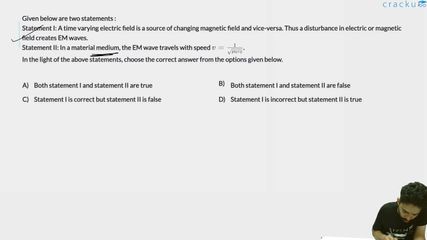
Given below are two statements :
Statement I: A time varying electric field is a source of changing magnetic field and vice-versa. Thus a disturbance in electric or magnetic field creates EM waves.
Statement II: In a material medium, the EM wave travels with speed $$v = \frac{1}{\sqrt{\mu_0\varepsilon_0}}$$.
In the light of the above statements, choose the correct answer from the options given below.
We need to evaluate two statements about electromagnetic waves.
Statement I: "A time varying electric field is a source of changing magnetic field and vice-versa. Thus a disturbance in electric or magnetic field creates EM waves."
This is correct. According to Maxwell's equations, a time-varying electric field produces a magnetic field (via the displacement current term in Ampere-Maxwell law), and a time-varying magnetic field produces an electric field (Faraday's law). This mutual generation of fields is the basis of electromagnetic wave propagation.
Statement II: "In a material medium, the EM wave travels with speed $$v = \frac{1}{\sqrt{\mu_0\varepsilon_0}}$$."
This is false. The speed $$\frac{1}{\sqrt{\mu_0\varepsilon_0}} = c$$ is the speed of light in vacuum. In a material medium, the speed of an EM wave is:
$$v = \frac{1}{\sqrt{\mu\varepsilon}}$$
where $$\mu$$ and $$\varepsilon$$ are the permeability and permittivity of the medium respectively (not the free-space values $$\mu_0$$ and $$\varepsilon_0$$). Since $$\mu \geq \mu_0$$ and $$\varepsilon \geq \varepsilon_0$$ for most materials, we have $$v \leq c$$.
Therefore, Statement I is correct but Statement II is false.
The correct answer is Option C.
Was this solution helpful?
Click on the Email ☝️ to Watch the Video Solution
Create a FREE account and get:
_1.webp)

Educational materials for JEE preparation

Ask our AI anything

AI can make mistakes. Please verify important information.
AI can make mistakes. Please verify important information.
