For the following questions answer them individually
The distance of the Sun from earth is $$1.5 \times 10^{11}$$ m and its angular diameter is $$2000''$$ when observed from the earth. The diameter of the Sun will be
The SI unit of a physical quantity is Pascal-sec. The dimensional formula of this quantity will be
If $$L, C$$ and $$R$$ are the self inductance, capacitance and resistance respectively, which of the following does not have the dimension of time?
When a ball is dropped into a lake from a height $$4.9$$ m above the water level, it hits the water with a velocity $$v$$ and then sinks to the bottom with the constant velocity $$v$$. It reaches the bottom of the lake $$4.0$$ s after it is dropped. The approximate depth of the lake is
One end of a massless spring of spring constant $$k$$ and natural length $$l_0$$ is fixed while the other end is connected to a small object of mass $$m$$ lying on a frictionless table. The spring remains horizontal on the table. If the object is made to rotate at an angular velocity $$\omega$$ about an axis passing through fixed end, then the elongation of the spring will be
A stone tied to a string of length $$L$$ is whirled in a vertical circle with the other end of the string at the centre. At a certain instant of time, the stone is at its lowest position and has a speed $$u$$. The magnitude of change in its velocity, as it reaches a position where the string is horizontal, is $$\sqrt{x(u^2 - gL)}$$. The value of $$x$$ is
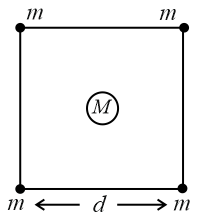
Four spheres each of mass $$m$$ form a square of side $$d$$ (as shown in figure). A fifth sphere of mass $$M$$ is situated at the centre of square. The total gravitational potential energy of the system is
A lead bullet penetrates into a solid object and melts. Assuming that $$40\%$$ of its kinetic energy is used to heat it, the initial speed of bullet is
(Given, initial temperature of the bullet $$= 127°$$C, Melting point of the bullet $$= 327°$$C, Latent heat of fusion of lead $$= 2.5 \times 10^4$$ J kg$$^{-1}$$, Specific heat capacity of lead $$= 125$$ J kg$$^{-1}$$ K$$^{-1}$$)
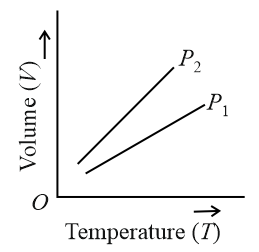
For a perfect gas, two pressures $$P_1$$ and $$P_2$$ are shown in figure. The graph shows
According to kinetic theory of gases,
A. The motion of the gas molecules freezes at $$0°$$C.
B. The mean free path of gas molecules decreases if the density of molecules is increased.
C. The mean free path of gas molecules increases if temperature is increased keeping pressure constant.
D. Average kinetic energy per molecule per degree of freedom is $$\frac{3}{2}k_BT$$ (for monoatomic gases).
Choose the most appropriate answer from the options given below