
Join Our JEE Preparation Group
Prep with like-minded aspirants; Get access to free daily tests and study material.
Sign in
Please select an account to continue using cracku.in
↓ →
Join Our JEE Preparation Group
Prep with like-minded aspirants; Get access to free daily tests and study material.
Arrange the following coordination compounds in the increasing order of magnetic moments. (Atomic numbers: Mn = 25; Fe = 26)
A. $$[FeF_6]^{3-}$$
B. $$[Fe(CN)_6]^{3-}$$
C. $$[MnCl_6]^{3-}$$ (high spin)
D. $$[Mn(CN)_6]^{3-}$$
Choose the correct answer from the options given below
We need to arrange the coordination compounds in increasing order of magnetic moments.
Magnetic moment $$\mu = \sqrt{n(n+2)}$$ BM, where $$n$$ is the number of unpaired electrons.
Determine the number of unpaired electrons in each complex.
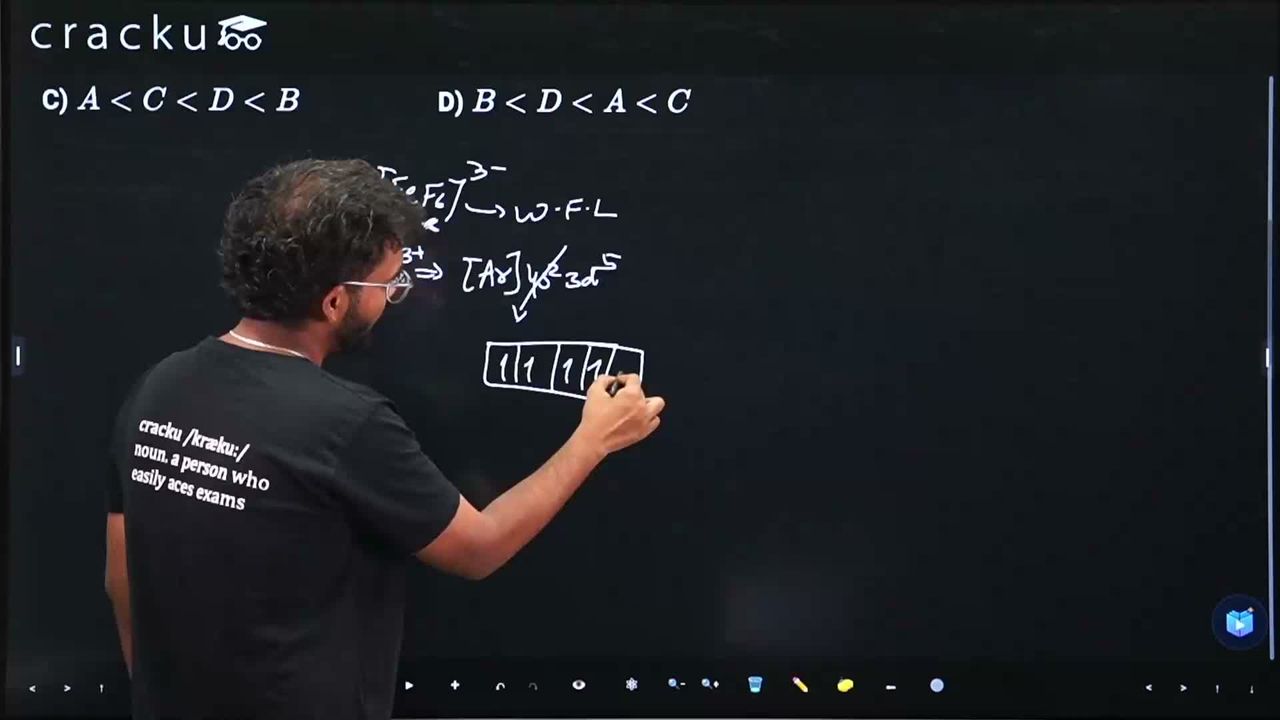
A. $$[FeF_6]^{3-}$$: Fe is in +3 oxidation state, so $$Fe^{3+}$$ has configuration $$3d^5$$. $$F^-$$ is a weak field ligand, so no pairing occurs (high spin). Unpaired electrons = 5.
$$\mu = \sqrt{5(5+2)} = \sqrt{35} = 5.92$$ BM
B. $$[Fe(CN)_6]^{3-}$$: Fe is in +3 oxidation state, so $$Fe^{3+}$$ has $$3d^5$$. $$CN^-$$ is a strong field ligand, so maximum pairing occurs (low spin): $$t_{2g}^5 e_g^0$$. Unpaired electrons = 1.
$$\mu = \sqrt{1(1+2)} = \sqrt{3} = 1.73$$ BM
C. $$[MnCl_6]^{3-}$$ (high spin): Mn is in +3 oxidation state, so $$Mn^{3+}$$ has $$3d^4$$. $$Cl^-$$ is a weak field ligand and it is given as high spin: $$t_{2g}^3 e_g^1$$. Unpaired electrons = 4.
$$\mu = \sqrt{4(4+2)} = \sqrt{24} = 4.90$$ BM
D. $$[Mn(CN)_6]^{3-}$$: Mn is in +3 oxidation state, so $$Mn^{3+}$$ has $$3d^4$$. $$CN^-$$ is a strong field ligand (low spin): $$t_{2g}^4 e_g^0$$. Unpaired electrons = 2.
$$\mu = \sqrt{2(2+2)} = \sqrt{8} = 2.83$$ BM
Arrange in increasing order of magnetic moment.
$$B (1.73) < D (2.83) < C (4.90) < A (5.92)$$
The increasing order is: $$B < D < C < A$$
The correct answer is Option B.
Was this solution helpful?
Click on the Email ☝️ to Watch the Video Solution
Create a FREE account and get:
_1.webp)

Educational materials for JEE preparation

Ask our AI anything

AI can make mistakes. Please verify important information.
AI can make mistakes. Please verify important information.
