
Join Our JEE Preparation Group
Prep with like-minded aspirants; Get access to free daily tests and study material.
Sign in
Please select an account to continue using cracku.in
↓ →
Join Our JEE Preparation Group
Prep with like-minded aspirants; Get access to free daily tests and study material.
Given below are two statements
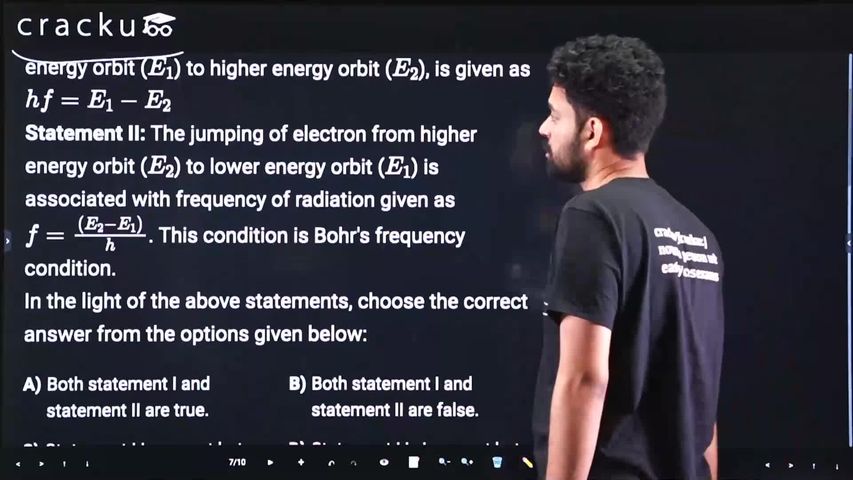
Statement I: In hydrogen atom, the frequency of radiation emitted when an electron jumps from lower energy orbit ($$E_1$$) to higher energy orbit ($$E_2$$), is given as $$hf = E_1 - E_2$$
Statement II: The jumping of electron from higher energy orbit ($$E_2$$) to lower energy orbit ($$E_1$$) is associated with frequency of radiation given as $$f = \frac{(E_2-E_1)}{h}$$. This condition is Bohr's frequency condition.
In the light of the above statements, choose the correct answer from the options given below:
We need to evaluate two statements about the hydrogen atom and Bohr's frequency condition.
Statement I: "In hydrogen atom, the frequency of radiation emitted when an electron jumps from lower energy orbit ($$E_1$$) to higher energy orbit ($$E_2$$), is given as $$hf = E_1 - E_2$$."
This is incorrect. When an electron jumps from a lower energy orbit to a higher energy orbit, it absorbs radiation (not emits). Emission occurs only when an electron transitions from a higher energy orbit to a lower energy orbit. Also, since $$E_2 > E_1$$, the expression $$E_1 - E_2$$ would be negative, which is unphysical for a photon energy.
Statement II: "The jumping of electron from higher energy orbit ($$E_2$$) to lower energy orbit ($$E_1$$) is associated with frequency of radiation given as $$f = \frac{(E_2 - E_1)}{h}$$. This condition is Bohr's frequency condition."
This is correct. When an electron transitions from a higher energy level $$E_2$$ to a lower energy level $$E_1$$, a photon is emitted with energy equal to the difference:
$$hf = E_2 - E_1$$
$$f = \frac{E_2 - E_1}{h}$$
This is indeed Bohr's frequency condition.
Therefore, Statement I is incorrect but Statement II is true.
The correct answer is Option D.
Was this solution helpful?
Click on the Email ☝️ to Watch the Video Solution
Create a FREE account and get:
_1.webp)

Educational materials for JEE preparation

Ask our AI anything

AI can make mistakes. Please verify important information.
AI can make mistakes. Please verify important information.
