
Join Our JEE Preparation Group
Prep with like-minded aspirants; Get access to free daily tests and study material.
Sign in
Please select an account to continue using cracku.in
↓ →
Join Our JEE Preparation Group
Prep with like-minded aspirants; Get access to free daily tests and study material.
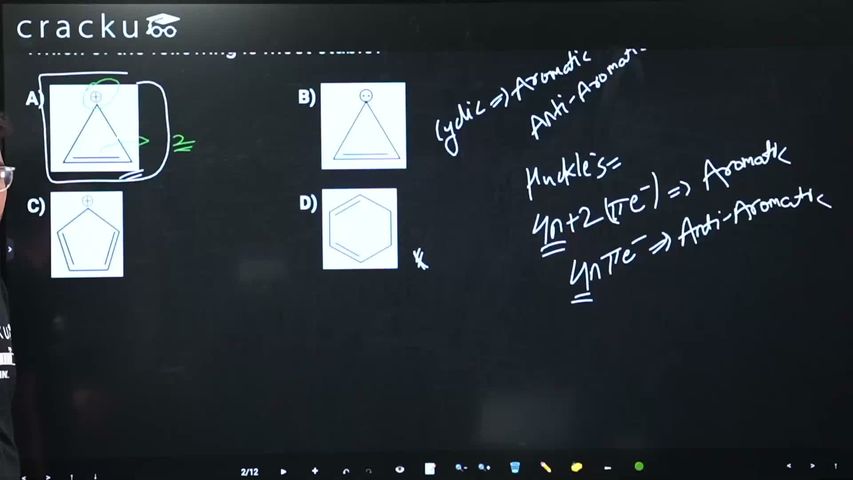
Apply Huckel's rule for aromaticity.
A cyclic, planar, fully conjugated system is aromatic if it has $$(4n + 2)$$ $$\pi$$-electrons (where $$n = 0, 1, 2, ...$$), and antiaromatic if it has $$4n$$ $$\pi$$-electrons. Aromatic species are exceptionally stable, while antiaromatic species are very unstable.
Analyze each species.
Option A - Cyclopropenyl cation ($$C_3H_3^+$$):
This has 3 carbon atoms in a ring with one positive charge. Number of $$\pi$$-electrons = 2 (one double bond contributes 2 electrons; the cationic carbon has an empty p-orbital). With $$4n + 2 = 2$$ ($$n = 0$$), this is aromatic and highly stable.
Option B - Cyclopropenyl anion ($$C_3H_3^-$$):
This has 4 $$\pi$$-electrons. With $$4n = 4$$ ($$n = 1$$), this is antiaromatic and very unstable.
Option C - Cyclopentadienyl cation ($$C_5H_5^+$$):
This has 4 $$\pi$$-electrons. With $$4n = 4$$ ($$n = 1$$), this is antiaromatic and unstable.
Option D - Cyclohexadienyl:
The cyclohexadienyl species is not fully conjugated (it has an $$sp^3$$ carbon breaking the conjugation), so it is non-aromatic and less stable than an aromatic species.
Conclusion.
The cyclopropenyl cation (Option A) is the only aromatic species among the choices, making it the most stable.
The answer is $$\boxed{\text{Option A}}$$.
Was this solution helpful?
Click on the Email ☝️ to Watch the Video Solution
Create a FREE account and get:
_1.webp)

Educational materials for JEE preparation

Ask our AI anything

AI can make mistakes. Please verify important information.
AI can make mistakes. Please verify important information.
