
Join Our JEE Preparation Group
Prep with like-minded aspirants; Get access to free daily tests and study material.
Sign in
Please select an account to continue using cracku.in
↓ →
Join Our JEE Preparation Group
Prep with like-minded aspirants; Get access to free daily tests and study material.
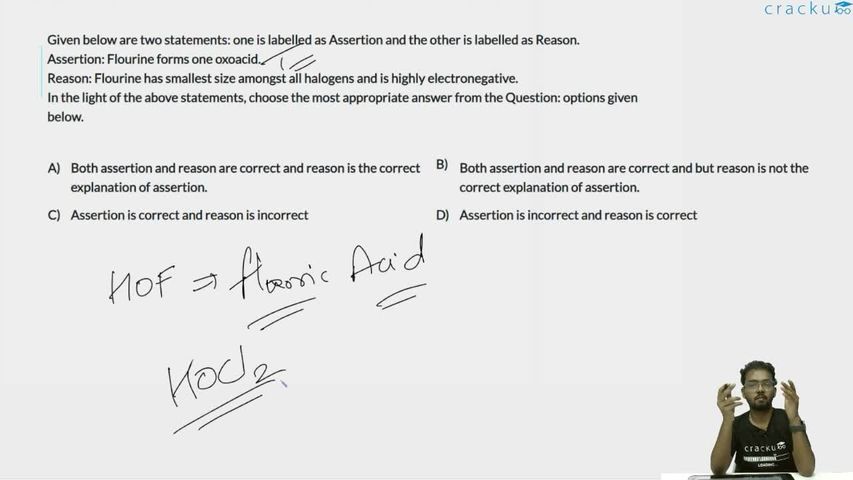
Given below are two statements: one is labelled as Assertion and the other is labelled as Reason.
Assertion: Flourine forms one oxoacid.
Reason: Flourine has smallest size amongst all halogens and is highly electronegative.
In the light of the above statements, choose the most appropriate answer from the Question: options given
below.
Fluorine forms one oxoacid. It forms only one oxoacid, which is hypofluorous acid ($$HOF$$, also called fluoric(I) acid). All other halogens (Cl, Br, I) form multiple oxoacids (e.g., $$HOCl, HClO_2, HClO_3, HClO_4$$). The assertion is correct.
Fluorine has the smallest size amongst all halogens and is highly electronegative. Fluorine is the smallest halogen (atomic radius ~ 64 pm) and has the highest electronegativity (3.98 on the Pauling scale). This is factually correct.
Fluorine forms only one oxoacid because:
1. Due to its very small size, fluorine cannot accommodate multiple oxygen atoms around it.
2. Due to its high electronegativity (higher than oxygen), fluorine cannot exhibit positive oxidation states. In oxoacids of other halogens, the halogen shows positive oxidation states (+1, +3, +5, +7), but fluorine cannot do this because it is more electronegative than oxygen.
3. Fluorine lacks d-orbitals, so it cannot expand its octet to form higher oxoacids.
Therefore, both the small size and high electronegativity of fluorine directly explain why it forms only one oxoacid. The reason is the correct explanation of the assertion.
The answer is $$\boxed{\text{Option A}}$$.
Was this solution helpful?
Click on the Email ☝️ to Watch the Video Solution
Create a FREE account and get:
_1.webp)

Educational materials for JEE preparation

Ask our AI anything

AI can make mistakes. Please verify important information.
AI can make mistakes. Please verify important information.
