
Join Our JEE Preparation Group
Prep with like-minded aspirants; Get access to free daily tests and study material.
Sign in
Please select an account to continue using cracku.in
↓ →
Join Our JEE Preparation Group
Prep with like-minded aspirants; Get access to free daily tests and study material.
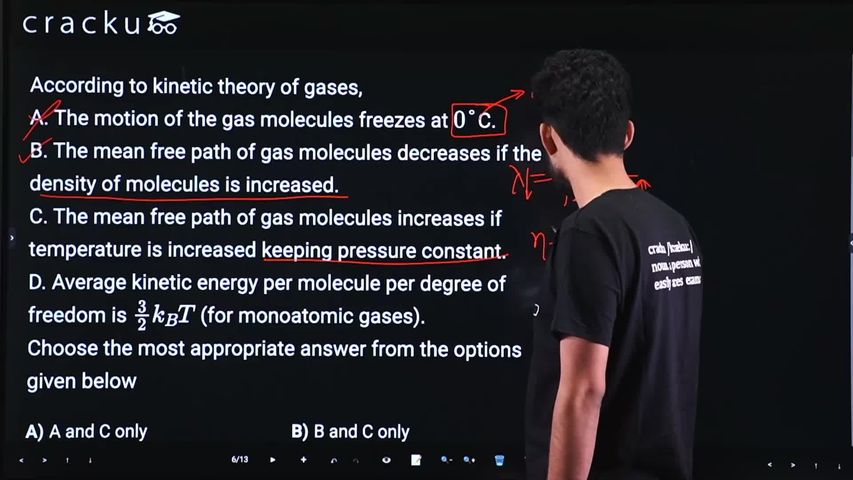
According to kinetic theory of gases,
A. The motion of the gas molecules freezes at $$0°$$C.
B. The mean free path of gas molecules decreases if the density of molecules is increased.
C. The mean free path of gas molecules increases if temperature is increased keeping pressure constant.
D. Average kinetic energy per molecule per degree of freedom is $$\frac{3}{2}k_BT$$ (for monoatomic gases).
Choose the most appropriate answer from the options given below
We need to identify which statements about the kinetic theory of gases are correct.
Statement A: "The motion of gas molecules freezes at 0°C."
This is false. The motion of gas molecules would theoretically cease at absolute zero (0 K = $$-273.15°$$C), not at 0°C. At 0°C (273.15 K), gas molecules still possess significant kinetic energy.
Statement B: "The mean free path decreases if the density of molecules is increased."
The mean free path is given by $$\lambda = \frac{1}{\sqrt{2}\pi d^2 n}$$, where $$n$$ is the number density and $$d$$ is the molecular diameter. As density ($$n$$) increases, mean free path decreases. This is true.
Statement C: "The mean free path increases if temperature is increased keeping pressure constant."
At constant pressure, $$n = \frac{P}{k_BT}$$. As temperature increases, $$n$$ decreases. Since $$\lambda = \frac{1}{\sqrt{2}\pi d^2 n}$$, a decrease in $$n$$ leads to an increase in $$\lambda$$. This is true.
Statement D: "Average kinetic energy per molecule per degree of freedom is $$\frac{3}{2}k_BT$$."
This is false. The average kinetic energy per molecule per degree of freedom is $$\frac{1}{2}k_BT$$. The total average kinetic energy for a monoatomic gas (3 degrees of freedom) is $$\frac{3}{2}k_BT$$, but that is per molecule, not per degree of freedom.
The correct statements are B and C.
The correct answer is Option B.
Was this solution helpful?
Click on the Email ☝️ to Watch the Video Solution
Create a FREE account and get:
_1.webp)

Educational materials for JEE preparation

Ask our AI anything

AI can make mistakes. Please verify important information.
AI can make mistakes. Please verify important information.
