
Join Our JEE Preparation Group
Prep with like-minded aspirants; Get access to free daily tests and study material.
Sign in
Please select an account to continue using cracku.in
↓ →
Join Our JEE Preparation Group
Prep with like-minded aspirants; Get access to free daily tests and study material.
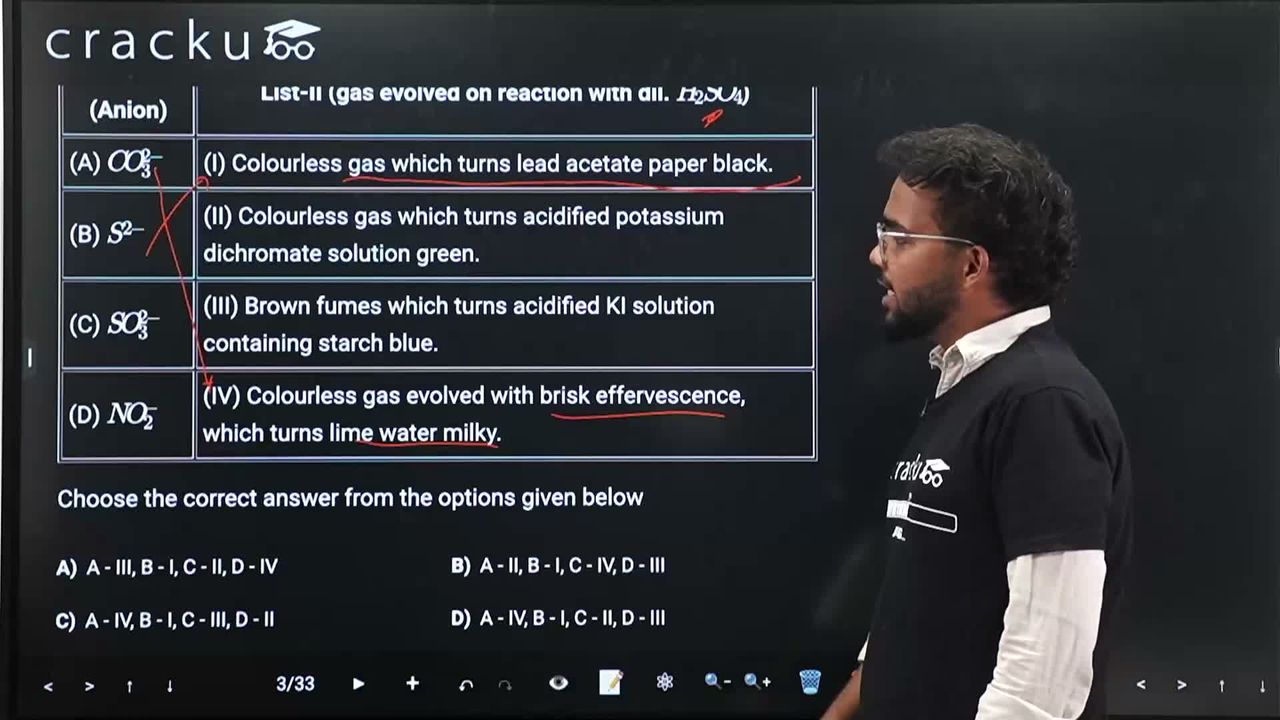
Match List - I with List - II.
| List-I (Anion) | List-II (gas evolved on reaction with dil. $$H_2SO_4$$) |
|---|---|
| (A) $$CO_3^{2-}$$ | (I) Colourless gas which turns lead acetate paper black. |
| (B) $$S^{2-}$$ | (II) Colourless gas which turns acidified potassium dichromate solution green. |
| (C) $$SO_3^{2-}$$ | (III) Brown fumes which turns acidified KI solution containing starch blue. |
| (D) $$NO_2^-$$ | (IV) Colourless gas evolved with brisk effervescence, which turns lime water milky. |
Choose the correct answer from the options given below
We need to match each anion with the gas evolved when it reacts with dilute $$H_2SO_4$$.
(A) $$CO_3^{2-}$$ reacts with $$H_2SO_4$$ to give carbon dioxide: $$CO_3^{2-} + H_2SO_4 \rightarrow CO_2 + H_2O + SO_4^{2-}$$. Carbon dioxide is a colourless gas that is evolved with brisk effervescence and turns lime water milky: $$CO_2 + Ca(OH)_2 \rightarrow CaCO_3\downarrow + H_2O$$. Therefore it matches with (IV).
(B) $$S^{2-}$$ reacts with $$H_2SO_4$$ to give hydrogen sulfide: $$S^{2-} + H_2SO_4 \rightarrow H_2S + SO_4^{2-}$$. Hydrogen sulfide is a colourless gas with a rotten egg smell and turns lead acetate paper black: $$Pb(CH_3COO)_2 + H_2S \rightarrow PbS\downarrow(\text{black}) + 2CH_3COOH$$. Therefore it matches with (I).
(C) $$SO_3^{2-}$$ reacts with $$H_2SO_4$$ to give sulfur dioxide: $$SO_3^{2-} + H_2SO_4 \rightarrow SO_2 + H_2O + SO_4^{2-}$$. Sulfur dioxide is a colourless gas with a pungent smell; it acts as a reducing agent and turns acidified potassium dichromate solution green: $$K_2Cr_2O_7 + 3SO_2 + H_2SO_4 \rightarrow K_2SO_4 + Cr_2(SO_4)_3(\text{green}) + H_2O$$. Therefore it matches with (II).
(D) $$NO_2^-$$ reacts with $$H_2SO_4$$ to form nitrous acid which decomposes to nitrogen dioxide: $$NO_2^- + H_2SO_4 \rightarrow HNO_2 \rightarrow NO_2(\text{brown fumes})$$. The brown fumes oxidize iodide ions to iodine, turning starch solution blue: $$2NO_2 + 2KI \rightarrow 2KNO_2 + I_2$$ and $$I_2 + \text{starch} \rightarrow \text{blue colour}$$. Therefore it matches with (III).
The correct answer is Option D: A - IV, B - I, C - II, D - III.
Was this solution helpful?
Click on the Email ☝️ to Watch the Video Solution
Create a FREE account and get:
_1.webp)

Educational materials for JEE preparation

Ask our AI anything

AI can make mistakes. Please verify important information.
AI can make mistakes. Please verify important information.
