
Join Our JEE Preparation Group
Prep with like-minded aspirants; Get access to free daily tests and study material.
Sign in
Please select an account to continue using cracku.in
↓ →
Join Our JEE Preparation Group
Prep with like-minded aspirants; Get access to free daily tests and study material.
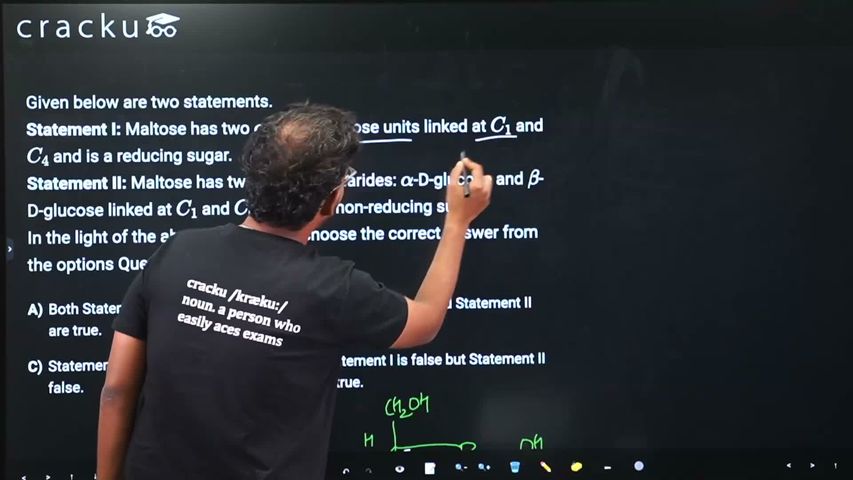
Given below are two statements.
Statement I: Maltose has two $$\alpha - D$$ - glucose units linked at $$C_1$$ and $$C_4$$ and is a reducing sugar.
Statement II: Maltose has two monosaccharides: $$\alpha$$-D-glucose and $$\beta$$-D-glucose linked at $$C_1$$ and $$C_6$$ and it is a non-reducing sugar.
In the light of the above statements, choose the correct answer from the options Question: given below.
We need to evaluate the two statements about Maltose. Maltose is a disaccharide formed by the hydrolysis of starch. Its structure consists of two $$\alpha$$-D-glucose units linked by a glycosidic bond between $$C_1$$ of one glucose and $$C_4$$ of the other glucose ($$\alpha$$-1,4-glycosidic linkage).
Statement I: "Maltose has two $$\alpha$$-D-glucose units linked at $$C_1$$ and $$C_4$$ and is a reducing sugar." This is true. Maltose indeed consists of two $$\alpha$$-D-glucose units connected by an $$\alpha$$-1,4-glycosidic bond. The anomeric carbon ($$C_1$$) of the second glucose unit is free (not involved in the glycosidic bond), which gives maltose its reducing property. The free anomeric carbon can open to form an aldehyde group, which can reduce Tollens' reagent and Fehling's solution.
Statement II: "Maltose has two monosaccharides: $$\alpha$$-D-glucose and $$\beta$$-D-glucose linked at $$C_1$$ and $$C_6$$ and it is a non-reducing sugar." This is false for multiple reasons: (1) Maltose is made up of two $$\alpha$$-D-glucose units, not one $$\alpha$$ and one $$\beta$$ unit. (2) The linkage is between $$C_1$$ and $$C_4$$ (not $$C_1$$ and $$C_6$$); the $$C_1$$-$$C_6$$ linkage is found in isomaltose. (3) Maltose is a reducing sugar, not a non-reducing sugar; the disaccharide with $$C_1$$-$$C_6$$ linkage between $$\alpha$$-D-glucose and $$\beta$$-D-glucose described here does not correspond to maltose.
Statement I is true but Statement II is false. The correct answer is Option C.
Was this solution helpful?
Click on the Email ☝️ to Watch the Video Solution
Create a FREE account and get:
_1.webp)

Educational materials for JEE preparation

Ask our AI anything

AI can make mistakes. Please verify important information.
AI can make mistakes. Please verify important information.
