
Join Our JEE Preparation Group
Prep with like-minded aspirants; Get access to free daily tests and study material.
Sign in
Please select an account to continue using cracku.in
↓ →
Join Our JEE Preparation Group
Prep with like-minded aspirants; Get access to free daily tests and study material.
Statement I: Leaching of gold with cyanide ion in absence of air/$$O_2$$ leads to cyano complex of Au(III).
Statement II: Zinc is oxidized during the displacement reaction carried out for gold extraction.
In the light of the above statements, choose the correct answer from the options given below
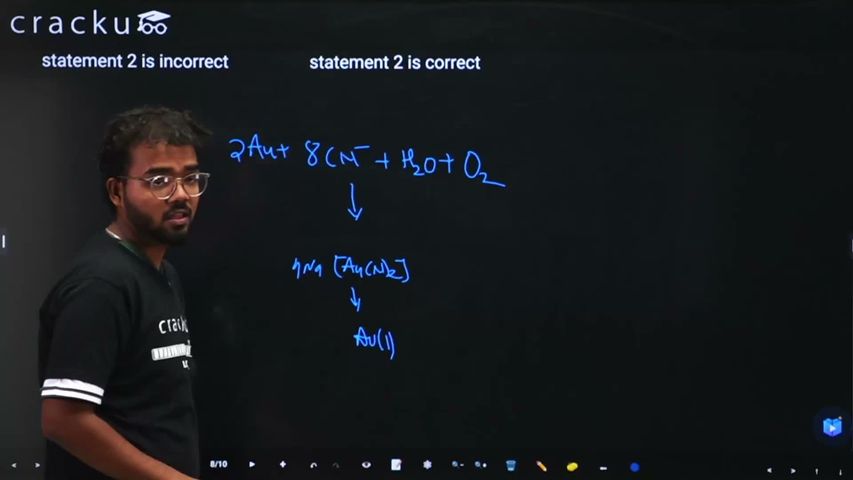
Statement I says: Leaching of gold with cyanide ion in absence of air/$$O_2$$ leads to cyano complex of Au(III). The actual cyanide leaching process (MacArthur-Forrest process) requires oxygen: $$4Au + 8CN^- + 2H_2O + O_2 \rightarrow 4[Au(CN)_2]^- + 4OH^-$$. This produces $$[Au(CN)_2]^-$$, which is a complex of Au(I), not Au(III). Moreover, the reaction requires air/$$O_2$$ as an oxidizing agent. In the absence of air/$$O_2$$, gold cannot be oxidized and leaching does not occur effectively. Therefore, Statement I is incorrect on two counts: it claims Au(III) is formed (actually Au(I)), and it claims the reaction works without air (it requires $$O_2$$).
Statement II says: Zinc is oxidized during the displacement reaction for gold extraction. In the displacement step, zinc dust is added to the gold cyanide solution: $$2[Au(CN)_2]^- + Zn \rightarrow [Zn(CN)_4]^{2-} + 2Au$$. Here, Zn is oxidized from Zn(0) to Zn(II), and Au(I) is reduced to Au(0). Therefore, Statement II is correct.
The answer is $$\boxed{\text{Option D}}$$.
Was this solution helpful?
Click on the Email ☝️ to Watch the Video Solution
Create a FREE account and get:
_1.webp)

Educational materials for JEE preparation

Ask our AI anything

AI can make mistakes. Please verify important information.
AI can make mistakes. Please verify important information.
