
Join Our JEE Preparation Group
Prep with like-minded aspirants; Get access to free daily tests and study material.
Sign in
Please select an account to continue using cracku.in
↓ →
Join Our JEE Preparation Group
Prep with like-minded aspirants; Get access to free daily tests and study material.
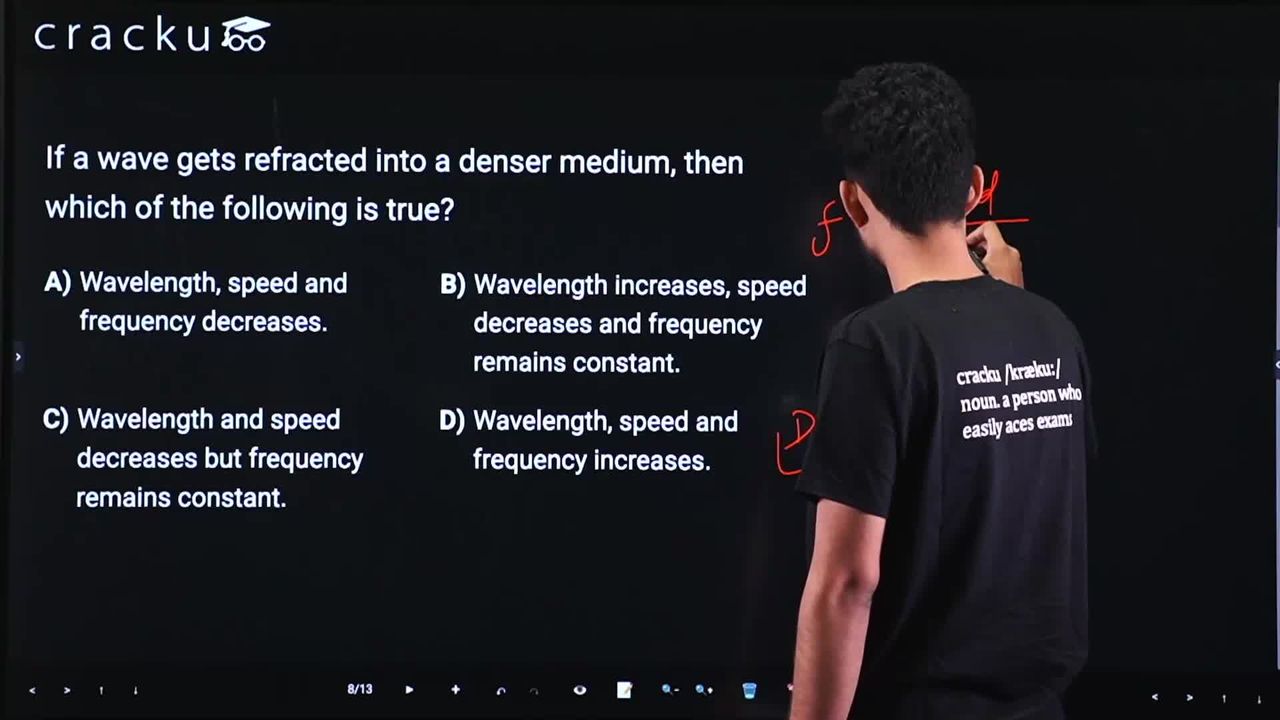
When a wave travels from a rarer medium to a denser medium (refraction into a denser medium), we need to determine what happens to its wavelength, speed, and frequency.
Frequency remains constant during refraction.
When a wave crosses a boundary between two media, the frequency does not change. This is because the number of wave crests arriving at the boundary per second must equal the number leaving — frequency is determined by the source.
Speed decreases in a denser medium.
In a denser medium, the speed of a wave decreases. For example, the speed of light in a medium is $$v = \frac{c}{n}$$, where $$n > 1$$ is the refractive index of the denser medium.
Wavelength decreases.
Since $$v = f\lambda$$ and frequency $$f$$ remains constant while speed $$v$$ decreases, the wavelength $$\lambda$$ must also decrease:
$$\lambda_{\text{denser}} = \frac{v_{\text{denser}}}{f} < \frac{v_{\text{rarer}}}{f} = \lambda_{\text{rarer}}$$
Therefore, wavelength and speed decrease but frequency remains constant.
The correct answer is Option C.
Was this solution helpful?
Click on the Email ☝️ to Watch the Video Solution
Create a FREE account and get:
_1.webp)

Educational materials for JEE preparation

Ask our AI anything

AI can make mistakes. Please verify important information.
AI can make mistakes. Please verify important information.
