
Join Our JEE Preparation Group
Prep with like-minded aspirants; Get access to free daily tests and study material.
Sign in
Please select an account to continue using cracku.in
↓ →
Join Our JEE Preparation Group
Prep with like-minded aspirants; Get access to free daily tests and study material.
If a charge $$q$$ is placed at the centre of a closed hemispherical non-conducting surface, the total flux passing through the flat surface would be
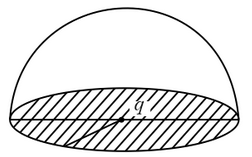
A charge $$q$$ is placed at the centre of a closed hemispherical non-conducting surface. We need to find the total flux through the flat surface.
Apply Gauss's Law to the closed hemispherical surface.
The closed surface consists of two parts: the curved hemispherical surface and the flat circular base. Since the charge $$q$$ is enclosed within this closed surface, by Gauss's law:
$$\Phi_{\text{total}} = \Phi_{\text{curved}} + \Phi_{\text{flat}} = \frac{q}{\varepsilon_0}$$
Calculate the flux through the curved surface using symmetry.
Imagine a complete sphere centred at the charge $$q$$. The total flux through the full sphere is $$\frac{q}{\varepsilon_0}$$. Since the charge is at the centre, the flux is uniformly distributed over the sphere. The curved hemisphere is exactly half of this full sphere, so:
$$\Phi_{\text{curved}} = \frac{1}{2} \times \frac{q}{\varepsilon_0} = \frac{q}{2\varepsilon_0}$$
Find the flux through the flat surface.
$$\Phi_{\text{flat}} = \Phi_{\text{total}} - \Phi_{\text{curved}} = \frac{q}{\varepsilon_0} - \frac{q}{2\varepsilon_0} = \frac{q}{2\varepsilon_0}$$
Therefore, the total flux passing through the flat surface is $$\dfrac{q}{2\varepsilon_0}$$.
The correct answer is Option B.
Was this solution helpful?
Click on the Email ☝️ to Watch the Video Solution
Create a FREE account and get:
_1.webp)

Educational materials for JEE preparation

Ask our AI anything

AI can make mistakes. Please verify important information.
AI can make mistakes. Please verify important information.
