
Join Our JEE Preparation Group
Prep with like-minded aspirants; Get access to free daily tests and study material.
Sign in
Please select an account to continue using cracku.in
↓ →
Join Our JEE Preparation Group
Prep with like-minded aspirants; Get access to free daily tests and study material.
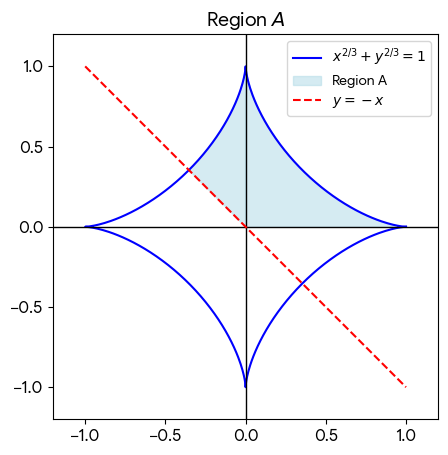
If the area of the region $$\left\{(x,y) : x^{\frac{2}{3}} + y^{\frac{2}{3}} \leq 1, x + y \geq 0, y \geq 0\right\}$$ is $$A$$, then $$\frac{256A}{\pi}$$ is ______
Correct Answer: 36
Given region,
$$x^{\frac23}+y^{\frac23}\le1,\qquad x+y\ge0,\qquad y\ge0$$
The curve
$$x^{\frac23}+y^{\frac23}=1$$
is an astroid.
Total area of the astroid is
$$\frac{3\pi}{8}$$
By symmetry, area in each quadrant is
$$\frac14\times\frac{3\pi}{8}=\frac{3\pi}{32}$$
Now,
$$y\ge0$$
restricts the region to the upper half-plane.
Also,
$$x+y\ge0$$
represents the region above the line
$$y=-x$$
In the first quadrant, this condition is always satisfied.
Hence, complete first quadrant area is included:
$$\frac{3\pi}{32}$$
In the second quadrant, the line
$$y=-x$$
bisects the astroid region symmetrically.
Therefore, only half of the second quadrant area is included:
$$\frac12\times\frac{3\pi}{32}=\frac{3\pi}{64}$$
Thus,
$$A=\frac{3\pi}{32}+\frac{3\pi}{64}=\frac{9\pi}{64}$$
Therefore,
$$\frac{256A}{\pi}=\frac{256}{\pi}\times\frac{9\pi}{64}=36$$
Hence,
$$\boxed{36}$$
Was this solution helpful?
Create a FREE account and get:
_1.webp)

Educational materials for JEE preparation

Ask our AI anything

AI can make mistakes. Please verify important information.
AI can make mistakes. Please verify important information.
