
Join Our JEE Preparation Group
Prep with like-minded aspirants; Get access to free daily tests and study material.
Sign in
Please select an account to continue using cracku.in
↓ →
Join Our JEE Preparation Group
Prep with like-minded aspirants; Get access to free daily tests and study material.
Consider the following set of quantum numbers.
A: n=3, l=3, m$$_{1}$$=-3
B: n=3, l=2, m$$_{1}$$=-2
C: n=2, l=1, m$$_{1}$$=+1
D: n=2, l=2, m$$_{1}$$=+2
The number of correct sets of quantum numbers is ______
Correct Answer: 2
We need to determine how many of the given sets of quantum numbers are valid.
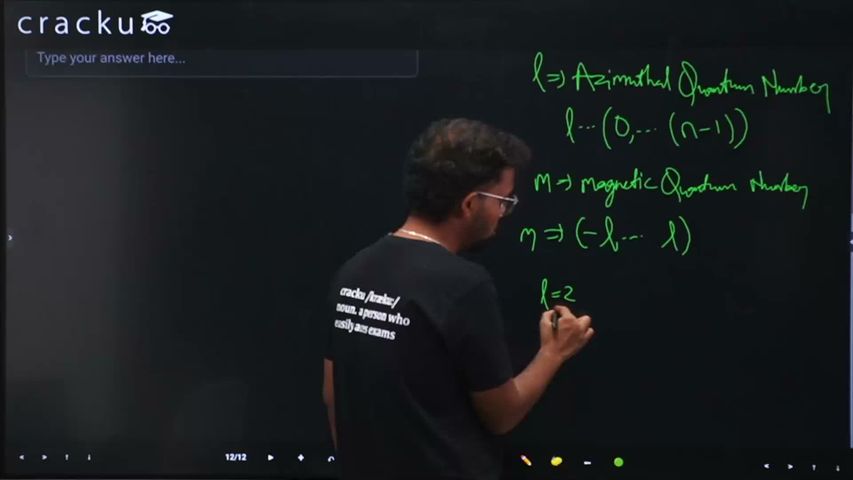
Key Rules for Quantum Numbers: 1. Principal quantum number: $$n = 1, 2, 3, ...$$; 2. Azimuthal quantum number: $$l = 0, 1, 2, ..., (n-1)$$; 3. Magnetic quantum number: $$m_l = -l, -(l-1), ..., 0, ..., (l-1), l$$.
For set A ($$n = 3, l = 3, m_l = -3$$), for $$n = 3$$ the allowed values of $$l$$ are 0, 1, 2 (i.e., $$l$$ ranges from 0 to $$n - 1 = 2$$). Here $$l = 3$$ is NOT allowed since $$l$$ must be less than $$n$$. Hence, set A is invalid.
For set B ($$n = 3, l = 2, m_l = -2$$), $$l$$ can be 0, 1, 2 so $$l = 2$$ is valid. For $$l = 2$$, $$m_l$$ can be $$-2, -1, 0, +1, +2$$ so $$m_l = -2$$ is valid. Hence, set B is valid.
For set C ($$n = 2, l = 1, m_l = +1$$), $$l$$ can be 0, 1 so $$l = 1$$ is valid. For $$l = 1$$, $$m_l$$ can be $$-1, 0, +1$$ so $$m_l = +1$$ is valid. Hence, set C is valid.
For set D ($$n = 2, l = 2, m_l = +2$$), $$l$$ can be 0, 1 (i.e., $$l$$ ranges from 0 to $$n - 1 = 1$$). Here $$l = 2$$ is NOT allowed since $$l$$ must be less than $$n$$. Hence, set D is invalid.
Only sets B and C are valid. The number of correct sets of quantum numbers is 2.
Was this solution helpful?
Click on the Email ☝️ to Watch the Video Solution
Create a FREE account and get:
_1.webp)

Educational materials for JEE preparation

Ask our AI anything

AI can make mistakes. Please verify important information.
AI can make mistakes. Please verify important information.
