
Join Our JEE Preparation Group
Prep with like-minded aspirants; Get access to free daily tests and study material.
Sign in
Please select an account to continue using cracku.in
↓ →
Join Our JEE Preparation Group
Prep with like-minded aspirants; Get access to free daily tests and study material.
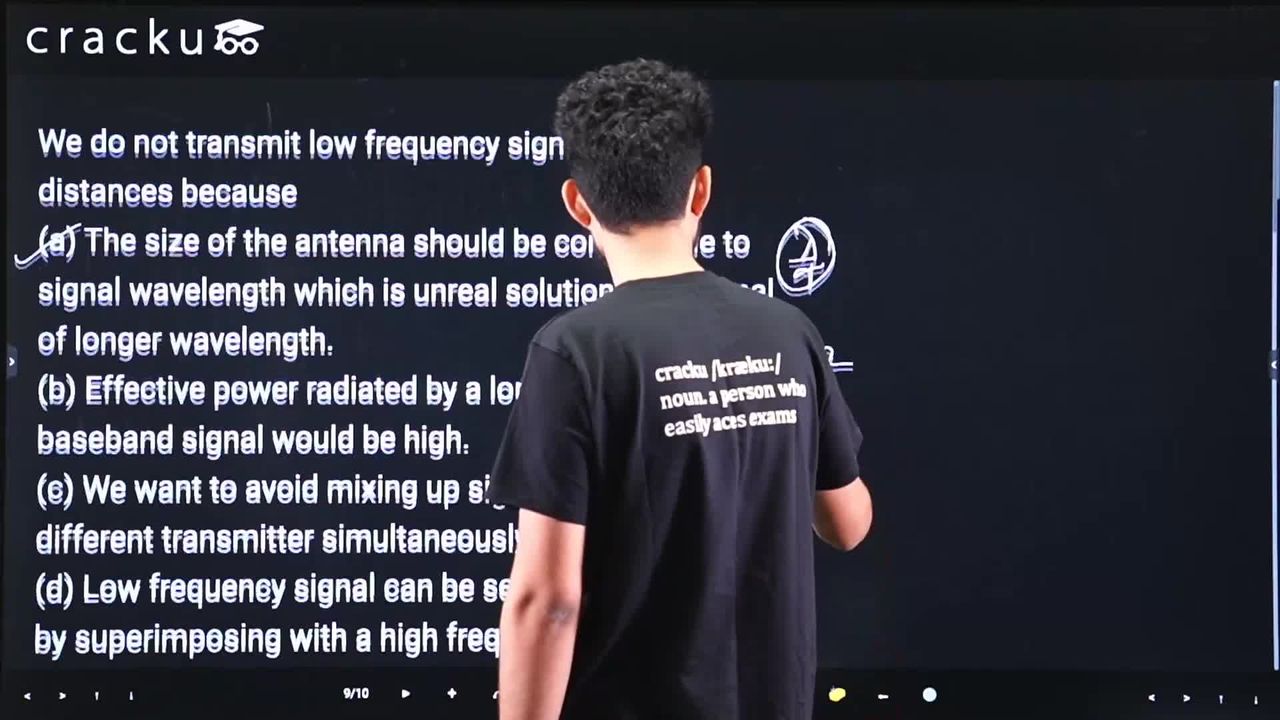
We do not transmit low frequency signal to long distances because
(a) The size of the antenna should be comparable to signal wavelength which is unreal solution for a signal of longer wavelength.
(b) Effective power radiated by a long wavelength baseband signal would be high.
(c) We want to avoid mixing up signals transmitted by different transmitter simultaneously.
(d) Low frequency signal can be sent to long distances by superimposing with a high frequency wave as well.
Therefore, the most suitable option will be :
We need to identify which statements correctly explain why low frequency signals are not transmitted directly to long distances.
Statement (a): "The size of the antenna should be comparable to signal wavelength which is unreal solution for a signal of longer wavelength."
This is true. For effective radiation, the antenna length should be comparable to the wavelength (at least $$\lambda/4$$). Low frequency signals have very large wavelengths (e.g., a 10 kHz signal has $$\lambda = 30$$ km), making it impractical to build such large antennas.
Statement (b): "Effective power radiated by a long wavelength baseband signal would be high."
This is false. The power radiated by an antenna is proportional to $$\left(\frac{l}{\lambda}\right)^2$$, where $$l$$ is the antenna length. For a baseband signal with very large wavelength, the ratio $$l/\lambda$$ is very small, so the effective power radiated would be very low, not high.
Statement (c): "We want to avoid mixing up signals transmitted by different transmitters simultaneously."
This is true. Modulation allows different signals to be transmitted at different carrier frequencies, enabling frequency-division multiplexing and preventing signal mixing. Without modulation, all baseband signals would occupy the same frequency range and interfere with each other.
Statement (d): "Low frequency signal can be sent to long distances by superimposing with a high frequency wave as well."
This is true. This is exactly the principle of modulation — a low frequency baseband signal is superimposed on a high frequency carrier wave for efficient long-distance transmission.
The true statements are (a), (c), and (d).
The correct answer is Option C.
Was this solution helpful?
Click on the Email ☝️ to Watch the Video Solution
Create a FREE account and get:
_1.webp)

Educational materials for JEE preparation

Ask our AI anything

AI can make mistakes. Please verify important information.
AI can make mistakes. Please verify important information.
