
Join Our JEE Preparation Group
Prep with like-minded aspirants; Get access to free daily tests and study material.
Sign in
Please select an account to continue using cracku.in
↓ →
Join Our JEE Preparation Group
Prep with like-minded aspirants; Get access to free daily tests and study material.
If the sum of the coefficients of all the positive powers of $$x$$, in the binomial expansion of $$\left(x^n + \frac{2}{x^5}\right)^7$$ is $$939$$, then the sum of all the possible integral values of $$n$$ is ______
Correct Answer: 57
We need to find the sum of all possible integral values of $$n$$ such that the sum of coefficients of all positive powers of $$x$$ in $$\left(x^n + \frac{2}{x^5}\right)^7$$ is 939.
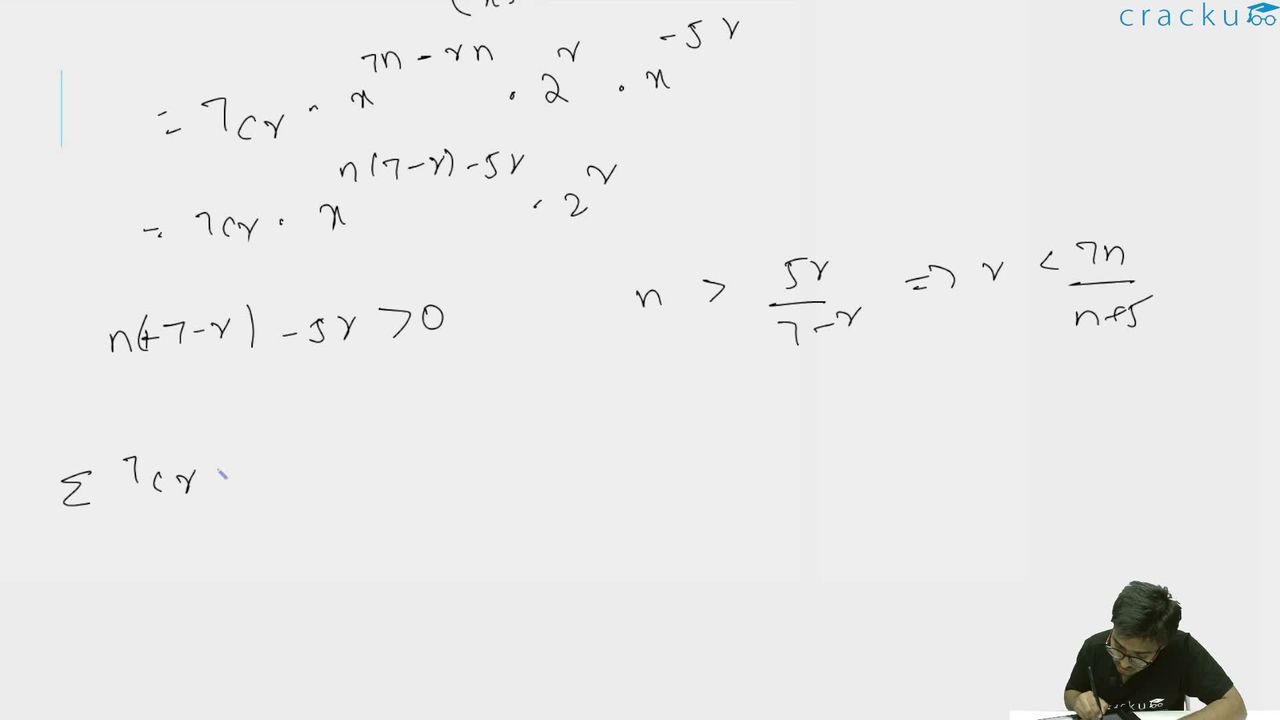
The general term of the expansion is $$T_{r+1} = \binom{7}{r}(x^n)^{7-r}\left(\frac{2}{x^5}\right)^r = \binom{7}{r} \cdot 2^r \cdot x^{n(7-r) - 5r}$$, so the power of $$x$$ in this term is $$7n - r(n + 5)$$. For this exponent to be positive we require $$7n - r(n + 5) > 0 \implies r < \frac{7n}{n + 5}$$.
Since the coefficient of $$T_{r+1}$$ is $$\binom{7}{r} \cdot 2^r$$, we need $$\sum_{\substack{r=0 \\ 7n - r(n+5) > 0}}^{7} \binom{7}{r} \cdot 2^r = 939$$. Computing gives $$\sum_{r=0}^{4} \binom{7}{r} \cdot 2^r = 1 + 14 + 84 + 280 + 560 = 939$$, so exactly $$r = 0, 1, 2, 3, 4$$ produce positive powers and $$r = 5$$ is the first to give a non-positive power.
Hence for $$r = 4$$ we need $$7n - 4(n + 5) = 3n - 20 > 0 \implies n > \frac{20}{3} \implies n \geq 7$$, while for $$r = 5$$ we require $$7n - 5(n + 5) = 2n - 25 \leq 0 \implies n \leq 12$$ (when $$n = 12$$: $$2(12) - 25 = -1 < 0$$ $$\checkmark$$; when $$n = 13$$: $$2(13) - 25 = 1 > 0$$ $$\times$$). Therefore $$n \in \{7, 8, 9, 10, 11, 12\}$$.
Summing these values yields $$7 + 8 + 9 + 10 + 11 + 12 = 57$$.
The correct answer is $$\boxed{57}$$.
Was this solution helpful?
Click on the Email ☝️ to Watch the Video Solution
Create a FREE account and get:
_1.webp)

Educational materials for JEE preparation

Ask our AI anything

AI can make mistakes. Please verify important information.
AI can make mistakes. Please verify important information.
