
Join Our JEE Preparation Group
Prep with like-minded aspirants; Get access to free daily tests and study material.
Sign in
Please select an account to continue using cracku.in
↓ →
Join Our JEE Preparation Group
Prep with like-minded aspirants; Get access to free daily tests and study material.
For the reaction taking place in the cell:
$$Pt(s)|H_2(g)|H^+(aq) || Ag^+(aq)|Ag(s)$$
$$E_{cell} = +0.5332$$ V.
The value of $$\Delta_r G^\circ$$ is ______ kJ mol$$^{-1}$$. (in nearest integer)
Correct Answer: 51
We need to find the value of $$\Delta_r G^\circ$$ for the electrochemical cell reaction. The cell notation is $$Pt(s)|H_2(g)|H^+(aq) || Ag^+(aq)|Ag(s)$$ and $$E_{cell} = +0.5332$$ V.
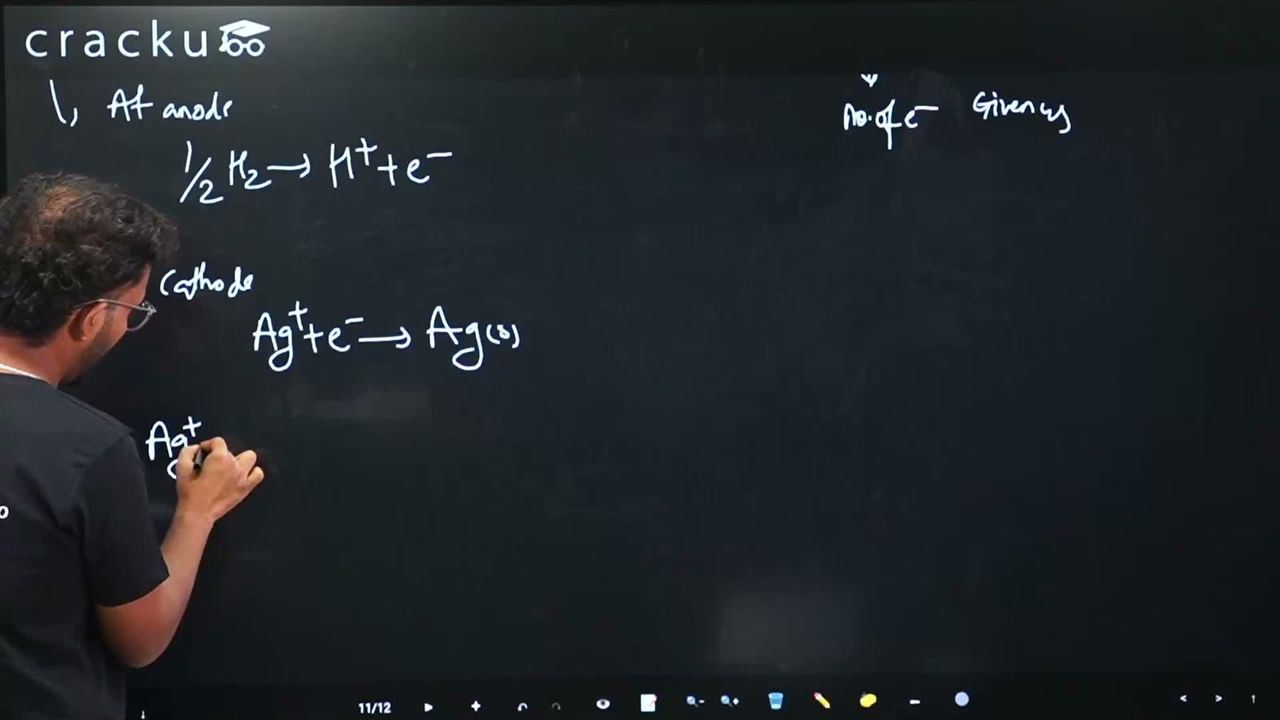
At the anode (oxidation, left half-cell) $$\dfrac{1}{2}H_2(g) \rightarrow H^+(aq) + e^-$$ and at the cathode (reduction, right half-cell) $$Ag^+(aq) + e^- \rightarrow Ag(s)$$, giving the overall reaction $$\dfrac{1}{2}H_2(g) + Ag^+(aq) \rightarrow H^+(aq) + Ag(s)$$ with number of electrons transferred $$n = 1$$.
The relationship between $$\Delta_r G^\circ$$ and $$E^\circ_{cell}$$ is given by $$\Delta_r G^\circ = -nFE^\circ_{cell}$$ where $$n = 1$$ (number of moles of electrons transferred), $$F = 96500$$ C mol$$^{-1}$$ (Faraday's constant), and $$E^\circ_{cell} = 0.5332$$ V.
Substituting the values yields $$\Delta_r G^\circ = -(1)(96500)(0.5332)$$ so that $$\Delta_r G^\circ = -96500 \times 0.5332$$. Computing the product term by term, $$96500 \times 0.5 = 48250$$, $$96500 \times 0.03 = 2895$$, $$96500 \times 0.003 = 289.5$$, and $$96500 \times 0.0002 = 19.3$$, hence $$96500 \times 0.5332 = 48250 + 2895 + 289.5 + 19.3 = 51453.8 \text{ J mol}^{-1}$$ and therefore $$\Delta_r G^\circ = -51453.8 \text{ J mol}^{-1} = -51.454 \text{ kJ mol}^{-1}$$.
Rounding to the nearest integer gives the magnitude of $$\Delta_r G^\circ$$ as approximately $$51$$ kJ mol$$^{-1}$$. Since the question asks for the value in kJ mol$$^{-1}$$ (nearest integer): $$|\Delta_r G^\circ| = 51$$ kJ mol$$^{-1}$$
Was this solution helpful?
Click on the Email ☝️ to Watch the Video Solution
Create a FREE account and get:
_1.webp)

Educational materials for JEE preparation

Ask our AI anything

AI can make mistakes. Please verify important information.
AI can make mistakes. Please verify important information.
