
Join Our JEE Preparation Group
Prep with like-minded aspirants; Get access to free daily tests and study material.
Sign in
Please select an account to continue using cracku.in
↓ →
Join Our JEE Preparation Group
Prep with like-minded aspirants; Get access to free daily tests and study material.
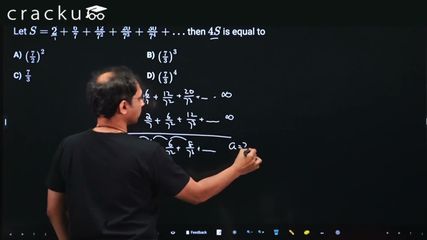
Let $$S = 2 + \frac{6}{7} + \frac{12}{7^2} + \frac{20}{7^3} + \frac{30}{7^4} + \ldots$$ then $$4S$$ is equal to
We need to find the value of $$4S$$ where $$S = 2 + \frac{6}{7} + \frac{12}{7^2} + \frac{20}{7^3} + \frac{30}{7^4} + \ldots$$
Observing that the numerators follow the sequence $$2, 6, 12, 20, 30, \ldots$$ reveals that each term is of the form $$n(n+1)$$ for $$n = 1,2,3,4,5,\ldots$$. Thus we can write
$$S = \sum_{n=1}^{\infty} \frac{n(n+1)}{7^{n-1}}$$
Since $$n(n+1) = n^2 + n$$, it follows that
$$S = \sum_{n=1}^{\infty} n^2 \left(\frac{1}{7}\right)^{n-1} + \sum_{n=1}^{\infty} n \left(\frac{1}{7}\right)^{n-1}$$
Letting $$r = \frac{1}{7}$$, we recall the standard results
$$\sum_{n=1}^{\infty} n \,r^{n-1} = \frac{1}{(1-r)^2}, \quad \sum_{n=1}^{\infty} n^2 \,r^{n-1} = \frac{1+r}{(1-r)^3}$$
Substituting $$r = \frac{1}{7}$$ gives $$1 - r = \frac{6}{7}$$, so
$$\sum_{n=1}^{\infty} n \,r^{n-1} = \frac{1}{(\tfrac{6}{7})^2} = \frac{49}{36}$$
and
$$\sum_{n=1}^{\infty} n^2 \,r^{n-1} = \frac{1 + 1/7}{(\tfrac{6}{7})^3} = \frac{8/7}{216/343} = \frac{8}{7} \times \frac{343}{216} = \frac{2744}{1512} = \frac{343}{189} = \frac{49}{27}$$
Therefore, combining these results yields
$$S = \frac{49}{27} + \frac{49}{36} = 49\left(\frac{1}{27} + \frac{1}{36}\right) = 49 \times \frac{4 + 3}{108} = 49 \times \frac{7}{108} = \frac{343}{108}$$
Hence
$$4S = \frac{4 \times 343}{108} = \frac{1372}{108} = \frac{343}{27} = \left(\frac{7}{3}\right)^3$$
Therefore, $$4S = \left(\frac{7}{3}\right)^3$$.
The correct answer is Option B: $$\left(\frac{7}{3}\right)^3$$.
Was this solution helpful?
Click on the Email ☝️ to Watch the Video Solution
Create a FREE account and get:
_1.webp)

Educational materials for JEE preparation

Ask our AI anything

AI can make mistakes. Please verify important information.
AI can make mistakes. Please verify important information.
