
Join Our JEE Preparation Group
Prep with like-minded aspirants; Get access to free daily tests and study material.
Sign in
Please select an account to continue using cracku.in
↓ →
Join Our JEE Preparation Group
Prep with like-minded aspirants; Get access to free daily tests and study material.
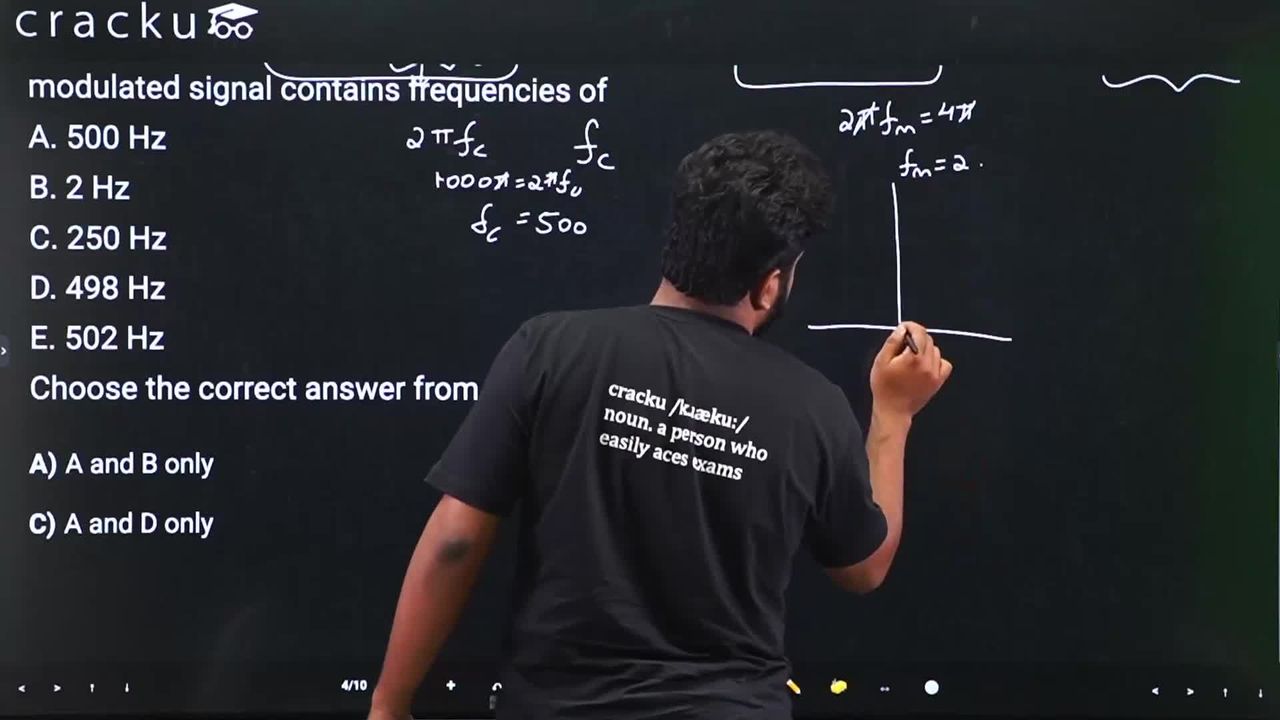
The amplitude of $$15 \sin(1000 \ \pi t)$$ is modulated by $$10 \sin(4 \ \pi t)$$ signal. The amplitude modulated signal contains frequencies of
A. 500 Hz
B. 2 Hz
C. 250 Hz
D. 498 Hz
E. 502 Hz
Choose the correct answer from the options given below
We need to find the frequencies in the amplitude modulated signal.
The carrier signal $$15\sin(1000\pi t)$$ has angular frequency $$\omega_c = 1000\pi$$ rad/s, which gives $$f_c = \frac{1000\pi}{2\pi} = 500$$ Hz. The modulating signal $$10\sin(4\pi t)$$ has angular frequency $$\omega_m = 4\pi$$ rad/s, so $$f_m = \frac{4\pi}{2\pi} = 2$$ Hz.
In amplitude modulation, the output contains the carrier frequency and two sidebands. The carrier frequency remains at $$f_c = 500$$ Hz. The lower sideband appears at $$f_c - f_m = 500 - 2 = 498$$ Hz, while the upper sideband appears at $$f_c + f_m = 500 + 2 = 502$$ Hz.
There is no component at the modulating frequency $$2$$ Hz alone or at $$250$$ Hz. Therefore, the signal contains only $$500$$ Hz, $$498$$ Hz and $$502$$ Hz, which correspond to options A, D, and E. The correct answer is Option 4: A, D and E only.
Was this solution helpful?
Click on the Email ☝️ to Watch the Video Solution
Create a FREE account and get:
_1.webp)

Educational materials for JEE preparation

Ask our AI anything

AI can make mistakes. Please verify important information.
AI can make mistakes. Please verify important information.


