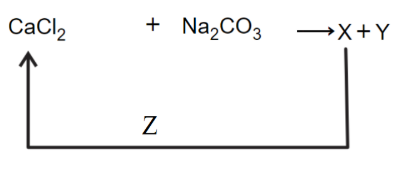
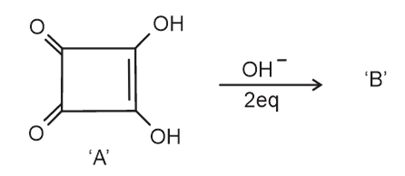
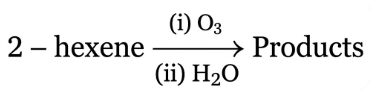
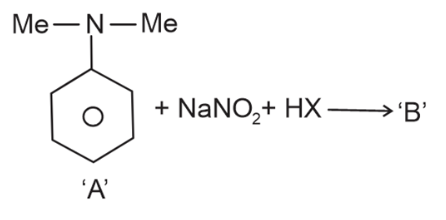
For the following questions answer them individually
Three forces $$F_1 = 10$$ N, $$F_2 = 8$$ N, $$F_3 = 6$$ N are acting on a particle of mass 5 kg. The forces $$F_2$$ and $$F_3$$ are applied perpendicularly so that particle remains at rest. If the force $$F_1$$ is removed, then the acceleration of the particle is
Match List I with List II
| List-I | List-II | ||
|---|---|---|---|
| A | Spring constant | I | $$[T^{-1}]$$ |
| B | Angular speed | II | $$[MT^{-2}]$$ |
| C | Angular momentum | III | $$[ML^2]$$ |
| D | Moment of Inertia | IV | $$[ML^2T^{-1}]$$ |
A ball is thrown vertically upward with an initial velocity of $$150$$ m s$$^{-1}$$. The ratio of velocity after 3 s and 5 s is $$\frac{x+1}{x}$$. The value of $$x$$ is _____. {take, $$g = 10$$ m s$$^{-2}$$}
Given below are two statements:
Statement I : A truck and a car moving with same kinetic energy are brought to rest by applying breaks which provide equal retarding forces. Both come to rest in equal distance.
Statement II : A car moving towards east takes a turn and moves towards north, the speed remains unchanged. The acceleration of the car is zero.
In the light of given statements, choose the most appropriate answer from the options given below
Two satellites $$A$$ and $$B$$ move round the earth in the same orbit. The mass of $$A$$ is twice the mass of $$B$$. The quantity which is same for the two satellites will be
The ratio of escape velocity of a planet to the escape velocity of earth will be:-
Given: Mass of the planet is 16 times mass of earth and radius of the planet is 4 times the radius of earth.
A body cools from $$80°$$C to $$60°$$ in $$5$$ minutes. The temperature for the surrounding is $$20°$$C. The time it takes to cool from $$60°$$C to $$40°$$C is
An engine operating between the boiling and freezing points of water will have
A. Efficiency more than 27%.
B. Efficiency less than the efficiency of a Carnot engine operating between the same two temperatures.
C. Efficiency equal to 27%.
D. Efficiency less than 27%.
Choose the correct answer from the options given below
If the r.m.s speed of chlorine molecule is $$490$$ m s$$^{-1}$$ at $$27°$$C, the r.m.s speed of argon molecules at the same temperature will be (Atomic mass of argon $$= 39.9$$ u, molecular mass of chlorine $$= 70.9$$ u)
A particle is executing simple harmonic motion (SHM). The ratio of potential energy and kinetic energy of the particle when its displacement is half of its amplitude will be