
Join Our JEE Preparation Group
Prep with like-minded aspirants; Get access to free daily tests and study material.
Sign in
Please select an account to continue using cracku.in
↓ →
Join Our JEE Preparation Group
Prep with like-minded aspirants; Get access to free daily tests and study material.
For lead storage battery pick the correct statements
A. During charging of battery, PbSO$$_4$$ on anode is converted into PbO$$_2$$
B. During charging of battery, PbSO$$_4$$ on cathode is converted into PbO$$_2$$
C. Lead storage battery consists of grid of lead packed with PbO$$_2$$ as anode
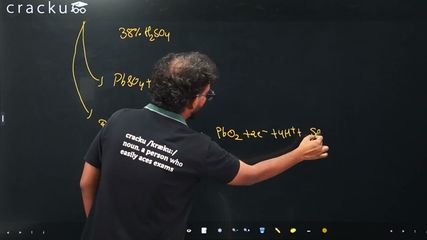
D. Lead storage battery has ~38% solution of sulphuric acid as an electrolyte
Choose the correct answer from the options given below:
A lead storage battery is a secondary cell (rechargeable).
To evaluate the statements, we analyze its composition and chemical processes during discharging and charging cycles.
1. Battery Construction (Standard State)
2. Chemical Reactions During Charging
During the charging process, an external electrical source reverses the spontaneous cell reactions. The $$PbSO_4$$ deposited during discharge is converted back:
At Anode (Reduction during charging):
At Cathode (Oxidation during charging):
| Statement | Analysis | Status |
|---|---|---|
| A | During charging, PbSO4 on the anode is reduced back to spongy lead (Pb), not PbO2. | Incorrect |
| B | During charging, PbSO4 on the cathode is oxidized to Lead Dioxide (PbO2). | Correct |
| C | The grid packed with PbO2 acts as the cathode, while the grid packed with spongy lead serves as the anode. | Incorrect |
| D | A standard lead storage battery uses a ~38% H2SO4 solution as its electrolyte environment. | Correct |
Final Conclusion
Statements B and D are completely precise and scientifically accurate based on core electrochemical principles.
Correct Answer: B, D only
Was this solution helpful?
Click on the Email ☝️ to Watch the Video Solution
Create a FREE account and get:
_1.webp)

Educational materials for JEE preparation

Ask our AI anything

AI can make mistakes. Please verify important information.
AI can make mistakes. Please verify important information.


