Join Our JEE Preparation Group
Prep with like-minded aspirants; Get access to free daily tests and study material.
Sign in
Please select an account to continue using cracku.in
↓ →
Join Our JEE Preparation Group
Prep with like-minded aspirants; Get access to free daily tests and study material.
Explanation
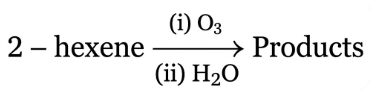
The given reaction is the ozonolysis of 2-hexene.
The structure of 2-hexene is
$$CH_3-CH=CH-CH_2-CH_2-CH_3$$
Ozonolysis cleaves the carbon-carbon double bond, producing two carbonyl fragments.
The cleavage gives
- A 2-carbon fragment
- A 4-carbon fragment
The final products depend on the workup conditions.
- Under reductive workup such as $$Zn/H_2O$$ or $$(CH_3)_2S$$, the products remain as aldehydes.
- Under oxidative workup, the initially formed aldehydes are further oxidized to carboxylic acids.
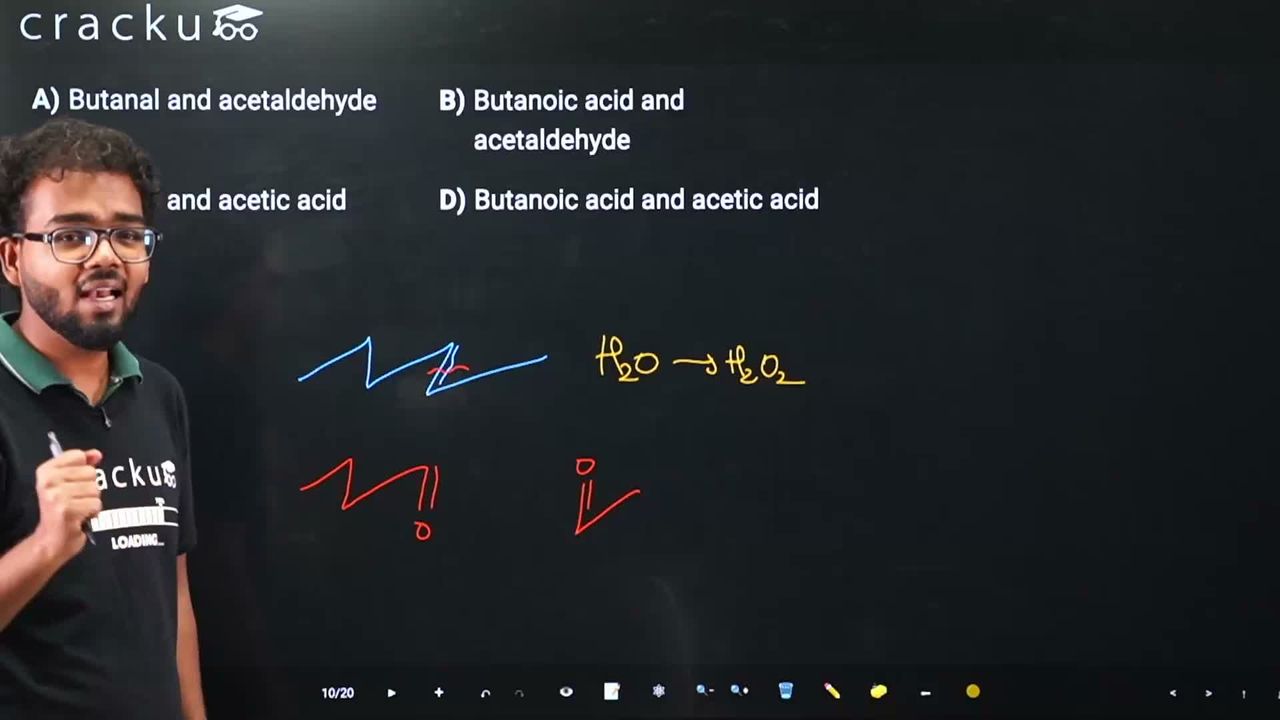
In the given reaction, the workup uses only $$H_2O$$. During hydrolysis of the ozonide, $$H_2O_2$$ is generated, which acts as an oxidizing agent and converts the aldehydes into carboxylic acids.
The products formed are
$$CH_3CHO \rightarrow CH_3COOH$$
$$CH_3CH_2CH_2CHO \rightarrow CH_3CH_2CH_2COOH$$
Hence, the final products are acetic acid and butanoic acid.
It is chemically inconsistent for one fragment to remain as an aldehyde while the other is oxidized to a carboxylic acid under the same oxidative workup conditions.
Therefore, the correct answer is D.
Was this solution helpful?
Click on the Email ☝️ to Watch the Video Solution
Create a FREE account and get:
_1.webp)

Educational materials for JEE preparation

Ask our AI anything

AI can make mistakes. Please verify important information.
AI can make mistakes. Please verify important information.