
Join Our JEE Preparation Group
Prep with like-minded aspirants; Get access to free daily tests and study material.
Sign in
Please select an account to continue using cracku.in
↓ →
Join Our JEE Preparation Group
Prep with like-minded aspirants; Get access to free daily tests and study material.
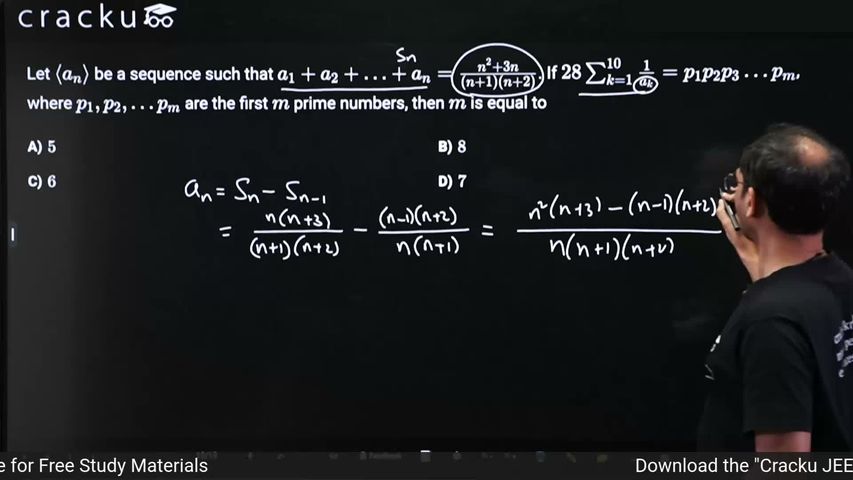
Let $$\langle a_n \rangle$$ be a sequence such that $$a_1 + a_2 + \ldots + a_n = \frac{n^2 + 3n}{(n+1)(n+2)}$$. If $$28 \sum_{k=1}^{10} \frac{1}{a_k} = p_1 p_2 p_3 \ldots p_m$$, where $$p_1, p_2, \ldots p_m$$ are the first $$m$$ prime numbers, then $$m$$ is equal to
The question gives the cumulative sum of the sequence as
$$S_n=a_1+a_2+\dots +a_n=\frac{n^{2}+3n}{(n+1)(n+2)}$$
To obtain the general term $$a_n$$ we subtract two successive partial sums:
$$\begin{aligned} a_n &=S_n-S_{\,n-1} \\[4pt] &=\frac{n(n+3)}{(n+1)(n+2)}-\frac{(n-1)(n+2)}{n(n+1)} . \end{aligned}$$
Take the common denominator $$n(n+1)(n+2)$$:
$$\begin{aligned} a_n&=\frac{n\,[n(n+3)]-(n+2)\,[\, (n-1)(n+2)\,]}{n(n+1)(n+2)}\\[4pt] &=\frac{n^3+3n^2-\bigl(n^3+3n^2-4\bigr)}{n(n+1)(n+2)}\\[4pt] &=\frac{4}{n(n+1)(n+2)} . \end{aligned}$$
Hence the reciprocal of the general term is
$$\frac{1}{a_n}=\frac{n(n+1)(n+2)}{4}.$$ For the required sum we need $$\sum_{k=1}^{10}\frac{1}{a_k} =\frac14\sum_{k=1}^{10}k(k+1)(k+2).$$
Expand the cubic inside the summation:
$$k(k+1)(k+2)=k^3+3k^2+2k.$$
Using the standard summation formulas $$\sum_{k=1}^{n}k=\frac{n(n+1)}2,\qquad \sum_{k=1}^{n}k^2=\frac{n(n+1)(2n+1)}6,\qquad \sum_{k=1}^{n}k^3=\left[\frac{n(n+1)}2\right]^2,$$ for $$n=10$$ we obtain
$$\begin{aligned} \sum_{k=1}^{10}k &=55,\\ \sum_{k=1}^{10}k^2&=385,\\ \sum_{k=1}^{10}k^3&=3025. \end{aligned}$$
Therefore
$$\begin{aligned} \sum_{k=1}^{10}k(k+1)(k+2) &=3025+3(385)+2(55)\\ &=3025+1155+110\\ &=4290. \end{aligned}$$
Hence $$\sum_{k=1}^{10}\frac{1}{a_k} =\frac{4290}{4}=\frac{2145}{2}=1072.5.$$ Multiplying by the given constant 28,
$$28\sum_{k=1}^{10}\frac{1}{a_k} =28\times\frac{2145}{2} =14\times2145 =30030.$$
Prime-factorising 30030,
$$30030=2\times3\times5\times7\times11\times13,$$ which is the product of the first six prime numbers.
Thus $$m=6.$$ Option C which is: 6
Was this solution helpful?
Click on the Email ☝️ to Watch the Video Solution
Create a FREE account and get:
_1.webp)

Educational materials for JEE preparation

Ask our AI anything

AI can make mistakes. Please verify important information.
AI can make mistakes. Please verify important information.


