
Join Our JEE Preparation Group
Prep with like-minded aspirants; Get access to free daily tests and study material.
Sign in
Please select an account to continue using cracku.in
↓ →
Join Our JEE Preparation Group
Prep with like-minded aspirants; Get access to free daily tests and study material.
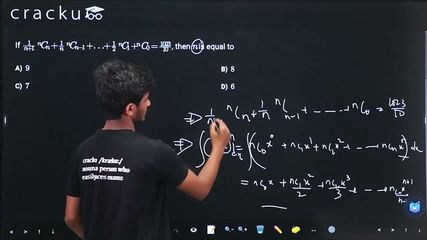
If $$\frac{1}{n+1}$$ $$^nC_n + \frac{1}{n}$$ $$^nC_{n-1} + \ldots + \frac{1}{2}$$ $$^nC_1 + ^nC_0 = \frac{1023}{10}$$, then $$n$$ is equal to
Explanation
Consider the given series
$$\binom{n}{0}+\frac{1}{2}\binom{n}{1}+\frac{1}{3}\binom{n}{2}+\cdots+\frac{1}{n}\binom{n}{n-1}+\frac{1}{n+1}\binom{n}{n}=\frac{1023}{10}$$
Observe that each term has the form
$$\frac{1}{r+1}\binom{n}{r}$$
Use the identity
$$\frac{1}{r+1}\binom{n}{r}=\frac{1}{n+1}\binom{n+1}{r+1}$$
Applying this identity to every term,
$$LHS=\frac{1}{n+1}\left[\binom{n+1}{1}+\binom{n+1}{2}+\cdots+\binom{n+1}{n+1}\right]$$
Now use the binomial identity
$$\sum_{r=0}^{n+1}\binom{n+1}{r}=2^{,n+1}$$
Therefore,
$$\binom{n+1}{1}+\binom{n+1}{2}+\cdots+\binom{n+1}{n+1}=2^{,n+1}-1$$
Hence,
$$LHS=\frac{2^{,n+1}-1}{n+1}$$
Given that
$$\frac{2^{,n+1}-1}{n+1}=\frac{1023}{10}$$
Comparing denominators suggests
$$n+1=10$$
Substituting,
$$2^{10}-1=1024-1=1023$$
which matches the numerator exactly.
Therefore,
$$n+1=10$$
$$n=9$$
Hence, the correct answer is
$$\boxed{9}$$
Was this solution helpful?
Click on the Email ☝️ to Watch the Video Solution
Create a FREE account and get:
_1.webp)

Educational materials for JEE preparation

Ask our AI anything

AI can make mistakes. Please verify important information.
AI can make mistakes. Please verify important information.


