
Join Our JEE Preparation Group
Prep with like-minded aspirants; Get access to free daily tests and study material.
Sign in
Please select an account to continue using cracku.in
↓ →
Join Our JEE Preparation Group
Prep with like-minded aspirants; Get access to free daily tests and study material.
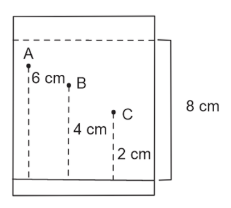
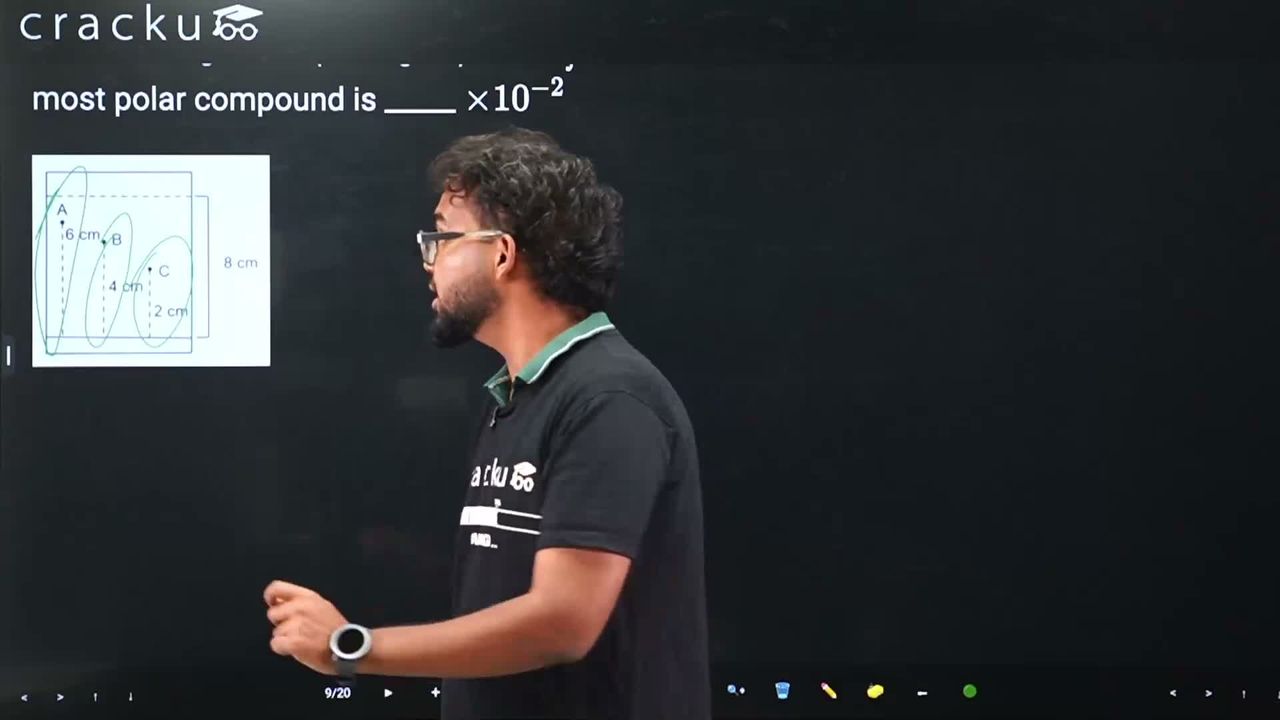
Three organic compounds A, B and C were allowed to run in thin layer chromatography using hexane and gave the following result (see figure). The R$$_f$$ value of the most polar compound is _____ $$\times 10^{-2}$$
Correct Answer: 25
1. Points of TLC
2. Identifying the Most Polar Compound
Looking at the distances traveled by each compound from the baseline:
Since Compound C traveled the shortest distance (2 cm), it interacted the strongest with the polar stationary phase. Therefore, Compound C is the most polar compound.
3. Calculating the Rf Value
The Retardation Factor (Rf) is calculated using the formula:
From the given image:
Plugging these values into the formula:
4. Matching the Question Format
We can convert 0.25 into scientific notation matching this layout:
Correct Answer: 25
Was this solution helpful?
Click on the Email ☝️ to Watch the Video Solution
Create a FREE account and get:
_1.webp)

Educational materials for JEE preparation

Ask our AI anything

AI can make mistakes. Please verify important information.
AI can make mistakes. Please verify important information.


