Join Our JEE Preparation Group
Prep with like-minded aspirants; Get access to free daily tests and study material.
Sign in
Please select an account to continue using cracku.in
↓ →
Join Our JEE Preparation Group
Prep with like-minded aspirants; Get access to free daily tests and study material.
Explanation
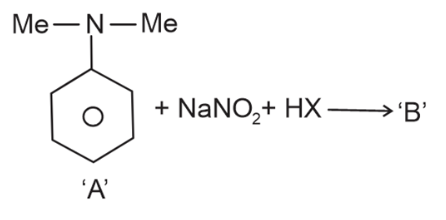
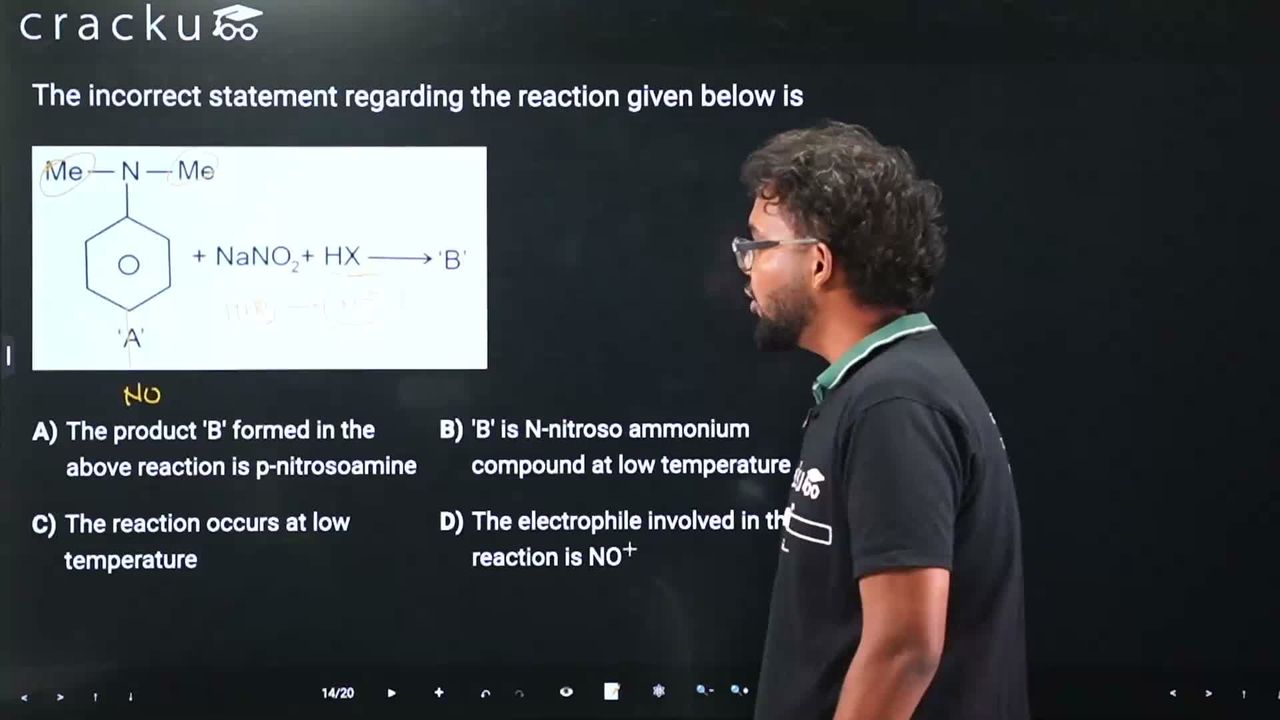
The starting compound is $$N,N$$-dimethylaniline, which is a tertiary aromatic amine.
In the presence of $$NaNO_2$$ and mineral acid $$HX$$, nitrous acid is generated in situ.
$$NaNO_2 + HX \rightarrow HNO_2$$
In acidic medium, nitrous acid generates the nitrosonium ion:
$$HNO_2 + H^+ \rightarrow NO^+ + H_2O$$
The electrophile in this reaction is:
$$NO^+$$
Since the $$-N(CH_3)_2$$ group is strongly electron-donating, it activates the benzene ring towards electrophilic substitution.
Due to steric hindrance, substitution occurs predominantly at the para position to give $$p$$-nitroso-$$N,N$$-dimethylaniline.
Statement A is correct because the product formed is the para-nitroso derivative of $$N,N$$-dimethylaniline.
Statement C is correct because nitrous acid is unstable at room temperature. Therefore, the reaction is carried out at low temperature, typically $$0^\circ\text{C}$$ to $$5^\circ\text{C}$$.
Statement D is correct because the electrophile responsible for the reaction is the nitrosonium ion:
$$NO^+$$
Statement B is incorrect.
Secondary amines undergo $$N$$-nitrosation to form $$N$$-nitrosoamines.
Tertiary aromatic amines do not undergo $$N$$-nitrosation because the nitrogen atom has no replaceable hydrogen.
Instead, they undergo $$C$$-nitrosation on the aromatic ring to form para-nitroso substituted products.
Hence, the stable product is a $$C$$-nitroso compound and not an $$N$$-nitroso ammonium compound.
Therefore, the incorrect statement is Option B.
Was this solution helpful?
Click on the Email ☝️ to Watch the Video Solution
Create a FREE account and get:
_1.webp)

Educational materials for JEE preparation

Ask our AI anything

AI can make mistakes. Please verify important information.
AI can make mistakes. Please verify important information.