
Join Our JEE Preparation Group
Prep with like-minded aspirants; Get access to free daily tests and study material.
Sign in
Please select an account to continue using cracku.in
↓ →
Join Our JEE Preparation Group
Prep with like-minded aspirants; Get access to free daily tests and study material.
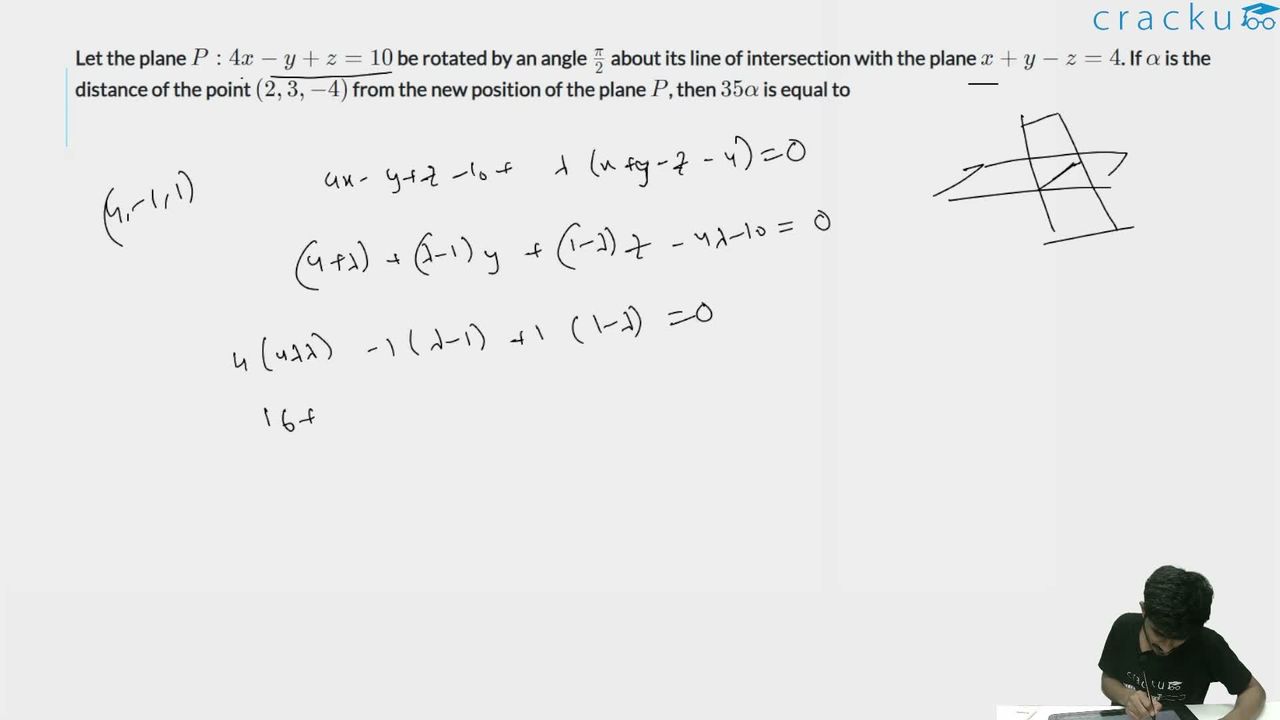
Let the plane $$P : 4x - y + z = 10$$ be rotated by an angle $$\frac{\pi}{2}$$ about its line of intersection with the plane $$x + y - z = 4$$. If $$\alpha$$ is the distance of the point $$(2, 3, -4)$$ from the new position of the plane $$P$$, then $$35\alpha$$ is equal to
Given plane $$P: 4x - y + z = 10$$ is rotated by $$\frac{\pi}{2}$$ about its line of intersection with plane $$x + y - z = 4$$.
Family of planes through the line of intersection.
Any plane through the line of intersection can be written as:
$$(4x - y + z - 10) + k(x + y - z - 4) = 0$$
$$(4+k)x + (-1+k)y + (1-k)z = 10 + 4k$$
Condition for $$\frac{\pi}{2}$$ rotation.
The new plane must be perpendicular to the original plane $$P$$. So their normals must be perpendicular:
$$\vec{n}_{new} \cdot \vec{n}_P = 0$$
$$(4+k)(4) + (-1+k)(-1) + (1-k)(1) = 0$$
$$16 + 4k + 1 - k + 1 - k = 0$$
$$18 + 2k = 0 \implies k = -9$$
Find the new plane equation.
$$-5x - 10y + 10z + 26 = 0$$
$$5x + 10y - 10z - 26 = 0$$
Distance from $$(2, 3, -4)$$ to the new plane.
$$\alpha = \frac{|5(2) + 10(3) - 10(-4) - 26|}{\sqrt{25 + 100 + 100}} = \frac{|10 + 30 + 40 - 26|}{\sqrt{225}} = \frac{54}{15} = \frac{18}{5}$$
$$35\alpha = 35 \times \frac{18}{5} = 7 \times 18 = 126$$
Therefore, the correct answer is Option C: $$\mathbf{126}$$.
Was this solution helpful?
Click on the Email ☝️ to Watch the Video Solution
Create a FREE account and get:
_1.webp)

Educational materials for JEE preparation

Ask our AI anything

AI can make mistakes. Please verify important information.
AI can make mistakes. Please verify important information.


