
Join Our JEE Preparation Group
Prep with like-minded aspirants; Get access to free daily tests and study material.
Sign in
Please select an account to continue using cracku.in
↓ →
Join Our JEE Preparation Group
Prep with like-minded aspirants; Get access to free daily tests and study material.
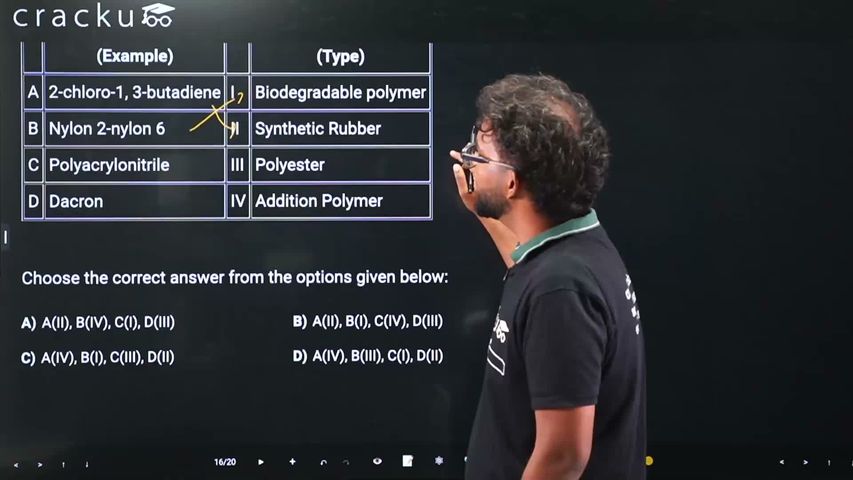
Match List I with List II
| List I (Example) | List II (Type) | ||
|---|---|---|---|
| A | 2-chloro-1, 3-butadiene | I | Biodegradable polymer |
| B | Nylon 2-nylon 6 | II | Synthetic Rubber |
| C | Polyacrylonitrile | III | Polyester |
| D | Dacron | IV | Addition Polymer |
Choose the correct answer from the options given below:
Polymers are classified into categories based on their chemical composition, properties, mechanisms of formation, and environmental degradability.
Step-by-Step Matching Analysis:
Reason: 2-chloro-1,3-butadiene is commonly known as chloroprene. Upon polymerization, it yields polychloroprene, commercially referred to as Neoprene, which is a prominent example of an elastomer or synthetic rubber.
$$\text{}$$
Reason: Nylon 2-nylon 6 is an alternating polyamide copolymer synthesized from glycine and aminocaproic acid. It contains linkages that environmental microorganisms can easily digest, classifying it as a well-known biodegradable polymer.
$$\text{}$$
Reason: Polyacrylonitrile (PAN) forms via the peroxide-catalyzed chain-growth polymerization of acrylonitrile monomers without losing any small molecular byproducts. This characterizes it strictly as an addition polymer.
$$\text{}$$
Reason: Dacron (also known as Terylene) is created by the step-growth condensation polymerization of ethylene glycol and terephthalic acid, producing key ester bonds throughout its structural backbone.
$$\text{}$$
Final Order Matching:
A → II, B → I, C → IV, D → III
Was this solution helpful?
Click on the Email ☝️ to Watch the Video Solution
Create a FREE account and get:
_1.webp)

Educational materials for JEE preparation

Ask our AI anything

AI can make mistakes. Please verify important information.
AI can make mistakes. Please verify important information.


