Join Our JEE Preparation Group
Prep with like-minded aspirants; Get access to free daily tests and study material.
Sign in
Please select an account to continue using cracku.in
↓ →
Join Our JEE Preparation Group
Prep with like-minded aspirants; Get access to free daily tests and study material.
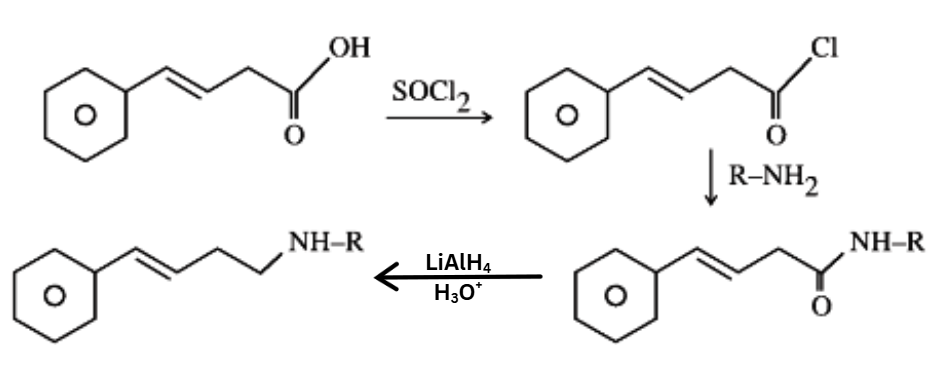
Step 1: Chlorination with Chlorinating Agent ($$\text{SOCl}_2$$)
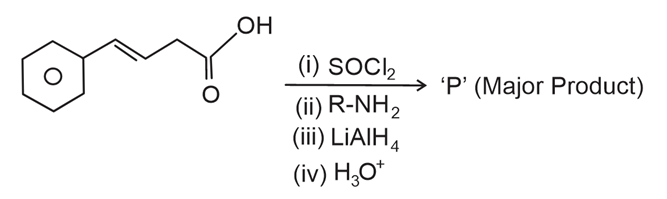
The starting material contains a carboxylic acid group ($$\text{--COOH}$$) and an isolated carbon-carbon double bond ($$\text{C=C}$$). Thionyl chloride ($$\text{SOCl}_2$$) selectively converts the hydroxyl group of the carboxylic acid into an acid chloride (acyl chloride) functional group without affecting the alkene:
Step 2: Nucleophilic Acyl Substitution with Amine ($$\text{R--NH}_2$$)
The highly reactive acid chloride intermediate undergoes nucleophilic attack by the primary amine ($$\text{R--NH}_2$$). Elimination of a chloride ion yields a secondary amide:
Step 3: Reduction using Lithium Aluminum Hydride ($$\text{LiAlH}_4$$)
Lithium aluminum hydride ($$\text{LiAlH}_4$$) is a powerful reducing agent that selectively reduces the carbonyl group ($$\text{C=O}$$) of an amide into a methylene group ($$\text{--CH}_2\text{--}$$), converting the amide function into a secondary amine. Crucially, $$\text{LiAlH}_4$$ does not reduce isolated non-conjugated alkene double bonds:
Intermediate Structures (e.g., Option B):
Structures containing the intact carbonyl group ($$\text{--CONH--R}$$) merely represent the intermediate formed after Step 2 and fail to account for the final hydride reduction step.
Alcohol-Containing Structures (e.g., Option A):
Carboxylic amides undergo clean reduction to form amines, completely removing the carbonyl oxygen atom rather than stopping at a hemiaminal or an alcohol-substituted chain like $$\text{--CH(OH)--NH--R}$$.
Alkene Reduction Products:
Any option where the carbon-carbon double bond ($$\text{C=C}$$) is hydrogenated to a single bond ($$\text{--CH}_2\text{--CH}_2\text{--}$$) is incorrect because $$\text{LiAlH}_4$$ is a nucleophilic reducing agent that cannot deliver hydrides to non-polarized, isolated carbon-carbon double bonds.
The complete sequence sequentially transforms the terminal carboxylic acid into an amine substituent group ($$\text{--CH}_2\text{--NH--R}$$) while leaving the rest of the unsaturated hydrocarbon framework entirely intact.
Answer: The option displaying the amine product with the double bond intact ($$\text{Ar--CH}_2\text{--CH=CH--CH}_2\text{--CH}_2\text{--NH--R}$$).
Was this solution helpful?
Click on the Email ☝️ to Watch the Video Solution
Create a FREE account and get:
_1.webp)

Educational materials for JEE preparation

Ask our AI anything

AI can make mistakes. Please verify important information.
AI can make mistakes. Please verify important information.