
Join Our JEE Preparation Group
Prep with like-minded aspirants; Get access to free daily tests and study material.
Sign in
Please select an account to continue using cracku.in
↓ →
Join Our JEE Preparation Group
Prep with like-minded aspirants; Get access to free daily tests and study material.
Let a, b, c be three distinct real numbers, none equal to one. If the vectors $$a\hat{i} + \hat{j} + \hat{k}$$, $$\hat{i} + b\hat{j} + \hat{k}$$ and $$\hat{i} + \hat{j} + c\hat{k}$$ are coplanar, then $$\frac{1}{1-a} + \frac{1}{1-b} + \frac{1}{1-c}$$ is equal to
We are given three vectors $$\vec{u} = a\hat{i} + \hat{j} + \hat{k}$$, $$\vec{v} = \hat{i} + b\hat{j} + \hat{k}$$, and $$\vec{w} = \hat{i} + \hat{j} + c\hat{k}$$, and told they are coplanar. We need to find the value of $$\frac{1}{1-a} + \frac{1}{1-b} + \frac{1}{1-c}$$.
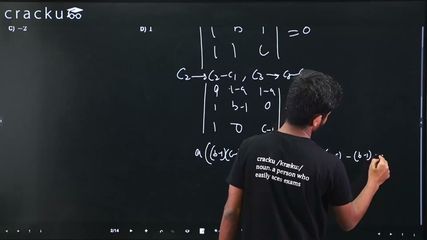
We begin by noting that three vectors are coplanar if and only if their scalar triple product is zero. The scalar triple product is computed as the determinant of the matrix formed by the three vectors: $$[\vec{u}, \vec{v}, \vec{w}] = \begin{vmatrix} a & 1 & 1 \\ 1 & b & 1 \\ 1 & 1 & c \end{vmatrix} = 0$$.
Next, expanding the determinant along the first row gives $$a(bc - 1) - 1(c - 1) + 1(1 - b) = 0$$, and simplifying each term yields $$abc - a - c + 1 + 1 - b = 0$$ and hence $$abc - a - b - c + 2 = 0$$.
We then set $$p = 1 - a$$, $$q = 1 - b$$, and $$r = 1 - c$$, noting that since $$a, b, c$$ are distinct and none equals 1, we have $$p, q, r$$ all non-zero. Therefore $$a = 1 - p$$, $$b = 1 - q$$, and $$c = 1 - r$$.
Substituting into $$abc - a - b - c + 2 = 0$$ entails computing
$$a + b + c = (1-p) + (1-q) + (1-r) = 3 - p - q - r$$
and
$$abc = (1-p)(1-q)(1-r)$$.
Expanding $$(1-p)(1-q)(1-r)$$ gives $$= 1 - p - q - r + pq + pr + qr - pqr$$.
Substituting into the equation $$abc - (a + b + c) + 2 = 0$$ leads to $$(1 - p - q - r + pq + pr + qr - pqr) - (3 - p - q - r) + 2 = 0$$.
Simplifying this yields $$1 - p - q - r + pq + pr + qr - pqr - 3 + p + q + r + 2 = 0$$ and hence $$pq + pr + qr - pqr = 0$$.
Factoring out $$pqr$$ (which is non-zero since $$p, q, r \neq 0$$) gives $$pq + pr + qr = pqr$$.
Dividing both sides by $$pqr$$ gives $$\frac{pq}{pqr} + \frac{pr}{pqr} + \frac{qr}{pqr} = 1$$ and hence $$\frac{1}{r} + \frac{1}{q} + \frac{1}{p} = 1$$.
Finally, since $$p = 1 - a$$, $$q = 1 - b$$, and $$r = 1 - c$$, we conclude that $$\frac{1}{1-a} + \frac{1}{1-b} + \frac{1}{1-c} = 1$$.
The correct answer is Option 4: $$1$$.
Was this solution helpful?
Click on the Email ☝️ to Watch the Video Solution
Create a FREE account and get:
_1.webp)

Educational materials for JEE preparation

Ask our AI anything

AI can make mistakes. Please verify important information.
AI can make mistakes. Please verify important information.


