
Join Our JEE Preparation Group
Prep with like-minded aspirants; Get access to free daily tests and study material.
Sign in
Please select an account to continue using cracku.in
↓ →
Join Our JEE Preparation Group
Prep with like-minded aspirants; Get access to free daily tests and study material.
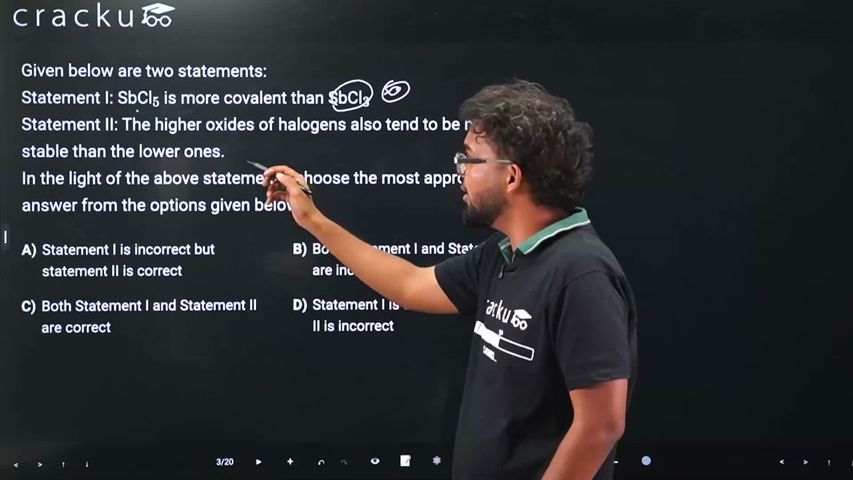
Given below are two statements:
Statement I: SbCl$$_5$$ is more covalent than SbCl$$_3$$
Statement II: The higher oxides of halogens also tend to be more stable than the lower ones.
In the light of the above statements, choose the most appropriate answer from the options given below.
"Statement I: $$SbCl_5$$ is more covalent than $$SbCl_3$$"
According to Fajans' Rules, covalent character increases with an increase in the charge of the cation. In $$SbCl_5$$, Antimony is in a +5 oxidation state, whereas in $$SbCl_3$$, it is in a +3 oxidation state.
The higher positive charge (+5) creates a higher charge density, leading to greater polarizing power to distort the electron cloud of the chloride anions. Therefore, $$SbCl_5$$is significantly more covalent than $$SbCl_3$$.
Status: Correct
"Statement II: The higher oxides of halogens also tend to be more stable than the lower ones."
According to standard periodic trends, the higher oxides of halogens are generally more stable than those in lower oxidation states.
For example, in the case of chlorine, higher oxides like $$Cl_{2}O_7$$ (where Cl is +7) are much more stable and less prone to violent decomposition compared to lower oxides like $$Cl_{2}O$$ or $$ClO_2$$, due to kinetic factors and multiple bond stabilization characters.
Status: Correct
Was this solution helpful?
Click on the Email ☝️ to Watch the Video Solution
Create a FREE account and get:
_1.webp)

Educational materials for JEE preparation

Ask our AI anything

AI can make mistakes. Please verify important information.
AI can make mistakes. Please verify important information.


