
Join Our JEE Preparation Group
Prep with like-minded aspirants; Get access to free daily tests and study material.
Sign in
Please select an account to continue using cracku.in
↓ →
Join Our JEE Preparation Group
Prep with like-minded aspirants; Get access to free daily tests and study material.
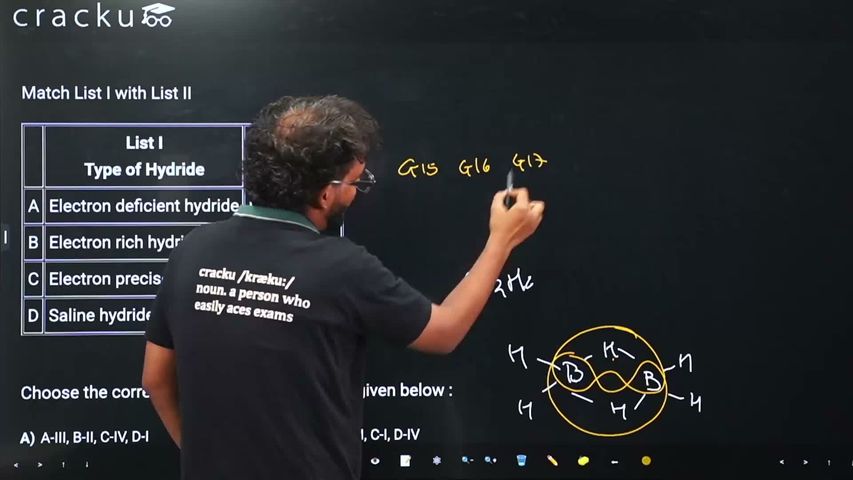
Match List I with List II
| List I Type of Hydride | List II Example | ||
|---|---|---|---|
| A | Electron deficient hydride | I | MgH$$_2$$ |
| B | Electron rich hydride | II | HF |
| C | Electron precise hydride | III | B$$_2$$H$$_6$$ |
| D | Saline hydride | IV | CH$$_4$$ |
Choose the correct answer from the options given below :
Molecular (covalent) hydrides are classified into three categories based on the availability of valence electrons relative to the total number required for drawing their standard Lewis structures, whereas ionic hydrides form distinct crystal lattices.
Matching Analysis:
Reason: Group 13 elements form electron-deficient hydrides. Diborane ($$B_{2}H_6$$) lacks sufficient valence electrons to satisfy a conventional octet network via normal 2-electron covalent bonds, necessitating unique 3-center-2-electron bridge bonds.
$$\text{}$$
Reason: Group 15, 16, and 17 elements form electron-rich compounds because they hold extra lone pairs of electrons not involved in bonding. Hydrogen fluoride ($$HF$$) features three lone pairs on its fluorine atom.
$$\text{}$$
Reason: Group 14 elements form electron-precise systems. Methane ($$CH_4$$) possesses exactly the right number of valence electrons (8 electrons) needed to form its 4 symmetric covalent bonds without remaining lone pairs.
$$\text{}$$
Reason: Saline (or ionic) hydrides are formed when hydrogen bonds with highly electropositive s-block elements (alkali and alkaline earth metals). Magnesium hydride ($$MgH_2$$) belongs cleanly to this ionic chemical class.
Was this solution helpful?
Click on the Email ☝️ to Watch the Video Solution
Create a FREE account and get:
_1.webp)

Educational materials for JEE preparation

Ask our AI anything

AI can make mistakes. Please verify important information.
AI can make mistakes. Please verify important information.


