
Join Our JEE Preparation Group
Prep with like-minded aspirants; Get access to free daily tests and study material.
Sign in
Please select an account to continue using cracku.in
↓ →
Join Our JEE Preparation Group
Prep with like-minded aspirants; Get access to free daily tests and study material.
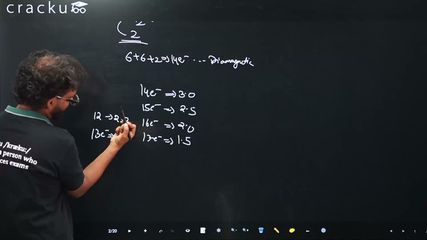
The acetylide ion $$C_2^{2-}$$ contains $$2(6) + 2 = 14$$ electrons. Using the MO diagram for homonuclear diatomic molecules without 2s-2p mixing, its electron configuration is $$\sigma_{1s}^2{\sigma^*_{1s}}^{2}\sigma_{2s}^2{\sigma^*_{2s}}^{2}\pi_{2p}^4\sigma_{2p}^2$$, which gives a bond order of $$\frac{10 - 4}{2} = 3$$. All electrons are paired, so $$C_2^{2-}$$ is diamagnetic.
In $$NO^+$$, nitrogen contributes 7 electrons and oxygen contributes 8, with the positive charge removing one electron, for a total of $$7 + 8 - 1 = 14$$ electrons. This makes $$NO^+$$ isoelectronic with $$C_2^{2-}$$. Its bond order is also $$3$$ and it is diamagnetic, matching the properties of the acetylide ion.
The species $$O_2^+$$ (15 electrons, bond order $$2.5$$, paramagnetic), $$N_2^+$$ (13 electrons, bond order $$2.5$$, paramagnetic), and $$O_2^-$$ (17 electrons, bond order $$1.5$$, paramagnetic) do not share the same bond order and magnetic behavior as $$C_2^{2-}$$.
Therefore, the species that matches both the bond order and magnetic property of the acetylide ion is $$NO^+$$. The correct answer is Option 3: $$NO^+$$.
Was this solution helpful?
Click on the Email ☝️ to Watch the Video Solution
Create a FREE account and get:
_1.webp)

Educational materials for JEE preparation

Ask our AI anything

AI can make mistakes. Please verify important information.
AI can make mistakes. Please verify important information.


