
Join Our JEE Preparation Group
Prep with like-minded aspirants; Get access to free daily tests and study material.
Sign in
Please select an account to continue using cracku.in
↓ →
Join Our JEE Preparation Group
Prep with like-minded aspirants; Get access to free daily tests and study material.
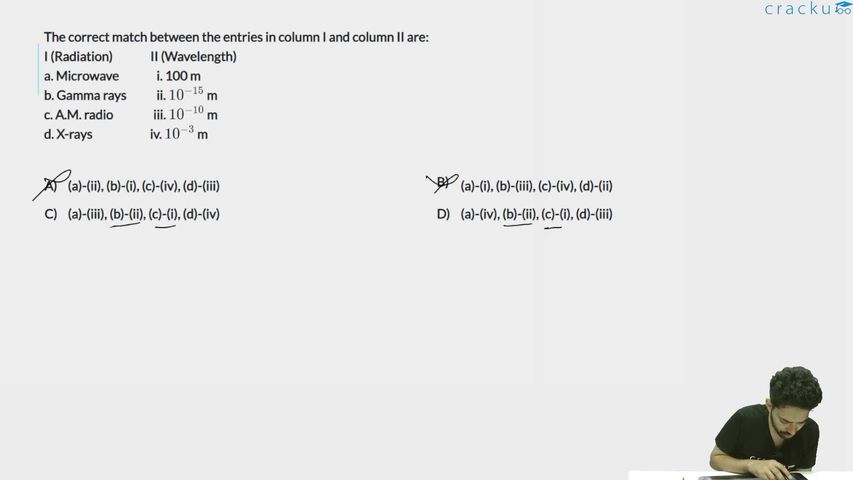
The correct match between the entries in column I and column II are:
I (Radiation) II (Wavelength)
a. Microwave i. 100 m
b. Gamma rays ii. $$10^{-15}$$ m
c. A.M. radio iii. $$10^{-10}$$ m
d. X-rays iv. $$10^{-3}$$ m
To decide which wavelength corresponds to each type of electromagnetic radiation, we first recall the standard order of the electromagnetic spectrum from the longest wavelength (radio) to the shortest wavelength (gamma rays). We have: radio waves (including A.M.), microwaves, infrared, visible, ultraviolet, X-rays, and finally gamma rays. As wavelength decreases, frequency increases.
Now we note the characteristic wavelength ranges, expressed here in metres.
For A.M. radio waves we customarily work in kilohertz; the wavelength $$\lambda$$ in metres is given by the fundamental relation $$\lambda=\dfrac{c}{\nu}$$ where $$c$$ is the speed of light and $$\nu$$ is the frequency. A typical A.M. broadcast frequency is about $$1\;\text{MHz}=10^{6}\;\text{Hz}$$, so
$$\lambda=\dfrac{3.0\times10^{8}\ \text{m s}^{-1}}{10^{6}\ \text{Hz}}=3.0\times10^{2}\ \text{m}\approx100\ \text{m}.$$
Hence A.M. radio corresponds to the wavelength entry $$100\ \text{m}$$, which is column II item (i).
Microwaves sit just below infrared in frequency and have wavelengths from roughly a millimetre to about a decimetre. Converting $$1\ \text{mm}$$ to metres gives
$$1\ \text{mm}=10^{-3}\ \text{m}.$$
Therefore microwaves match the wavelength $$10^{-3}\ \text{m}$$, column II item (iv).
X-rays are produced when high-energy electrons decelerate or when inner-shell electrons in atoms transition. Their wavelengths lie in the ångström region; $$1\ \text{Å}=10^{-10}\ \text{m}.$$ Hence X-rays correspond to the wavelength $$10^{-10}\ \text{m}$$, column II item (iii).
Gamma rays arise from nuclear transitions and have wavelengths shorter than those of X-rays, typically $$10^{-12}\ \text{m}$$ down to about $$10^{-16}\ \text{m}$$. The closest tabulated value is $$10^{-15}\ \text{m}$$, column II item (ii).
Collecting the matches, we obtain:
Microwave → $$10^{-3}\ \text{m}$$ (iv)
Gamma rays → $$10^{-15}\ \text{m}$$ (ii)
A.M. radio → $$100\ \text{m}$$ (i)
X-rays → $$10^{-10}\ \text{m}$$ (iii)
Writing these as ordered pairs (Radiation - Wavelength):
(a) - (iv), (b) - (ii), (c) - (i), (d) - (iii).
Comparing with the given options, this set corresponds to Option D.
Hence, the correct answer is Option D.
Was this solution helpful?
Click on the Email ☝️ to Watch the Video Solution
Create a FREE account and get:
_1.webp)

Educational materials for JEE preparation

Ask our AI anything

AI can make mistakes. Please verify important information.
AI can make mistakes. Please verify important information.
