
Join Our JEE Preparation Group
Prep with like-minded aspirants; Get access to free daily tests and study material.
Sign in
Please select an account to continue using cracku.in
↓ →
Join Our JEE Preparation Group
Prep with like-minded aspirants; Get access to free daily tests and study material.
Given below are two statements:
Statement I: Electromagnetic waves carry energy as they travel through space and this energy is equally shared by the electric and magnetic fields.
Statement II: When electromagnetic waves strike a surface, a pressure is exerted on the surface.
In the light of the above statements, choose the most appropriate answer from the options given below:
We need to evaluate two statements about electromagnetic waves.
Analysis of Statement I: "Electromagnetic waves carry energy as they travel through space and this energy is equally shared by the electric and magnetic fields."
An electromagnetic wave has energy density given by:
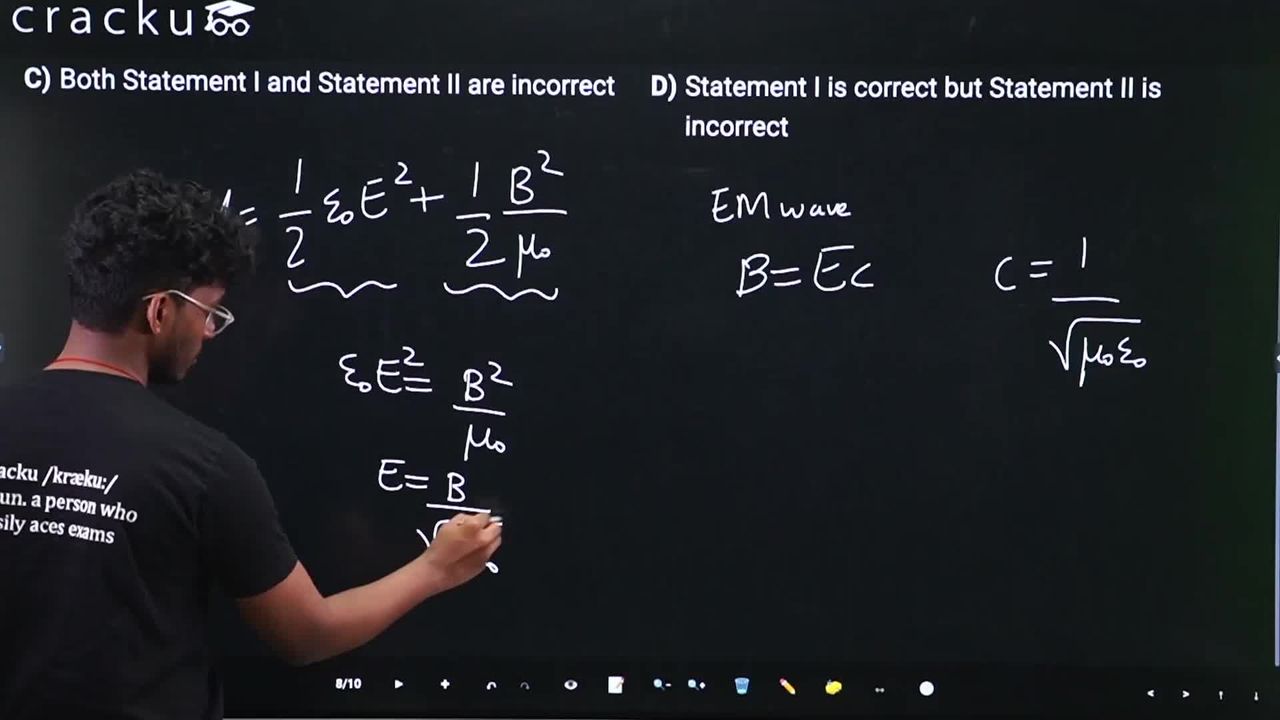
$$u = \frac{1}{2}\epsilon_0 E^2 + \frac{B^2}{2\mu_0}$$
For an EM wave, the relationship $$E = cB$$ holds, where $$c = 1/\sqrt{\mu_0 \epsilon_0}$$. Substituting:
$$\frac{1}{2}\epsilon_0 E^2 = \frac{1}{2}\epsilon_0 c^2 B^2 = \frac{B^2}{2\mu_0}$$
This shows that the electric field energy density equals the magnetic field energy density. The energy is indeed equally shared between the two fields. Statement I is CORRECT.
Analysis of Statement II: "When electromagnetic waves strike a surface, a pressure is exerted on the surface."
Electromagnetic waves carry momentum $$p = E/c$$ (where $$E$$ is energy). When they strike a surface, they transfer momentum, exerting radiation pressure. For a perfectly absorbing surface, the radiation pressure is $$P = I/c$$, where $$I$$ is the intensity. For a perfectly reflecting surface, $$P = 2I/c$$. Statement II is CORRECT.
The correct answer is Option 2: Both Statement I and Statement II are correct.
Was this solution helpful?
Click on the Email ☝️ to Watch the Video Solution
Create a FREE account and get:
_1.webp)

Educational materials for JEE preparation

Ask our AI anything

AI can make mistakes. Please verify important information.
AI can make mistakes. Please verify important information.
