
Join Our JEE Preparation Group
Prep with like-minded aspirants; Get access to free daily tests and study material.
Sign in
Please select an account to continue using cracku.in
↓ →
Join Our JEE Preparation Group
Prep with like-minded aspirants; Get access to free daily tests and study material.
If $$\mu_0$$ and $$\varepsilon_0$$ are the permeability and permittivity of free space, respectively, then the dimension of $$\left(\frac{1}{\mu_0 \varepsilon_0}\right)$$ is :
The permeability of free space is denoted by $$\mu_0$$ and the permittivity of free space by $$\varepsilon_0$$.
Electromagnetic‐wave theory gives the relation between the speed of light $$c$$ and these two constants:
$$c \;=\;\frac{1}{\sqrt{\mu_0\,\varepsilon_0}} \quad -(1)$$
Square both sides of $$(1)$$ to obtain
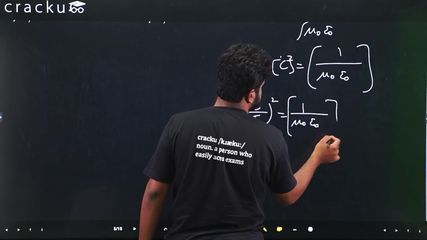
$$c^{2} \;=\;\frac{1}{\mu_0\,\varepsilon_0} \quad -(2)$$
The dimensions of speed are $$[c] = L\,T^{-1}$$. Squaring this,
$$[c^{2}] = (L\,T^{-1})^{2} = L^{2}\,T^{-2} \quad -(3)$$
From $$(2)$$, $$\dfrac{1}{\mu_0\,\varepsilon_0}$$ has the same dimensions as $$c^{2}$$. Therefore,
$$\left[\frac{1}{\mu_0\,\varepsilon_0}\right] = L^{2}\,T^{-2}$$
Hence, the correct option is Option B $$\big(L^{2}\,T^{-2}\big)$$.
Was this solution helpful?
Click on the Email ☝️ to Watch the Video Solution
Create a FREE account and get:
_1.webp)

Educational materials for JEE preparation

Ask our AI anything

AI can make mistakes. Please verify important information.
AI can make mistakes. Please verify important information.


