
Join Our JEE Preparation Group
Prep with like-minded aspirants; Get access to free daily tests and study material.
Sign in
Please select an account to continue using cracku.in
↓ →
Join Our JEE Preparation Group
Prep with like-minded aspirants; Get access to free daily tests and study material.
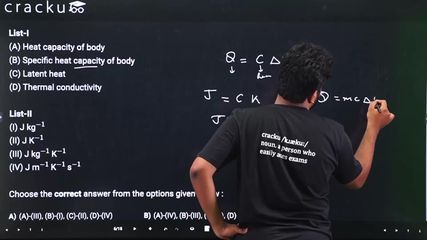
Match List-I with List-II.
List-I
(A) Heat capacity of body
(B) Specific heat capacity of body
(C) Latent heat
(D) Thermal conductivity
List-II
(I) J kg$$^{-1}$$
(II) J K$$^{-1}$$
(III) J kg$$^{-1}$$ K$$^{-1}$$
(IV) J m$$^{-1}$$ K$$^{-1}$$ s$$^{-1}$$
Choose the correct answer from the options given below :
For each physical quantity, first recall its definition, then write the factors on which it depends, and finally write the corresponding SI unit.
Case A - Heat capacity of a body
Definition: Heat required to raise the temperature of the entire body by $$1\;{\rm K}$$.
Heat $$Q$$ needed is proportional only to temperature change $$\Delta T$$: $$Q = C\,\Delta T$$ where $$C$$ is heat capacity.
Hence unit of $$C$$ is Joule per Kelvin, $$\rm J\,K^{-1}$$.
Match: (A) $$\rightarrow$$ (II).
Case B - Specific heat capacity
Definition: Heat required to raise temperature of unit mass of a substance by $$1\;{\rm K}$$.
Formula: $$Q = m\,c\,\Delta T$$.
Here $$c$$ relates heat to both mass and temperature difference, so its unit is Joule per kilogram per Kelvin, $$\rm J\,kg^{-1}\,K^{-1}$$.
Match: (B) $$\rightarrow$$ (III).
Case C - Latent heat
Definition: Heat required to change the phase of unit mass of a substance without temperature change.
Formula: $$Q = m\,L$$, where $$L$$ is latent heat.
Only mass appears in the relation, so the unit is Joule per kilogram, $$\rm J\,kg^{-1}$$.
Match: (C) $$\rightarrow$$ (I).
Case D - Thermal conductivity
Definition (Fourier’s law for one-dimensional steady conduction):$$\displaystyle \frac{dQ}{dt} = k\,A\,\frac{\Delta T}{\Delta x}$$.
Rearrange for $$k$$: $$k = \frac{1}{A}\,\frac{dQ}{dt}\,\frac{\Delta x}{\Delta T}$$.
Units:
$$\frac{dQ}{dt}$$ has unit $$\rm J\,s^{-1}$$ (power), $$A$$ is $$\rm m^{2}$$, $$\Delta x$$ is $$\rm m$$, $$\Delta T$$ is $$\rm K$$.
Thus $$k$$ has unit $$\dfrac{\rm J\,s^{-1}}{\rm m^{2}}\times \rm m \times \rm K^{-1}=J\,m^{-1}\,K^{-1}\,s^{-1}$$.
Match: (D) $$\rightarrow$$ (IV).
Combining all matches:
(A)-(II), (B)-(III), (C)-(I), (D)-(IV).
The option with this sequence is Option D.
Was this solution helpful?
Click on the Email ☝️ to Watch the Video Solution
Create a FREE account and get:
_1.webp)

Educational materials for JEE preparation

Ask our AI anything

AI can make mistakes. Please verify important information.
AI can make mistakes. Please verify important information.


