
Join Our JEE Preparation Group
Prep with like-minded aspirants; Get access to free daily tests and study material.
Sign in
Please select an account to continue using cracku.in
↓ →
Join Our JEE Preparation Group
Prep with like-minded aspirants; Get access to free daily tests and study material.
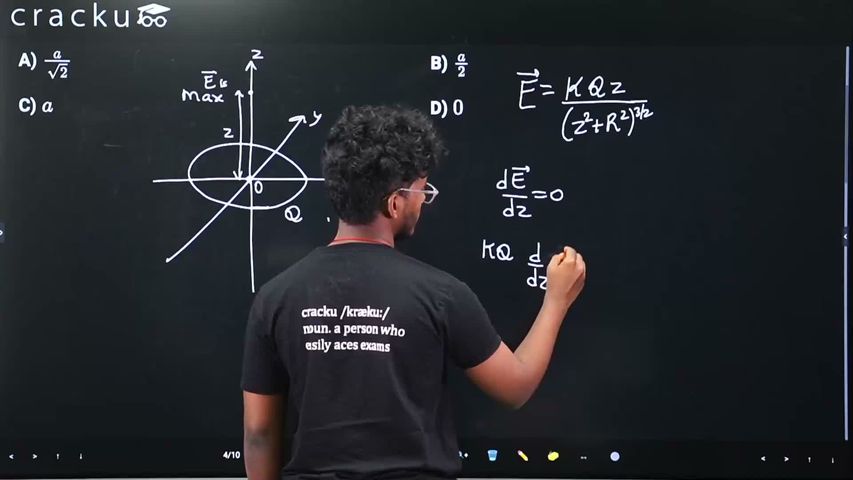
Consider a circular loop that is uniformly charged and has a radius $$a\sqrt{2}$$. Find the position along the positive z-axis of the cartesian coordinate system where the electric field is maximum if the ring was assumed to be placed in xy-plane at the origin :
The ring lies in the $$xy$$-plane with its centre at the origin and has radius $$R = a\sqrt{2}$$. The linear charge density is uniform; therefore the axial electric field depends only on the distance $$z$$ from the centre along the $$+z$$-axis.
Electric field on the axis of a uniformly charged ring (standard result):
$$E(z)=\frac{1}{4\pi\varepsilon_0}\,\frac{Q\,z}{\left(z^{2}+R^{2}\right)^{3/2}}$$ $$-(1)$$
where $$Q$$ is the total charge on the ring.
To locate the position where the magnitude $$E(z)$$ is maximum, differentiate $$E(z)$$ with respect to $$z$$ and set the derivative to zero.
Because the constant factor $$\frac{1}{4\pi\varepsilon_0}Q$$ is positive, maximising $$E(z)$$ is equivalent to maximising the function
$$f(z)=\frac{z}{\left(z^{2}+R^{2}\right)^{3/2}}$$ $$-(2)$$
Differentiate $$f(z)$$ using the quotient rule:
$$\frac{df}{dz}= \frac{(z^{2}+R^{2})^{3/2}-z\cdot\frac{3}{2}(z^{2}+R^{2})^{1/2}\,(2z)}{(z^{2}+R^{2})^{3}}$$
Simplify the numerator step by step:
$$\begin{aligned} \text{Numerator} &= (z^{2}+R^{2})^{1/2}\Big[(z^{2}+R^{2})-3z^{2}\Big] \\ &= (z^{2}+R^{2})^{1/2}\Big[-2z^{2}+R^{2}\Big] \end{aligned}$$
Setting $$\frac{df}{dz}=0$$ gives
$$-2z^{2}+R^{2}=0 \quad\Longrightarrow\quad z^{2}=\frac{R^{2}}{2}$$
Since we need the point on the positive $$z$$-axis,
$$z=\frac{R}{\sqrt{2}}$$ $$-(3)$$
Insert the actual radius $$R=a\sqrt{2}$$:
$$z=\frac{a\sqrt{2}}{\sqrt{2}}=a$$
Therefore the electric field produced by the uniformly charged ring is maximum at a distance $$a$$ from the centre along the positive $$z$$-axis.
Final answer: Option C, $$a$$.
Was this solution helpful?
Click on the Email ☝️ to Watch the Video Solution
Create a FREE account and get:
_1.webp)

Educational materials for JEE preparation

Ask our AI anything

AI can make mistakes. Please verify important information.
AI can make mistakes. Please verify important information.


